
Table of Contents
Table of Contents
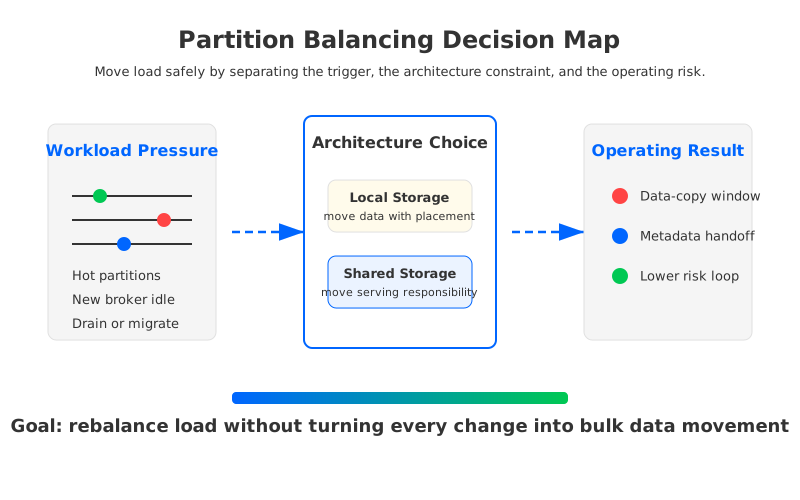
Partition balancing sounds like a placement problem until it happens during a production incident. A broker is running hot, a new node has joined the cluster, or a traffic pattern has shifted toward a small set of partitions. The immediate question is simple: how do we move load without making the cluster less stable than it already is?
For Kafka operators, that question quickly turns into an architecture question. In a traditional shared-nothing Kafka deployment, partition ownership is tied to broker-local storage. Moving a partition is not only a metadata update; it can mean copying log data, throttling network and disk usage, watching replica catch-up, and accepting a period of operational risk. In a shared-storage design, the same intent can be handled differently because durable data is no longer trapped on the broker that currently serves it.
That distinction matters for SREs, platform engineers, and architects who are trying to make Kafka-compatible infrastructure behave like cloud infrastructure. Compute should be elastic. Storage should scale independently. Balancing should be a routine control loop, not an event that requires a maintenance window and a nervous Slack channel.
1Why Teams Search for Partition Balancing Operations in Kafka
Most searches for partition balancing operations kafka come from teams that already know the basic Kafka model. They know topics are split into partitions, partitions have leaders and replicas, and client traffic follows partition placement. What they need is not a definition. They need a safer way to change placement after the cluster is already carrying real business traffic.
The trigger is usually one of four production conditions. A cluster has uneven broker utilization because partition counts do not reflect actual traffic. A new broker has been added but remains mostly empty. A broker must be removed or replaced, so its partitions need a new home. Or a migration is underway, and the team must preserve producer throughput, consumer offsets, access controls, observability, and rollback options while reshaping the cluster.
These are operationally different cases, but they share the same constraint: balancing changes who serves data. If serving data also means owning a local copy of the durable log, every balancing action becomes a data movement action. That is why a command that looks harmless in a runbook can become one of the riskiest operations in the Kafka lifecycle.
2The Production Constraint Behind Balancing
Traditional Kafka was designed around durable brokers. Each broker stores log segments for the partitions it owns, and replication provides fault tolerance by keeping additional copies on other brokers. This model is robust and familiar. It also means the cluster's physical data layout is part of the serving path, so placement and storage cannot be cleanly separated.
When a partition is reassigned from one broker to another, the destination needs the relevant log data before it can safely take over its role. That transfer competes with normal producer writes, consumer fetches, replica traffic, and disk flushes. Operators can throttle reassignment, but throttling only changes the shape of the pain. Move too fast and production latency may suffer; move too slowly and the cluster stays imbalanced for longer.
The operational risk is rarely one big failure mode. It is a stack of smaller risks that arrive together:
- Reassignment traffic consumes the same network and disk resources that production traffic needs.
- Under-replicated partitions can persist longer than expected when catch-up falls behind.
- Hot partitions may move, but their traffic pattern can recreate a hot broker somewhere else.
- Scaling down is harder than scaling up because data must be drained before capacity can be removed.
- A rollback plan must account for both metadata state and partially copied data.
The last point is easy to underestimate. A balancing operation is not finished when a command returns. It is finished when replicas are healthy, consumers are stable, latency has returned to baseline, cost telemetry is understood, and the team knows whether the new placement actually solved the problem.
3Shared Nothing Versus Shared Storage
The phrase "shared nothing" is not an insult. It describes an architecture that made sense when local disks were the dominant way to build high-throughput log systems. Kafka's original storage model keeps brokers responsible for compute and persistent storage, and that coupling gives operators direct control over the data path. It also gives them direct responsibility for every data movement side effect.
Shared storage changes the failure and balancing model. Instead of treating broker-attached disks as the durable source of truth, the system places durable log data in a shared storage layer such as object storage, with a write-ahead path for low-latency ingestion. Brokers still serve Kafka clients, coordinate leadership, and enforce protocol semantics, but they do not need to carry long-lived retained data as local state.
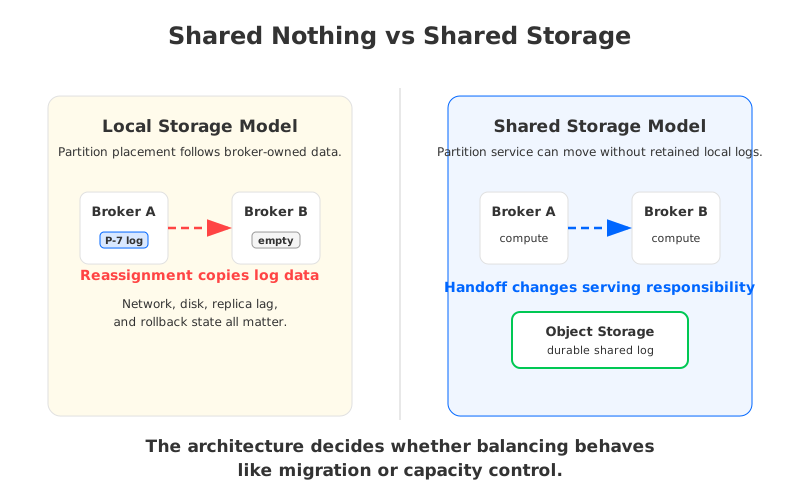
The operational difference becomes visible during balancing. In a local-storage model, a reassignment asks the cluster to copy data to match the new placement. In a shared-storage model, placement can be much closer to a compute assignment because each broker can access the same durable data layer. The system still has to manage leadership, cache warmth, WAL health, metadata correctness, and client routing, but it avoids turning every balancing decision into a bulk data copy.
That is the core trade-off. Local storage keeps the data path explicit and mature, but it makes operations state-heavy. Shared storage removes a large class of broker-local data movement, but it shifts engineering attention toward the shared storage path, metadata control, cache behavior, and cloud service boundaries. A serious evaluation should compare those operating models instead of asking whether one command line tool is more convenient than another.
| Evaluation area | Local-storage Kafka | Shared-storage Kafka-compatible architecture |
|---|---|---|
| Partition movement | Often requires log data transfer between brokers | Primarily metadata and compute assignment, depending on implementation |
| Scaling out | New broker needs reassigned partitions before it carries meaningful existing load | New compute can serve assigned partitions without owning retained local logs |
| Scaling in | Requires careful drain of local partition data | Focuses on safe handoff, metadata, cache, and capacity checks |
| Cost pressure | Broker disks, replica traffic, and cross-zone transfer can dominate at scale | Object storage and shared durability can reduce repeated data copies |
| Operational focus | Reassignment throttles, disk I/O, replica lag, and broker capacity | Storage service health, WAL path, metadata, and stateless broker capacity |
The table is not a claim that shared storage removes all operations. It changes the operations that matter. Teams still need observability, failure drills, quota controls, and upgrade discipline. The useful question is whether the remaining work is better aligned with cloud infrastructure than repeated broker-to-broker data movement.
4A Practical Evaluation Checklist
A good partition balancing plan starts before anyone runs a reassignment. The team needs to know which constraint it is solving: broker CPU, network, disk, partition count, leader skew, consumer locality, or growth headroom. Without that diagnosis, balancing can become expensive motion that does not reduce risk.
Use this checklist when deciding whether to rebalance, add brokers, migrate workloads, or evaluate a different architecture:
- Compatibility boundary. Confirm which Kafka protocol features, client versions, ACLs, transactions, compaction behavior, Streams usage, Connect dependencies, and observability hooks must remain unchanged.
- Traffic shape. Separate partition count from partition traffic. A broker with fewer partitions can still be the bottleneck if it owns the hottest leaders.
- Data movement budget. Estimate how much log data would move, which links and disks would carry it, and what throttle settings are safe during peak and off-peak hours.
- Failure posture. Decide what happens if a broker fails halfway through the operation or if replica catch-up remains slow.
- Rollback design. Write down the signal that triggers rollback and the exact state the cluster must return to.
- Cost telemetry. Watch cross-zone transfer, object-storage requests, broker disks, and compute utilization alongside Kafka metrics.
The uncomfortable part of this checklist is that several items are not Kafka commands. They belong to platform engineering, cloud networking, security governance, and cost management. That is exactly why partition balancing becomes a CTO-level architecture discussion once Kafka carries enough traffic.
5How AutoMQ Changes the Operating Model
If the hard part is broker-owned storage, the architectural alternative is to keep the Kafka interface while decoupling durable storage from the broker. AutoMQ is a Kafka-compatible streaming system built around that idea: brokers remain compatible with Kafka clients and ecosystem tools, while the storage architecture uses shared storage and object storage to make brokers closer to stateless compute.
That design changes the balancing loop. When brokers do not own the retained durable log on local disks, partition reassignment can focus on metadata, leadership, and serving responsibility rather than moving large volumes of broker-local data. AutoMQ's documentation describes partition reassignment in seconds, continuous self-balancing, and a shared storage architecture in which object storage provides the durable data layer. The value is not that operators stop caring about balancing. The value is that balancing becomes more like capacity control and less like a data migration.
This also changes cloud cost behavior. In multi-AZ Kafka deployments with local broker storage, replication and reads can create inter-zone traffic because data is copied or fetched across availability-zone boundaries. AutoMQ's inter-zone traffic documentation describes an S3-based architecture and locality-aware routing that are intended to reduce those transfers. The important point for architects is the mechanism: fewer broker-to-broker copies across zones means fewer balancing operations that amplify network cost.
The migration implication is pragmatic. A Kafka-compatible shared-storage system should not ask application teams to rewrite producers and consumers before the infrastructure team can improve operations. The surface area that must be tested is still real: topic configuration, consumer offsets, security, metrics, MirrorMaker or linking strategy, cutover sequencing, and rollback. But the goal is narrower than an application migration. It is a storage and operations model migration behind a familiar Kafka API.
6Production Readiness Scorecard
Balancing maturity is best measured by how boring the operation becomes. A mature platform can explain why a balancing event is needed, predict its blast radius, run it with bounded impact, and prove afterward that the cluster is healthier. A less mature platform treats each rebalance as a special case because the outcome depends on how much data happens to be attached to the affected brokers.
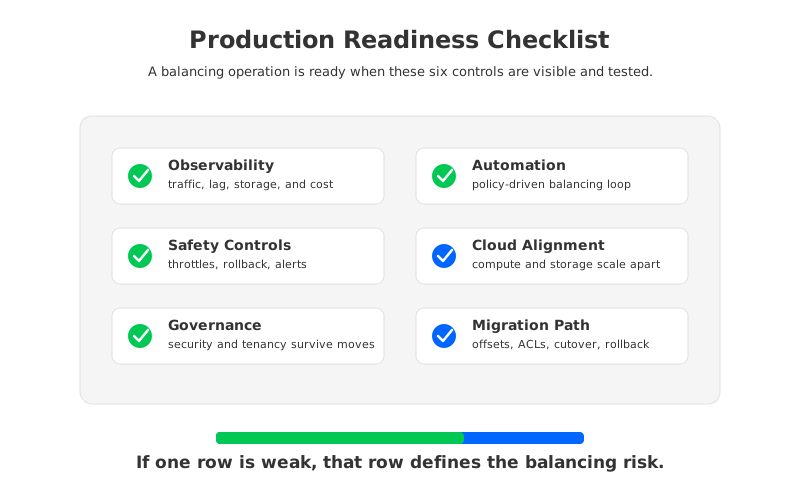
The scorecard below is a useful pre-production gate for either architecture:
| Readiness area | Questions to answer before production |
|---|---|
| Observability | Can you see leader skew, partition traffic, consumer lag, replica health, storage latency, and cost drivers in the same operational view? |
| Automation | Is balancing policy-driven, or does it depend on manual diagnosis and one-off commands? |
| Safety controls | Are throttles, maintenance windows, rollback states, and alert thresholds documented and tested? |
| Cloud alignment | Does the architecture scale compute independently from retained storage, or does every capacity change imply data movement? |
| Governance | Do security, compliance, and tenancy boundaries survive reassignment, migration, and failover? |
| Migration path | Can workloads move incrementally with offset continuity, ACL parity, and a credible rollback plan? |
The most useful score is not a single number. It is the row where your team hesitates. If the hesitation is around a runbook gap, fix the runbook. If it is around broker-owned data movement that appears in every scaling, failure, and cost discussion, the issue is architectural.
7Closing the Loop
The next time a broker runs hot, the immediate temptation will be to ask which partitions should move. That is still the right tactical question. The strategic question is whether moving them should require moving the durable log at all.
Local-storage Kafka can be operated well, but it asks teams to treat balancing as a careful data movement workflow. Shared-storage Kafka-compatible systems change that workflow by separating serving responsibility from retained data ownership. For platform teams carrying high-throughput, multi-AZ, or fast-changing workloads, that separation can turn partition balancing from a late-night operation into a normal part of capacity management.
If you are evaluating whether your current Kafka architecture is limited by broker-local storage, review AutoMQ's shared storage architecture and migration guidance at go.automq.com. The most useful proof is not a diagram; it is a workload inventory, a balancing drill, and a cost trace from your own environment.
8References
- Apache Kafka documentation
- AutoMQ shared storage architecture overview
- AutoMQ native compatibility with Apache Kafka
- AutoMQ partition reassignment in seconds
- AutoMQ continuous self-balancing
- AutoMQ inter-zone traffic overview
- Migrating from Apache Kafka to AutoMQ
9FAQ
9.1Is partition balancing the same as consumer group rebalancing?
No. Partition balancing changes where topic partitions are hosted or led inside the cluster. Consumer group rebalancing changes which consumers read which partitions inside a group. They can affect each other because broker-side movement may change latency, leadership, and client fetch behavior, but they are different control loops.
9.2When should a team rebalance partitions instead of adding brokers?
Add brokers when the cluster lacks aggregate compute, network, or storage capacity. Rebalance partitions when capacity exists but load is unevenly placed. In local-storage Kafka, these two actions often become linked because a new broker does not carry useful existing load until partitions and their data move onto it.
9.3Does shared storage remove the need for Kafka operations?
No. It changes the operations. Teams still need monitoring, alerting, security controls, upgrade discipline, client tuning, and failure drills. The difference is that partition placement can be handled with far less broker-local data movement when durable logs live in shared storage.
9.4What should be tested before migrating partition-heavy workloads?
Test client compatibility, topic configuration, consumer offset handling, ACL parity, monitoring coverage, failover behavior, rollback sequencing, and cost telemetry. A good migration starts with a workload inventory and moves incrementally by domain or topic group rather than treating the entire Kafka estate as one cutover.


