
Table of Contents
Table of Contents
Teams rarely search for kafka partition reassignment cloud because they want a cleaner command syntax. They search for it when a Kafka cluster has become difficult to resize, a broker is running hot, a disk is filling faster than expected, or a migration window is being squeezed by the amount of log data that must be copied. The visible task is partition reassignment. The underlying problem is that every capacity change can become a data movement project.
That distinction matters in cloud infrastructure. Compute, storage, and network are billed and constrained as separate resources, while traditional Kafka brokers combine all three inside stateful nodes. A reassignment that looks like a metadata operation in a runbook may create sustained disk reads, network transfer, replica catch-up, and operational risk. If the cluster spans availability zones, the same movement can also touch cross-zone traffic meters and failure-domain design.
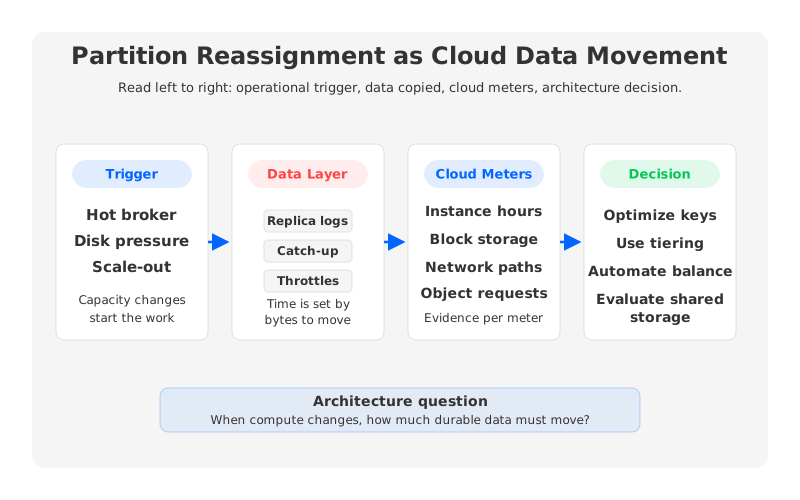
Kafka's reassignment tooling is useful and mature, but it does not remove the physics of moving retained log data. Architects should therefore evaluate reassignment as an architecture boundary, not as an isolated maintenance command. The practical question is not "Can we reassign partitions?" but "How often will our platform force us to copy durable data when compute capacity changes?"
1The Cloud Constraint Behind Partition Reassignment
Apache Kafka stores topic partitions as logs. In the classic Shared Nothing architecture, brokers own local log segments for the partitions assigned to them, and replication maintains durability across brokers. When a partition is moved from one broker to another, the target broker needs the relevant data before it can safely serve as a replica or leader. Kafka's operational documentation describes cluster expansion through reassignment because adding brokers does not automatically make old data appear on the additional brokers.
This is the normal cost of stateful ownership. It is not a bug in Kafka. The model gives operators direct control over replicas, in-sync replica health, and placement. It also means storage placement is coupled to broker placement. When the reason for reassignment is compute pressure, the system may still need to move storage. When the reason is disk pressure, the system may also consume network and CPU while it tries to recover balance.
Cloud deployments make the tradeoff sharper for four reasons:
- Elasticity expectations: Platform teams expect to add and remove compute capacity without long stabilization windows.
- Separate meters: Instance hours, block storage, object storage, requests, and network transfer are accounted for separately.
- Failure-domain placement: Multi-AZ Kafka designs improve resilience, but replica traffic and reassignment traffic may cross zone boundaries depending on placement.
- Retention growth: Longer retention increases the amount of data tied to each partition and makes any movement heavier.
The hard part is not starting a reassignment. The hard part is controlling its blast radius while production traffic continues. Consumer lag, replica lag, controller activity, broker disk throughput, and network saturation can all become part of the same event. A small cluster may absorb that without drama. A platform running high-throughput logs, telemetry, CDC, or AI feature streams may find that the maintenance window is no longer sized by the command. It is sized by the data.
2Why Data Movement Becomes the Bottleneck
Partition reassignment has two different layers. The control layer changes partition replica assignments and leadership metadata. The data layer catches the new replicas up to the point where they can participate safely. Kafka exposes administrative APIs for listing and altering partition reassignments, but those APIs coordinate a process whose duration depends on workload, retained bytes, throttles, disk performance, and network placement.
The bottleneck usually appears as one of three patterns. First, a broker with hot partitions needs relief, but moving those partitions also transfers their retained logs. Second, an additional broker is added for throughput, but it stays underutilized until enough partitions and data have moved. Third, a broker replacement or disk event causes recovery traffic to compete with foreground produce and fetch traffic. The operator can throttle reassignment, but throttling changes the time dimension rather than removing the work.
The following comparison is the key architectural lens:
| Platform model | What moves during scaling | Main operational concern | Cloud cost surface |
|---|---|---|---|
| Traditional Kafka with broker-local storage | Partition replicas and retained log segments | Reassignment duration, replica lag, disk and network saturation | Compute, block storage, cross-zone traffic, recovery bandwidth |
| Kafka with Tiered Storage | Hot local segments and metadata still matter; older segments may live remotely | Tier boundary, local disk pressure, remote fetch behavior | Compute, local storage, remote storage, requests, network |
| Kafka-compatible Shared Storage architecture | Broker compute changes more independently from durable log placement | WAL path, cache behavior, object storage access, metadata correctness | Compute, WAL storage, object storage, requests, controlled network paths |
Tiered Storage deserves careful placement in this discussion. Apache Kafka Tiered Storage is designed to move older log segments to remote storage, reducing pressure on broker-local disks for long retention. It can help with retention economics and broker disk sizing. It does not automatically make brokers stateless. Operators still need to understand what remains local, how remote reads behave, and whether reassignment of active partitions still creates operational pressure.
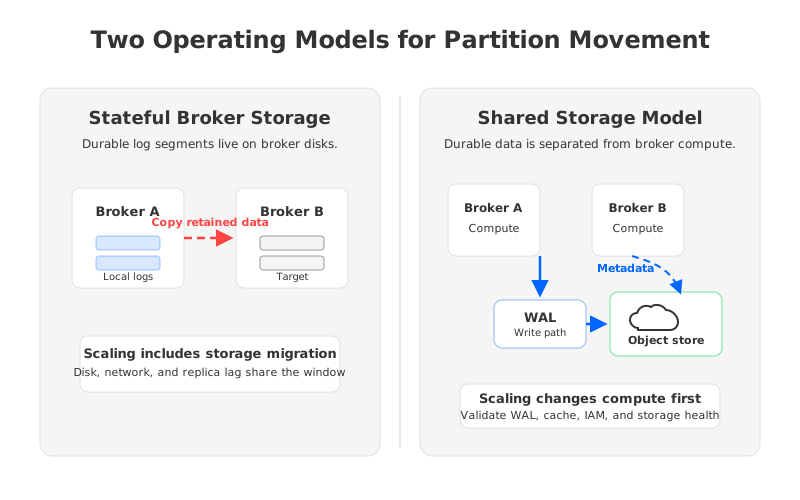
For SREs, the practical issue is concurrency. A reassignment rarely happens in isolation. Traffic continues, consumers continue fetching, producers continue writing, and other maintenance may be waiting behind the same capacity constraint. If reassignment traffic consumes the same disk or network budget as user traffic, the platform has to decide which work slows down.
3A Vendor-Neutral Evaluation Framework
Before choosing a tool or platform, map the reassignment problem to the workload. A cluster with short retention, steady throughput, and predictable partition distribution can often stay with conventional Kafka operations and clear runbooks. A cluster with long retention, bursty tenants, uneven keys, and frequent scaling events needs a stronger architecture review.
Use these questions as the first pass:
- How many bytes are tied to the partitions that usually become hot?
- Are the hot partitions hot because of producer key distribution, consumer placement, or broker resource limits?
- Does reassignment traffic cross availability zones, regions, or private connectivity boundaries?
- Which limit is reached first during reassignment: broker disk throughput, network bandwidth, controller operations, or consumer lag tolerance?
- Can the team test reassignment under production-like traffic without relying on a maintenance freeze?
- Is the target state a larger stateful Kafka cluster, a Tiered Storage design, or a Shared Storage architecture?
The answer may be "tune the current Kafka cluster." That is a valid outcome. Better partition keys, partition-count planning, reassignment throttles, Cruise Control style automation, and stricter tenant quotas can reduce the frequency and impact of movement. The risk is that these improvements manage the symptom while leaving the architecture unchanged. If the business keeps adding retention and bursty workloads, the next scaling event may return to the same bottleneck.
Architects should also separate two decisions that are often bundled together. One decision is whether applications must keep the Kafka protocol, clients, offsets, and ecosystem tools. Another decision is whether durable log storage must remain broker-local. Keeping Kafka compatibility does not require every implementation to preserve the same storage model. That distinction opens the design space for cloud-native systems that keep the application contract while changing the infrastructure contract.
4What To Measure Before a Reassignment Window
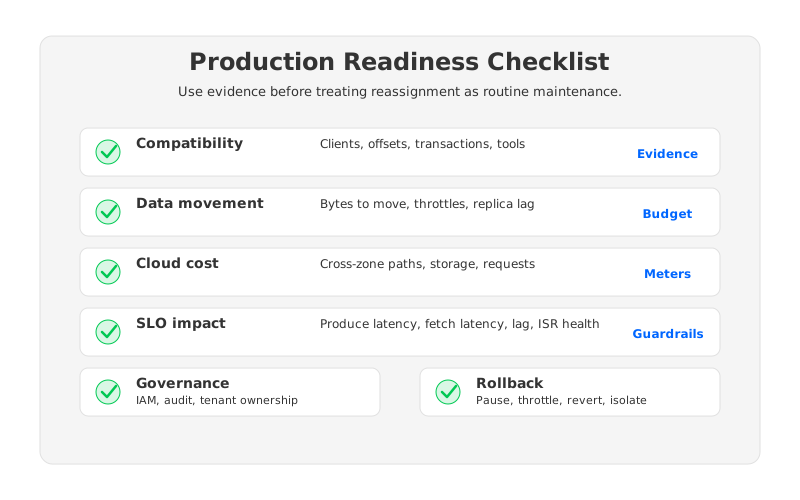
The most reliable reassignment plan starts with evidence rather than a generic throughput number. A runbook that says "move partitions slowly" is less useful than a capacity envelope with explicit meters. The envelope should show how much headroom exists for foreground traffic and how much can be allocated to reassignment without breaking SLOs.
Measure at least these signals:
- Broker disk read and write throughput during normal peak traffic.
- Broker network egress and ingress by availability zone.
- Replica lag and under-replicated partitions during controlled movement.
- Produce latency, fetch latency, and consumer lag for critical topics.
- Controller and metadata operation health during reassignment.
- Cloud billing dimensions for cross-zone traffic, block storage, object storage, and private connectivity.
This is where cloud pricing pages are relevant, but only as inputs. AWS, Google Cloud, and Azure each document network pricing and bandwidth categories in their own terms. A production estimate should use the exact region, service, traffic direction, and account discounts that apply to the deployment. The architectural point remains stable: when reassignment creates additional network movement, the cost and risk are no longer limited to broker CPU.
For platform teams, the final measure is operational reversibility. If a reassignment causes unexpected lag, can the team pause safely, change throttles, roll back placement decisions, or isolate the tenant? If a broker fails during the process, does the recovery path compete with reassignment traffic? The answer determines whether reassignment is routine maintenance or a high-risk event.
5Where Shared Storage Changes the Operating Model
After the neutral evaluation, AutoMQ becomes relevant as one example of a Kafka-compatible Shared Storage architecture. AutoMQ keeps the Kafka protocol and ecosystem compatibility while reworking the storage layer around S3Stream, WAL storage, and object storage. The important architectural change is that durable log data is no longer treated as broker-local state that must be copied wholesale whenever broker compute changes.
In AutoMQ's documented partition reassignment flow, most data resides in object storage, while a smaller amount may temporarily reside in WAL storage. During reassignment, the system focuses on flushing the not-yet-uploaded WAL data and restoring partition metadata on the target broker. That is a different operating model from copying retained partition data between stateful brokers. It does not remove the need to validate latency, cache behavior, object storage access, or failure handling. It changes which subsystem is on the critical path.
For cloud teams, this distinction affects three recurring workflows. Scaling out can become more about adding broker compute and balancing ownership than copying a large retained log. Broker replacement can become less dependent on recovering local disk contents. Hot partition mitigation can focus more on traffic placement and metadata operations, because the durable storage layer is shared.
That does not make Shared Storage architecture a universal answer. A team should still test client compatibility, transaction behavior, Kafka Streams workloads, Connect integrations, ACLs, observability, backup expectations, and operational runbooks. The Shared Storage path also shifts attention toward WAL durability, object storage request patterns, cache hit ratios, IAM boundaries, and cloud storage health. The benefit is not "no operations." The benefit is that compute elasticity is less entangled with retained-data movement.
6Decision Table for Platform Teams
The decision should be based on how often reassignment pressure appears and how much architecture change the organization can absorb. A conventional Kafka cluster may remain the right choice when the workload is stable and the team values direct broker-local control. Tiered Storage may be the right improvement when long retention is the primary issue and the team can manage hot local segments separately from remote historical data. Shared Storage architecture becomes more compelling when the recurring pain is that scaling, recovery, and balancing all require moving too much durable data between brokers.
| If your main pressure is... | Start with... | Escalate when... |
|---|---|---|
| Uneven key distribution | Producer key review and partition planning | Hot partitions remain after application-level fixes |
| Disk growth from retention | Tiered Storage or retention policy changes | Active reassignment still blocks scaling or recovery |
| Broker replacement risk | Stronger replication, runbooks, and throttles | Recovery traffic repeatedly competes with user traffic |
| Cloud elasticity | Autoscaling plus reassignment automation | Scaling windows are governed by data copy time |
| Data control with Kafka compatibility | BYOC and self-managed options | The team also wants shared storage and stateless broker operations |
The cleanest architecture review asks one plain question: when compute capacity changes, what durable data must move? If the answer is "a large part of the retained log," reassignment will remain a major operating constraint. If the answer is "metadata plus a bounded write-ahead path," the platform has a different scaling profile. That is the real reason partition reassignment belongs in cloud architecture discussions, not only in Kafka administration checklists.
7References
- Apache Kafka documentation: basic operations and cluster expansion
- Apache Kafka documentation: tiered storage
- Apache Kafka documentation: KRaft
- Apache Kafka Admin API documentation
- AWS EC2 pricing: data transfer
- Google Cloud network pricing
- Azure bandwidth pricing
- AutoMQ documentation: compatibility with Apache Kafka
- AutoMQ documentation: partition reassignment in seconds
- AutoMQ documentation: S3Stream shared streaming storage
8FAQ
8.1Is Kafka partition reassignment always a problem in the cloud?
No. It is routine when clusters are modest, retention is controlled, and reassignment traffic stays within available disk and network headroom. It becomes an architecture problem when the amount of retained data, tenant churn, hot partitions, or broker replacement frequency makes data movement the limiting factor for operations.
8.2Does Kafka tiered storage eliminate reassignment data movement?
Tiered Storage can reduce local disk pressure by placing older log segments in remote storage. It does not automatically turn Kafka brokers into stateless compute. Teams still need to test active partition movement, local segment behavior, remote fetch patterns, and operational tooling under their own workload.
8.3When should teams evaluate Shared Storage Kafka-compatible systems?
Evaluate them when Kafka compatibility remains important but broker-local storage is the main source of scaling, recovery, or cost pressure. The evaluation should include client behavior, transactions, connectors, observability, storage access, WAL durability, and cloud network placement.
8.4How does AutoMQ fit into this decision?
AutoMQ fits the Kafka-compatible Shared Storage category. It is relevant when a team wants to keep Kafka clients and ecosystem expectations while reducing the amount of durable log data tied to individual brokers. It should be tested against the same workload and SLOs as any other production streaming platform.
8.5What is the first metric to check before a reassignment?
Start with the expected bytes to move and the headroom available on broker disk throughput, broker network throughput, and cross-zone paths. Then connect those limits to user-facing SLOs such as produce latency, fetch latency, replica lag, and consumer lag.


