
Table of Contents
Table of Contents
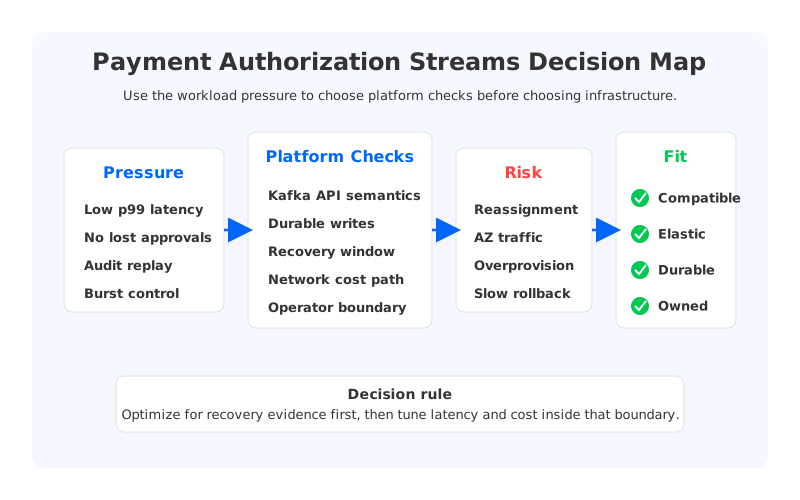
A payment authorization path is a stream with an oversized blast radius. The payload may be a few kilobytes, but the decision behind it decides whether a customer can check out, whether a merchant sees duplicate attempts, and whether the risk team can explain a decision. That is why searches for payment authorization streams kafka usually come from teams that already know Kafka. They are asking whether a Kafka-compatible platform can sit inside a revenue path without turning maintenance into a fraud, audit, or support incident.
The hard part is that payment authorization combines requirements that pull in different directions. Low latency matters because the customer waits. Durability matters because approval, decline, reversal, and risk signals become evidence. Recovery matters because a partial outage should not force a choice between duplicate decisions and weak reconciliation. When Kafka becomes the backbone for that path, the architecture decision is no longer only about brokers and partitions. It becomes a decision about failure domains, storage ownership, network cost, governance, and proof.
1Why teams search for payment authorization streams kafka
The search intent is usually practical. A payments team may be replacing a synchronous integration with event-driven orchestration, or a platform team may be separating authorization events from downstream settlement, fraud scoring, ledger posting, notifications, and analytics. Kafka is attractive because it gives the organization a durable log, consumer groups, offsets, replay, partitioning, and a mature client ecosystem.
The problem starts when the authorization stream moves from an integration pattern to a production dependency. A fraud model can be behind by seconds and still be useful for post-authorization review. The authorization service cannot. A reporting sink can replay a day of data after a connector failure. The evidence trail for approvals and reversals must survive infrastructure loss and still explain ordering, retries, and consumer progress.
For architects, the key distinction is between the authorization decision path and the surrounding event mesh. The decision path carries requests, risk signals, idempotency keys, response events, and sometimes compensating actions. The surrounding mesh carries enriched events to service, analytics, reconciliation, and model training. Both may use Kafka-compatible APIs, but they do not share the same SLO. Treating every topic as if it had the same latency, retention, replication, and replay requirements creates expensive clusters that are still hard to recover.
2The production constraint behind the problem
Payment authorization streams make Kafka design less forgiving because they combine online behavior with audit behavior. A normal topic can tolerate a brief producer retry storm if the downstream system catches up. In an authorization path, retry behavior changes customer experience and can create duplicate work for issuers, gateways, or internal risk services. The system also needs enough retention and replay fidelity to reconstruct decisions during disputes.
Four constraints usually define the platform design:
- Latency has to be measured at the decision boundary. Broker produce latency is only one part of the path. Client batching, partition key choice, consumer processing, network routing, and connector backpressure all contribute to the time between a customer action and an authorization outcome.
- Durability has to include metadata and offsets. The event body is not enough. Teams also need to protect topic configuration, transactional state where used, committed offsets, ACLs, and the operational evidence that shows which consumer saw which record.
- Recovery has to avoid hidden data movement. If adding brokers, replacing failed nodes, or rebalancing partitions requires a long copy of broker-local data, the recovery plan may look clean on paper and still miss the business SLO.
- Governance has to match the payment boundary. Authorization streams often contain sensitive identifiers, decision metadata, and regulated trails. Access control, encryption, network isolation, and data residency are part of the architecture.
This is where generic Kafka advice becomes too thin. “Increase replication factor” may improve broker failure tolerance, but it can also increase cross-zone replication traffic and storage footprint. “Use longer retention” may improve audit replay, but it changes disk sizing, partition recovery, and catch-up reads. The useful question is which Kafka-compatible operating model keeps the payment path recoverable under real constraints.
3Architecture options and trade-offs
Traditional Kafka uses a shared-nothing architecture. Each broker owns local log segments for its partitions, and replication copies data across brokers to protect against broker or disk loss. This design is well understood and compatible with tooling many payment teams already run. It also means broker capacity, local storage, partition placement, and failure recovery are tightly coupled.
That coupling shows up during scale and recovery. When traffic grows, the cluster may need more brokers for CPU, network, disk throughput, or storage capacity. If the limiting resource is storage, adding compute does not help until partitions move. If the limiting resource is compute, the team may still move data because partition ownership is tied to broker-local logs. During incidents, recovery can stretch because the platform has to restore enough local state before serving affected partitions.
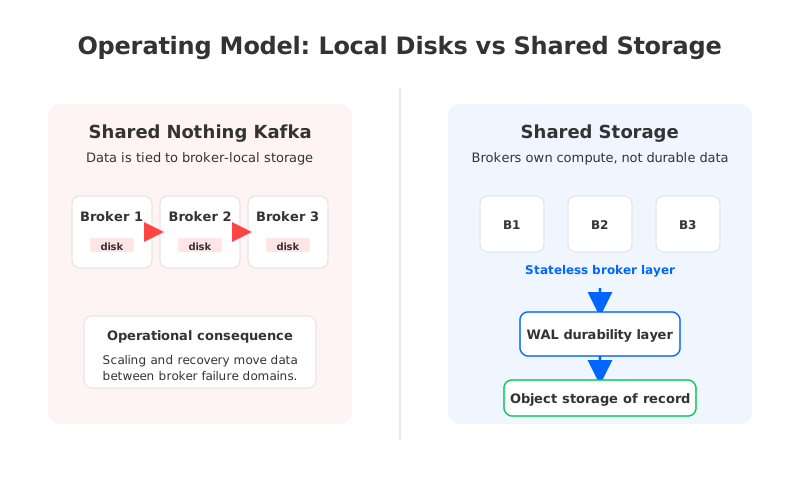
Tiered storage changes part of this equation by moving older log segments to remote storage while keeping the active write path on brokers. That can reduce pressure from long retention and historical replay, which is valuable for audit-heavy workloads. It does not fully remove the tie between active partitions and broker-local storage. For authorization streams, that distinction matters because the hottest data is also the data most likely to be needed during immediate recovery.
A shared storage model takes a different path. Durable data is placed in a shared storage layer, while brokers focus on Kafka protocol handling, leadership, caching, and request execution. The design goal is to make broker replacement, scaling, and partition movement less dependent on copying durable data between brokers. The trade-off shifts from local disk management to storage-service behavior, write-ahead log design, cache strategy, and shared storage maturity.
The decision is not one-dimensional. Local-disk Kafka gives operators direct control over broker disks and a familiar failure model. Tiered storage helps with retention and historical reads. Shared storage can reduce data movement during scaling and recovery, but it needs a careful write path so low-latency acknowledgement and durable recovery are both credible. A payments platform should evaluate those options against the authorization SLO.
4Evaluation checklist for platform teams
A useful evaluation framework starts with behavior, not product names. The platform has to preserve Kafka client expectations, expose controls for payments governance, and recover in a way the operations team can rehearse. The table below is intentionally strict because vague answers become operational debt in payment systems.
| Area | What to verify | Why it matters for payment authorization |
|---|---|---|
| Kafka compatibility | Producer, consumer, transactions, offsets, ACLs, admin tooling, and connector behavior | Existing payment services should not require a broad client rewrite to change infrastructure. |
| Latency envelope | p50, p95, p99, retry behavior, and catch-up reads under burst load | The customer-facing path is shaped by tail behavior, not average broker latency. |
| Durability model | Write acknowledgement path, replication or WAL behavior, metadata protection, and storage failure domain | Authorization evidence must survive more than a single broker failure. |
| Recovery practice | Broker loss, AZ impairment, bad deploy rollback, connector failure, and offset restoration | A plan that is not rehearsed is a document, not a recovery capability. |
| Cost visibility | Compute, storage, retention, cross-AZ traffic, private connectivity, and observability costs | Payment peaks and audit retention can make hidden network and storage paths material. |
| Governance | Encryption, identity, network boundary, data residency, audit logs, and least privilege | The payment stream is sensitive even when it does not carry full card data. |
This framework also prevents a common mistake: optimizing the broker layer while leaving edge cases undefined. Exactly-once semantics in Kafka depend on idempotent producers, transactions, and consumer behavior; they do not remove the need for application-level idempotency in a payment service. Consumer groups and offsets provide a clean way to scale processing and resume progress, but a platform team still has to decide who can reset offsets, how replay is approved, and how replay output is prevented from triggering duplicate external calls.
Migration deserves the same discipline. A payment stream needs a rehearsal plan for topic creation, ACL parity, schema compatibility, producer bridge strategy, consumer offset migration, rollback criteria, and observability cutover. The migration is successful only when the team can prove that old and target paths produce the same business decisions, not merely that messages are flowing.
5How AutoMQ changes the operating model
Once the evaluation framework is clear, AutoMQ fits into a specific architecture category: a Kafka-compatible cloud-native streaming platform that separates compute from storage and uses shared storage as the durable foundation. It keeps Kafka protocol and semantics compatibility as the integration contract, while changing the storage model that creates much of the operational friction in broker-local Kafka deployments.
For payment authorization streams, the important shift is that brokers become closer to stateless compute nodes. In AutoMQ’s shared storage architecture, durable stream data is stored through S3Stream with a write-ahead log layer for low-latency durability and object storage as the main storage layer. Broker scaling and partition reassignment can focus more on leadership, metadata, and traffic ownership than on long transfers of local log data. Capacity planning remains necessary, but compute, cache, WAL behavior, and object storage characteristics can be reasoned about separately.
This separation has practical consequences for payments teams:
- Elasticity becomes less tied to data copying. When traffic spikes around campaigns, payroll days, travel events, or fraud attacks, the platform can scale compute without treating every capacity change as a storage migration project.
- Recovery can be designed around shared durable state. A failed broker is less likely to become a long local-disk reconstruction event because durable data is not primarily owned by that broker.
- Cost modeling becomes more transparent. Storage retention, compute headroom, and inter-zone traffic can be modeled as separate paths instead of being hidden inside a broker sizing exercise.
- Deployment boundaries stay customer-controlled in BYOC and software deployments. For teams with payment governance requirements, the data plane can run in the customer’s cloud account or private environment, with customer-owned network and storage boundaries.
AutoMQ also addresses a cloud-specific issue payment teams often discover late: cross-AZ traffic. In traditional multi-AZ Kafka, replication and reads can create inter-zone data transfer paths that become visible at scale. AutoMQ documents zone-aware designs and zero cross-AZ traffic approaches that use its S3-based storage architecture and client or broker configuration to reduce this cost and topology risk. For authorization streams, unnecessary cross-zone movement makes resilience more expensive than it needs to be.
There are still design choices to make. WAL type, object storage service, network path, client configuration, retention, and observability all affect the final system. The difference is a cleaner model: Kafka-compatible compute on one side, shared durable storage on the other, and fewer operational events that require data movement.
6Production readiness scorecard
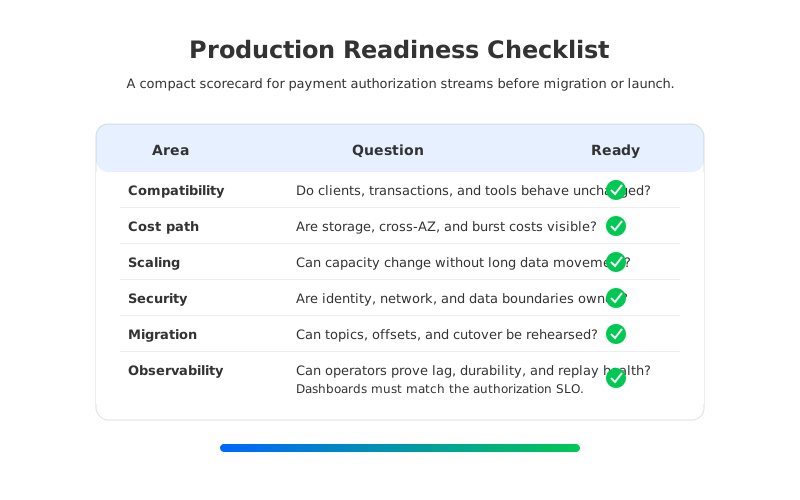
The fastest way to expose weak assumptions is to turn the architecture into a scorecard. Each item should have an owner, a test, and evidence from staging or a controlled production exercise. A “yes” without a runbook, dashboard, or replay log is not a yes for payment authorization.
| Readiness area | Evidence to collect before launch |
|---|---|
| Compatibility | Client versions, transactions, ACL migration, admin commands, and connector behavior tested against the target platform. |
| Latency | End-to-end p99 measured from authorization request event to decision response under normal and burst traffic. |
| Durability | Write acknowledgement path, WAL or replication behavior, metadata backup, and storage failure-domain assumptions documented. |
| Recovery | Broker loss, consumer lag, bad release rollback, offset reset, and replay drills completed with named operators. |
| Governance | Encryption, identity, network access, audit logging, and data residency reviewed with the payment risk and compliance owners. |
| Cost | Compute, storage, retention, cross-AZ traffic, private connectivity, and monitoring costs modeled for peak and normal load. |
The scorecard should be revisited after launch because payment traffic changes. Payment methods, issuer routing, fraud rules, marketplace growth, and regional expansion can alter partition keys, fan-out, retention, and replay volume. A platform that looked well sized for authorization may strain when analytics, dispute automation, and machine-learning feedback loops consume the same stream. That is another reason to prefer architectures where compute and storage can scale independently.
For teams evaluating a Kafka-compatible replacement or cloud-native Kafka design, the next useful step is a small proof of architecture rather than a broad benchmark. Pick one authorization-like topic, one replay consumer, one connector path, and one failure drill. Measure the decision latency, recovery behavior, and cost paths that matter to the payment SLO. If AutoMQ’s shared storage model matches that operating model, the AutoMQ architecture overview is a practical next read before a migration plan.
7References
- Apache Kafka documentation for producer, consumer, offset, transaction, and operations concepts.
- Apache Kafka Connect documentation for connector architecture and operational context.
- Apache Kafka tiered storage operations documentation for remote log storage behavior and trade-offs.
- AutoMQ Kafka compatibility documentation.
- AutoMQ shared storage architecture overview.
- AutoMQ S3Stream shared streaming storage overview.
- AutoMQ zero inter-zone traffic documentation.
- AWS S3 data durability documentation for object storage durability context.
8FAQ
8.1Is Kafka suitable for payment authorization streams?
Kafka can be suitable when the platform is designed around the authorization SLO. The useful primitives are durable logs, partition ordering, consumer groups, offsets, transactions, replay, and a mature ecosystem. The risky part is assuming those primitives automatically solve payment correctness. You still need application idempotency, clear partition-key design, controlled replay, governance, and rehearsed recovery.
8.2Should authorization events and analytics events use the same Kafka cluster?
They can, but they should not be treated as the same workload. Authorization events are latency-sensitive and operationally sensitive. Analytics, model training, and reporting consumers can usually tolerate more lag and replay. Many teams keep a shared Kafka-compatible platform while separating topics, quotas, retention, ACLs, and observability by workload class.
8.3Does shared storage remove the need for replication?
Shared storage changes where durable state lives and how brokers recover; it does not remove the need to reason about failure domains. The platform still needs a durable write path, protected metadata, storage redundancy, and a tested recovery plan. The benefit is that broker replacement and scaling can be less dependent on moving broker-local log data.
8.4What should be tested before migrating a payment authorization stream?
Test client compatibility, topic configuration, ACLs, idempotent producer behavior, transaction usage if applicable, consumer offset handling, connector behavior, replay controls, and rollback. The migration proof should compare business decisions and recovery evidence, not only message throughput.


