
Table of Contents
Table of Contents
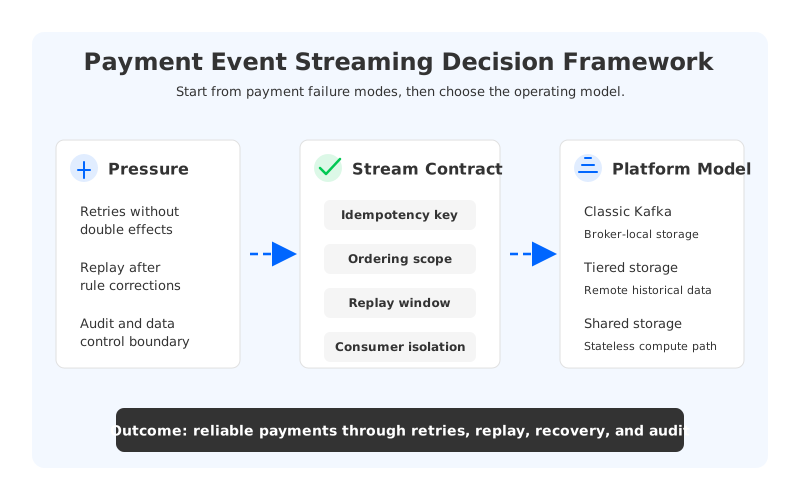
Payment systems do not fail only when an event is lost. They fail when an authorization event arrives after a fraud decision, when a settlement update is processed twice, or when an incident response team cannot replay the sequence that produced a customer-facing result. That is why payment event streaming is a reliability topic before it is a throughput topic.
Kafka-compatible streaming is a common fit because payment platforms need durable logs, ordered partitions, independent consumers, replay, and a broad ecosystem of stream processors and connectors. The harder question is how to operate those semantics. A payment stream may serve authorization, fraud scoring, ledger updates, reconciliation, disputes, analytics, and regulatory evidence at the same time. Each workload consumes the same timeline with a different risk profile.
The useful architecture review starts with the failure modes. Can the platform tolerate a consumer retry without double-posting money movement? Can it recover from a broker or zone failure without losing the audit trail? Can it replay after a schema, model, or business-rule correction without disturbing the live path? These questions turn payment event streaming from a generic Kafka deployment into a reliability system.
1Why Payment Event Streaming Is a Reliability Problem
Payment events have a different shape from telemetry or clickstream data. They often carry business intent, money movement state, identity context, authorization results, settlement updates, chargeback signals, and exception records. A late event can affect customer experience; a duplicated event can affect balances; an unavailable event log can block investigation.
Traditional batch processing remains valuable for reporting, settlement files, model training, and historical analysis. The operational path is different. Authorization, fraud evaluation, customer notification, ledger posting, and exception routing need a fresh and consistent view of what happened. The platform must preserve enough history to support replay while keeping the live path predictable.
The production constraints usually cluster into five areas:
- Ordering: Some decisions need account-level, card-level, merchant-level, or transaction-level order. The partitioning strategy has to match the business invariant.
- Idempotency: Retries are normal in distributed systems. Producers, stream processors, and downstream services need stable keys and duplicate-safe writes.
- Replay: Payment teams need to reprocess after rule changes, feature corrections, fraud-label updates, or incident analysis.
- Isolation: Fraud scoring, ledger posting, reconciliation, analytics, and notification services should not block one another's progress.
- Governance: Payment data often crosses security, privacy, audit, and data-residency boundaries. The streaming platform has to fit those controls.
Apache Kafka gives teams a mature foundation for these concerns: topics, partitions, offsets, consumer groups, durable logs, producer acknowledgments, and transaction support. The architecture decision is whether the platform can operate those primitives under payment-grade load, retention, recovery, and audit expectations.
2Pattern 1: Design for Idempotent Payment Outcomes
Retries should be assumed. A producer may retry after a network timeout. A consumer may reprocess after a rebalance. A sink may receive the same business event again after a deployment rollback. If the payment system treats every delivery as a new intent, the streaming platform becomes a source of financial error.
Idempotency is usually implemented above the broker through business keys and durable state. A payment authorization event may use a payment intent ID, authorization ID, account ID plus sequence number, or another domain-specific idempotency key. Downstream services then record which keys have already been applied. This lets the system retry transport-level work without repeating the business effect.
Kafka's idempotent producer and transaction features can reduce duplicate production and support atomic writes across partitions and offsets, but they do not remove the need for domain-level idempotency. Payment workflows cross databases, processors, ledgers, fraud engines, and customer systems. The broker can help preserve stream semantics; the business application still owns the invariant that one payment intent produces one correct financial result.
Platform teams should make this visible in the event contract:
| Contract field | Why it matters |
|---|---|
| Event ID | Enables traceability and duplicate detection across services |
| Idempotency key | Defines the business operation that must not be applied twice |
| Aggregate key | Preserves the ordering unit, such as account, card, merchant, or payment intent |
| Event type and version | Separates authorization, capture, reversal, settlement, dispute, and correction events |
| Causation and correlation IDs | Connects retries, decisions, ledger updates, and investigation trails |
This is not documentation ceremony. It is how SREs and application teams debug an incident when the symptom appears downstream from the original event.
3Pattern 2: Separate Live Decisions from Replay
A payment event log is valuable because it is durable and replayable. That same value can become operational risk when replay traffic competes with live payment decisions. A fraud team may need to replay hours of authorization events after a model fix. A reconciliation team may need to rebuild a state store after a schema correction. An incident team may need to inspect a narrow window around a failed processor integration. None of that should starve live consumers.
Consumer groups are the first boundary. Fraud scoring, ledger services, notification services, analytics pipelines, and reconciliation jobs should commit offsets independently. One slow analytics workload should not define the progress of a live authorization path. Topic design is the second boundary. Raw events, normalized payment events, decisions, ledger entries, and correction events often deserve separate topics because they have different retention, ownership, and replay rules.
The third boundary is capacity. Replay-heavy systems stress storage reads, network paths, and downstream dependencies. If retained data sits only on broker-local disks, longer retention can turn into a broker storage project. If replay reads share constrained resources with live traffic, a correction job can degrade the path it is trying to protect.
This is where teams should evaluate storage architecture, not only broker count. Tiered storage can reduce local disk pressure for older segments. Shared-storage Kafka-compatible systems go further by making durable stream data independent of a specific broker's local disk. The right choice depends on latency, retention, recovery targets, maturity, and migration constraints.
4Pattern 3: Make Failure Recovery Part of the Stream Design
Payment reliability is not a single uptime number. It is the ability to keep accepting, evaluating, recording, and explaining events through partial failure. A broker failure, zone outage, downstream database incident, schema issue, or cloud-network interruption can each produce a different failure pattern.
The review should map each payment stream to explicit recovery targets:
- RPO: How much event loss, if any, is acceptable for this stream?
- RTO: How quickly must live payment processing recover?
- Replay window: How far back must the team reprocess for correction or audit?
- Degraded mode: Can the workflow queue decisions, fall back to a ruleset, or route exceptions?
- Rollback path: Can a bad consumer deployment be stopped and rewound without corrupting downstream state?
Kafka replication protects against broker loss, but it also introduces cost and placement decisions. Replicas across availability zones can improve resilience while increasing cross-zone traffic. Long retention improves investigation and replay while increasing storage demand. More partitions improve parallelism while making ordering and operations more complex.
For payment platforms, the safest design is usually topic-specific rather than cluster-wide. Authorization decisions, ledger postings, settlement updates, fraud features, notifications, and analytics feeds do not all need the same retention, ordering key, and recovery policy. A single default applied everywhere is convenient, but payment systems age better when reliability targets are attached to each stream's business role.
5Pattern 4: Treat Governance as a Runtime Requirement
Payment event streaming often carries sensitive data, but the sensitive part is not always obvious. A single event may include a tokenized card reference, account identifier, device signal, merchant category, geolocation hint, risk score, or dispute reason. Joined together, those signals can become more sensitive than any one field.
Governance belongs in the runtime architecture. Topic ownership, schema review, encryption, access control, network boundaries, audit logging, and retention rules should be designed before teams start adding consumers. Otherwise the platform drifts into a shared data exhaust pipe: easy to publish into, difficult to reason about, and risky to expose across teams.
Financial-services platform teams commonly need answers to practical questions:
- Which services can produce payment events, and how are producer identities authenticated?
- Which consumers can access raw payment data versus normalized or redacted events?
- Where does stream data physically reside, and who controls the cloud account, VPC, keys, and object storage?
- How are schema changes reviewed before they affect fraud, ledger, or reconciliation consumers?
- How are replay jobs approved, rate-limited, observed, and audited?
These questions are not separate from reliability. A recovery plan that requires unrestricted access to sensitive events may fail a security review. A governance model that blocks replay may fail an incident review. Payment streaming needs both.
6Pattern 5: Evaluate the Broker Storage Model
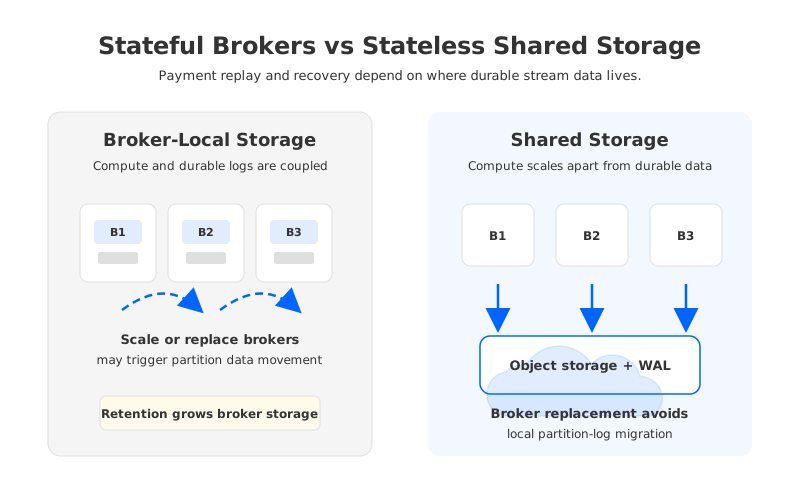
Classic Kafka uses a shared-nothing model in which brokers own local partition logs and replicate data for durability. This model is proven and widely understood. It is also stateful. Scaling, replacement, rebalancing, and storage expansion can involve data movement tied to broker-local disks.
Payment workloads expose that coupling because they often need both live low-latency processing and retained history. Retention supports disputes, investigations, model correction, and reconciliation. Elastic capacity supports authorization peaks, fraud spikes, launches, and replay. In a stateful broker model, those goals can pull on the same local storage and replication machinery.
Tiered storage addresses part of the problem by moving older log segments to remote storage. That can make longer retention more practical, especially when historical reads are less common than tail reads. Teams should still evaluate what remains local, how catch-up reads behave, how failures recover, and whether broker replacement requires significant data movement.
Kafka-compatible shared storage changes the operating model more directly. In this architecture, brokers keep Kafka protocol compatibility while durable stream data is stored in shared storage, often backed by object storage with a fast write-ahead log path. Brokers become closer to stateless compute. For payment systems, that can make capacity changes, replacement, and retention less dependent on moving partition data from one broker's disk to another.
AutoMQ fits this category: it is a Kafka-compatible, cloud-native streaming system that separates compute from storage through a shared-storage architecture. In customer-controlled deployments such as BYOC or self-managed software, the data plane can run inside the customer's cloud boundary while using object storage as the durable foundation. That does not make every migration automatic. It gives platform teams another operating model to evaluate when broker-local storage and replication become limiting factors.
7Evaluation Checklist for Platform Teams
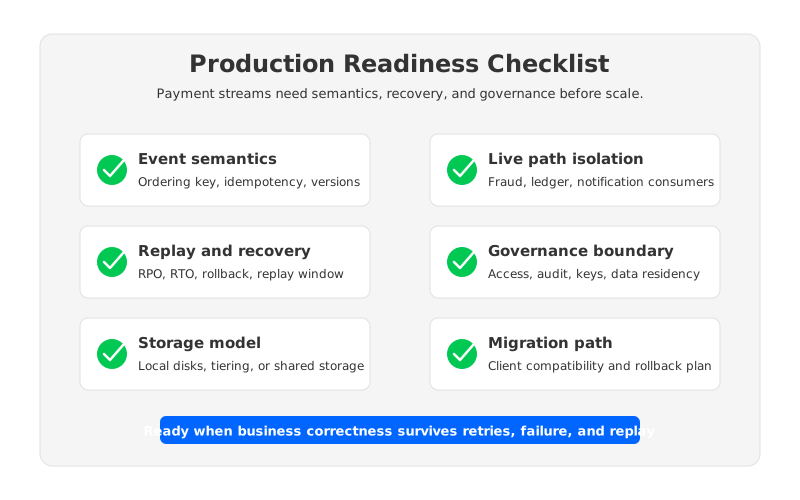
The following checklist is a better starting point than asking whether one platform is faster than another. Payment event streaming succeeds when stream semantics, operating model, and organizational controls line up.
| Area | Questions to answer before production |
|---|---|
| Event semantics | What is the ordering key, idempotency key, event version, and correction model? |
| Live path | Which consumers are on the authorization, fraud, ledger, or customer-facing critical path? |
| Replay | How far back must each stream be replayable, and who can run replay jobs? |
| Failure recovery | What are the RPO, RTO, degraded mode, and rollback path for each stream? |
| Storage model | Does retention or scaling require broker-local data movement that affects operations? |
| Governance | Who controls producer access, consumer access, schema approval, encryption, and audit evidence? |
| Migration | Can the team migrate producers and consumers incrementally while preserving Kafka protocol expectations? |
The checklist also helps decide whether to optimize the current Kafka estate, introduce tiered storage, split workloads, or evaluate a shared-storage Kafka-compatible platform such as AutoMQ. Stable workloads with modest retention and strong operations may not need a platform change. Workloads with growing replay needs, unpredictable peaks, strict data-control requirements, and frequent capacity changes deserve a deeper storage-model review.
8Decision Table
| Situation | Likely direction |
|---|---|
| Payment topics are stable, retention is short, and the team has mature Kafka operations | Keep optimizing the existing Kafka deployment and tighten event contracts |
| Replay and investigation workloads are growing faster than live traffic | Separate live and replay capacity; evaluate tiered or shared storage |
| Broker replacement, partition movement, or cross-zone replication is a recurring operational concern | Review whether the storage model is adding reliability and cost risk |
| Security requires customer-controlled networking, keys, and data-plane boundaries | Prioritize deployment models with clear cloud-account and storage ownership |
| Teams need Kafka clients and ecosystem compatibility but more elastic operations | Evaluate Kafka-compatible shared-storage platforms alongside managed Kafka options |
The point is not to force every payment system into one architecture. It is to prevent a narrow broker-sizing exercise from hiding the real reliability questions. Payment event streaming has to preserve business correctness through retries, replay, failure, governance review, and growth. When those requirements are explicit, the architecture conversation becomes more useful.
For teams evaluating a Kafka-compatible shared-storage approach, AutoMQ is one option to examine after the neutral checklist is complete. To compare the model against your payment stream inventory, retention policy, replay needs, and cloud-control requirements, review the AutoMQ architecture overview.
9References
- Apache Kafka Documentation
- Apache Kafka Consumer Groups and Offsets
- Apache Kafka Transactions
- Apache Kafka Protocol Guide
- AWS Well-Architected Framework: Reliability Pillar
- AutoMQ Architecture Overview
- AutoMQ Shared Streaming Storage
- AutoMQ Continuous Self-Balancing
10FAQ
10.1Is Kafka a good fit for payment event streaming?
Kafka-compatible streaming can be a strong fit when payment systems need durable logs, ordered partitions, independent consumers, replay, and integration with stream-processing tools. The critical work is defining payment-specific event contracts, idempotency, recovery targets, and governance controls rather than treating Kafka as a generic transport layer.
10.2Does exactly-once support remove the need for idempotency?
No. Kafka transactions and idempotent production can help with stream-processing correctness, but payment workflows cross many systems outside the broker. Domain-level idempotency keys and duplicate-safe downstream writes are still required to prevent a retried event from producing a duplicate financial outcome.
10.3How should teams choose partition keys for payment streams?
Choose keys around the ordering invariant the business actually needs, such as payment intent, account, card, merchant, or ledger entity. Avoid a key that creates hot partitions during peak periods. If several workflows need different ordering scopes, separate topics may be safer than forcing every consumer onto one key.
10.4When should payment teams evaluate shared-storage Kafka-compatible platforms?
Shared-storage platforms become worth evaluating when retention, replay, broker replacement, partition movement, or elastic scaling are creating recurring operational risk. They are especially relevant when the team wants Kafka ecosystem compatibility but needs a storage model less tied to broker-local disks.


