
Table of Contents
Table of Contents
Kafka capacity planning gets uncomfortable when the workload refuses to behave like a steady line on a dashboard. The average write rate looks harmless, but the holiday campaign, product launch, market-open window, fraud spike, or nightly reconciliation job needs several times that capacity for a short period. If the platform team sizes the cluster for the average, producers throttle and consumer lag climbs exactly when the business is watching. If the team sizes the cluster for the peak, finance sees a fleet of brokers, disks, and network paths sitting underused for most of the week.
That is why peak traffic rightsizing kafka is a real architecture search, not a spreadsheet exercise. The better question is "Which parts of the streaming system must be provisioned for peak, which can scale independently, and which costs are created by the architecture itself?" Traditional Kafka-compatible deployments often bind those answers together because brokers own compute, network serving, and persistent local storage.
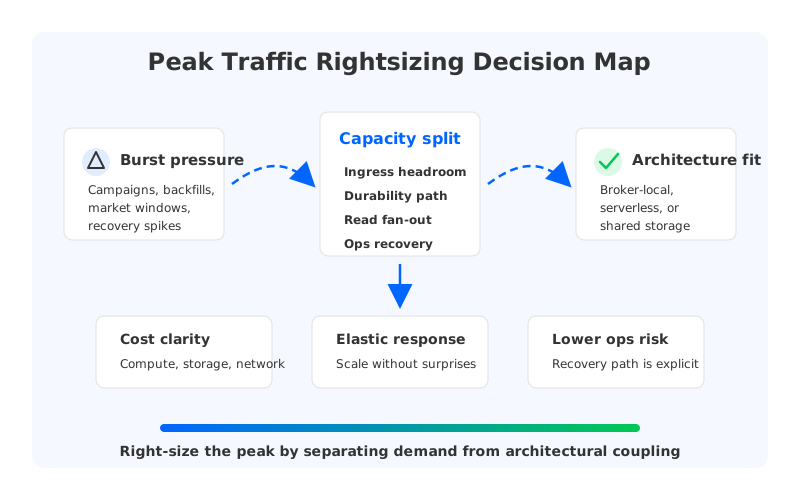
Rightsizing should begin with the peak, but it should not end there. A production cluster has to absorb the burst, preserve durability, keep consumers within their service-level objectives, and recover from failures without turning the peak event into a rebalance event. The useful output is a decision model that separates workload pressure from infrastructure coupling.
1Why Peak Rightsizing Is Harder Than Average Capacity
Average throughput is useful for long-term cost modeling, but it hides the shape of demand. A workload that writes 100 MiB/s for 24 hours is different from a workload that writes 40 MiB/s most of the day and 800 MiB/s during a 20-minute campaign window. Both can produce large daily volume, but only one forces peak headroom across brokers, partitions, disk bandwidth, request queues, network paths, and consumer catch-up capacity.
Kafka peak pressure is multidimensional. Producer traffic is only the first dimension. Replication traffic, retention, compaction, consumer fan-out, connector backfills, stream processing recovery, and cross-zone placement can all amplify the original burst. When multiple dimensions peak together, the cluster may show elevated produce latency, then consumer lag, then broker disk pressure, then longer partition reassignment windows.
The planning mistake is treating all of this as one "cluster size" variable. In reality, a bursty Kafka-compatible workload has at least four different capacity questions:
- Ingress headroom: Can brokers accept the peak write rate with the configured acknowledgments, batching, compression, and partition distribution?
- Durability headroom: Can the storage path persist the burst while maintaining recovery objectives and avoiding local disk exhaustion?
- Read headroom: Can consumers, replays, and analytical readers catch up without starving live workloads?
- Operational headroom: Can the team scale, replace, rebalance, and roll back during the same window without moving too much data?
Those questions are connected, but they do not have to be inseparable. The architecture determines whether peak rightsizing is mostly compute scheduling, storage provisioning, network budgeting, or all of them at once.
2The Cloud Cost Drivers Behind the Workload
Kafka was designed around brokers that store log segments locally and replicate partition data across brokers for durability. That model gives applications a familiar log abstraction, strong ecosystem compatibility, and predictable semantics. It also means cloud cost follows broker ownership. When a broker owns durable data, scaling compute often implies thinking about disks. When replicas span Availability Zones, data movement can become a network bill.
For a bursty workload, the cost model usually has five moving parts:
| Cost area | Why bursts expose it | Rightsizing question |
|---|---|---|
| Broker compute | Peak writes, reads, compression, and request handling need CPU and memory headroom. | Can compute scale for the event without long data movement? |
| Broker-local storage | Retention and replica placement can force storage to be sized ahead of demand. | Is storage sized for actual retained bytes or for worst-case broker ownership? |
| Cross-zone traffic | Replication and client placement may move data between zones in cloud deployments. | Which traffic paths cross zones during peak, replay, and recovery? |
| Rebalancing operations | Adding brokers can trigger partition movement or leader changes. | Does scale-out help quickly enough to matter during the peak? |
| Governance and isolation | Bursts often coincide with business-critical events and stricter change control. | Can teams prove data location, permissions, and rollback paths under pressure? |
This table is deliberately architecture-neutral. A team may choose self-managed Kafka, a managed Kafka service, a serverless Kafka-compatible service, or a shared-storage Kafka-compatible platform. The important point is that each option turns the same workload shape into a different operating bill. A serverless abstraction may reduce idle capacity but introduce opaque usage meters. A traditional broker-local deployment may provide control but require conservative provisioning. A shared-storage design may make compute elasticity more independent but requires careful evaluation of WAL, object storage, and deployment boundaries.
Cloud networking deserves special attention because it is often missed in early sizing. Kafka replication, client placement, connector placement, and consumer fan-out can create traffic paths that are invisible in a simple "write throughput x retention" model. AWS, for example, documents data transfer pricing separately from compute and storage, and the relevant path depends on region, Availability Zone, service, and endpoint design. Peak traffic rightsizing should count data movement as a first-class architecture variable.
3Storage, Network, and Compute Trade-Offs
The classic Shared Nothing Kafka model couples a partition's durable log to the brokers that host its replicas. The broker serving the partition has the data close by, and Kafka's replication model is well understood. During steady workloads, the model can be tuned with partition counts, broker sizing, disk choices, producer settings, and consumer group design.
Bursts stress the model because the system has to carry enough local resources for the worst moments. If compute is short, adding brokers may not help until partitions and leaders are redistributed. If storage is short, adding storage can involve volume changes, broker restarts, or partition movement. If a broker fails during a peak, recovery competes with live traffic for network and disk throughput. The rightsizing unit is bigger than the business event that caused the burst.
Kafka Tiered Storage changes part of this picture by allowing older log segments to move to remote storage. That is valuable for long retention and replay-heavy use cases. It does not automatically make brokers stateless, and it does not remove the need to size the active write path, hot reads, metadata operations, and failure recovery path. For bursty workloads, offloading cold data is not the same as making peak compute scale independently from durable log ownership.
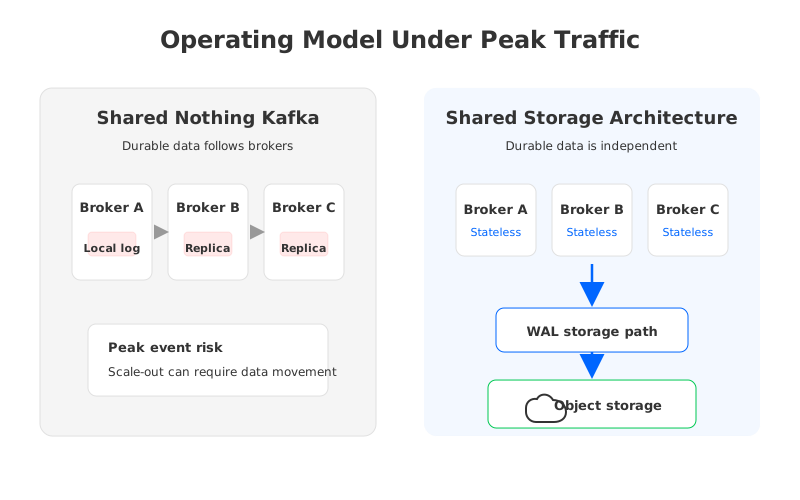
A shared-storage Kafka-compatible architecture changes the rightsizing discussion by moving durable stream data out of broker-local ownership. Brokers still serve Kafka protocol traffic, manage leadership, cache hot data, and handle request processing, but persistent data lives in a shared storage layer, commonly backed by object storage and a write-ahead log path. Durable bytes are no longer trapped inside the lifecycle of a particular broker.
That separation gives architects a cleaner set of trade-offs to test. Compute can be evaluated as request handling and cache capacity. Storage can be evaluated as WAL durability, object storage behavior, retention, and request patterns. Network can be evaluated as explicit data paths rather than a side effect of broker-local replica movement. The design still needs benchmarks under the team's workload, but the test plan becomes more precise.
4Evaluation Checklist for FinOps and Platform Teams
A useful peak rightsizing review should be uncomfortable enough to catch real production risk. If it only asks for average throughput, retention, and broker count, it will miss the work that happens when the peak arrives.
| Evaluation area | What to verify | Evidence to collect |
|---|---|---|
| Peak definition | The largest sustained event window, not only daily average. | Time-series write/read rate, producer latency, consumer lag, connector lag. |
| Burst amplification | Replication, fan-out, replay, compaction, and stream processing recovery during the same window. | Traffic path map and consumer group inventory. |
| Scaling behavior | How fast extra capacity helps and whether it moves durable data. | Scale-out test, broker replacement test, reassignment duration. |
| Storage model | Whether durable data is broker-local, tiered, or shared. | Retention math, disk utilization, remote storage request profile. |
| Network model | Which paths cross zones or accounts during write, read, recovery, and migration. | Cloud billing categories, VPC flow logs, endpoint design. |
| Governance model | Data location, IAM, audit, encryption, and operational access. | Security review, account boundary map, rollback plan. |
| Migration risk | Client compatibility, offset continuity, rollback, and dual-write or mirror strategy. | Compatibility test, replay test, consumer failover procedure. |
The table is not meant to produce a universal score. It exposes which assumptions are architectural and which are operational. A platform team may accept higher idle capacity for a regulated workload with strict change windows. A FinOps team may accept a more complex migration if the current cluster spends too much on unused peak headroom.
Broker count is an output. The inputs are workload shape, durability target, recovery objective, data movement, governance, and the team's ability to operate the system during the same event that creates the peak.
5How AutoMQ Changes the Operating Model
Once the evaluation is framed this way, AutoMQ becomes relevant as an example of the shared-storage pattern rather than as a replacement slogan. AutoMQ is a Kafka-compatible, cloud-native streaming platform that keeps Kafka protocol compatibility while changing the storage architecture underneath. Its Shared Storage architecture uses stateless brokers with durable data stored through S3Stream in object storage, plus WAL storage on the write path for durability, buffering, and recovery.
For peak rightsizing, the practical shift is the separation of durable data from broker lifecycle. A traditional broker-local cluster has to think carefully about whether scale-out, replacement, or partition reassignment will move large amounts of data when traffic is already high. In AutoMQ's model, persistent stream data is not owned by a broker's local disk. Broker replacement and scaling can therefore be reasoned about more like compute and traffic-management operations, while storage capacity is planned around object storage, WAL choice, and retention requirements.
That does not remove engineering judgment. WAL type affects latency and cost. Object storage request patterns matter. Caching strategy matters for hot reads and replay behavior. AutoMQ BYOC and AutoMQ Software are especially relevant when teams want Kafka compatibility while keeping the data plane, cloud resources, and governance boundary under their control.
AutoMQ's cross-AZ traffic optimization is also relevant to burst planning in supported deployments. Traditional Kafka deployments often replicate partition data across zones for durability, which can make peak writes and recovery events show up as cross-zone traffic. AutoMQ's design uses shared storage and routing techniques to reduce or eliminate Kafka replication paths that would otherwise cross zones. The review question becomes "Which data paths remain, and are they intentional?"
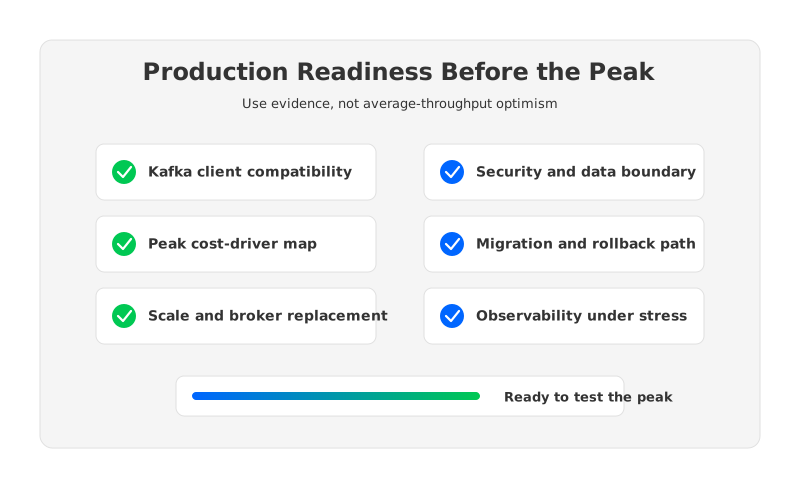
The migration path should keep applications boring. Start with client compatibility, producer and consumer behavior, offset expectations, and connector dependencies. Then replay production-like bursts into a test environment and compare produce latency, consumer lag recovery, storage growth, cloud bill categories, broker replacement, and rollback procedure. A shared-storage architecture is most convincing when the workload proves that peak capacity, retained data, and recovery behavior can be evaluated independently.
6A Practical Right-Sizing Workflow
The fastest way to make peak rightsizing concrete is to build a workload profile before choosing a target architecture. Use the same language across platform, SRE, finance, and security teams. "Peak" should mean a named business window with measured duration and measured read/write behavior, not a vague multiplier over average traffic.
Start by drawing the event path. Identify the producers that create the peak, the topics they write, the partitions that become hot, the consumers that must remain near real time, and the connectors or processors that can lag safely. Then add broker placement, storage placement, replication paths, private endpoints, observability export, and migration paths. This one diagram often explains more than a month of cost reports.
After that, test failure cases during the simulated peak, not after it. Replace a broker, scale out the cluster, restart a connector, replay a consumer group, and run a controlled rollback. The goal is to see whether recovery work competes with the storage, network, and compute resources needed by live traffic.
A strong decision memo should include five artifacts: a peak traffic profile, a cost-driver map, a rightsizing matrix, a migration and rollback plan, and a production readiness checklist. If a shared-storage Kafka-compatible platform such as AutoMQ is worth testing, the memo should identify the exact assumptions the test must prove.
If your current Kafka planning starts with a peak event and ends with expensive idle headroom, the next step is to separate workload demand from architectural coupling. To evaluate a Kafka-compatible shared-storage design against your own traffic profile, start with the AutoMQ deployment consultation.
7References
- Apache Kafka documentation: concepts, replication, producers, consumers, and operations
- Apache Kafka documentation: Tiered Storage operations
- AWS documentation: Amazon S3 data durability
- AWS documentation: EC2 data transfer pricing
- AutoMQ documentation: Shared Storage architecture
- AutoMQ documentation: WAL storage
- AutoMQ documentation: cross-AZ traffic optimization
8FAQ
8.1What does peak traffic rightsizing mean for Kafka?
Peak traffic rightsizing means sizing and operating the streaming platform around the largest meaningful production event window, not only average daily throughput. For Kafka-compatible workloads, that includes producer ingress, replication, consumer fan-out, replay, retention, broker recovery, and operational change windows.
8.2Why is average throughput misleading for bursty Kafka workloads?
Average throughput hides the timing of demand. A workload with moderate daily volume can still need high short-term broker, storage, and network headroom if traffic arrives during a launch, campaign, market window, or reconciliation period.
8.3Does Kafka Tiered Storage solve peak rightsizing?
Kafka Tiered Storage can help with long retention and historical reads by moving older segments to remote storage. It does not automatically make brokers stateless or remove the need to size the active write path, hot reads, metadata operations, and recovery behavior during peak traffic.
8.4When should teams evaluate AutoMQ for bursty Kafka-compatible workloads?
Evaluate AutoMQ when broker-local storage, slow scale-out, cross-zone replication exposure, retained-data cost, or difficult broker recovery is making peak rightsizing too conservative. The strongest evaluation keeps Kafka clients and workload behavior familiar, then measures scaling, recovery, storage, and network paths under a production-like burst.
8.5Is shared storage always better than broker-local Kafka storage?
No. Shared storage changes the operating model, but it still has trade-offs around WAL choice, object storage behavior, cache design, cloud region, latency target, and team maturity. The right answer depends on the workload profile and the evidence collected during a realistic test.


