
Table of Contents
Table of Contents
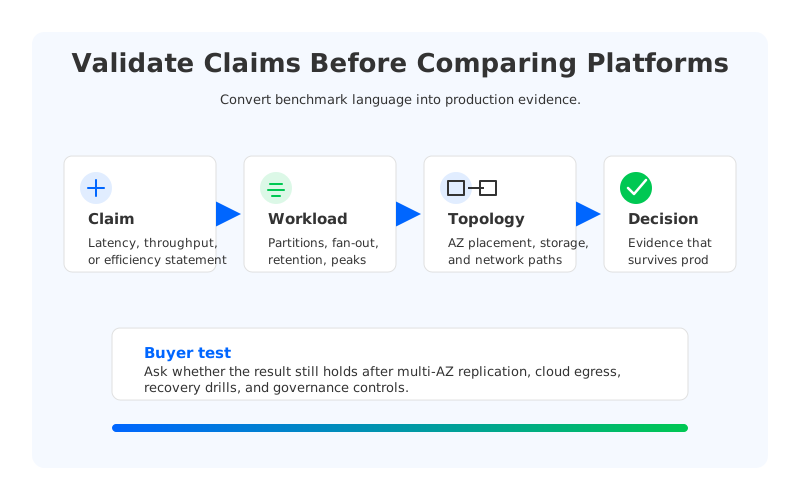
Teams rarely search for redpanda alternatives because they want a generic product catalog. The usual trigger is more specific: a platform team has seen a compelling performance claim, a pricing model that looks attractive, or an operational promise that deserves a closer look before it becomes part of the next architecture review. That is a healthy instinct. Streaming platforms sit on the hot path for payments, personalization, telemetry, fraud detection, data products, and operational analytics. A benchmark that looks excellent in isolation can still fail the ownership test once replication, recovery, network paths, client behavior, and governance enter the picture.
Redpanda deserves a fair evaluation in that process. It is a Kafka API-compatible streaming platform with its own architecture, deployment model, and operational assumptions. Apache Kafka, Amazon MSK, Confluent, Aiven, Redpanda, AutoMQ, and self-managed Kafka can all be reasonable answers under different constraints. The mistake is to compare them as names first and systems second. The better approach is to translate every performance claim into a production question that your team can measure, operate, and defend.
1Why Teams Search for Redpanda Alternatives
The word "alternative" can hide several different buying motions. One team may be comparing Redpanda with Apache Kafka because application teams require Kafka protocol compatibility but infrastructure owners want a different broker architecture. Another may already run Kafka and wants to reduce operational toil without changing client code. A third may be reacting to cloud bills where compute, storage, and data transfer costs no longer scale the way the original Kafka cluster design assumed.
Those motions lead to different validation work:
- Architecture validation: Does the platform keep the Kafka APIs and semantics the estate already depends on, or does it require application-level changes?
- Cost validation: Which parts of the bill scale with throughput, retention, availability zones, consumer fan-out, support, and managed-service boundaries?
- Migration validation: Can topics, clients, ACLs, schemas, connectors, consumer offsets, and rollback paths be handled without turning the project into a multi-quarter rewrite?
- Operations validation: Who owns upgrades, observability, incident response, capacity planning, security controls, and recovery drills?
Performance belongs inside that wider frame. A throughput number is useful only after you know the partition shape, message size, producer acknowledgments, replication settings, retention policy, hardware profile, network placement, and failure mode. The practical question is not "which platform is faster?" It is "which platform preserves the latency, durability, and cost envelope we need after we add the production constraints we cannot remove?"
2What Performance Claims Need Before They Become Evidence
Performance claims usually sound precise, but they often omit the operating envelope. That omission is not always intentional. Vendors naturally highlight the workloads where their design performs well, and buyers naturally gravitate toward numbers that match an existing pain point. The gap appears when the platform team tries to translate the result into a workload that has messy producers, uneven partitions, long retention, compliance requirements, and unpredictable consumer behavior.
A useful validation packet should answer five questions before a claim becomes decision-grade evidence:
| Claim Type | Validation Question | Why It Matters |
|---|---|---|
| Throughput | What was the partition count, message size, compression, and acknowledgment policy? | Kafka-style workloads are sensitive to batch shape and partition parallelism. |
| Latency | Was the measurement taken during normal operation, recovery, rebalancing, and tiered reads? | Steady-state latency can hide tail behavior during the events operators care about. |
| Cost efficiency | Does the model include compute, storage, inter-AZ traffic, data transfer, and operational labor? | A lower broker count can still leave a platform exposed to network or storage growth. |
| Durability | Which failure domains are covered, and where is the durable copy located? | Local disk, replicated brokers, and object storage create different recovery boundaries. |
| Compatibility | Which Kafka APIs and client behaviors are supported for your estate? | API compatibility is a migration risk question, not a marketing label. |
The table prevents false shortcuts. If a claim cannot be mapped to your partitioning model, durability policy, and cloud topology, treat it as a hypothesis rather than proof.
3Architecture Criteria Behind the Shortlist
Kafka-compatible streaming systems differ most sharply in the relationship between compute, storage, and network. Traditional Kafka couples brokers with local storage. That design is proven and widely understood, but it makes broker capacity, durable data placement, and recovery work tightly connected. Managed Kafka services can reduce operational burden, yet the underlying cost structure may still reflect broker instances, attached storage, replication traffic, and service boundaries. Kafka-compatible systems with shared storage separate some of those concerns by keeping brokers more stateless and placing durable data in object storage or another shared storage layer.
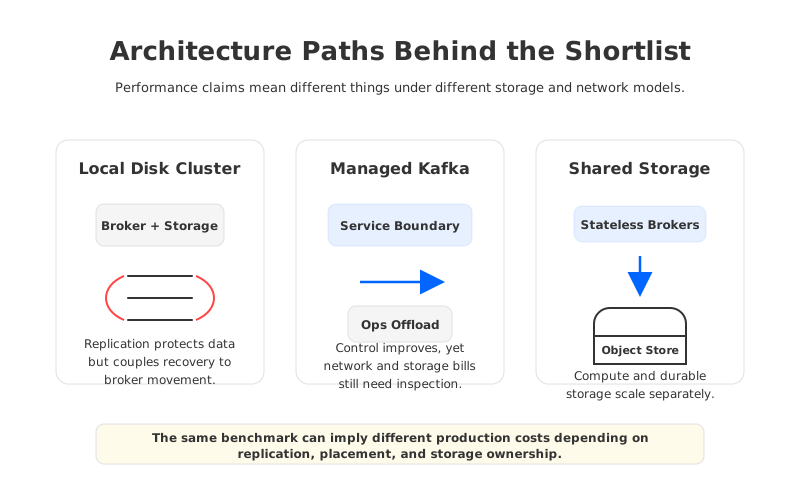
No model is free from trade-offs. Local disk can deliver strong hot-path performance when the cluster is sized and balanced well, but rebalancing and broker replacement remain material operational events. Managed services can improve ownership by moving upgrades and service operation to a provider, but buyers still need to understand network paths, quota behavior, scaling mechanics, and feature boundaries. Shared-storage architectures can improve elasticity and reduce the operational blast radius of broker replacement, but they must solve the write-ahead log, cache, and object-storage latency problem carefully.
That is where performance validation becomes architecture validation. Ask what the platform does when capacity changes. If adding brokers requires moving large amounts of local data, scale-out latency and recovery behavior may matter as much as benchmark throughput. Ask where the durable copy lives, because broker-local replicas make availability-zone placement and replication traffic core cost inputs. Apache Kafka's own ecosystem reflects this tension: KRaft and tiered storage work make architecture choices more explicit rather than removing them.
4Migration and Ownership Questions for Platform Teams
Performance claims become expensive when migration assumptions are wrong. The easiest workload to migrate is an application with a small number of clients, a short retention window, and no hard dependency on advanced Kafka semantics. Most enterprise estates are not like that. They include old client versions, schema registries, connectors, consumer groups with uneven lag, ACL automation, observability dashboards, retention exceptions, and informal operational scripts.
Before a team chooses a Redpanda alternative or any Kafka-compatible target, it should classify workloads by migration sensitivity:
- Protocol-sensitive workloads depend on specific Kafka client behavior, transactions, idempotent producers, security protocols, ACL patterns, or consumer group semantics. These require compatibility testing with real clients, not only a feature matrix.
- Replay-sensitive workloads rely on long retention, historical catch-up, or bursty consumer recovery. These need tests for tiered reads, storage retrieval behavior, and network cost during replay.
- Latency-sensitive workloads care about p99 and p999 behavior during broker restart, partition movement, quota pressure, compaction, and scale events.
- Governance-sensitive workloads depend on clear ownership of encryption, network isolation, audit trails, identity integration, and administrative boundaries.
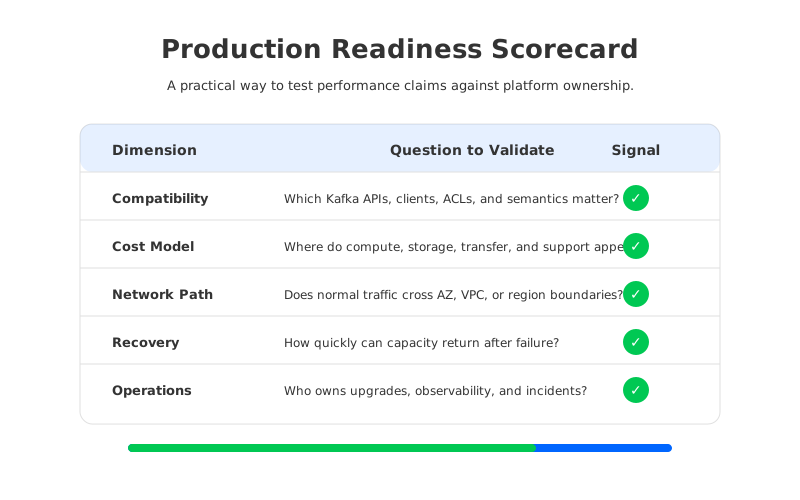
The ownership question often matters more than the migration script. A platform can be technically compatible but operationally awkward if the team loses visibility into critical metrics or cannot reproduce incidents in a lower environment. A stronger proof of concept includes normal traffic, producer retries, consumer lag recovery, broker failure, capacity expansion, tiered reads, ACL provisioning, observability integration, and rollback. If a vendor or service performs well across that set, the performance claim has started to earn trust.
5Cost Claims Need a Cloud Bill Model
Kafka cost analysis often starts with broker count, but cloud bills are rarely that neat. A production streaming platform accumulates cost through compute, attached storage, object storage, cross-AZ or cross-region traffic, PrivateLink or VPC endpoint usage, data transfer, monitoring, support, and engineering time. Amazon MSK pricing, AWS data transfer rules, and VPC networking documentation are useful reminders that managed services still sit inside a broader cloud cost model.
For Redpanda alternatives, the cleanest cost worksheet separates four layers:
| Layer | What to Count | Common Blind Spot |
|---|---|---|
| Compute | Brokers, controllers, coordinators, and supporting services | Overprovisioned capacity for peaks that occur only a few hours per week. |
| Storage | Hot data, retained data, tiered data, snapshots, and metadata | Retention growth that does not track broker CPU growth. |
| Network | Producer writes, replication, consumer reads, cross-AZ paths, and egress | Fan-out traffic from consumers that dwarfs producer ingress. |
| Operations | Upgrades, incident response, on-call burden, tooling, and compliance work | Internal labor hidden outside the platform bill. |
The key is to model cost under the same workload used for performance validation. If a platform reduces broker overhead but increases cross-boundary traffic, the savings may be smaller than the benchmark suggests. If a shared-storage platform reduces local disk dependence and avoids normal cross-AZ replication traffic, the economics may improve most for workloads with high retention, elastic capacity needs, or large recovery events. If a managed service reduces operational labor, that value should be counted even when the cloud invoice looks higher than self-managed infrastructure.
Cost and performance should not be evaluated in separate spreadsheets. Latency targets influence replication and placement, retention affects storage architecture, consumer fan-out changes network exposure, and availability requirements shape failure domains. A credible Redpanda alternative analysis ties those variables together instead of treating price as a separate procurement exercise.
6How AutoMQ Fits the Evaluation
After the neutral framework is in place, AutoMQ enters the discussion as one specific architecture path: a Kafka-compatible, cloud-native streaming platform that separates compute from storage and uses object storage as the durable foundation. The point is not that every workload needs this model. The point is that some performance and cost questions become easier to reason about when brokers are designed to be more stateless and durable data is no longer anchored to broker-local disks.
AutoMQ's S3Stream shared-storage architecture is designed around that premise. Brokers handle Kafka-compatible compute responsibilities while durable stream data is placed in object storage with a write-ahead log and cache layer to protect hot-path performance. In buyer terms, the architecture is relevant when the evaluation hinges on independent compute and storage scaling, faster broker replacement, reduced data movement during scaling, and avoiding normal cross-AZ replication traffic for Kafka durability.
That does not remove the need for testing. A team considering AutoMQ should still validate its client estate, throughput profile, latency target, retention policy, cloud network topology, and operating model. The practical difference is that AutoMQ gives the team a shared-storage Kafka-compatible option to place beside local-disk Kafka, managed Kafka, and Redpanda in the same decision framework.
For teams evaluating Redpanda alternatives, the useful question is not whether shared storage sounds attractive in the abstract. The useful question is whether separating compute from durable storage changes the hardest part of your current platform: scaling, recovery, data movement, retention cost, availability-zone traffic, or operational ownership. If those are the constraints driving the search, AutoMQ deserves a hands-on benchmark using the same workload packet you apply to every other candidate.
To run that evaluation against your own workload assumptions, start with AutoMQ's pricing and deployment material: review AutoMQ pricing and deployment options.
7A Practical Validation Workflow
A strong evaluation requires a repeatable worksheet that prevents performance claims from escaping their context. Start with the applications that will move first, because the first migration teaches the organization how much hidden Kafka behavior exists in the estate. Then choose one demanding workload that represents the future platform's pressure points, such as long retention, high fan-out, strict latency, or frequent scale changes.
Use this workflow:
- Define the workload envelope: partitions, message size, compression, producer acknowledgments, retention, consumer groups, peak-to-average ratio, and failure domains.
- Define the compatibility envelope: required Kafka APIs, client versions, authentication, authorization, transactions, idempotence, schema tooling, connectors, and observability.
- Define the cloud envelope: regions, availability zones, VPC boundaries, private connectivity, storage classes, endpoint usage, and cross-boundary traffic expectations.
- Run steady-state and failure-state tests: normal load, broker restart, capacity change, consumer catch-up, replay, tiered reads, and rollback.
- Convert results into ownership terms: monthly cost model, incident playbook, upgrade plan, monitoring coverage, and migration risk register.
This sequence changes the vendor conversation. Instead of asking for a general benchmark, you ask each candidate to explain how its architecture behaves under your constraints. Redpanda can be evaluated on Kafka API compatibility and operational model. Apache Kafka and MSK can be evaluated on ecosystem fit and managed-service boundaries. AutoMQ can be evaluated on shared-storage elasticity and cloud cost structure.
8References
- Apache Kafka Documentation: https://kafka.apache.org/documentation/
- Apache Kafka KRaft Documentation: https://kafka.apache.org/41/operations/kraft/
- Apache Kafka KIP-405: https://cwiki.apache.org/confluence/display/KAFKA/KIP-405%3A+Kafka+Tiered+Storage
- AWS Amazon MSK Pricing: https://aws.amazon.com/msk/pricing/
- AWS PrivateLink Documentation: https://docs.aws.amazon.com/vpc/latest/privatelink/what-is-privatelink.html
- Redpanda Kafka Client Compatibility Documentation: https://docs.redpanda.com/streaming/current/develop/kafka-clients/
- Redpanda Tiered Storage Documentation: https://docs.redpanda.com/streaming/current/manage/tiered-storage/
- AutoMQ Architecture Overview: https://docs.automq.com/automq/architecture/overview?utm_source=blog&utm_medium=reference&utm_campaign=gs100-0039
- AutoMQ S3Stream Shared Storage: https://docs.automq.com/automq/architecture/s3stream-shared-streaming-storage/overview?utm_source=blog&utm_medium=reference&utm_campaign=gs100-0039
9FAQ
9.1What should teams validate first when comparing Redpanda alternatives?
Start with compatibility and workload shape. Confirm the Kafka APIs, clients, security patterns, retention requirements, partition counts, and consumer behavior that matter to your estate. Performance results are more useful after those boundaries are clear.
9.2Are Redpanda alternatives always Kafka replacements?
No. Some alternatives are managed Kafka services, some are Kafka-compatible systems with different internals, and some are adjacent streaming systems that require application changes. Treat "alternative" as an evaluation category, not proof of drop-in compatibility.
9.3How should performance benchmarks be compared?
Compare benchmarks only when workload, replication, durability, message size, partition count, hardware, network placement, and failure-state behavior are visible. Otherwise, use the benchmark as a hypothesis and rerun it under your own envelope.
9.4Where does AutoMQ differ architecturally?
AutoMQ is Kafka-compatible and uses a shared-storage architecture that separates compute from durable storage. That makes it especially relevant when the evaluation is driven by elastic scaling, broker replacement, retention cost, and cloud network efficiency.
9.5Should cost analysis include engineering labor?
Yes. A streaming platform's real cost includes infrastructure and ownership. Upgrades, incident response, migration work, observability, compliance, and on-call load all affect the decision, even when they do not appear on the cloud provider invoice.


