
Table of Contents
Table of Contents
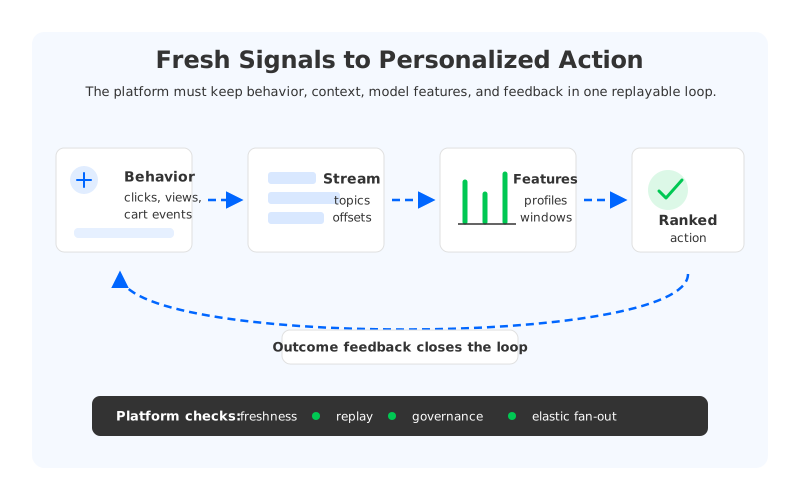
Teams search for real time personalization event signals when recommendations start missing the moment that made them useful. A user views a product, changes location, adds an item to a cart, abandons checkout, or responds to a notification. The ranking service should learn from that behavior before the next page view, not after the next batch job. The hard part is keeping the event fresh, ordered enough, governed, replayable, and affordable as more applications consume it.
Personalization pipelines often begin as a narrow integration between an application event stream and a model endpoint. That path works for a pilot, but production introduces messier pressure: campaign spikes, changing identity graphs, redefined feature logic, consent updates, and model backfills that run while live ranking still has to respond within the user session. A streaming platform for personalization therefore has to behave like an operational data plane, not a message buffer between the web tier and a model.
1Why fresh signals change the recommendation architecture
Personalized recommendations depend on a chain of small, time-sensitive facts. A click after a search query, from a known device, inside a session, against a catalog item with changing inventory is more useful than a click alone. The platform has to capture that chain while preserving enough context for downstream ranking, experimentation, fraud checks, and analytics to agree on what happened.
The usual batch pattern breaks down because the product surface keeps moving. A daily feature refresh can still help with long-term affinity, but it cannot react to a shopper who switches from browsing laptops to buying accessories in the same session. A recommendation system that waits too long may optimize for yesterday's intent. Real time personalization event signals close that gap by continuously updating profiles, short-window features, and outcome feedback.
That freshness has a cost. Every additional consumer, enrichment job, and feature backfill increases stress on the stream. If the stream cannot be trusted during replay, lag, schema changes, and retention growth, personalization teams create side channels: direct database reads, copied event logs, one-off exports, and model-specific pipelines. Those shortcuts usually make the next governance or migration project harder.
2The production constraints behind real time personalization event signals
The first design question is what the event stream must guarantee. Recommendation systems rarely need perfect global order, but they often need predictable order within a user, session, device, account, or cart. Kafka-compatible platforms give teams topics, partitions, offsets, and consumer groups, but the architecture still has to choose keys that match the way ranking decisions are made.
Freshness is the second constraint. The platform has to recover when a slow consumer falls behind, when a campaign doubles event volume, or when mobile clients reconnect and flush buffered events. Measure freshness as end-to-end signal age: the time from user action to feature availability to decision use. Consumer lag is a useful proxy, but ranking quality depends on whether the model sees the signal before the opportunity passes.
Replay is the third constraint. Personalization teams replay events to rebuild features, test a model version, investigate bad recommendations, or correct an enrichment bug. Replay is a normal operating path, not an exceptional disaster-recovery activity. The platform has to isolate backfills from live traffic, make offsets auditable, and keep enough retained history to reproduce a decision.
Governance is the fourth constraint. Personalization event streams can include identifiers, consent state, location hints, product interest, pricing context, and sensitive behavioral patterns. Teams need access control, encryption, auditability, deletion workflows, and a clear boundary between raw events, eligible features, and derived model inputs.
3Architecture patterns teams usually compare
Most teams evaluate four patterns. The right answer depends less on vendor labels and more on where the personalization workload creates operational pressure.
| Pattern | Where it fits | What to test before scaling |
|---|---|---|
| Batch-first feature refresh | Stable recommendations, low session sensitivity, limited traffic bursts | Whether stale features noticeably reduce conversion or engagement |
| Traditional Kafka deployment | Strong Kafka ecosystem needs, moderate retention, known traffic shape | Broker storage growth, partition movement, replication traffic, and replay isolation |
| Kafka with tiered storage | Long retention with lower pressure on older local log segments | Whether active replay and scaling are still dominated by broker-local state |
| Kafka-compatible shared storage | Elastic fan-out, replay-heavy feature work, long retention, cloud cost pressure | Kafka client compatibility, governance boundary, write path behavior, and migration plan |
Traditional Kafka remains a proven foundation for event-driven systems. Brokers store log segments locally, partitions are replicated, and consumers track offsets. This model benefits from a broad ecosystem of clients, connectors, stream processors, and operational practices. For personalization, it works well when traffic is predictable and retention requirements do not force the broker fleet to grow faster than compute needs.
The challenge appears when storage, compute, and data movement become entangled. More retained history often means more broker disk. More brokers may require partition reassignment. Cross-zone replication improves resilience but can increase network traffic in cloud deployments. Backfills can compete with live ranking consumers. Together, those pressures can make personalization freshness depend on infrastructure choreography.
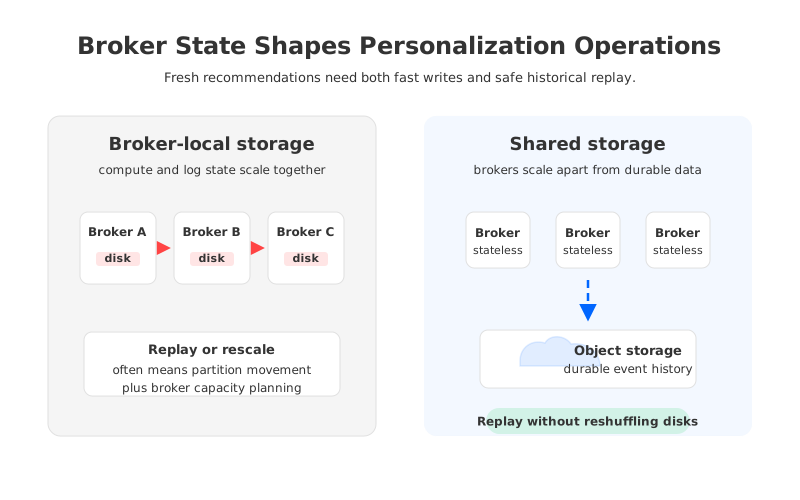
Tiered storage can reduce pressure by moving older log segments to object storage while keeping recent data on brokers. That is useful when the biggest problem is historical retention. It may not fully solve elastic operations if the active working set, recovery path, and partition placement still depend on broker-local state. Test live ranking traffic plus replay, not replay in an empty cluster.
Shared-storage Kafka-compatible architectures push the separation further. Brokers speak Kafka-facing APIs, while durable stream data lives in shared storage and the write path uses a dedicated WAL design. The operational goal is to make brokers closer to stateless compute: easier to replace, scale, and rebalance because durable data is not tied to a local disk fleet. For personalization systems with uneven traffic and frequent backfills, that shift can matter more than a feature checklist.
4Design the stream around decision points
A practical personalization stream starts with the decision the product needs to make. A marketplace ranks products after a search; a media app recommends videos after a watch event; a financial application evaluates offer eligibility after a user action. The topic model should reflect those decision points rather than mirroring every application table.
A common structure separates raw behavior, identity resolution, contextual enrichment, feature updates, model scores, and outcome feedback. Raw behavior topics preserve the original event; enrichment topics add catalog, inventory, account, consent, or session context; feature topics carry short-window aggregates and profile updates; decision and outcome topics record what was shown and what happened next. Keeping stages separate gives teams a cleaner way to replay, validate, and audit the loop.
Key strategy is where many pipelines quietly fail. A random request ID forces consumers to rebuild user or session order, while a single key for a high-traffic tenant can create a hot partition during campaigns. Test candidate keys against real traffic shape: user ID, anonymous ID, account ID, session ID, cart ID, or a composite key. The right key preserves decision context without concentrating too much load.
Schema discipline also matters. Recommendation systems evolve quickly, and event producers are often owned by application teams rather than the platform group. A schema change that breaks a feature consumer can degrade rankings before anyone notices. Use compatibility rules, versioned topics when necessary, and validation at the edge of the stream.
5Evaluation checklist for platform teams
Before choosing a platform, run tests that resemble personalization operations. Publish live behavior events while replaying a historical feature window. Add a slow analytics consumer and verify that ranking consumers stay fresh. Increase retention, simulate broker replacement, and change a schema in a controlled way. Evaluate the result using signals the recommendation team understands: feature freshness, decision latency, backfill duration, consumer isolation, and recovery time.
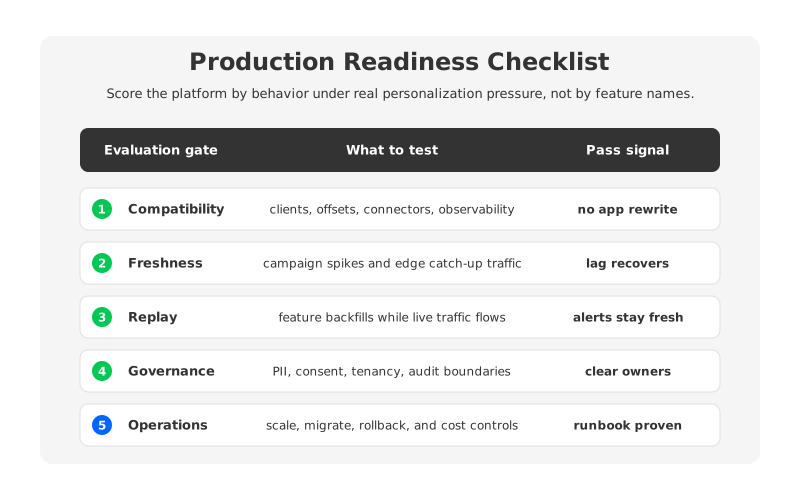
The checklist should include compatibility first. Kafka compatibility is not only about accepting produce and fetch requests. It includes producer semantics, consumer group behavior, offset management, transactions when needed, connector support, monitoring conventions, and integration with stream processors. If the platform breaks the tools around the stream, migration cost moves from the broker layer into every application team.
Cost should be evaluated as a workload model, not as a list price. Personalization streams create cost through compute, storage, network traffic, retention, replay, and operational time. Measure how cost grows with retained days, event volume, fan-out, and cross-zone traffic, especially when multiple model teams replay the same history.
Governance should be tested with the same seriousness as throughput. Can the team separate raw identifiers from derived features? Can a deletion or consent change flow through downstream topics? Can auditors understand who read sensitive behavioral data? Can the platform run inside the required cloud account, VPC, or private network boundary?
6Where AutoMQ changes the operating model
After those neutral checks, AutoMQ becomes relevant as a Kafka-compatible, cloud-native option for teams constrained by broker-local storage, replay friction, or elastic scaling. AutoMQ preserves Kafka protocol compatibility while using a Shared Storage architecture: Stateless brokers, a WAL-based write path, and S3-compatible object storage for durable stream data. It does not replace ranking models, feature stores, or experimentation systems; it changes the storage and operations layer underneath Kafka-facing pipelines.
For personalization workloads, that operating model is useful in four situations:
- Freshness must survive bursty traffic. Stateless broker operations reduce the amount of data movement tied to scaling decisions, which helps when campaigns, launches, or reconnect storms create temporary pressure.
- Replay is part of daily work. Object-storage-backed durable history can make retention and historical reads less dependent on expanding broker-local disks.
- Migration risk has to stay low. Kafka-compatible APIs let existing producers, consumers, connectors, and stream processors remain the integration surface.
- Data boundaries matter. AutoMQ BYOC and AutoMQ Software deployment models can fit teams that need customer-controlled cloud accounts, VPC boundaries, and storage ownership as part of the security review.
AutoMQ is not the automatic answer for every recommendation pipeline. If the current Kafka deployment has stable traffic, short retention, and limited replay needs, tuning keys, schemas, consumer groups, and observability may be enough. AutoMQ is worth evaluating when backfills disrupt live consumers, storage grows faster than broker compute, capacity changes move too much data, or governance requires a clearer cloud ownership boundary.
7Decision table: optimize, redesign, or evaluate shared storage
The decision should follow the bottleneck. Start with the current Kafka-compatible architecture and identify whether the problem is application design, stream governance, broker operations, or cloud cost. A platform migration will not fix poor event contracts or a confused identity strategy, but it can remove infrastructure limits that keep a well-designed personalization loop from scaling.
| Situation | Best next move | Why |
|---|---|---|
| Recommendations use mostly long-term affinity and daily refresh | Improve batch and feature governance first | The business may not need session-level freshness yet |
| Live ranking needs click, cart, and context signals within the session | Build a real time event loop around Kafka-compatible topics | Offsets, consumer groups, and replayable logs support fast iteration |
| Feature backfills regularly interfere with ranking consumers | Redesign replay isolation and storage strategy | Historical reads should not destabilize live personalization |
| Broker scaling or replacement requires large partition movement | Evaluate stateless broker and shared-storage architecture | Capacity operations should be less tied to local log movement |
| Behavioral data must remain inside a strict cloud boundary | Evaluate BYOC or software deployment models | Account, VPC, storage, and audit ownership become part of platform design |
Fresh recommendations are not only a model-quality problem. They are a systems problem: how quickly the platform can turn behavior into features, how safely it can replay history, how clearly it can govern sensitive events, and how predictably it can scale when user behavior is least predictable. When broker-local storage starts slowing that loop, AutoMQ provides a Kafka-compatible shared-storage path to evaluate without discarding the Kafka ecosystem that personalization teams already rely on.
8References
- Apache Kafka Documentation
- Apache Kafka Consumer Groups and Offsets
- Apache Kafka Transactions
- Apache Kafka Tiered Storage
- AWS Personalize event tracking documentation
- Azure Event-Driven Architecture Guide
- AutoMQ Architecture Overview
- AutoMQ Native Apache Kafka Compatibility
- AutoMQ Stateless Broker
- AutoMQ Zone Traffic Optimization
9FAQ
9.1Do personalized recommendations require Kafka?
No. A recommendation system can use several streaming or queueing technologies. Kafka-compatible streaming becomes attractive when teams need durable event history, partitioned ordering, independent consumer groups, replay from offsets, and a large ecosystem of connectors and stream processors. Those mechanics become more valuable as recommendation events feed more product surfaces and model workflows.
9.2How fresh do recommendation signals need to be?
The freshness target depends on the product decision. Session recommendations may need signals within seconds, while long-term affinity models can tolerate slower updates. Platform teams should define freshness as signal age from user action to feature availability to decision use, then test that age during traffic spikes, replay jobs, and consumer failures.
9.3What event key should a personalization stream use?
Start with the identity that matches the decision context: user ID, anonymous ID, session ID, account ID, cart ID, or tenant plus user. The key should preserve useful ordering without creating hot partitions. Test candidate keys with real traffic distribution before committing to the topic design.
9.4When is tiered storage enough?
Tiered storage can be enough when the main issue is retaining older Kafka log segments at a lower storage cost. It may not solve the whole problem if live scaling, broker replacement, and active replay are still dominated by broker-local state. Test live traffic and replay together before deciding.
9.5Where does AutoMQ fit?
AutoMQ fits at the Kafka-compatible streaming platform layer. It does not replace recommendation models, feature stores, experimentation tools, or application code. Its role is to provide Kafka-compatible APIs with Shared Storage architecture and stateless broker operations, which can help when retention, replay, elasticity, and customer-controlled deployment boundaries become important.


