
Table of Contents
Table of Contents
A replay request rarely arrives as a clean architecture exercise. It arrives after a failed sink load, a schema bug, a CDC gap, a data quality incident, or a customer-facing report that no longer reconciles with the source system. The data integration team is then asked a deceptively hard question: can we replay the pipeline without corrupting the downstream system, breaking other consumers, or turning Kafka operations into an emergency project?
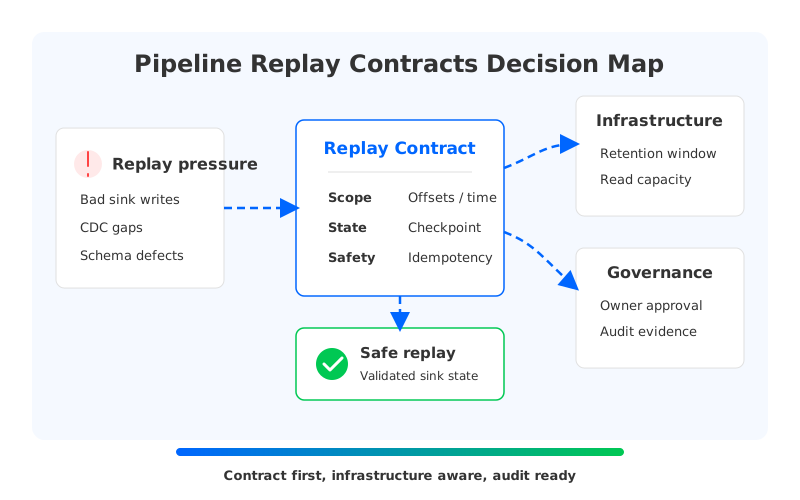
That question is why pipeline replay contracts kafka deserves a formal answer. Kafka can retain event history, consumers can reset offsets, and connectors can be restarted. Those are mechanisms, not contracts. A replay contract defines who may request a replay, what range is replayed, which schema and transformation rules apply, how idempotency is enforced, how downstream owners are notified, and which metrics prove that the pipeline is back in a trusted state.
The missing contract becomes visible in connector-heavy platforms because the connector is often the boundary between teams. Source owners care about extraction correctness. Platform teams care about Kafka durability, offsets, capacity, and access control. Sink owners care about duplicate writes, ordering, late-arriving records, and rollback. When replay ownership is vague, every incident becomes a meeting about semantics that should have been written down before production traffic started.
1Why teams search for pipeline replay contracts kafka
Kafka gives integration teams a powerful default: records are retained for a configured period and consumers track their own progress. That makes replay possible, but it does not make replay safe. A pipeline that writes to an analytics warehouse can usually tolerate a different replay pattern than a pipeline that writes to a payment ledger, operational database, search index, or feature store. The same offset reset that fixes one workload can create duplicate side effects in another.
A useful replay contract starts by separating transport semantics from business semantics. Kafka can tell you where a consumer group committed an offset. It cannot decide whether downstream state should be overwritten, merged, deduplicated, ignored, or compensated. Kafka Connect can move data between systems, but each connector still needs policy around retries, transforms, offsets, and sink behavior.
The search intent behind this topic is practical. Teams are asking how to turn replay into a production workflow that survives audits, on-call pressure, and cross-team ownership. Four questions tend to appear first:
- Which entity owns the replay decision: the platform team, the data integration team, the source application owner, or the downstream system owner?
- Which state is authoritative during replay: Kafka offsets, source CDC positions, connector offsets, target table checkpoints, or business reconciliation results?
- Which replay scopes are allowed: a topic, partition range, consumer group, key range, time window, schema version, or individual connector task?
- Which rollback path exists if replay makes the downstream system worse rather than better?
Those questions expose an uncomfortable truth. Replay is a cross-system recovery procedure that happens to use Kafka as the durable event backbone.
2The operational constraint behind connector-heavy platforms
Connector platforms concentrate operational risk because they make integration low-friction enough to spread quickly. A team starts with a few source connectors, then adds CDC, warehouse sinks, search indexing, object storage exports, ML feature updates, and operational alerting feeds. Each pipeline is individually reasonable. The platform-level problem appears when many of those pipelines need replay at the same time or when one replay consumes the capacity that other pipelines expected to use.
Traditional Kafka deployments make this harder because brokers are not only serving traffic; they also own local log storage. Retention, catch-up reads, replica placement, partition reassignment, and broker recovery all interact with the replay window. If a replay reads historical data aggressively, it can compete with real-time consumers. If the cluster needs more capacity, adding brokers may trigger data movement before the added capacity becomes useful. If a broker is already under pressure, the replay workload can amplify the incident instead of resolving it.
This does not mean local-disk Kafka is wrong. It means replay contracts must include infrastructure assumptions, not only connector procedures. A contract that says "reset the consumer group and replay from Monday" is incomplete unless it also says whether the cluster can absorb the catch-up read, whether storage retention covers the requested window, whether cross-zone traffic will spike, and whether the sink can accept repeated writes.
| Contract dimension | What the team must define | Why it matters in Kafka operations |
|---|---|---|
| Replay scope | Topic, partition, time range, key range, connector, or consumer group | Prevents broad offset resets from affecting unrelated consumers |
| State authority | Kafka offsets, connector offsets, CDC source position, sink checkpoint, or reconciliation query | Avoids conflicting definitions of "replayed successfully" |
| Idempotency rule | Upsert key, exactly-once boundary, dedupe key, compensation step, or full rebuild | Controls duplicate side effects in downstream systems |
| Capacity budget | Read bandwidth, broker headroom, retention window, and sink write limits | Keeps recovery traffic from damaging live workloads |
| Governance path | Approval, audit log, access control, change ticket, and owner sign-off | Makes replay repeatable during incidents and audits |
Replay policy that lives only in a design document will be ignored during an incident. The contract has to map to commands, dashboards, alert thresholds, connector settings, and ownership boundaries that engineers can use under pressure.
3Failure handling, schema, and replay trade-offs
Replay contracts become interesting when failure is partial. A connector may have processed records up to a Kafka offset but failed before the sink committed them. A CDC source may emit an update based on bad application logic. A schema change may parse correctly but map a field into the wrong downstream column. In each case, "replay the data" hides a different recovery problem.
Offset-based replay is the most familiar pattern. It works well when the downstream system is idempotent or when the consumer can rebuild state from a known point. The risk is that Kafka offsets describe position in a log, not correctness in a target system. If a sink connector wrote duplicate rows before the incident was detected, replaying from an earlier offset can add more duplicates unless the sink contract defines a stable primary key or merge rule.
Time-window replay is easier for business stakeholders to understand, but it can be less precise. Event time, ingestion time, connector processing time, and sink commit time may disagree. CDC pipelines add another layer because source transaction order and Kafka partition order are related but not identical. A contract should name the clock used for the replay request and the clock used for validation.
Schema-aware replay is the most neglected pattern. When a pipeline changes schemas, transforms, or connector configuration, old records may be replayed through revised logic. Sometimes that is exactly what you want. Other times it silently rewrites history. A mature replay contract records which schema version, transform version, connector image, and sink write mode apply to the replay. Without that, a replay is also an unplanned migration.
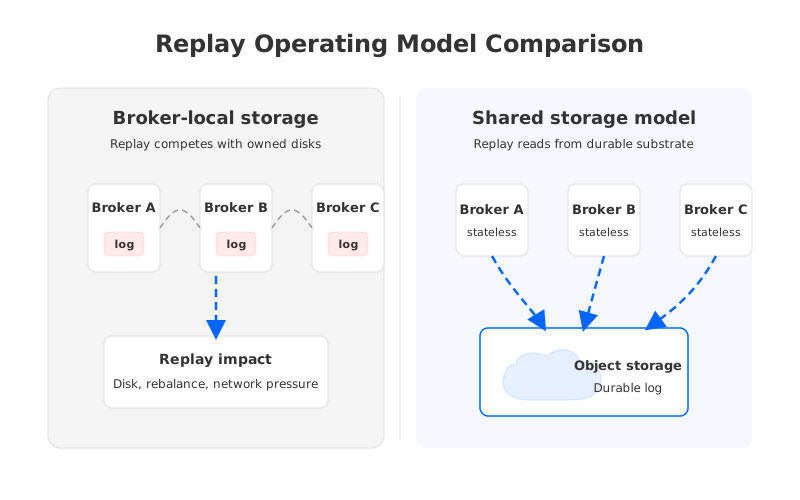
There is also a cost trade-off hiding behind every replay policy. Long retention gives teams a wider repair window, but broker-local storage turns that window into disk capacity planning. Aggressive catch-up reads shorten recovery time, but they can create network and I/O pressure. Multi-availability-zone deployments improve resilience, but traditional replication and consumer placement can introduce cross-zone data movement that shows up later in cloud bills. The replay contract should say how much recovery traffic the platform is allowed to generate before it needs a different plan.
4Evaluation checklist for platform teams
The neutral way to evaluate Kafka-compatible infrastructure for replay-heavy integration teams is to treat replay as a first-class production workload. Do not start with a vendor feature matrix. Start with the 02:00 incident, when the source connector has emitted bad data and three downstream teams disagree about the correct recovery point.
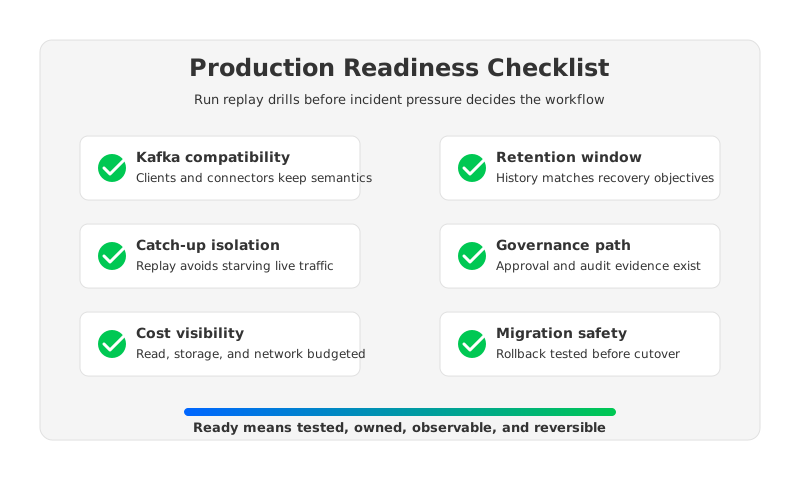
The checklist below is a readiness scorecard. It forces explicit trade-offs before a replay incident makes those trade-offs for you.
| Evaluation area | Good signal | Risk signal |
|---|---|---|
| Kafka compatibility | Existing producers, consumers, and connector clients can run with minimal code change | Replay depends on custom clients or nonstandard connector behavior |
| Retention and storage | Retention windows match recovery objectives without constant manual expansion | Replay windows are shortened because local disks are expensive or hard to rebalance |
| Catch-up isolation | Historical reads can be served without starving real-time consumers | Replay traffic competes directly with hot-path ingestion and tail reads |
| Governance | Replay approvals, owner sign-off, and audit records are attached to the workflow | Replay is performed through ad hoc offset resets by whoever has cluster access |
| Cost visibility | Teams can predict storage, read, and cross-zone network impact before replay | The first cost signal appears after the cloud bill arrives |
| Migration safety | Existing Kafka semantics, ACLs, monitoring, and rollback paths are tested before cutover | The platform changes infrastructure and replay policy at the same time |
Two details deserve more attention. First, replay contracts should be tested with synthetic incidents, not only reviewed in architecture meetings. A bounded replay exercise will reveal missing permissions, broken dashboards, unowned sink tables, and incorrect assumptions about offset reset procedures. Second, the scorecard should be owned jointly. Platform teams can provide the Kafka substrate, but sink owners must define idempotency and validation because they own the damage if replay writes the wrong state.
5How AutoMQ changes the operating model
Once the evaluation framework is clear, the infrastructure question becomes sharper: how much of the replay burden comes from Kafka semantics, and how much comes from the way the cluster stores and moves data? The answer matters because the first category must be handled by contracts and application design, while the second category can be improved by architecture.
AutoMQ fits into that second category as a Kafka-compatible streaming platform built around shared storage and stateless brokers. It keeps Kafka protocol compatibility as the integration surface, while moving durable stream storage away from broker-local disks and into object storage. AutoMQ documentation describes this as a Shared Storage architecture with S3Stream and a write-ahead log layer, designed so brokers no longer have to carry long-lived local log ownership in the same way traditional Kafka brokers do.
That shift does not remove the need for replay contracts. It changes what the contract can assume about operations. If compute and storage scale more independently, replay planning can focus less on whether adding brokers will trigger heavy data movement and more on whether the replay workload has enough read capacity and downstream guardrails. If broker recovery does not depend on reconstructing large local disks, failure handling becomes less entangled with historical data ownership. If object storage is the durable substrate, longer retention windows become an architectural option rather than a broker-disk negotiation.
The practical advantage for data integration teams is not "replay is automatic." The advantage is that the platform can make replay less disruptive when the contract is already well designed. A connector team still needs source positions, sink idempotency, schema rules, and validation queries. The platform team gets a Kafka-compatible substrate where storage elasticity, broker recovery, partition movement, and cloud traffic patterns are less likely to dominate every replay discussion.
A replay contract is a human and system agreement; AutoMQ is infrastructure that can make the agreement easier to execute. The strongest evaluation combines both: write the contract as if the downstream system will punish every duplicate, then choose infrastructure that does not punish every historical read.
6A replay contract template you can adapt
A production replay contract should be short enough to use and precise enough to audit. Long policy documents tend to disappear when an incident starts. A better pattern is a compact template attached to each connector or pipeline class, with a runbook that maps each field to a command, dashboard, or approval step.
Use this structure as a starting point:
- Pipeline identity: source system, Kafka topic, connector name, sink system, owner group, and escalation contact.
- Replay boundary: allowed time windows, offset ranges, partition handling, schema versions, and maximum replay volume.
- State rule: the authoritative checkpoint and the validation query that proves the sink is correct after replay.
- Idempotency rule: upsert key, dedupe key, compaction behavior, sink transaction boundary, or rebuild process.
- Operational budget: expected read bandwidth, sink write limit, retention requirement, and alert thresholds during replay.
- Approval and audit: requester, approver, ticket, reason, start time, end time, and post-replay evidence.
The contract should also name forbidden actions. For example, a team may allow replay from a dead-letter topic into a staging sink, but prohibit direct replay into a production operational database without sink owner approval. Another team may allow consumer group offset reset for analytics workloads, but require a full table rebuild for pipelines that cannot guarantee idempotent writes. These restrictions are not bureaucracy. They are how you keep one team's repair from becoming another team's incident.
When replay policy depends on Kafka-compatible semantics but cloud operations are constrained by broker-local storage, review AutoMQ's shared-storage architecture and compatibility model.
7References
- Apache Kafka Documentation: https://kafka.apache.org/documentation/
- Apache Kafka Connect documentation section: https://kafka.apache.org/documentation/#connect
- AutoMQ architecture overview: https://docs.automq.com/automq/architecture/overview.md
- AutoMQ Kafka compatibility: https://docs.automq.com/automq/architecture/technical-advantage/native-compatible-with-apache-kafka.md
- AutoMQ managed Kafka Connect overview: https://docs.automq.com/automq-cloud/kafka-connect/overview.md
- AWS S3 user guide: https://docs.aws.amazon.com/AmazonS3/latest/userguide/Welcome.html
- AWS S3 data durability documentation: https://docs.aws.amazon.com/AmazonS3/latest/userguide/DataDurability.html
8FAQ
8.1What is a pipeline replay contract in Kafka?
A pipeline replay contract is an operational agreement that defines how a Kafka-backed data pipeline can be replayed safely. It covers replay scope, offsets or time windows, schema and transform versions, idempotency rules, downstream validation, ownership, approval, and audit evidence.
8.2Is resetting a Kafka consumer group offset enough for replay?
No. Offset reset is only one mechanism. A safe replay also needs downstream idempotency, sink validation, schema handling, and capacity planning. Without those pieces, the reset may duplicate data or rewrite target state incorrectly.
8.3How should CDC pipelines handle replay?
CDC replay should define the authoritative source position, transaction ordering expectations, schema version, and sink merge rule. Teams should validate the target system with reconciliation queries rather than assuming that a consumed Kafka offset proves business correctness.
8.4Where does AutoMQ fit in a replay strategy?
AutoMQ can provide a Kafka-compatible shared-storage operating model that reduces the infrastructure friction around retention, scaling, broker recovery, and historical reads. It does not replace replay contracts; it makes well-designed contracts easier to execute in cloud environments.
8.5How should a team start?
Pick one high-value connector and run a bounded replay exercise. Record the owner, replay scope, offset or time boundary, sink idempotency rule, validation query, infrastructure impact, and approval path. If the exercise requires hidden tribal knowledge, turn that knowledge into the contract before expanding the pattern.


