
Table of Contents
Table of Contents
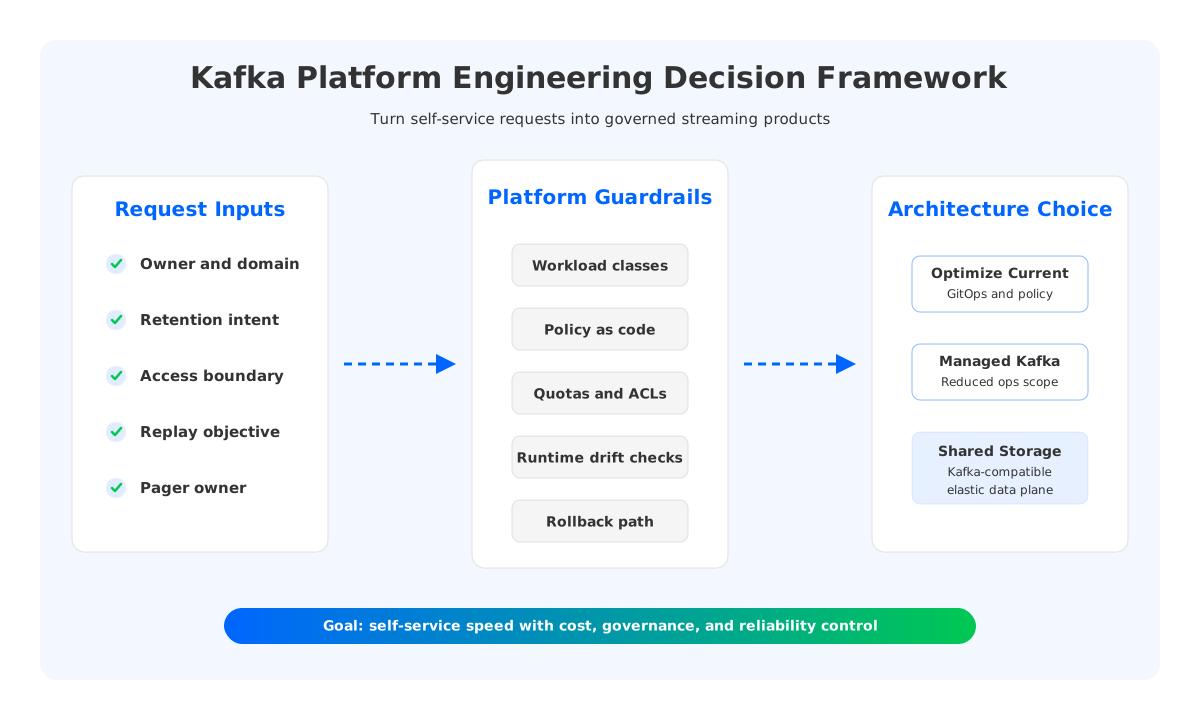
Kafka platform engineering usually starts with a reasonable request: give product teams a faster way to create topics, connect applications, and ship event-driven features. The problem arrives later, when every "small" topic request becomes a long-lived production commitment. A platform team is no longer approving a queue; it is accepting retention cost, replication traffic, access policy, observability ownership, and an eventual migration path.
That is why Kafka self-service cannot be treated as a portal project. A good portal reduces ticket volume. A good platform reduces the number of decisions that can quietly damage the fleet. The difference matters because Kafka carries state, and state makes automation less forgiving than it looks.
1Why Kafka Platform Engineering Is Harder Than It Looks
Most company Kafka platforms grow from operational pain, not architectural ambition. Application teams wait too long for topics. SREs get pulled into partition-count debates. Security teams want consistent ACLs. Finance teams see a cloud bill that maps poorly to business ownership. Leadership asks for "self-service Kafka," and the first response is often to wrap existing scripts with a cleaner interface.
That helps, but it does not change the failure mode. If the platform exposes low-level Kafka controls without a design model, every team can create infrastructure debt at production speed. The platform needs defaults, limits, ownership, and recovery paths so that self-service does not become self-inflicted operational load.
Three pressures usually force the issue: cost ownership becomes blurry, governance becomes fragmented, and reliability depends on invisible coupling. Topic retention, replication factor, partition count, cross-zone traffic, ACLs, schema policy, consumer lag, quota enforcement, and maintenance windows all interact. The platform engineer's job is to hide incidental complexity while preserving architectural control, so safe actions are easy, risky actions explicit, and impossible actions unavailable.
2The Production Constraints Behind the Search
Apache Kafka's model is powerful because it gives teams durable ordered logs, consumer groups, replay, transactions, and a mature client ecosystem. Those semantics are exactly why teams want a shared platform instead of one-off messaging systems per application. But Kafka's traditional shared-nothing architecture also means brokers are not disposable in the same way stateless application pods are disposable.
In a conventional deployment, brokers own local log segments. Replication protects those segments across brokers and, in many production deployments, across availability zones. When the cluster grows, shrinks, loses a broker, or needs storage rebalancing, the platform has to move partition data. That data movement is not administrative noise; it competes for disk, network, and broker resources that also serve producers and consumers.
Self-service automation must respect that physical reality. A topic creation workflow is not complete when it calls an admin API. It needs to answer questions that affect the fleet after approval:
| Platform decision | Why it matters in production | Safer default |
|---|---|---|
| Partition count | Determines parallelism, metadata volume, rebalance cost, and future movement. | Offer workload classes instead of raw numbers. |
| Retention policy | Converts business requirements into storage and replay cost. | Use tiered defaults by data product type. |
| Access model | Prevents broad credentials and unclear data ownership. | Bind ACLs to service identities and environments. |
| Quotas | Keeps one team from absorbing shared cluster capacity. | Apply producer, consumer, and request quotas by tenant. |
| Change path | Makes rollback possible when a topic or connector change misbehaves. | Require versioned declarations and review gates for risky changes. |
This is where the word "platform" earns its keep. A platform is an opinionated operating model: what teams can do alone, what needs review, and what the system continuously reconciles.
3Self-Service Requires Guardrails, Not Unlimited Knobs
The fastest path to chaos is to expose every Kafka configuration as a form field. It feels flexible, but it transfers platform design to every application team. Some teams will make good choices. Others will copy a value from an unrelated workload, and the platform team will debug the result later.
A stronger model starts with workload classes. A platform might offer "low-latency operational events," "high-retention audit logs," "analytics ingestion," and "development sandbox" as product choices. Each class maps to approved settings for retention, compaction, partition growth, quota envelope, monitoring, and support expectations. Advanced overrides still exist, but they move through a change path because they are no longer ordinary self-service.
That pattern keeps the user experience simple without pretending the architecture is simple. The portal can ask questions a product team can answer:
- What business domain owns the stream?
- Which environment will produce and consume the data?
- How long does the data need to be replayable?
- Is ordering required within a key?
- What happens if consumers fall behind?
- Which team is paged when lag or produce errors cross a threshold?
Those answers are more useful than asking a developer to guess segment sizes. They let the platform translate intent into policy, and they create a paper trail that is meaningful during audits and incidents.
4Architecture Patterns Teams Usually Compare
Once self-service grows beyond a single cluster, platform teams usually compare three operating patterns. The right answer depends on organizational maturity, cloud constraints, and migration tolerance.
First, some teams keep traditional Kafka and improve the control plane around it. This is often right when workloads are stable, the team has deep Kafka expertise, and the biggest problem is inconsistent provisioning. Infrastructure as code, GitOps, policy-as-code, quota templates, and better observability can help without changing the data plane.
Second, teams may adopt managed Kafka or a cloud provider service to reduce operational ownership. This can improve day-two operations, but it does not remove the need for naming conventions, tenancy boundaries, cost attribution, network design, schema policy, lifecycle automation, and migration discipline.
Third, teams can evaluate Kafka-compatible architectures that change how storage and compute relate to each other. This path matters when the bottleneck is not the portal but the stateful operating model behind it. If broker-local storage drives slow scaling, complex rebalancing, and capacity reservation, platform automation can reduce friction but cannot remove the coupling.
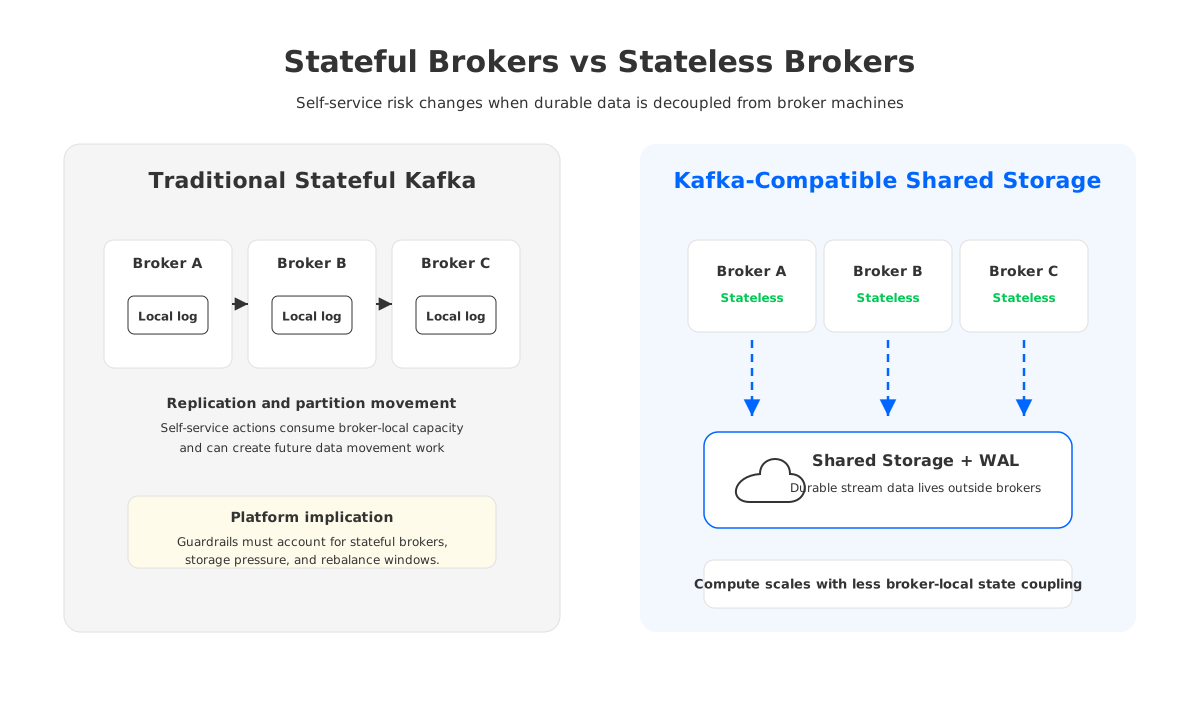
The distinction is practical. With stateful brokers, self-service must be conservative because each action may consume broker-local capacity or trigger future data movement. With shared storage, broker compute can become more elastic because durable stream data lives outside the broker. The platform contract changes from "protect every broker because it owns data" to "protect shared storage and control plane while making compute easier to replace."
That is not a reason to declare one architecture universally right. It is a reason to tie platform engineering decisions to operating constraints. A regulated bank running a few stable Kafka clusters may value mature process over architectural change. A SaaS company with spiky tenants, high retention, and frequent environment creation may find that a stateful data plane keeps fighting its self-service goals.
5A Vendor-Neutral Evaluation Framework
Platform teams should evaluate Kafka self-service across five dimensions before selecting tools. The framework keeps the conversation grounded in operating outcomes rather than vendor labels.
| Dimension | Questions to ask | Warning sign |
|---|---|---|
| Compatibility | Do existing Kafka clients, connectors, ACL patterns, consumer groups, and transaction requirements keep working? | Migration requires rewriting application semantics. |
| Elasticity | Can capacity follow demand without long partition movement windows or heavy manual balancing? | Teams must reserve for peaks because scaling is slow. |
| Governance | Are identity, access, schema, quota, audit, and ownership policies declared and reconciled? | The portal creates resources faster than policy can review them. |
| Cost control | Can the platform attribute storage, traffic, compute, and retention to teams or data products? | Finance sees cluster-level spend with no accountable owner. |
| Exit and rollback | Can workloads move gradually, run in parallel, and roll back without losing offsets or breaking clients? | The migration plan is a cutover weekend with hope attached. |
Compatibility constrains every other choice. Kafka is an ecosystem of clients, operational habits, connectors, security models, and failure expectations. A platform that breaks those expectations may create a cleaner architecture while forcing every application team to pay the migration tax.
Elasticity and cost control come next. Slow scaling encourages over-provisioning, and over-provisioning hides waste inside "reliability." A platform team needs to know whether extra capacity is protecting customer experience or compensating for a data plane that cannot move quickly enough.
6Where AutoMQ Changes the Operating Model
After that neutral evaluation, AutoMQ fits into a specific architectural category: Kafka-compatible streaming with shared storage and stateless broker design. It keeps Kafka API and ecosystem compatibility as the entry point, while changing the storage layer so durable stream data is placed on cloud storage rather than broker-local disks.
This matters for platform engineering because it changes what self-service has to protect. In a traditional Kafka model, a topic request eventually consumes broker-local storage and may contribute to future partition movement. In AutoMQ's shared-storage model, brokers are designed to be more stateless, while the storage responsibility moves to cloud storage services and a WAL-based architecture. The platform can then focus more on policy, tenancy, quotas, and lifecycle management instead of treating every broker as a long-lived data holder.
AutoMQ is not a replacement for platform discipline. Teams still need topic catalogs, service identity, schema governance, access review, observability, and migration plans. Some hard operating constraints become less tied to individual broker machines:
- Scaling can be modeled closer to compute elasticity. Stateless broker design makes broker replacement and capacity changes less dependent on large broker-local data movement.
- Compatibility reduces the application migration surface. Kafka clients and ecosystem tools can remain part of the operating model when compatibility requirements are met and tested.
- BYOC and software deployment boundaries support data-control requirements. Platform teams can evaluate shared-storage Kafka-compatible architecture without assuming a pure external SaaS boundary.
- Cost discussions become architectural instead of only procedural. Retention, replication, cross-zone traffic, and over-provisioning can be reviewed as part of the storage model, not only as after-the-fact FinOps cleanup.
The right way to introduce AutoMQ into a platform roadmap is to pilot it against a workload class, not announce a wholesale replacement. Pick a stream family where the current platform shows a clear constraint: high retention, frequent scaling, costly replication traffic, or repeated broker-storage operations. Then validate compatibility, observability, rollback, and cost attribution before expanding the catalog.
7Designing the Platform Contract
Regardless of the data plane, Kafka platform engineering should produce a contract that application teams understand and SREs can enforce. A contract is stronger than a wiki page because it is encoded in automation and checked continuously.
At minimum, the contract should define four layers. The request layer covers topics, connectors, schemas, quotas, and ownership. The policy layer decides what is auto-approved, reviewed, or disallowed. The runtime layer reconciles desired state, monitors drift, and alerts owners. The lifecycle layer handles deprecation, migration, archive, and deletion.
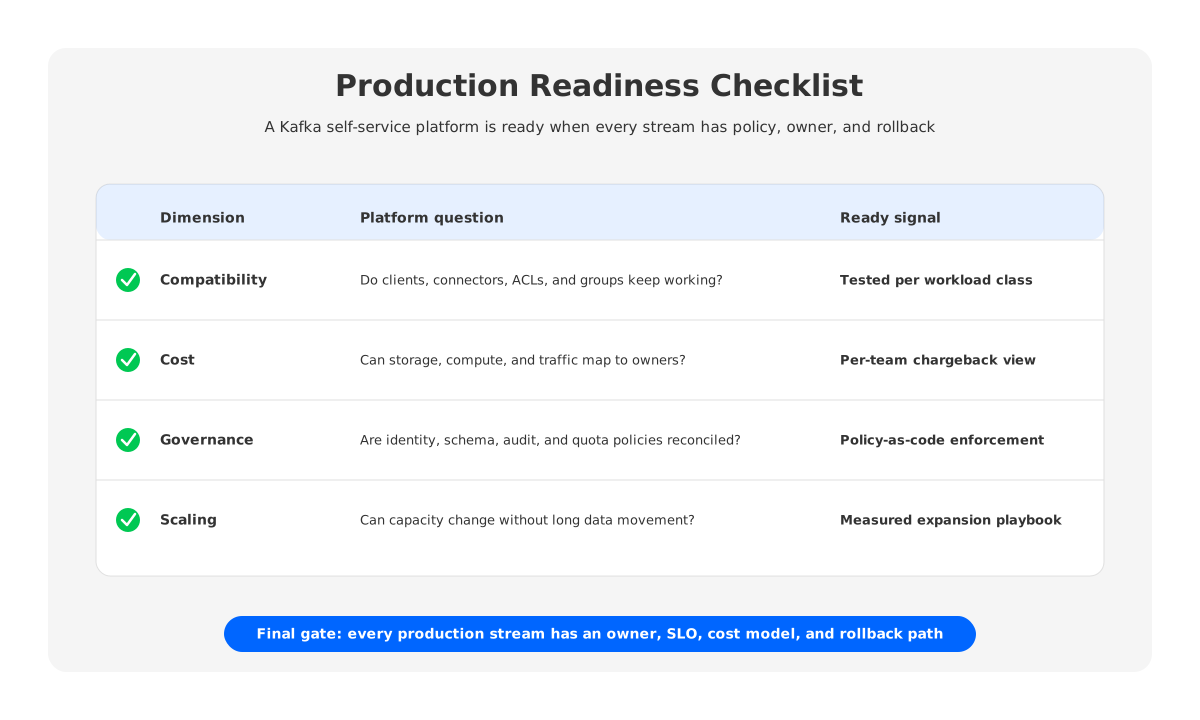
A self-service Kafka platform is healthy when most teams never need broker-level knowledge, but every production stream still has an owner, a cost model, a policy boundary, and a rollback path.
That sentence is a useful design test. If a request path is easy but ownership is unclear, the platform is incomplete. If governance is strong but every change requires a meeting, the platform is not self-service. If the architecture scales but migration is risky, the platform is not yet a product.
8A Practical Decision Table
The decision is rarely binary. Most organizations should improve the control plane and evaluate data-plane changes in parallel because platform maturity and architecture maturity reinforce each other.
| Situation | Likely next step | Why |
|---|---|---|
| Small number of stable clusters, strong Kafka team, limited growth pressure | Improve GitOps, policy, quotas, and observability around current Kafka. | The main gap is consistency, not architecture. |
| Many teams, inconsistent topic ownership, audit pressure | Build a platform contract before changing vendors. | A new backend will not fix unclear ownership. |
| Slow scaling, high retention, frequent rebalance pain, broker storage pressure | Evaluate Kafka-compatible shared-storage architecture. | The operating model is constrained by broker-local state. |
| Strict data residency and cloud-account control requirements | Compare self-managed, BYOC, and software deployment boundaries. | The control boundary may matter as much as feature depth. |
| Migration risk dominates all other concerns | Start with one workload class and prove rollback. | Compatibility and reversibility are the gating criteria. |
Kafka platform engineering is ultimately about choosing where complexity should live. Application teams should not carry broker details in their heads. Platform teams should not be trapped approving repetitive tickets. The architecture should not force everyone to reserve capacity for a future peak that may not arrive.
If you are already building an internal Kafka platform, use the checklist above to separate portal work from architectural work. When broker-local state is the constraint, include Kafka-compatible shared-storage options such as AutoMQ in the evaluation, test them against a real workload class, and make the migration path as observable as the steady state.
9References
- Apache Kafka documentation
- Apache Kafka operations documentation
- Apache Kafka KIP-405: Kafka Tiered Storage
- AutoMQ compatibility with Apache Kafka
- AutoMQ difference with tiered storage
- AutoMQ stateless broker
- AutoMQ BYOC environment
10FAQ
10.1What is Kafka platform engineering?
Kafka platform engineering is the practice of turning Kafka into a company platform with self-service provisioning, policy enforcement, observability, cost attribution, and lifecycle management. It is broader than automation because it defines what teams can safely do without opening a ticket.
10.2Should a Kafka platform expose every topic configuration?
Usually no. Exposing every knob shifts architectural responsibility to application teams. A better approach is to offer workload classes with approved defaults, then require review for advanced overrides that affect cost, reliability, or governance.
10.3When should teams evaluate shared-storage Kafka-compatible architecture?
Evaluate it when broker-local storage is blocking platform goals: slow scaling, expensive over-provisioning, high retention pressure, heavy partition movement, or difficult maintenance. The evaluation should include compatibility tests and rollback planning, not only architecture diagrams.
10.4How does AutoMQ fit into Kafka platform engineering?
AutoMQ can be evaluated as a Kafka-compatible, shared-storage, cloud-native option for teams that want Kafka semantics with a more elastic broker operating model. It should appear after the platform team has defined compatibility, governance, cost, and migration requirements.


