
Table of Contents
Table of Contents
Teams usually search for least privilege kafka operations after the policy document has stopped matching production reality. A data team needs a Topic before launch. A payments team asks for a temporary Offset reset during incident recovery. A security reviewer asks who can alter ACLs, rotate credentials, deploy Kafka Connect, change retention, or expand a cluster across Availability Zones. The issue is not that Kafka has no controls; it is that production Kafka operations often force too many people to hold too many permissions for too many unrelated tasks.
Least privilege in Kafka is therefore not only an ACL problem. Apache Kafka concepts such as Topics, Partitions, Offsets, Consumer groups, transactions, and Kafka Connect map directly to operational authority. Someone can read customer events, write transactionally, reset a Consumer group's committed position, deploy a connector, reassign Partitions, or expand brokers. Least privilege Kafka operations work only when platform ownership boundaries match the architecture underneath the cluster.
1Why teams search for least privilege kafka operations
The phrase sounds narrow, but the search intent is broad. Platform teams are turning Kafka from a shared technical service into a governed production platform. Auditors, application owners, and infrastructure teams ask the same questions in different language: who owns the data contract, who can change runtime capacity, who can see records, who can move data across environments, who can approve exceptions, and who can prove what happened.
In a small Kafka estate, one platform group may own broker configuration, storage volumes, network paths, Topic creation, ACLs, quotas, connector runtime, monitoring, and emergency remediation. That breaks down when many teams need partial control. The fraud team should not need broker admin permissions to evolve a schema. The analytics team should not need broad read access to validate a consumer lag alert. The infrastructure team should not need application-level Topic privileges to resize a node pool.
This is where the least-privilege model starts to stretch. Kafka's authorization layer can express resource-level operations, but real production work spans several layers at once:
- Data access: Produce, consume, describe, alter, and transaction permissions must map to owners, environments, and data sensitivity.
- Runtime operations: Broker scaling, Partition reassignment, retention changes, and recovery workflows require stronger administrative authority than application teams should hold.
- Pipeline operations: Kafka Connect, schema governance, data contracts, and sink credentials create access paths beyond Kafka itself.
- Infrastructure operations: VPC routing, private endpoints, object storage, encryption keys, identity roles, and observability pipelines define where data and metadata can travel.
The hard part is designing a platform where the permission table is realistic enough that teams follow it during incidents.
2The production constraint behind the problem
Traditional Kafka runs on a Shared Nothing architecture: each Broker owns local persistent log segments, and Partition replicas are distributed across Brokers for durability and availability. That mature model couples several kinds of authority that compliance teams would rather separate. When durable data is tied to broker-local storage, capacity changes, failure recovery, and rebalancing become data movement events, not only compute operations.
That coupling shows up in permission design. Scaling a cluster may require moving Partition data. Replacing a failed Broker can trigger replication, catch-up reads, and ISR changes. Changing retention affects local disk capacity, restore behavior, and Consumer replay windows. The operator is not merely managing infrastructure; the operator is indirectly managing the location and availability of event history.
Multi-AZ deployments make the boundary less tidy. Kafka replication across zones improves availability, but it also creates cross-zone network traffic and a larger operational surface across cloud networking, broker listeners, rack awareness, and client configuration. When a production issue spans those layers, least privilege can degrade into a shared break-glass role because no single scoped role can complete the workflow.
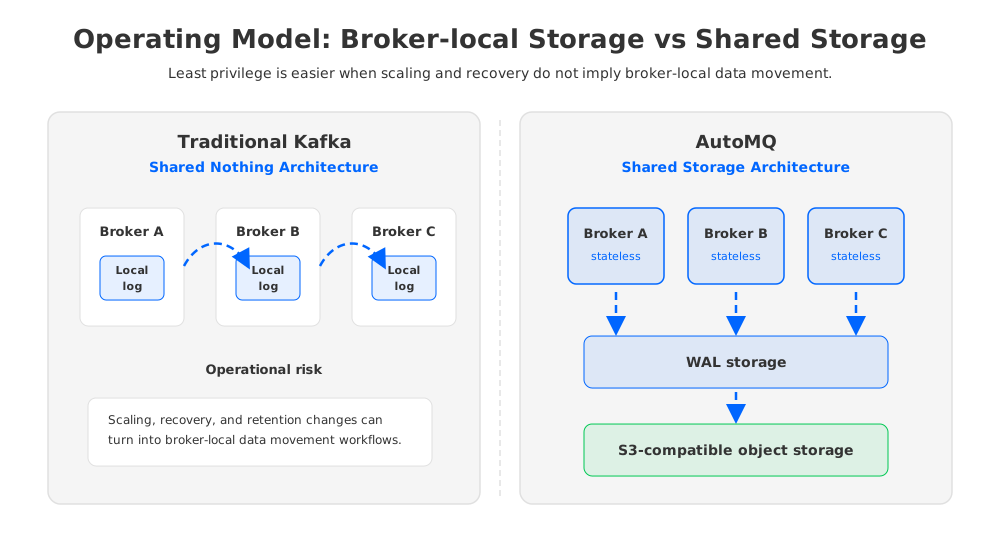
Tiered Storage can reduce long-retention pressure by moving older segments to object storage, but it does not fully remove the broker-local ownership problem. The hot log still lives on broker storage, and the cluster still needs care around local capacity, leader movement, and replica placement. For teams whose governance problem is rooted in durable data and broker operations being fused together, Tiered Storage is incremental rather than a different ownership model.
3Architecture options and trade-offs
A useful least-privilege review starts by separating platform choices into operating models, not vendor names. Self-managed Kafka gives the team maximum control over ACLs, identity integration, network isolation, and cloud resources, but it also makes the team responsible for every operational path. The permission model is explicit because the team owns everything; the cost is that the team owns everything.
A fully managed Kafka service can reduce day-two work and standardize many controls, but it changes the ownership question. Some authority moves to the provider, some remains with the customer, and some becomes a support or API boundary. This can fit teams that value service abstraction more than infrastructure control, as long as they review data residency, support access, private networking, and audit evidence.
A Kafka-compatible platform with customer-controlled deployment boundaries keeps Kafka protocol compatibility while asking whether the control plane, data plane, storage, network, and identity resources run inside the customer's cloud account or private environment. The architectural question is not "managed or unmanaged." It is whether the platform reduces operational coupling without moving sensitive data or broad permissions outside the approved boundary.
The following decision map connects governance requirements to the operating model.
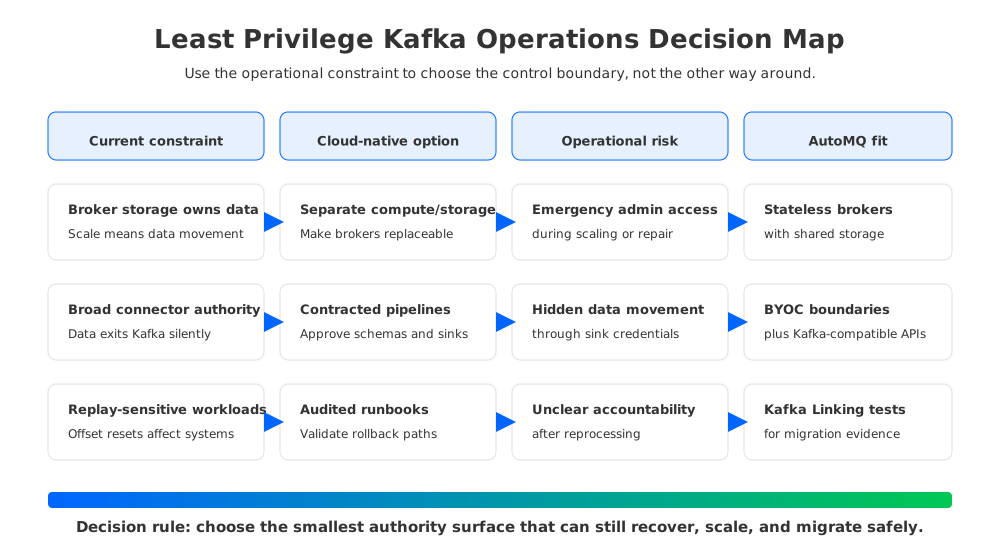
| Evaluation area | What to test | Why it matters for least privilege |
|---|---|---|
| Kafka compatibility | Client behavior, Consumer groups, Offset handling, transactions, Connect, and tooling | Migration risk rises when least-privilege controls require application rewrites. |
| Administrative scope | Who can create Topics, alter configs, reset Offsets, deploy connectors, and change ACLs | Broad admin roles are often a symptom of missing platform boundaries. |
| Infrastructure scope | Which roles can touch VPCs, endpoints, object storage, keys, and compute | Kafka operations should not require uncontrolled cloud-admin permissions. |
| Cost and elasticity | What happens during scale-out, scale-in, retention growth, and replay | Capacity work should not force emergency privilege expansion. |
| Evidence and rollback | Audit logs, change records, migration state, and recovery checkpoints | Least privilege is easier to defend when every exception is visible and reversible. |
The matrix usually reveals the same pattern: teams fail least privilege when the operational workflow crosses too many ownership layers at once.
4Evaluation checklist for platform teams
The checklist below turns that pattern into a practical review for security, governance, and application owners.
-
Draw the authority boundary before reviewing features. Mark where the control plane runs, where the data plane runs, where Kafka records are stored, where metrics and logs go, and which identities can cross each boundary. AWS IAM guidance recommends granting only the permissions required for a task; Kafka platform design should apply the same idea to Topics, Consumer groups, connectors, and infrastructure roles.
-
Separate application ownership from platform ownership. Application teams should manage Topic-level access, data contracts, quotas, and connector approvals without inheriting broker-level or cloud-infrastructure permissions. Platform teams should scale and repair the service without unnecessary access to application payloads.
-
Treat Offset and transaction operations as sensitive actions. Resetting a Consumer group can replay data into downstream systems, and transactional writes can affect correctness across multiple Partitions. These actions need explicit approval, logging, and rollback planning.
-
Review pipeline exits, not only Kafka entry points. Kafka Connect, sink credentials, dead-letter queues, schema changes, and table integrations can move data into systems with different controls. A least-privilege model that protects Topic reads but ignores connector deployment is incomplete.
-
Test scale and recovery under the production permission model. A design that needs elevated human access during every rebalance or broker replacement will not remain least privilege for long. Run failure, scale, and migration scenarios with the intended roles.
This is where cost and governance meet. If a cluster keeps large amounts of idle broker-local capacity to avoid risky scale events, the permission model becomes a capacity planning workaround. If every burst requires urgent infrastructure changes, least privilege depends on people staying calm during a page. That is not a control; it is hope with an audit trail.
5How AutoMQ changes the operating model
Once the evaluation framework is clear, AutoMQ becomes relevant as an architectural option rather than a generic Kafka replacement. AutoMQ is a Kafka-compatible streaming platform built around Shared Storage architecture: it keeps the Kafka protocol and ecosystem surface while moving durable stream storage into S3-compatible object storage through S3Stream. AutoMQ Brokers are stateless brokers; WAL (Write-Ahead Log) storage handles durable write buffering, while object storage becomes the main data repository.
The least-privilege implication is that broker operations can be less entangled with durable data ownership. In a Shared Nothing Kafka cluster, broker scaling and replacement are tied to local log placement. In AutoMQ, the durable data path is object-storage-backed, so scaling compute capacity does not require the same broker-local data migration. Partition ownership, traffic routing, and cache behavior still matter, but the operational unit changes from "move data between disks" to "coordinate compute, metadata, and shared storage access."
That shift matters for platform boundaries. In AutoMQ BYOC, the control plane and data plane run in the customer's cloud account and VPC, and the customer-owned storage layer holds the data. In AutoMQ Software, the same boundary can be kept inside a private environment. For a security team, the question is whether cloud roles, object storage policies, encryption keys, private networking, Kafka ACLs, schema and data contract review, and observability exports can be reviewed as customer-controlled surfaces.
AutoMQ also changes how teams should test migration risk. Because it is Kafka-compatible, the proof of concept should focus on whether the governance model survives the move: client compatibility, Consumer group continuity, Offset expectations, transactions, connectors, quotas, monitoring, and rollback. Kafka Linking can be part of that review when teams need migration paths that preserve message bytes and Consumer progress, but it should be tested with production security controls.
The right conclusion is not that every regulated Kafka workload needs the same platform. Some teams may prefer a managed service boundary. Some may prefer self-managed Kafka because they already have the operating discipline. AutoMQ fits teams that want Kafka semantics, customer-controlled deployment boundaries, object-storage-backed durability, stateless brokers, and a clearer map between operational authority and infrastructure ownership.
6A practical readiness scorecard
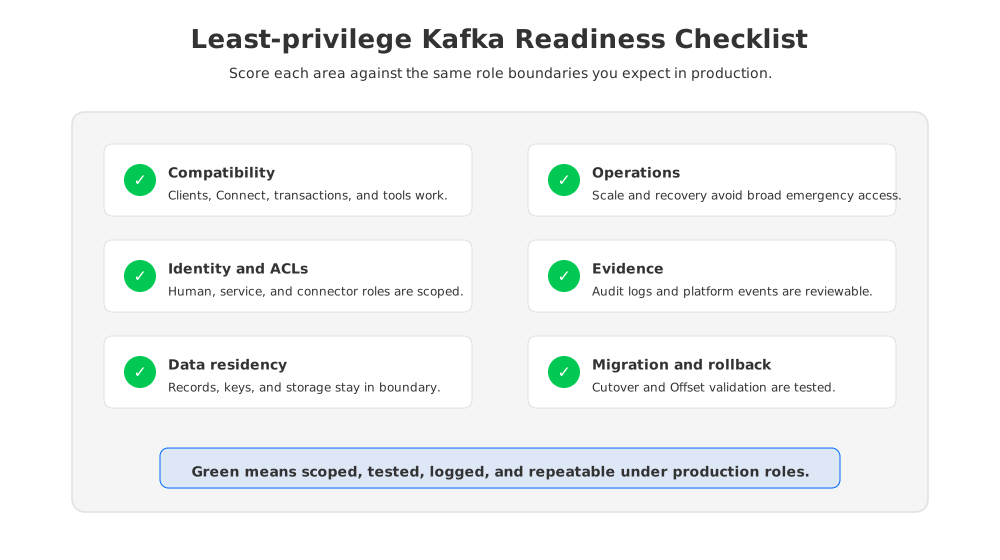
Before choosing a platform, give each area a red, yellow, or green score. Red means the control is missing or works only through a broad admin role. Yellow means it needs manual exception handling. Green means it is scoped, tested, logged, and repeatable.
| Readiness area | Green looks like this |
|---|---|
| Compatibility | Existing clients, Connect jobs, Consumer groups, transactions, and monitoring tools work without redesign. |
| Identity and ACLs | Human, service, connector, and automation identities have separate scoped permissions. |
| Data residency | Kafka records, object storage, keys, and private network paths stay inside the approved boundary. |
| Operations | Scaling, replacement, recovery, and retention changes do not require broad emergency access. |
| Evidence | Cloud audit logs, Kafka ACL changes, connector deployment events, and platform operations are reviewable. |
| Migration and rollback | Cutover, Offset validation, and rollback are tested before production traffic moves. |
If red items cluster around Kafka resource policy, improve the ACL and governance workflow first. If they cluster around network, storage, and cloud roles, review the deployment boundary. If they cluster around scaling and recovery, review the architecture. Least privilege is strongest when those layers support each other rather than forcing a choice between security and operability.
For teams evaluating a Kafka-compatible shared-storage model, the next step is a proof of concept that uses real ownership boundaries, not a convenience lab setup. Start with workloads that create exception requests: high-retention Topics, regulated pipelines, connector-heavy domains, bursty traffic, or Consumer groups that need careful Offset control. Then test whether each team can do its job without borrowing someone else's authority. To explore AutoMQ in that context, start here: evaluate AutoMQ for a governed Kafka-compatible deployment.
7FAQ
7.1Is least privilege in Kafka only about ACLs?
No. Kafka ACLs are necessary, but production least privilege also covers Topic ownership, Consumer group operations, Offset resets, transactions, connector deployment, schema and data contract changes, observability access, network boundaries, cloud roles, encryption keys, and recovery workflows.
7.2Does Shared Storage architecture remove the need for Kafka governance?
No. Shared Storage architecture changes the operating model by reducing the dependency between broker-local storage and durable data, but teams still need identity, ACLs, data contracts, audit logs, connector controls, and migration validation.
7.3When should a team evaluate AutoMQ for least-privilege Kafka operations?
Evaluate AutoMQ when Kafka compatibility matters, but the current operating model forces broad permissions during scaling, recovery, retention growth, or migration. It is especially relevant when the team wants customer-controlled deployment boundaries through AutoMQ BYOC or AutoMQ Software.
7.4What should be tested first in a proof of concept?
Start with client compatibility, Consumer group behavior, Offset-sensitive workloads, transactions, connector deployment, private networking, object storage policies, encryption, observability, scale-out, broker replacement, and rollback. Use the same role boundaries expected in production.


