
Table of Contents
Table of Contents
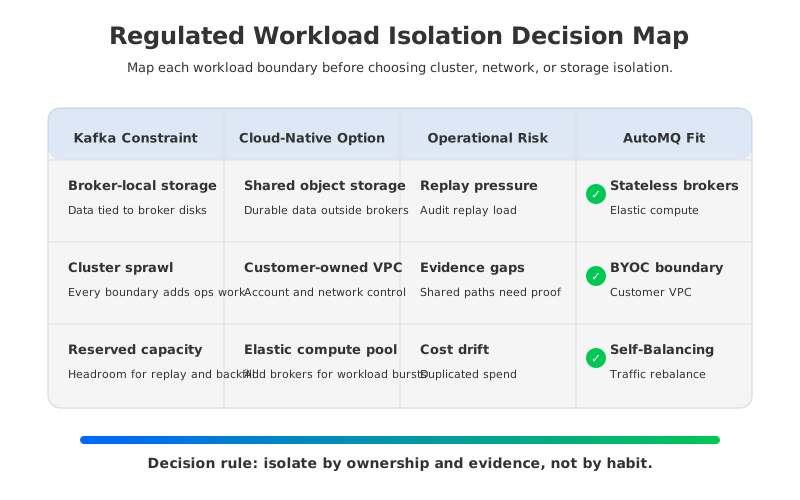
Teams search for regulated workload isolation kafka when a shared streaming platform stops being a neutral utility. A payments team wants replay access that should not expose customer data to analytics users. A fraud model needs enrichment without weakening residency rules. A compliance reviewer asks whether a topic, consumer group, connector, key policy, and storage boundary all belong to the same approved control domain.
Kafka can separate topics. The harder question is whether the platform can prove where ownership starts and ends while traffic is live, partitions move, and consumers replay. Regulated workload isolation makes those boundaries operational: who owns the data, who operates the platform, who can recover it, who can inspect evidence, and which infrastructure boundary contains the blast radius.
1Why Teams Search for regulated workload isolation kafka
Kafka gives platform teams strong primitives. Authentication and authorization control access. Topics and partitions separate streams. Consumer groups coordinate processing and commit offsets. Transactions support atomic writes across partitions, and Kafka Connect gives integrations a consistent runtime. These are building blocks, not a complete isolation model.
The gap appears when different owners share one cluster but carry different regulatory obligations. A data science workload may consume pseudonymized events but not raw payment records. An audit workload may need long replay windows. A regional workload may be restricted to a specific cloud account, Virtual Private Cloud (VPC), or Region. These differences shape storage, networking, observability, cost allocation, and incident response.
That is why a useful isolation review begins with ownership boundaries, not product features:
- Data ownership: Which team owns the schema, contract, retention rule, and privacy classification for each event stream?
- Runtime ownership: Which team operates brokers, connectors, consumer groups, and policy enforcement jobs when a workload is under review?
- Infrastructure ownership: Which cloud account, VPC, Region, key policy, and object storage bucket form the approved boundary?
- Evidence ownership: Which logs, metrics, offsets, policy versions, and access records can be shown during an audit without exposing more data?
- Recovery ownership: Which team can pause, replay, quarantine, or roll back a workload, and under what approval path?
The list looks organizational, but every item turns into architecture. A vague owner model becomes vague ACLs, unclear topic naming, shared connectors, mixed retention, broad support permissions, and recovery runbooks that depend on whoever knows the cluster best.
2The Production Constraint Behind the Problem
Traditional Kafka uses a Shared Nothing architecture: each broker owns local storage for its assigned partition replicas, and replication across brokers provides durability. This design is mature, but it couples data placement, compute capacity, and recovery scope. When workloads carry different compliance boundaries, the coupling starts to leak into operations.
Consider a regulated workload that needs a dedicated cluster to keep raw data away from broad platform access. The boundary is clear, but it adds capacity planning, replication, patching, monitoring, network endpoints, and storage reservations. If the same workload needs long retention, broker-local disks must be sized for it, or the team has to introduce Tiered Storage while still keeping recent data on local disks.
Shared clusters have the opposite shape. They reduce infrastructure count, but the isolation boundary moves into topic naming, ACL design, quotas, connector tenancy, encryption keys, network routes, and observability filters. During an incident, the question shifts from "which cluster contains this workload?" to "which subset of shared resources represented the approved boundary?"
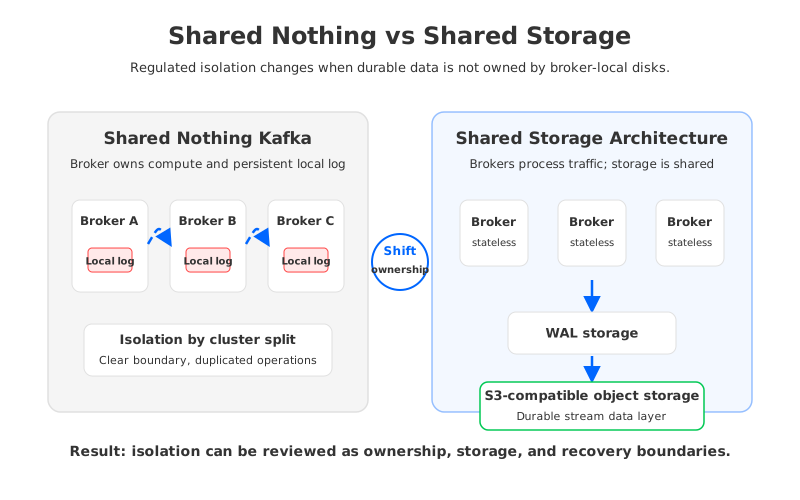
This is the production constraint: isolation is expensive when implemented only by duplicating clusters, and risky when implemented only by logical conventions. Broker-local storage intensifies the trade-off because storage growth, scaling, recovery, and data movement remain tied to broker ownership.
Security teams see the control failure. SRE teams see the operational failure. Data governance teams see the contract failure. Application teams see the migration burden. A regulated streaming platform has to make all four visible in one model.
3Architecture Options and Trade-Offs
There is no single correct isolation pattern for Kafka. The right pattern depends on data class, workload volatility, audit depth, recovery target, and team maturity. A useful evaluation compares what each boundary isolates and what it makes harder.
| Option | What it isolates well | What it makes harder |
|---|---|---|
| Dedicated Kafka cluster | Strong blast-radius, network, and administrative separation | Higher operations load, duplicated capacity, separate upgrades, and cross-cluster data movement |
| Shared cluster with strict topic and ACL model | Efficient infrastructure use and centralized governance | Evidence depends on consistent naming, IAM, quotas, connector isolation, and audit discipline |
| Dedicated connector or processing pool | Source/sink policy, masking, enrichment, and team ownership | Runtime becomes another regulated boundary that needs patching, metrics, and rollback |
| Separate cloud account, VPC, or Region | Infrastructure ownership, residency, key control, and network containment | More routing work, more deployment automation, and more cross-boundary integration planning |
| Shared storage with stateless brokers | Elastic compute and clearer separation between broker capacity and durable data | Requires careful review of object storage permissions, WAL type, metadata, and observability |
The table exposes a pattern feature comparisons often hide. Regulated isolation is not maximum separation. Too many clusters, connectors, and replication paths can make the audit surface larger. The better goal is controlled separation: strong boundaries where risk requires them, shared services where evidence remains clear, and migration paths that do not force every application team to relearn Kafka.
Compatibility has to stay in the frame. Teams that depend on Kafka clients, consumer groups, offsets, transactions, Kafka Connect, and operational tooling cannot treat isolation as a greenfield rebuild. A platform that breaks client assumptions may create a long tail of application changes, offset reconciliation, and rollback risk.
Cost also belongs in the architecture discussion, but not as a vague "lower cost" claim. Isolation changes cost through duplicated broker capacity, retention, cross-Availability Zone (AZ) traffic, private connectivity, connector workers, object storage requests, observability, and support time. Check cloud pricing in the target Region before rollout because network paths often turn a clean governance design into a surprising bill.
4Evaluation Checklist for Platform Teams
Start the review by naming the regulated workload as if it were a product. Give it an owner, a data class, a consumer set, an approved network boundary, a recovery target, and a retention rule. During an incident, that is the fastest way to understand who can act.
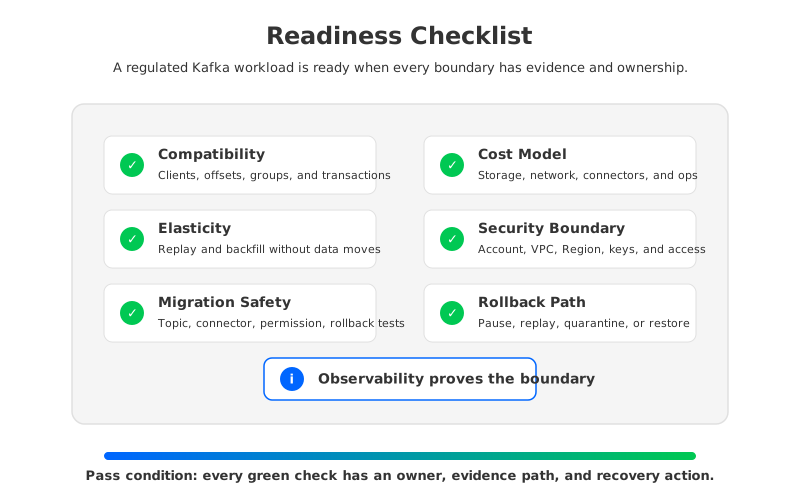
Use this checklist before selecting or changing a Kafka-compatible platform:
- Compatibility: Can existing producers, consumers, consumer groups, offsets, transactions, and Kafka Connect jobs continue with minimal application change?
- Boundary clarity: Can the team draw the boundary across account, VPC, Region, subnet, key policy, storage bucket, topic, connector, and support access?
- Cost model: Has the team estimated broker capacity, retention, object storage requests, cross-AZ traffic, private connectivity, observability, and operations effort?
- Elasticity: Can compute scale during replay, backfill, or policy spikes without turning each burst into broker-local data movement?
- Governance evidence: Can identity, contract version, topic, offset range, retention policy, access change, and operator action be reconstructed later?
- Failure recovery: Can the workload be paused, failed over, replayed, quarantined, or rolled back without broad access to unrelated teams?
- Migration safety: If the workload moves platforms, can topic data, offsets, permissions, connectors, and rollback criteria be tested before cutover?
The checklist should produce a decision, not a pile of notes. Raw regulated data with strict residency may justify a separate account or VPC. Shared non-sensitive events may work with logical isolation, stronger contracts, and better observability. If replay and retention dominate the risk, storage architecture may matter more than cluster count.
5How AutoMQ Changes the Operating Model
Once the evaluation reaches storage, elasticity, and deployment ownership, AutoMQ becomes relevant as a Kafka-compatible, cloud-native streaming platform built around Shared Storage architecture. AutoMQ keeps Kafka protocol compatibility while replacing broker-local durable log storage with S3Stream, which uses WAL storage and S3-compatible object storage for stream durability.
Shared Storage architecture does not replace governance. Teams still need data contracts, ACLs, identity policies, connector controls, encryption choices, audit logs, and runbooks. The shift is that durable stream data is no longer primarily owned by the broker's local disk. Brokers become stateless from the perspective of persistent stream data, while object storage becomes the durable data layer and WAL storage supports the write path.
That changes regulated workload isolation in three practical ways. First, scaling compute is less entangled with moving persistent partition data between brokers. Second, long retention and audit replay can be evaluated against an object-storage-backed data model rather than broker disk sizing alone. Third, recovery and partition reassignment can be framed around metadata, leadership, cache, and ownership changes instead of bulk data movement.
Deployment boundaries matter equally. AutoMQ BYOC deploys the control plane and data plane inside the customer's cloud account and VPC, while AutoMQ Software is designed for customer-operated private environments. For compliance teams, that means infrastructure ownership, network isolation, data residency, storage buckets, and IAM policies can be reviewed inside the customer's approved boundary. AutoMQ Cloud acts as the environment management entry point; it is not where customer Kafka records need to live.
AutoMQ also brings platform controls into the discussion. Self-Balancing helps redistribute workload pressure across brokers. Kafka Linking supports migration from Kafka-compatible sources in supported scenarios by preserving topic data and consumer progress relationships. Managed Connector, Schema Registry, Table Topic, and observability features matter because connectors, schemas, data lake outputs, and telemetry often become part of the regulated evidence path.
That framing keeps the product fit honest. AutoMQ is a strong candidate when the isolation problem is dominated by broker-local storage constraints, scaling friction, retention economics, cross-AZ traffic exposure, and customer-controlled deployment boundaries. It is not a shortcut around ownership design.
6Decision Matrix for Regulated Isolation
Use the matrix below to turn the checklist into a platform decision. Rate each row green, yellow, or red for the current and target architecture. Do not average the result; a red item in recovery or evidence can block rollout even if cost looks attractive.
| Decision area | Green signal | Red signal |
|---|---|---|
| Ownership model | Data, runtime, infrastructure, evidence, and recovery owners are named | The Kafka platform team owns every exception by default |
| Storage boundary | Retention and replay map to approved storage and key policies | Audit replay depends on broker disk headroom or ad hoc exports |
| Runtime isolation | Spikes are throttled, observable, and isolated from unrelated workloads | Backfill or replay can starve production consumers |
| Network boundary | VPC, subnet, AZ, private connectivity, and Region choices are documented | Data or support paths cross unreviewed networks |
| Migration path | Offsets, clients, connectors, and rollback are tested before cutover | Platform migration and governance redesign happen in one step |
| Evidence path | Identity, topic, offset, policy, storage, and operator action can be reconstructed | The team can show dashboards but not reconstruct a decision |
The strongest regulated Kafka architecture is rarely the one with the most isolated boxes. It is the one where each boundary has a reason, an owner, a recovery path, and a cost model. Without that ownership, isolation is only a diagram.
If every regulated workload feels like a new cluster, capacity reservation, or audit exception, start with one workload and map its real boundary. Then evaluate whether a Kafka-compatible Shared Storage architecture can reduce the operational weight without weakening control. To test that model with AutoMQ, start from the AutoMQ Cloud entry point and bring one workload, one replay scenario, and one audit question.
7FAQ
7.1Is regulated workload isolation the same as multi-tenancy?
No. Multi-tenancy is about sharing platform resources across teams or applications. Regulated workload isolation is about proving that a workload's data, runtime, infrastructure, evidence, and recovery boundaries match its compliance obligations. A multi-tenant Kafka platform can support regulated isolation, but only if ownership and audit paths are explicit.
7.2Should regulated workloads always run on dedicated Kafka clusters?
Not always. Dedicated clusters provide strong blast-radius and administrative separation, but they also increase operations, cost, and migration surfaces. Some workloads are better served by shared clusters with strict ACLs, quotas, connector boundaries, storage policies, and audit evidence. The choice depends on the data class, residency requirement, recovery target, and operational risk.
7.3How does Shared Storage architecture help isolation?
Shared Storage architecture separates durable stream data from broker-local disks. That can make scaling, reassignment, replay, and retention easier to reason about because compute changes are less tied to moving persistent partition data. It does not replace identity, policy, encryption, or audit controls.
7.4What Kafka concepts matter most during an isolation review?
Review topic ownership, partition placement, consumer groups, committed offsets, transactions, retention settings, connector boundaries, authentication, authorization, and operational metadata. These concepts define how data enters the platform, who consumes it, how progress is tracked, and how evidence can be reconstructed.
7.5How should teams approach migration for regulated Kafka workloads?
Treat migration as a controlled evidence project. Validate client compatibility, topic mappings, offsets, connector behavior, permissions, observability, rollback criteria, and retention before cutover. Avoid redesigning governance controls and moving platforms in the same untested step.


