
Table of Contents
Table of Contents
A team searching for stream governance operating model kafka is usually past the point of debating whether event streaming matters. The harder question is ownership: who can create topics, change schemas, replay retained data, approve connectors, and explain the system during an audit? Kafka makes this question sharp because the same platform serves application integration, analytics, AI features, security telemetry, and operational recovery. When those uses share topics and infrastructure, governance becomes a production control system rather than a documentation exercise.
The uncomfortable part is that Kafka governance often starts in the wrong layer. Teams write topic naming rules, ACL conventions, schema review steps, and retention policies, then discover that the operating model is still dominated by broker storage, partition movement, capacity reservations, migration risk, and cloud network paths. The governance policy says who owns the stream, but the platform architecture decides how hard that ownership is to operate under load.
The useful question is not "How do we govern Kafka?" It is narrower and more practical: can the platform preserve Kafka behavior while making ownership boundaries clear across compatibility, cost, scaling, data residency, migration, and audit evidence?
1Why Teams Search for stream governance operating model kafka
Governance becomes visible when the first shared stream turns into a dependency for multiple teams. Producers own event meaning, consumers own downstream behavior, platform engineering owns availability, security owns access review, and compliance owns evidence. The conflict starts when one change crosses those responsibilities.
A schema change might be compatible at the serialization layer but still unsafe because a field changes meaning, contains sensitive data, or breaks a fraud model trained on the old event. A connector change has the same shape: approved as an integration, yet risky if it writes to a system in a different account or region. Governance is not one approval gate; it is a chain of runtime and operational controls.
Kafka adds another layer because its core semantics are durable and replayable. Consumer groups commit offsets, producers may rely on idempotence or transactions, and retained topics can become the recovery source for downstream systems. The Apache Kafka documentation is the right baseline for these mechanics, including Consumer groups, offsets, transactions, Kafka Connect, KRaft, and Tiered Storage. A stream governance operating model has to respect those semantics instead of treating Kafka as a generic queue.
Name the owners of these objects before choosing a tooling stack:
- Stream contract ownership: who defines event structure, semantic meaning, compatibility rules, privacy classification, and deprecation windows.
- Runtime ownership: who controls producers, consumers, Consumer groups, Kafka Connect workers, credentials, and replay authorization.
- Platform ownership: who owns broker capacity, partition placement, storage, network paths, observability, upgrades, and incident response.
- Boundary ownership: who controls cloud accounts, VPCs (Virtual Private Clouds), regions, object storage, encryption keys, private connectivity, support access, and audit retention.
If those owners cannot make a decision without waiting for hidden data movement or capacity work, the operating model is coordinated by meetings.
2The Production Constraint Behind the Problem
Traditional Kafka uses a Shared Nothing architecture. Each Broker manages local storage, each Partition has a leader, and durability is achieved through replication to followers in the ISR (In-Sync Replicas). This design is proven and still a strong fit for teams with mature Kafka operations. The trade-off is that data ownership and compute ownership are tightly coupled at the broker layer.
That coupling changes the meaning of governance. A policy might say that a regulated topic must stay in one region, but the platform still has to prove where replicas live, how retention is stored, how reassignment behaves, and which network paths carry recovery traffic. A policy might say that application teams own topics, but the platform team still owns the expensive part of every high-retention decision: disk sizing, replication load, broker replacement, and capacity headroom.
Capacity planning is where the mismatch becomes obvious. Governance teams want fewer exceptions, clearer replay rights, stronger evidence, and better change control. Platform teams often respond by pre-allocating disk, slowing topic onboarding, limiting retention, scheduling reassignment windows, and requiring manual review before large replay jobs. Those controls reduce risk, but they also turn the Kafka team into the bottleneck for data product delivery.
Cloud deployment adds cost and network ambiguity. Cross-AZ traffic, private endpoint charges, object storage requests, observability export, and migration traffic may be priced separately by the cloud provider. AWS, for example, publishes distinct pages for data transfer and PrivateLink. A production review should map which operational paths create which charges and who approves them.
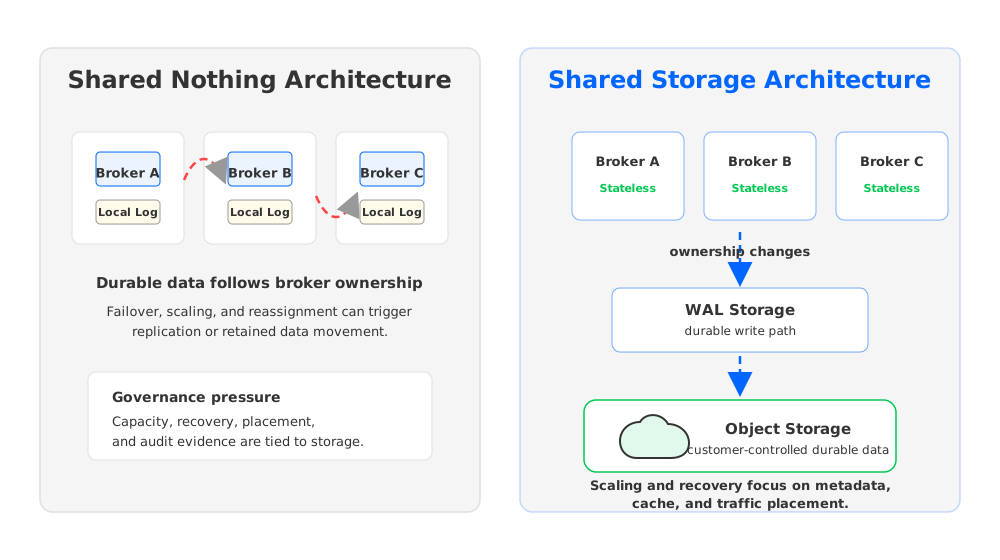
The production constraint is therefore bigger than schema governance. Shared ownership only works when the architecture lets teams separate "who owns the stream" from "who has to move the bytes every time the platform changes shape."
3Architecture Options and Trade-offs
Most teams compare three operating patterns. Self-managed Kafka gives the clearest infrastructure ownership: instances, storage, network, credentials, upgrades, and incident procedures. That model is attractive for strict environments, but it also makes the Kafka team responsible for every broker-local storage consequence.
Managed Kafka changes the labor model. It can reduce broker administration and simplify routine upgrades. The governance review still has to ask where the data plane runs, who owns storage, how support access works, which telemetry leaves the customer boundary, and what happens during migration or exit. "Managed" is not a governance boundary by itself.
The third pattern is Kafka-compatible streaming with Shared Storage architecture. Durable stream data is placed in shared object storage while brokers act more like compute nodes. The platform still needs authentication, authorization, encryption, observability, schema controls, connector approvals, and migration procedures. The difference is that scaling, replacement, and reassignment can be evaluated less as retained-log relocation projects and more as ownership, metadata, cache, and traffic-placement operations.
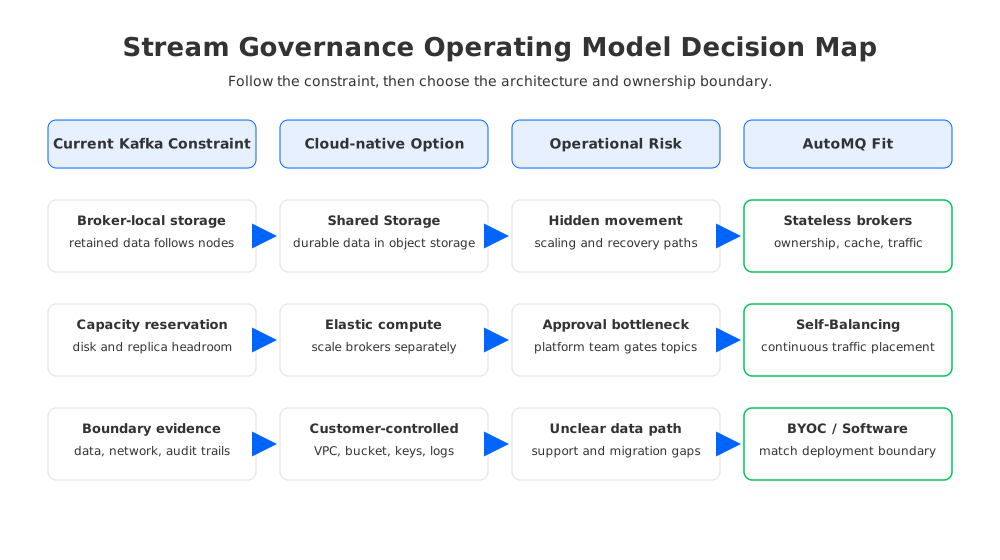
The comparison should stay neutral until the team has evidence. A useful decision map asks four questions: What constraint is hurting us now? Which architecture changes that constraint? What operational risk remains? Which platform pattern fits the ownership boundary?
| Evaluation Area | Governance Question | Evidence to Request |
|---|---|---|
| Kafka compatibility | Will existing clients, Consumer groups, offsets, transactions, and Connect jobs behave as expected? | Client matrix, protocol behavior, admin API coverage, and representative workload tests. |
| Cost boundary | Which costs are created by retained data, broker capacity, cross-AZ traffic, private connectivity, object requests, and migration? | Cloud pricing inputs by region, workload assumptions, and path-level cost model. |
| Elasticity | Does scaling require moving retained data or changing ownership metadata and traffic placement? | Failure drill, scale-out test, scale-in test, and reassignment evidence. |
| Governance control | Where are schema rules, data contracts, ACLs, connector approvals, replay rights, and audit logs enforced? | Approval workflow, runtime enforcement points, logs, and evidence retention policy. |
| Migration risk | Can the team cut over, preserve offsets, observe lag, and roll back? | Topic mapping, dual-run plan, offset validation, rollback checkpoint, and traffic boundary map. |
The matrix prevents a common mistake: evaluating governance as if it were a catalog problem. Catalogs help people find streams, but production governance depends on what happens when streams change, brokers fail, consumers replay, and teams migrate.
4Evaluation Checklist for Platform Teams
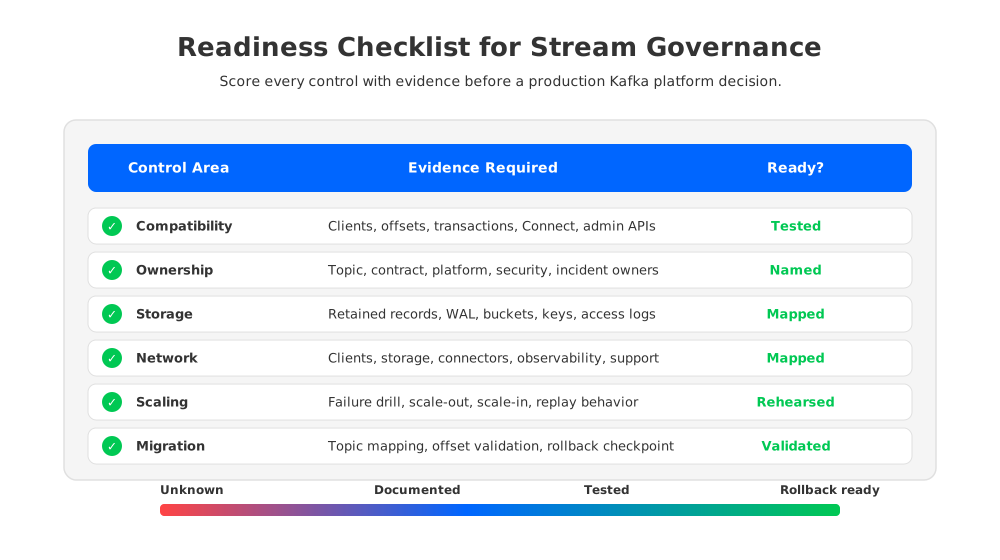
Start with a responsibility model. Write down which team owns each decision and which system enforces it. A decision with an owner but no enforcement point is a guideline. An enforcement point without an owner becomes an incident during the first exception.
Then test the model against operational events. Kafka platforms keep changing: topics grow, consumers lag, connectors are added, regions are reviewed, and brokers are replaced. The checklist treats governance as decisions that must survive normal platform motion.
- Compatibility: Test producer and consumer versions, Consumer group behavior, offset commits, idempotent writes, transactions where used, Kafka Connect jobs, schema workflows, and admin tooling.
- Ownership: Assign topic owners, contract owners, platform owners, security approvers, data stewards, and incident commanders. Avoid shared inbox ownership for production streams.
- Storage: Identify retained records, WAL storage, object storage buckets, backup paths, encryption keys, object access logs, and data residency controls.
- Network: Map client-to-broker, broker-to-storage, connector-to-system, observability, control, migration, and support paths. Include DNS, private endpoints, firewall rules, and region placement.
- Scaling and recovery: Rehearse broker failure, traffic bursts, scale-out, scale-in, cold replay, and partition movement. Record which operations move data and which change metadata or ownership.
- Migration and rollback: Validate topic mapping, offset continuity, cutover sequencing, producer behavior, consumer recovery, replay limits, and rollback checkpoints.
- Auditability: Confirm that logs, metrics, traces, schema approvals, ACL changes, connector changes, and support workflows produce evidence without exposing business records outside the approved boundary.
Score each item with evidence: unknown, documented, tested in a non-production environment, and tested with production-like traffic plus rollback. Any "unknown" in compatibility, storage ownership, migration, or auditability should block a production decision.
5How AutoMQ Changes the Operating Model
After the neutral evaluation is complete, AutoMQ becomes relevant when the blocker is not Kafka semantics but the operating model created by broker-local durable storage. AutoMQ is a Kafka-compatible streaming platform that uses a Shared Storage architecture. It keeps Kafka-facing APIs while replacing broker-local log storage with S3Stream-backed storage on S3-compatible object storage.
This changes the ownership conversation. In traditional Kafka, a Broker is both compute and local owner of durable log data. In AutoMQ, stateless brokers handle Kafka-facing compute, request routing, cache, and scheduling, while durable data is stored in shared object storage. The WAL (Write-Ahead Log) storage layer provides the write durability path before data is uploaded to object storage. The result is a cleaner separation between stream ownership and broker lifecycle work.
For platform owners, that separation matters during scaling and recovery. Broker replacement, scale events, and partition reassignment can be reviewed as metadata, ownership, and traffic-placement changes rather than retained-data movement projects. AutoMQ documents stateless brokers, seconds-level partition reassignment, and Self-Balancing for this reason.
Deployment boundaries also become part of the governance model. AutoMQ BYOC is designed for customer-controlled cloud environments, while AutoMQ Software targets private data center deployments. In a regulated review, teams can evaluate cloud account ownership, VPC placement, object storage buckets, keys, service accounts, observability export, and support access as part of their own boundary. The product does not eliminate schema governance, data contracts, ACL review, connector approval, or audit retention; it gives those controls an architecture where durable stream data is not tied to a broker disk.
Migration still deserves a separate gate. Teams moving from an existing Kafka estate should test topic behavior, Consumer group recovery, offset continuity, producer cutover, connector behavior, and rollback evidence. AutoMQ documents Kafka Linking as a migration path for AutoMQ environments, but production teams should validate migration traffic inside the same network and audit boundary used for steady-state operations.
6Decision Scorecard
The final decision should be readable by platform engineering, security, compliance, application teams, and finance. If the review stays at "Kafka-compatible" or "private networking enabled," it is too shallow. If it turns into every broker configuration, it loses the ownership question.
Use the scorecard below to keep the decision grounded:
| Requirement | Strong Signal | Weak Signal |
|---|---|---|
| Ownership boundaries | Each stream, contract, platform path, and evidence artifact has an accountable owner. | Ownership is spread across tickets, wiki pages, and tribal knowledge. |
| Architecture fit | The platform reduces the operational work that conflicts with governance boundaries. | Governance depends on manual exceptions during scaling, recovery, or migration. |
| Cost visibility | Cost is modeled by compute, storage, network path, object requests, observability, and migration. | Cost is discussed as a single monthly number without path-level assumptions. |
| Data control | Storage, keys, network, logs, metrics, and support workflows match the approved boundary. | Private connectivity exists, but storage and operational evidence are unclear. |
| Migration confidence | Cutover, offset validation, lag observation, and rollback are rehearsed. | Migration is treated as a one-way project plan. |
The search for stream governance operating model kafka begins with governance language, but it ends with architecture evidence. A governed stream is a production path whose data, cost, failure behavior, migration plan, and audit evidence can be explained under pressure. If broker-local storage is the main source of boundary complexity, use the checklist above against a representative workload and evaluate AutoMQ as a Kafka-compatible Shared Storage architecture option. Start with the AutoMQ BYOC path and test the boundaries that matter in your environment.
7FAQ
7.1What is a stream governance operating model for Kafka?
A stream governance operating model defines who owns event contracts, topic lifecycle, access, replay rights, connector changes, platform operations, data residency, and audit evidence for Kafka or Kafka-compatible streaming systems. It turns governance from a policy document into production decisions with owners and enforcement points.
7.2Are Kafka data contracts enough for streaming governance?
No. Kafka data contracts are important because they define event structure, compatibility, meaning, and ownership expectations. Production governance also needs runtime access control, schema approval, connector policy, storage ownership, observability, replay authorization, migration planning, and incident evidence.
7.3How does Shared Storage architecture affect governance?
Shared Storage architecture can separate durable stream data from broker-local disks. That can make scaling, broker replacement, and reassignment easier to govern because those events do not have to be treated as large local-data movement projects. Teams still need to validate identity, encryption, object storage policy, WAL behavior, and audit logging.
7.4When should AutoMQ enter the evaluation?
AutoMQ should enter after the team defines neutral requirements for compatibility, cost, elasticity, governance, recovery, migration, and deployment boundaries. It is most relevant when the team wants Kafka compatibility but sees broker-local storage, capacity reservation, slow reassignment, or data-boundary review as the source of operating-model friction.


