
Table of Contents
Table of Contents
An Apache Kafka® renewal often arrives as a pricing exercise: confirm the committed spend, accept the forecast, and get the signature before the current term ends. A Kafka contract renewal also creates a rare review window, when your usage history, architecture assumptions, and exit rights are all open for review at the same time. That window is where the most useful work should happen.
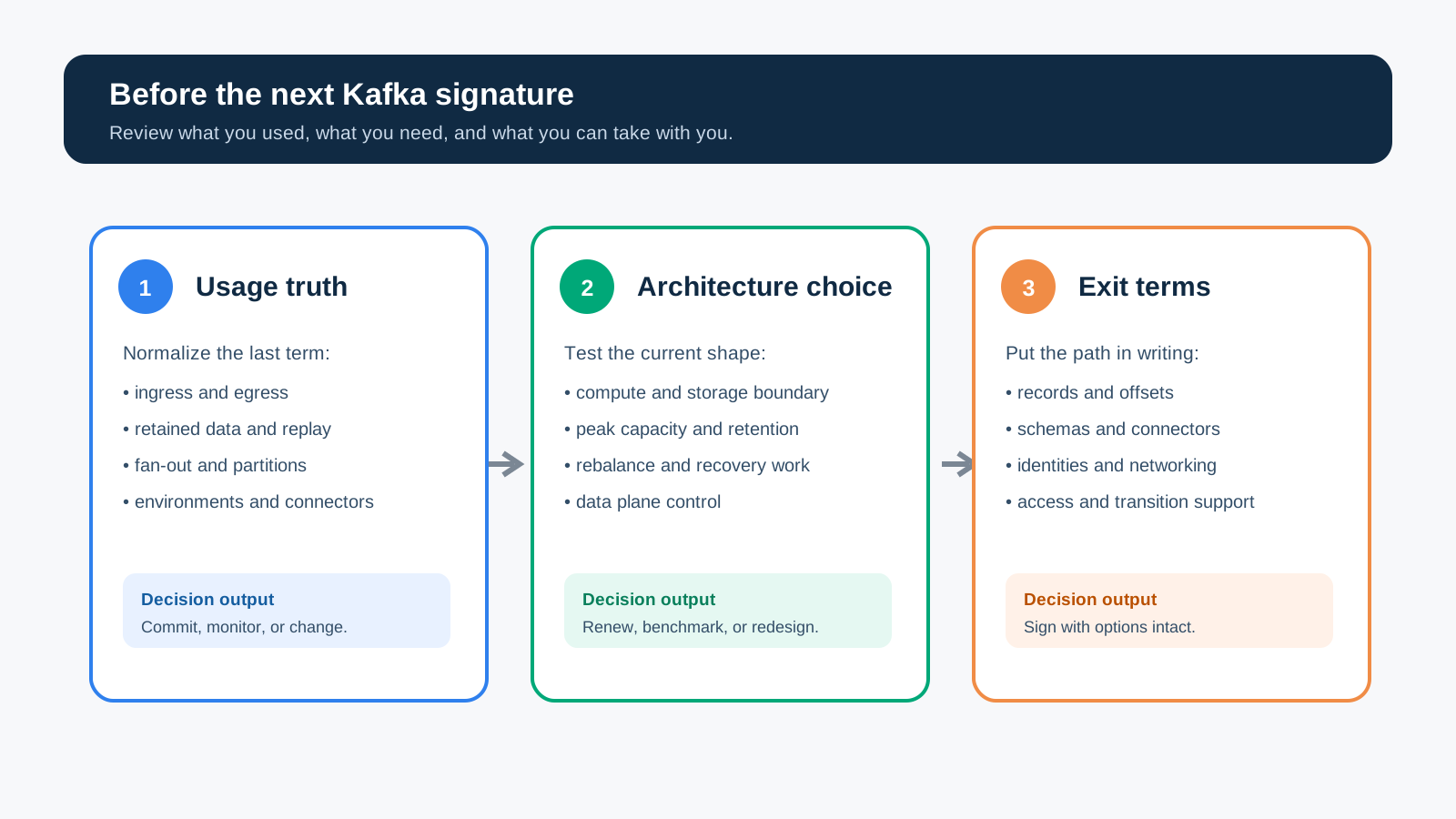
The question is not whether the current provider has delivered value. It is whether the next contract still matches what your platform actually consumes and what your team needs to control. Review the decision in three passes: usage truth, architecture choice, and exit terms. Then take a fact-based proposal into the negotiation instead of asking for a discount against an unexamined forecast.
1Renewal is a scarce bargaining window
Once a multi-year deal is signed, the buyer's options narrow. A commitment can shape which environments stay on the platform, how quickly a team can test another architecture, and whether an underused service remains in the budget because leaving would waste the commitment. That does not make a long contract wrong. It makes the assumptions inside it worth examining before they become obligations.
Start by separating three things that are often mixed together in renewal calls:
- What the platform consumed. The invoice, usage meters, retained data, traffic patterns, and support history describe the last term.
- What the platform still needs. Workload shape, retention, fan-out, availability requirements, and operational boundaries describe the next term.
- What the contract permits. Commitment drawdown, expansion, termination, data return, and transition assistance determine how much choice remains after signing.
A vendor can answer the first set of questions with a quote. Your platform, FinOps, security, and procurement teams need to answer all three before that quote becomes the baseline. The rest of the review is about finding the gaps between them.
2Usage truth: what did we actually consume?
The first renewal question is not “What will next year cost?” It is “Which parts of last year's bill came from durable workload demand, and which came from decisions we can change?” Pull the previous contract year into one worksheet. Use invoices, service usage, cloud network charges, topic and consumer inventories, connector records, retention settings, and incident notes. Keep production, staging, development, and temporary environments separate so a short-lived project does not become a permanent forecast.
Averages are a poor basis for negotiation when the platform is bursty. Record the peak and the shape around it. An ingress spike may drive capacity planning; consumer fan-out may multiply reads; long retention may keep storage growing after traffic settles; private connectivity or inter-region movement may create charges outside the headline service line. The purpose is not to build a more elaborate invoice. It is to show which technical behavior created each commercial meter.
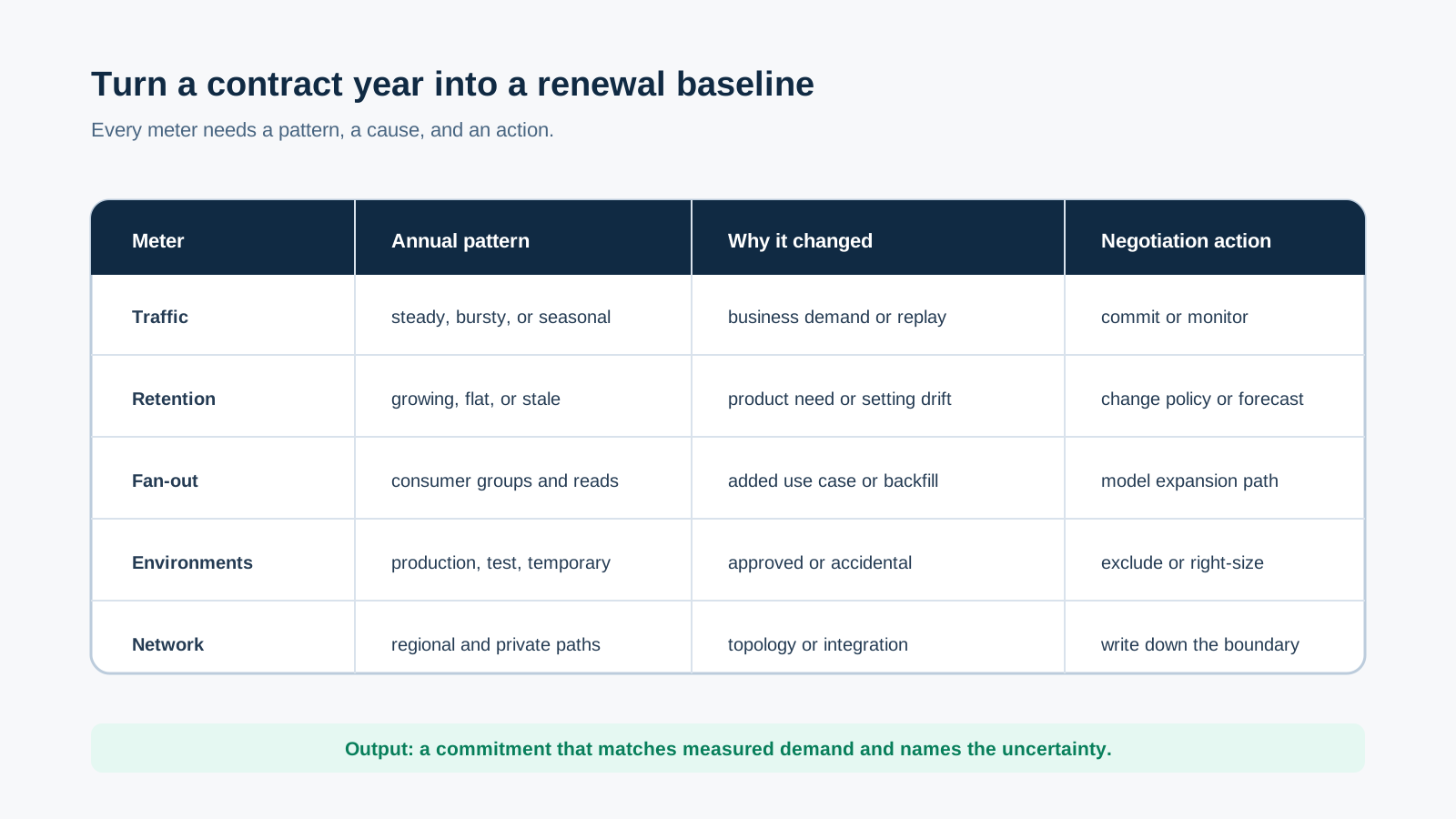
Use a usage card with four columns: the meter, the annual pattern, the reason it changed, and the action it supports. The last two columns matter most. A larger retained dataset caused by a product requirement deserves a growth assumption. A larger dataset caused by stale topics or an overly long retention setting deserves an operating change. Treating both as “growth” hands the provider a forecast that your team has not actually approved.
Ask the provider and your own team these questions:
- Which usage dimensions are included in the proposed commitment, and which remain variable?
- What did each environment consume month by month, and which environments should exist in the next term?
- How much demand came from production traffic, replay, backfill, testing, or connector movement?
- Which retention policies, consumer groups, partitions, and integrations account for the largest changes?
- Which peak conditions must the platform absorb, and which can be handled through scheduling, throttling, or workload redesign?
- What happens to the commercial model if storage grows faster than throughput, or if fan-out grows faster than production traffic?
The output should be an annual baseline with a short explanation beside every material change. It does not need a speculative precision that the data cannot support. It needs enough clarity to let you say, “This is the usage we are willing to commit to, this is the usage we will monitor, and this is the usage we will not prepay.”
That distinction changes the negotiation. Instead of arguing over a provider's forecast, you can ask for a commitment that maps to measured demand, a clear treatment for expansion, and a review point when the workload moves outside the agreed range.
3Architecture choice: do we still need this shape?
Usage tells you what happened. Architecture questions explain why it happened and whether the same cost and operating pattern should continue. A renewal is a poor time to assume that the current platform shape is permanent because the applications are stable.
Review the boundary between compute and storage. In a traditional Kafka deployment, brokers handle client requests while also carrying local durable data and replica movement. A managed service may hide much of that work, but the underlying questions remain: how much capacity must stay provisioned for peaks, how much data must move when brokers change, and how tightly are storage, compute, and fault recovery tied together? If the workload has long retention and uneven traffic, that relationship deserves a direct review.
Do not treat every alternative as a migration project. First classify the decision you are making:
| Question | If the answer is yes | What to investigate |
|---|---|---|
| Is the workload dominated by predictable, steady demand? | A conventional managed service may still fit well | Contract predictability, support, and capacity terms |
| Do storage and retention grow independently of live traffic? | A storage model that scales with retained data deserves comparison | Object storage access pattern, read behavior, recovery, and data controls |
| Do bursts force long periods of reserved capacity? | Separate compute and storage may change the sizing conversation | Elasticity, scaling boundaries, and peak handling |
| Does broker change require data movement or lengthy rebalance work? | The operating cost of the current architecture may be larger than the invoice shows | Reassignment behavior, failure recovery, and migration mechanics |
The key distinction is between adding a remote copy of old data and using shared storage as the primary persistence model. Apache Kafka's Tiered Storage documentation describes a model where older data can be moved out of local storage. A Shared Storage architecture makes storage and broker ownership a different boundary from the start. Those approaches can solve different problems, so the renewal review should state which behavior the workload needs.
Then ask the architecture questions plainly:
- Are brokers sized for durable data placement, request processing, or both?
- What is the team paying in operational effort when partitions are reassigned, nodes are replaced, or demand changes?
- Which workloads need local hot data, and which spend most of their life in retention or replay?
- Can the data plane run inside the cloud boundary your security and networking teams already require?
- Which integrations, schemas, ACLs, observability paths, and client settings depend on provider-specific services?
A useful answer can still be “renew.” The point is to renew because the architecture fits the workload and the operating model, not because nobody had time to test the assumption. If the current design carries costs or constraints that the team would not choose today, the renewal should at least include an evaluation path for a different shape.
4A replacement benchmark makes the review concrete
A neutral architecture review can remain abstract until another platform is measured against the same workload. That is where AutoMQ can serve as a benchmark for teams evaluating a Kafka-compatible, object-storage-centered design. AutoMQ BYOC places the control plane and data plane in the customer's cloud environment, while its Shared Storage architecture separates broker compute from persistent storage. Those are architectural properties to test, not savings claims to assume.
Use the same evidence on both sides. Bring representative producer and consumer behavior, retention settings, replay patterns, connector dependencies, network boundaries, and failure scenarios into the comparison. Check Kafka compatibility at the client and integration layer. Review the migration path before drawing a conclusion about effort.
The benchmark has one job: give procurement a credible reference point and give engineering a way to test the architecture question. If the incumbent remains the right fit, the exercise explains why. If the alternative exposes a different storage, deployment, or operating boundary, the team can decide whether that difference is worth pursuing before signing away the time to investigate it.
5Exit terms: what can we take with us?
Portability is a contract question as much as a technical one. A Kafka protocol can keep applications familiar while the surrounding platform remains difficult to leave. The renewal review should map every dependency that would need to move or be replaced.
Start with the data plane. Identify Topics, Partitions, offsets, timestamps, retention settings, and ordering assumptions. Then map the services around it: Schema Registry, Kafka Connect, stream processing jobs, ACLs, identities, private endpoints, DNS, observability, alerting, and runbooks. A team that can copy records but cannot preserve consumer progress or recreate its security boundary does not yet have a practical exit path.
Ask for written answers to these questions:
- In what format can the organization retrieve retained records and metadata after termination?
- How long does access remain available after the service term ends, and who controls the deletion request?
- Can the team export consumer offsets, schemas, connector configuration, ACLs, and audit history in a usable form?
- Which APIs, replication tools, or migration services can run without a renewal extension?
- What transition assistance, support coverage, and access to technical contacts apply during a move?
- Which provider-specific services need replacement, and can each replacement be tested before the contract is signed?
Treat “the data is yours” as the beginning of the answer. The usable answer includes format, timing, permissions, dependencies, and a runbook. It should also cover rollback. A migration plan that only describes how to leave is incomplete until the team knows how to stop, resume, or return traffic if validation fails.
This is why exit language has value even when the team expects to renew. It turns a future emergency into a present design requirement. A provider that cannot commit to a clear data-return process may still be selected, but the uncertainty belongs in the decision record and the contract risk review.
6The negotiation script for an annual-data review
Bring one page to the call. Put the annual usage baseline at the top, the architecture findings in the middle, and the requested terms at the bottom. The script should make the order of the discussion hard to lose:
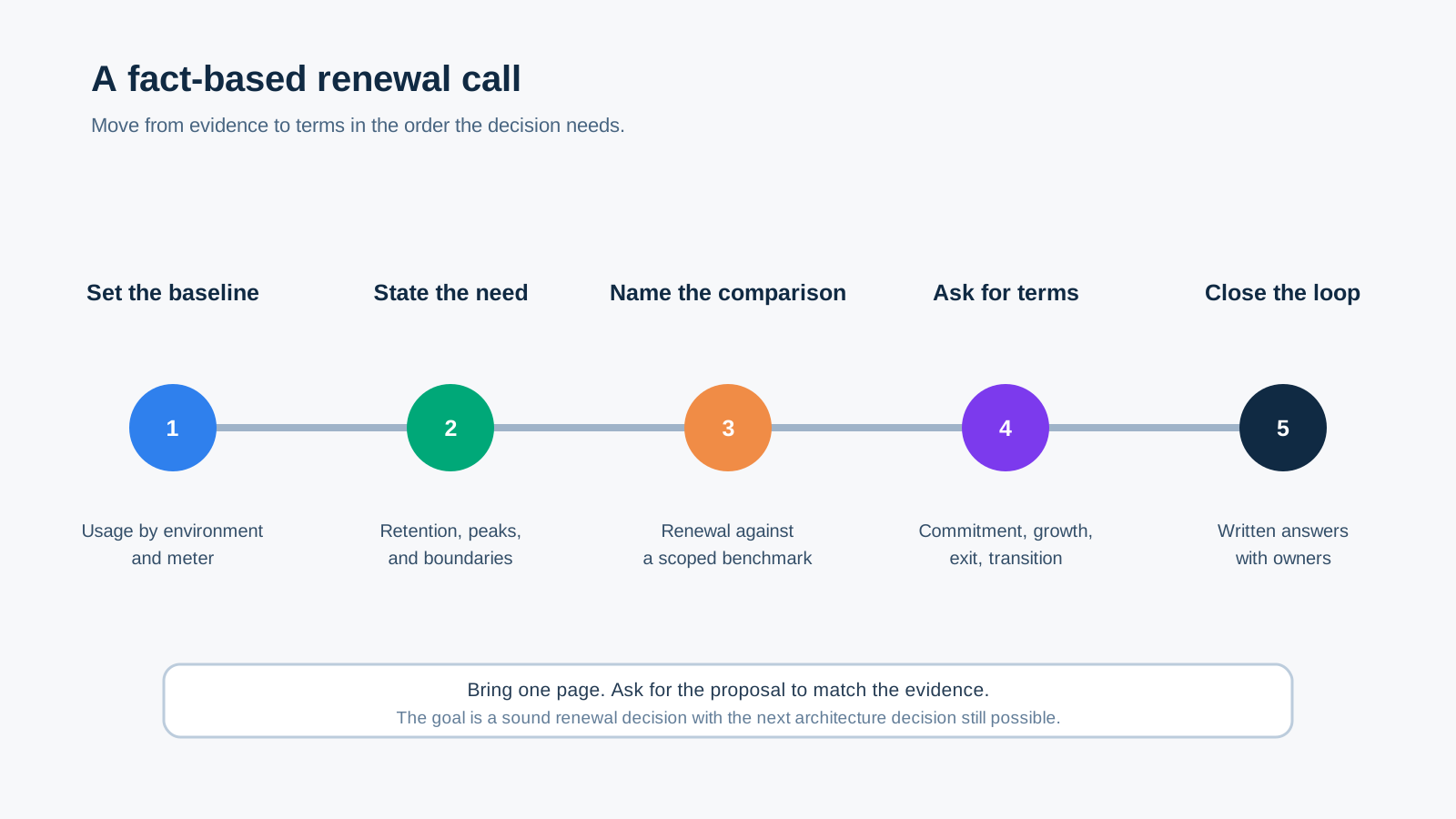
- Set the baseline. “We normalized the previous contract year by environment and usage meter. Here is what was structural, what was temporary, and what we plan to change.”
- State the architecture decision. “The next term needs to account for our retention, peak, data-plane, and operational requirements. Here are the assumptions we are willing to carry forward and the ones we are testing.”
- Name the comparison. “We are comparing renewal against a scoped benchmark and an internal operating option using the same workload evidence. We need the proposal to make those boundaries comparable.”
- Ask for terms that preserve choice. “Please show how the commitment handles expansion, lower usage, environment changes, data return, transition access, and termination.”
- Close the evidence loop. “Put the commercial and technical answers in the order form, service terms, or an attached written response. We will approve the proposal after the open items have owners.”
The script gives the provider a fair chance to compete on the full decision, including support and operational value. It also prevents a lower unit rate from hiding a rigid commitment, an unbounded overage path, or an exit process nobody has tested.
A multi-year term can be reasonable when the workload is understood and the terms match the risk. Ask for a shorter evaluation period, staged commitment, expansion rules, or a scheduled review when the forecast is uncertain. The exact concession depends on your procurement policy and the provider's contract, but the principle is stable: commit to measured demand and keep the next architecture decision possible.
Return to the first worksheet before signing. If the annual usage baseline, architecture choice, and exit terms cannot fit on one decision page, the contract is asking the organization to accept more uncertainty than the price discussion reveals. That is the moment to pause the signature and resolve the missing answers.
If you want a concrete comparison baseline, bring the same workload inventory to an AutoMQ evaluation and test compatibility, data placement, operating boundaries, and migration steps before the renewal deadline becomes the decision maker.
7References
- Apache Kafka documentation
- Apache Kafka Topic and configuration documentation
- AutoMQ architecture overview
- AutoMQ Kafka compatibility
- AutoMQ migration overview
- What a byte actually costs in cloud Kafka
- Kafka client compatibility: what to validate before platform changes
8FAQ
8.1When should a team start a Kafka contract renewal review?
Start when the provider's proposal is still changeable and you can collect the previous contract year's invoices, usage, architecture changes, and exit dependencies. The right date depends on procurement lead time, but the review needs room for a benchmark or migration test if the architecture question remains open.
8.2What should FinOps bring to a Kafka renewal negotiation?
Bring a normalized annual baseline by environment and meter, a record of peaks and retention growth, the cause of material changes, and a forecast that separates committed demand from uncertain demand. This turns a renewal quote into a reviewable model.
8.3Which vendor questions matter most before renewing Kafka?
Ask what the commitment covers, how usage outside the baseline is treated, how expansion and lower usage work, which services are provider-specific, and what data, offset, schema, configuration, and transition access exists when the relationship ends.
8.4Should a platform team evaluate an alternative before renewing?
Evaluate an alternative when the current architecture no longer matches the workload, when the contract hides material usage uncertainty, or when the exit path has never been tested. A scoped benchmark can improve the renewal decision even when the result is to stay.
8.5Is a multi-year Kafka contract always a bad idea?
No. A longer term can fit a stable workload with clear service value, understood growth, workable expansion and termination terms, and a tested exit path. The problem is signing for a forecast the team cannot explain or a platform boundary it has not reviewed.


