
Table of Contents
Table of Contents
When a team searches for government kafka platform, they are rarely looking for a basic definition of Kafka. They are usually under pressure from a production program: a digital service needs real-time events, procurement wants an approvable deployment model, and security wants a clear boundary for sensitive data. The technical question sounds like streaming architecture, but the buying question is broader: who owns the data plane, who operates the platform, and what happens when the cluster must scale or recover under audit.
That is why a government Kafka platform cannot be evaluated only by broker throughput or a managed-service checklist. Public-sector teams have to connect Kafka mechanics to governance mechanics. A Consumer group, an Offset, a Connector, and a retention setting become evidence in incident response, data retention policy, cost review, and migration planning. The platform team translates application needs into controls that security, compliance, and finance teams can inspect.
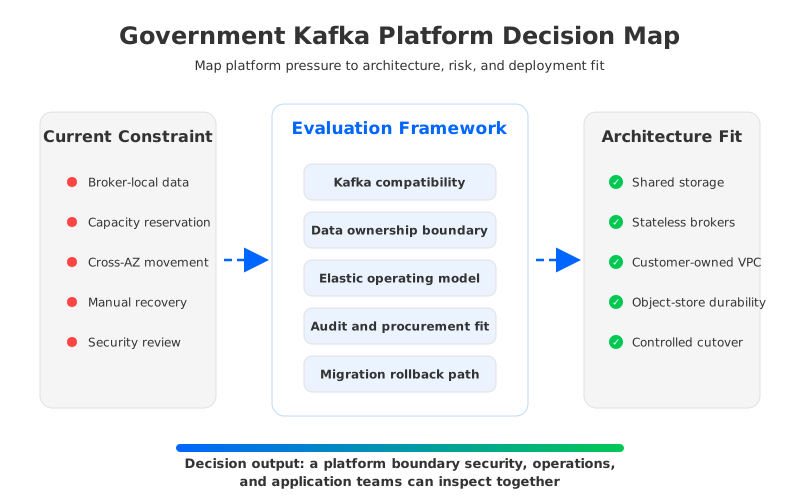
The useful starting point is not "Which vendor has the most features?" It is "Which operating model lets the agency keep Kafka compatibility while making the platform boundary visible?" A good answer should preserve the Kafka client ecosystem, avoid unnecessary application rewrites, keep customer data in a controlled environment, and reduce the operational load that traditional broker-local storage pushes onto the platform team.
1Why Teams Search for government kafka platform
Government workloads create a specific kind of streaming demand. Citizen-facing systems need event streams for notifications, identity workflows, fraud detection, payments, and reporting. Internal platform teams need a reusable Kafka-compatible layer so every program office does not build its own queue, connector fleet, monitoring stack, and disaster recovery process. Security teams need to know whether business data leaves a controlled account, how logs are separated from records, and which team can prove what happened during a failure.
Those needs collide when Kafka moves from a single application cluster to a shared platform. A project team may only ask for Topics and client credentials. The platform team has to answer a longer set of questions:
- Can existing Kafka clients, Connect workers, schemas, and operational runbooks continue to work?
- Does the data plane run in a customer-owned cloud account, a private data center, or a provider-operated environment?
- Who owns IAM, network routing, key management, audit logs, and retention policy?
- How is capacity added when another program creates a sudden burst of records?
- Can the team rehearse migration and rollback before a production cutover?
The phrase "government Kafka platform" is useful because it forces these questions into the same room. Kafka is the protocol and ecosystem boundary. Government is the governance boundary. Platform is the operational boundary. If one of the three is missing, the architecture may work in a benchmark and still fail in procurement, security review, or day-two operations.
2The Production Constraint Behind the Problem
Traditional Apache Kafka was designed around a Shared Nothing architecture. Each broker owns compute and local persistent storage, and Kafka uses leader/follower replication to keep partition data available across brokers. That model is documented in the Apache Kafka documentation and remains proven, but it creates a clear operational consequence: data is tied to the broker layout.
That broker-local ownership matters more in regulated platforms than it does in small self-managed clusters. When a broker fails, platform teams care about the affected partitions, under-replicated state, leader movement, and whether consumers see lag during recovery. When capacity changes, teams care about reassignment, disk headroom, and how much data must move across nodes or Availability Zones. When a revised retention policy arrives, they care about storage planning and whether historical data creates a cost surprise.
Cloud infrastructure adds another layer. Multi-AZ Kafka deployments are common because public services need resilience, but replication traffic, client placement, and cross-zone routing become cost and architecture concerns. Platform teams do not need every application developer to understand those details, but they do need a standard operating model that prevents every workload from rediscovering them.
The platform team is not merely keeping brokers alive. It is deciding whether streaming storage should remain a broker-local concern or become a shared platform capability. That decision changes who plans capacity, who carries migration risk, who proves data ownership, and how quickly the platform can respond to demand.
3Architecture Options and Trade-Offs
A practical evaluation should compare operating models, not only product names. The same Kafka-compatible API can sit on top of very different storage, control, and deployment boundaries. For government and public-sector programs, three patterns show up most often.
| Option | What the platform team owns | Strength | Trade-off to inspect |
|---|---|---|---|
| Self-managed Kafka | Brokers, storage, networking, upgrades, monitoring, and recovery | Maximum control over every layer | High operational burden; capacity and recovery remain tied to local broker storage |
| Provider-managed Kafka | Service configuration, client access, IAM integration, and cost governance | Less infrastructure management | Data-plane boundary, networking model, and procurement controls must be reviewed carefully |
| Customer-owned cloud-native Kafka | Customer account or data center boundary, platform policy, and lifecycle automation | Stronger alignment between Kafka compatibility and controlled deployment | Requires clear split between control plane, data plane, and support responsibilities |
The right choice depends on the program, but the wrong evaluation pattern is easy to spot. If the architecture review starts and ends with "Kafka compatible," it misses the storage model. If it focuses only on control-plane convenience, it may miss where data and logs move. If it focuses only on cost, it may miss the rollback and audit plan that will decide whether the platform is approved for production.
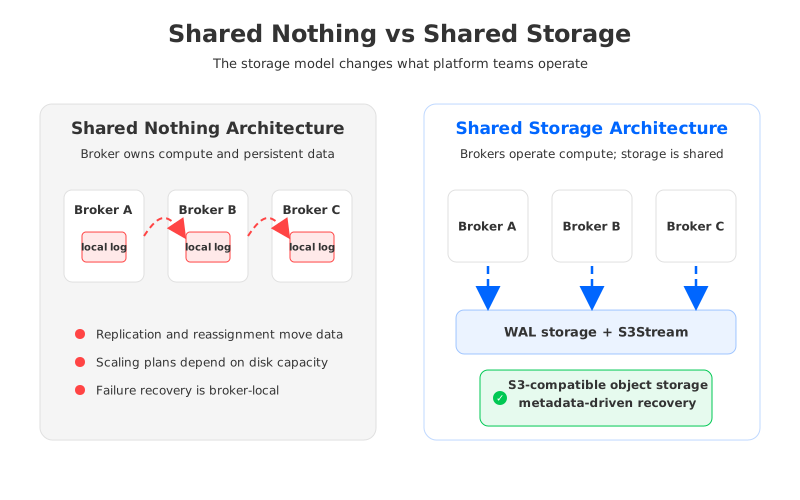
The storage model is the most important technical hinge. In a Shared Nothing architecture, brokers are stateful because partition data lives with broker-local storage. Adding or removing brokers often means moving data, and platform teams must plan around that movement. Tiered Storage can reduce the amount of historical data kept on local disks, but it does not fully remove the broker-local operating model because recent data and partition ownership still matter.
A Shared Storage architecture changes that premise. Persistent data is written to shared object storage, and brokers become primarily compute nodes that handle Kafka protocol work, leadership, caching, and request processing. In that model, scaling is less about copying partition data from one broker to another and more about changing ownership, metadata, and traffic placement. The architectural question becomes: can the platform preserve Kafka semantics while moving durable storage into a service boundary that the customer already controls?
4Evaluation Checklist for Platform Teams
Before choosing a government Kafka platform, the platform team should run a review that mirrors how the platform will be operated. The checklist below is not a replacement for security authorization, but it gives engineering, security, and procurement teams the same set of questions.
| Area | Platform question | Why it matters |
|---|---|---|
| Compatibility | Which Kafka client versions, Connectors, transactions, and Consumer group behaviors are supported? | Application teams need migration without rewriting producers and consumers. |
| Data boundary | Where do records, WAL data, object storage, logs, metrics, and control metadata live? | Security teams need to distinguish business data from operational telemetry. |
| Cost model | Are compute, storage, cross-AZ traffic, PrivateLink or endpoint charges, and operations modeled separately? | A low broker price can hide network or storage growth. |
| Elasticity | Does scaling require partition data movement, or can brokers be replaced as compute capacity? | Public programs often receive bursty traffic tied to deadlines or service launches. |
| Governance | Can IAM, VPC routing, encryption, audit logs, and retention be mapped to existing controls? | The platform must fit the agency's evidence and approval process. |
| Migration | Is there a tested path for byte movement, offset continuity, validation, and rollback? | A failed cutover can affect multiple services at once. |
| Observability | Do teams share broker, client, storage, lag, and control-plane signals? | Incident response needs one view of cause and impact. |
The checklist should produce a decision record, not a slide deck. For each area, document the owner, evidence source, residual risk, and next validation step. That habit matters because Kafka platforms tend to expand. A cluster that starts with one program can become a shared dependency for many agencies, contractors, and analytics teams.
Cost deserves a careful note. Cloud providers publish pricing for data transfer, endpoints, storage, and compute, and those pages should be checked during procurement because numbers vary by region and service. Avoid universal percentage claims. Model write throughput, retention, replication, consumer fan-out, cross-zone placement, and operational staff time to expose whether the expensive part is broker compute, durable storage, network movement, or human operation.
5How AutoMQ Changes the Operating Model
After the neutral review, the architectural requirement becomes clearer: keep Kafka compatibility, make durable storage independent from broker-local disks, and preserve a customer-controlled deployment boundary. AutoMQ is a Kafka-compatible streaming platform built around that requirement, replacing Kafka's local log storage with a Shared Storage architecture backed by S3-compatible object storage.
The key change is not a cosmetic deployment wrapper around brokers. AutoMQ uses S3Stream as the storage layer, with WAL (Write-Ahead Log) storage for durable writes and S3-compatible object storage as the primary storage layer. Brokers are stateless in the sense that they do not depend on local persistent partition data for recovery. That moves many tasks from "copy data between brokers" to "adjust ownership, leadership, metadata, and traffic."
AutoMQ BYOC and AutoMQ Software matter in government-style evaluations because they make deployment boundaries explicit. With AutoMQ BYOC, the control plane and data plane run in the customer's cloud account and VPC. Customer records remain in customer-owned storage, while the control path manages lifecycle operations, configuration, monitoring, and automation. With AutoMQ Software, the same boundary logic applies to private data centers.
This separation also helps teams explain responsibility. The data plane carries Kafka traffic and records. The control plane manages clusters, resources, upgrades, configuration, and observability. Operational telemetry is not the same thing as business records, and that distinction should appear in the security review.
AutoMQ's Kafka compatibility is also central to migration planning. Existing Kafka applications usually depend on producers, consumers, Consumer groups, offsets, transactions, Kafka Connect, and familiar administrative workflows. AutoMQ documents Kafka compatibility and uses Kafka's ecosystem boundary as the migration surface. Teams can evaluate MirrorMaker2 for open-source migration, while Kafka Linking in commercial editions is designed for byte-level message synchronization and offset consistency.
None of this removes the need for validation. Government platform teams should still test client behavior, ACLs, Connectors, schema workflows, monitoring, failure recovery, retention, throughput, and rollback under their own constraints. Shared Storage architecture changes the shape of that validation: instead of proving every future broker has enough local disk, the team can focus on storage boundary, WAL choice, object storage policy, network path, and automation.
6A Readiness Scorecard for the Final Review
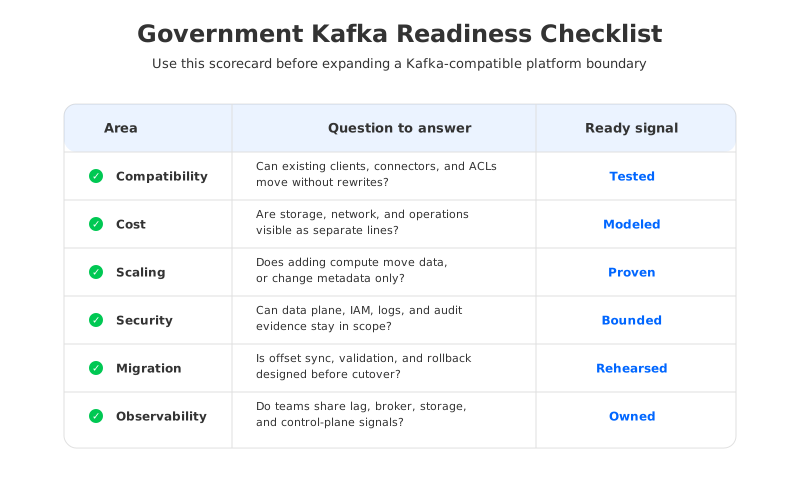
The final review should feel routine rather than improvised. Every stakeholder should know what evidence they are looking at and what decision it supports. Use this scorecard before a pilot, before procurement, and again before production expansion.
- Compatibility is tested, not assumed. Run representative producers, consumers, Consumer groups, Connectors, ACLs, and transaction patterns against the target platform.
- The data boundary is diagrammed. Show where records, WAL data, object storage, logs, metrics, and control messages live.
- The cost model is workload-based. Include compute, storage, network transfer, endpoints, retention, consumer fan-out, and operational labor.
- Scaling behavior is rehearsed. Add and remove capacity under load, then measure lag, rebalance behavior, and operational steps.
- Migration has a rollback path. Define source-of-truth timing, offset handling, data validation, consumer cutover, and the point where rollback stops being safe.
- Security evidence is owned. Assign owners for IAM, encryption, audit logs, VPC routing, data retention, and incident response.
- Observability is shared. Application, platform, and security teams should inspect the same lag, broker, storage, and control-plane signals during an incident.
A government Kafka platform is not ready when the demo works. It is ready when the team can explain what happens during growth, failure, audit, and migration without inventing another process each time.
7FAQ
7.1What does "government Kafka platform" mean?
It means a Kafka-compatible streaming platform evaluated for public-sector operating requirements: controlled deployment boundaries, security review, procurement fit, audit evidence, migration planning, and long-term platform ownership.
7.2Is Kafka compatibility enough for a government platform?
No. Kafka compatibility is necessary because applications depend on Kafka clients, Consumer groups, offsets, Connectors, and operational tooling. Platform teams also need to prove data ownership, network routing, observability, cost model, recovery behavior, and migration safety.
7.3Why does Shared Storage architecture matter?
Shared Storage architecture separates durable storage from broker-local disks. That lets brokers operate more like replaceable compute capacity while object storage provides the durable data layer.
7.4How should a team compare BYOC Kafka options?
Start with deployment boundaries. Ask where the control plane runs, where the data plane runs, where records are stored, how IAM and networking are configured, and how support access works. Then evaluate compatibility, cost, elasticity, migration, and observability under a representative workload.
7.5Where does AutoMQ fit?
AutoMQ fits teams that want Kafka-compatible streaming with customer-controlled deployment boundaries and a Shared Storage architecture. AutoMQ BYOC targets customer cloud accounts and VPCs, while AutoMQ Software targets private data center environments.
If your team is evaluating a customer-owned Kafka-compatible platform boundary, start with a small representative workload and validate compatibility, storage policy, and rollback before committing the shared platform. You can explore the AutoMQ BYOC path through AutoMQ Cloud.


