
Table of Contents
Table of Contents
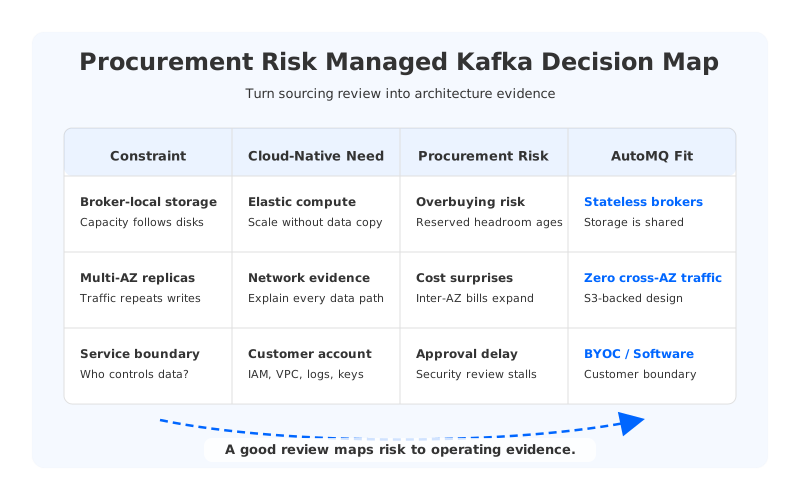
Teams search for procurement risk managed kafka when Kafka has stopped being only an engineering choice. The platform team may still own partitions, consumer lag, Connect workers, and broker upgrades, but the buying process has pulled in security, finance, procurement, legal, and application owners. The question is no longer "Can this service run Kafka workloads?" It is "What operational, financial, and governance risk are we accepting when this streaming platform becomes part of the production estate?"
That shift is easy to underestimate because managed Kafka sounds like a way to remove responsibility. In practice, it often changes where responsibility sits. A vendor may operate part of the service, a cloud provider may bill for network and storage behavior, and the platform team may still be accountable when a regulated workload cannot pass data residency review or a critical consumer cannot tolerate offset drift during migration. Procurement risk is the gap between what the contract appears to buy and what the production system still requires your team to prove.
1Why teams search for procurement risk managed kafka
The search usually starts after one of three events. A contract cycle exposes a larger bill than expected. A security review asks where event data, encryption keys, audit logs, and operational access actually live. Or an application migration discovers that "Kafka-compatible" is not a single yes-or-no property but a set of behaviors across clients, transactions, offset management, Kafka Connect, monitoring, and failure handling.
For platform teams, that creates an awkward middle ground. Self-managed Kafka is familiar but operationally heavy. A fully managed service can reduce day-to-day broker work but may move the data plane, control access, and cost model into a boundary the customer does not fully govern. A BYOC model can keep more infrastructure in the customer's cloud account, but it still needs a clear operating contract: who upgrades, who observes, who remediates, and what happens during an incident?
The evaluation has to start from the responsibilities that remain with the buyer:
- Workload responsibility: Producers, consumers, serializers, schemas, quotas, retries, idempotent producers, transactional producers, and downstream processors still belong to the application and platform teams.
- Governance responsibility: Data residency, encryption policy, identity integration, audit evidence, and access review need concrete deployment boundaries rather than generic security language.
- Economic responsibility: Compute, storage, replication traffic, private connectivity, support, and migration effort show up in different budget lines, even when the service is presented as a single managed platform.
- Exit responsibility: Contract terms matter, but exit risk is technical. Topics, offsets, schemas, ACLs, connectors, and replay requirements determine whether the team can move without a hard stop.
This is why procurement risk for managed Kafka is not a procurement-only topic. It is a platform architecture topic that happens to surface during buying.
2The production constraint behind the problem
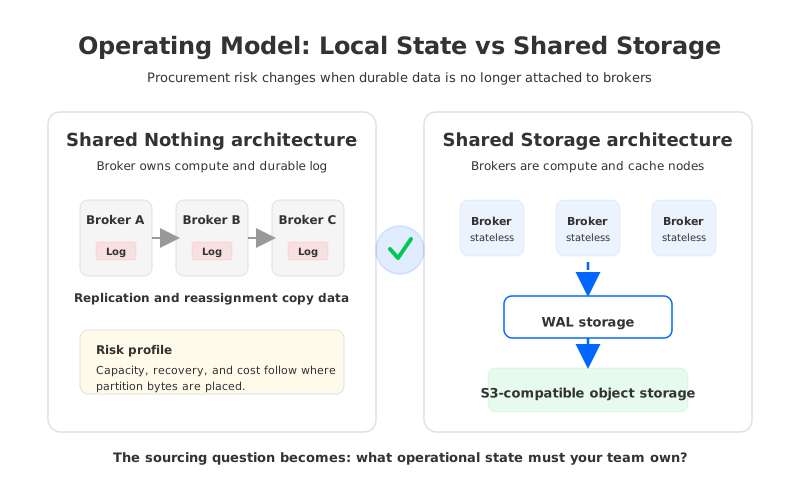
Traditional Apache Kafka was designed around a Shared Nothing architecture: each broker owns local log storage, and durability is achieved through replication across brokers. That model is powerful because it keeps the write path close to the broker and gives Kafka its familiar partition semantics. It also means that production operations are tied to where bytes live. Scaling out, replacing brokers, expanding retention, and moving partitions can all become data movement projects.
That coupling matters in cloud procurement because the cloud bill and the operating model follow the architecture. If every durable partition replica is attached to broker-local storage, the team must plan broker capacity around both compute and data. If replication crosses Availability Zones, the team needs to understand the network path and the billing model. If rebalancing requires copying retained data, elastic scaling is not only a question of launching instances; it is a question of how quickly the data placement catches up.
Apache Kafka has evolved to address many operational needs. KRaft removes ZooKeeper from Kafka's metadata quorum. Tiered Storage moves older log segments to remote storage while retaining local storage for the active log. Kafka Connect standardizes streaming integration with external systems. These capabilities matter, and any serious platform evaluation should account for them. But they do not erase the procurement question by themselves: which party owns the durable data path, the scaling envelope, the network bill, and the operational evidence during failure?
That is the part buyers often miss. A managed service can abstract broker administration while preserving cost and governance dependencies that appear later. If procurement compares only subscription price and feature lists, the platform team inherits the unsolved architecture questions after the agreement is signed.
3Architecture options and trade-offs
A practical managed Kafka evaluation should compare operating models before comparing SKUs. The names vary by provider, but most options fall into a few architectural patterns.
| Option | What the buyer gains | Risk to test before signing |
|---|---|---|
| Self-managed Kafka | Maximum control over deployment, network, and upgrade timing | Highest operational burden; broker-local storage and rebalancing remain platform-owned |
| Cloud-provider managed Kafka | Familiar cloud procurement and integrated networking | Cost model, supported Kafka features, scaling behavior, and migration constraints vary by service |
| Vendor-managed service | Reduced platform operations and a bundled experience | Data plane boundary, private connectivity, support model, and exit path need proof |
| BYOC or customer-environment deployment | More customer control over account, VPC, storage, IAM, logs, and compliance evidence | Shared responsibility must be explicit; operations and upgrade boundaries must be tested |
| Kafka-compatible shared-storage platform | Separates broker compute from durable storage to change scaling and recovery behavior | Compatibility, WAL choice, object storage behavior, and workload latency must be validated |
The table is not a ranking. A small analytics workload with short retention and loose latency requirements may be well served by a simple managed offering. A regulated payments, security telemetry, or AI feature pipeline workload may put more weight on customer-controlled infrastructure, replay capacity, and audit evidence. The right answer depends on which risk is most expensive for the organization to carry.
Procurement teams can help by asking architecture-shaped questions instead of only commercial ones. Where is the data plane deployed? Which account owns the object storage, network interfaces, encryption keys, and logs? Does the platform require cross-zone data movement for normal operation? Can the buyer export enough metrics to validate service-level objectives? What happens if the vendor relationship changes before the application lifecycle ends?
These questions keep the discussion concrete. They also give engineering and procurement a shared vocabulary: not "managed versus self-managed," but "which responsibilities are transferred, which remain internal, and which are shared?"
That shared vocabulary should become part of the buying artifact. A strong request for proposal does not only ask for availability targets or support response times. It asks for a data-flow diagram, a responsibility matrix, a migration test plan, a cost model with named assumptions, and an incident evidence package. The point is not to make procurement more technical for its own sake. The point is to prevent the platform team from discovering after signature that a critical control, metric, or rollback path was never inside the service boundary.
4Evaluation checklist for platform teams
The platform team's job is to turn risk into evidence. That means running proof points that match the production workload rather than accepting a generic compatibility statement. Start with the behaviors that break applications when they are wrong: producer acknowledgments, consumer group rebalancing, offset commits, transactions, ACLs, quotas, schema workflows, Connect tasks, and failure recovery.
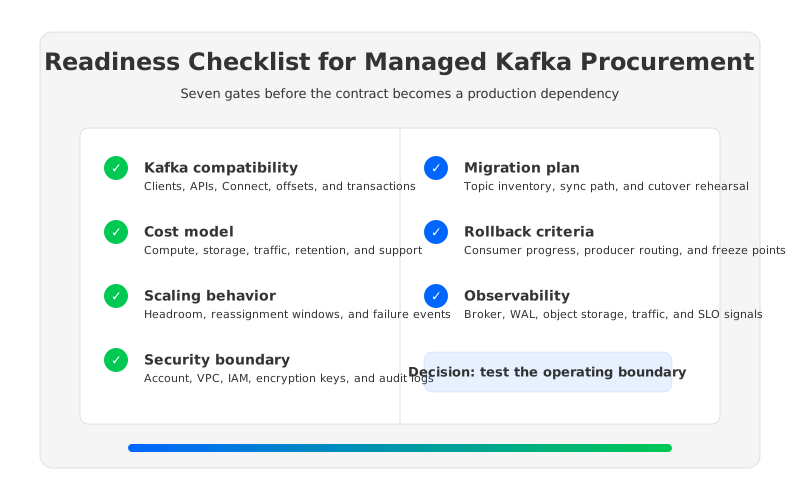
A useful review packet should cover seven gates:
- Kafka compatibility: Test the actual client versions, libraries, security settings, topic configuration, idempotence, transactions, consumer groups, and Kafka Connect integrations used by your applications.
- Cost model: Separate compute, storage, retention growth, private connectivity, cross-zone or cross-region traffic, observability export, support, and migration capacity. A single monthly estimate hides too much.
- Scaling behavior: Validate how the platform handles traffic spikes, partition growth, broker replacement, and retained data. Measure the operational step, not only the steady state.
- Security boundary: Document where control plane services, data plane brokers, object storage, logs, keys, and audit trails reside. Map each boundary to the team's compliance evidence requirements.
- Migration plan: Inventory topics, consumer groups, schemas, ACLs, connectors, and producer routing. A migration plan without offset behavior and rollback criteria is not a production plan.
- Rollback criteria: Define the freeze point, validation window, consumer progress checks, and traffic switch conditions before the cutover. Rollback is a designed state, not a hope.
- Observability: Confirm that broker, storage, WAL, cache, network, consumer lag, and connector metrics can be exported into the tools your incident process already uses.
This checklist also changes how procurement meetings run. Instead of asking whether a vendor supports a feature in the abstract, the team asks for evidence against a named gate. That makes legal and security review faster because the technical boundary is visible, and it makes engineering review more disciplined because the test plan is tied to purchase risk.
5How AutoMQ changes the operating model
Once the neutral framework is in place, AutoMQ becomes relevant for teams that want Kafka compatibility but do not want broker-local disks to define the operating model. AutoMQ is a Kafka-compatible cloud-native streaming platform built around Shared Storage architecture. Brokers handle Kafka protocol traffic, request processing, caching, and scheduling, while durable data is stored through S3Stream, WAL storage, and S3-compatible object storage.
The procurement implication is straightforward: storage architecture changes the questions that buyers need to ask. In a traditional broker-local design, scaling and recovery are closely tied to partition data placement. In AutoMQ's design, stateless brokers reduce the operational weight of broker replacement and partition reassignment because durable data is not owned by a single broker's local disk. The platform team still needs to validate workload behavior, latency, and failure recovery, but the review starts from a different premise.
Deployment boundary is the second reason AutoMQ belongs in this evaluation. AutoMQ BYOC is designed for cloud deployments where the control plane and data plane run in the customer's cloud account and VPC. AutoMQ Software is designed for private data center deployments. For procurement and security teams, that boundary can simplify evidence gathering because the customer's own environment holds the network, storage, identity, and audit context that the organization already governs.
AutoMQ should not be treated as a shortcut around due diligence. A team should still test Kafka API behavior, migration tooling, WAL storage options, object storage configuration, observability export, and operational runbooks. The advantage is that those tests are aimed at a cloud-native operating model rather than a conventional broker-and-disk cluster wrapped in managed-service packaging.
The decision point is therefore specific. Evaluate AutoMQ when the buying criteria include Kafka compatibility, customer-controlled deployment boundaries, long retention, elastic scaling, and reduced dependence on broker-local data movement. If the project is only about outsourcing routine broker administration for a small workload, a simpler managed service may be enough. If procurement risk is really about data ownership, scaling friction, and exit leverage, architecture deserves a first-class seat in the buying process.
If your procurement review has reached the point where Kafka compatibility, data-plane boundaries, migration evidence, and cloud cost behavior are all on the same checklist, evaluate AutoMQ with a production-shaped workload and a real runbook. Start with the AutoMQ BYOC assessment path.
6FAQ
6.1What does procurement risk mean for managed Kafka?
It means the technical, financial, governance, and exit risks that remain after a team buys a managed Kafka or Kafka-compatible streaming service. The contract may transfer some operations, but the buyer still needs evidence for compatibility, data boundaries, cost behavior, migration, and incident response.
6.2Is BYOC Kafka always lower risk than a fully managed service?
No. BYOC can improve customer control over cloud accounts, VPCs, storage, IAM, and audit evidence, but it also requires a clear shared-responsibility model. Lower risk comes from explicit boundaries and tested operations, not from the acronym alone.
6.3Why does Shared Storage architecture matter in procurement?
Shared Storage architecture changes how brokers, durable data, scaling, and recovery relate to each other. When durable data is no longer tied to broker-local disks, the team can evaluate a different operating model for replacement, reassignment, retention, and elasticity.
6.4What should platform teams test before signing?
Test the exact workload boundary: client versions, producer settings, transactions, consumer groups, offsets, topic configuration, Kafka Connect, security integration, observability, scaling events, migration, and rollback. A procurement-ready design proves these behaviors before the platform becomes a production dependency.


