
Table of Contents
Table of Contents
Searches for self service environment provisioning kafka usually start after a platform team has solved the first problem: developers can request infrastructure through a portal, API, Terraform module, or internal service catalog. The harder problem appears when Kafka moves from a shared utility into a governed product surface. A team that can create a database schema in minutes expects the same motion for streaming, while security, SRE, procurement, and architecture teams need to know where data lives, who can operate it, how costs are allocated, and what happens during failure.
That tension is not a sign that platform teams are blocking progress. Kafka environments carry durable event logs, long-lived client contracts, offsets, access controls, network paths, schema dependencies, and incident responsibilities. Giving every application team a button that creates a production Kafka environment can improve delivery speed, but only if the platform team has already turned the messy parts into policy.
The useful question is not "How do we make Kafka self-service?" It is: Which Kafka decisions should be automated for application teams, and which must remain owned by the platform team because they define the operating boundary? The answer sits at the intersection of architecture, cost, governance, and migration risk.
1Why Teams Search for self service environment provisioning kafka
A self-service request normally looks simple from the application side. A team wants an environment, a few topics, credentials, network access, and enough throughput to build without filing tickets for every change. In the background, the platform team is translating that request into decisions about broker capacity, retention, replication, access control, upgrade windows, observability, and chargeback. The gap between those two views is where most self-service streaming programs struggle.
The search intent behind this topic often comes from one of four situations:
- Developer experience has outgrown manual Kafka operations. Teams are waiting on tickets for topics, clusters, ACLs, or connectivity, and the delay has become visible in delivery plans.
- A central Kafka cluster has become a political boundary. Every team wants isolation, but every isolated environment adds operational overhead.
- Governance teams want clearer ownership. They need to know which account, VPC (Virtual Private Cloud), key, IAM role, and audit trail applies to each streaming workload.
- Finance teams want unit economics before the next rollout. The bill includes compute, storage, network transfer, monitoring, managed service charges, and support effort, not only broker instances.
Those pressures are reasonable. Kafka is often used for operational data that downstream services treat as a source of truth. The platform team cannot provision it like an ephemeral test container, but a ticket-driven model does not scale when every domain team is building event-driven services, CDC pipelines, search indexing, feature pipelines, or AI data ingestion.
2The Production Constraint Behind the Problem
Apache Kafka's core abstractions make self-service attractive. Topics, partitions, offsets, consumer groups, Kafka Connect workers, and client compatibility give teams a common way to publish, consume, replay, and integrate data. The official Apache Kafka documentation describes these building blocks as part of a durable log with client APIs and operational semantics that many organizations already know. That familiarity is why platform teams want to expose Kafka through a standardized internal product.
The friction comes from the traditional operating model. In Shared Nothing architecture, each broker owns local persistent storage, and the cluster relies on broker-to-broker replication to keep partition replicas available. That design is proven, but it makes capacity changes expensive in operational terms. Adding brokers, changing retention, moving partitions, or rebalancing hot topics can turn into data movement across disks, nodes, and Availability Zones (AZs). A self-service portal can hide the request form, but it cannot hide that physics.
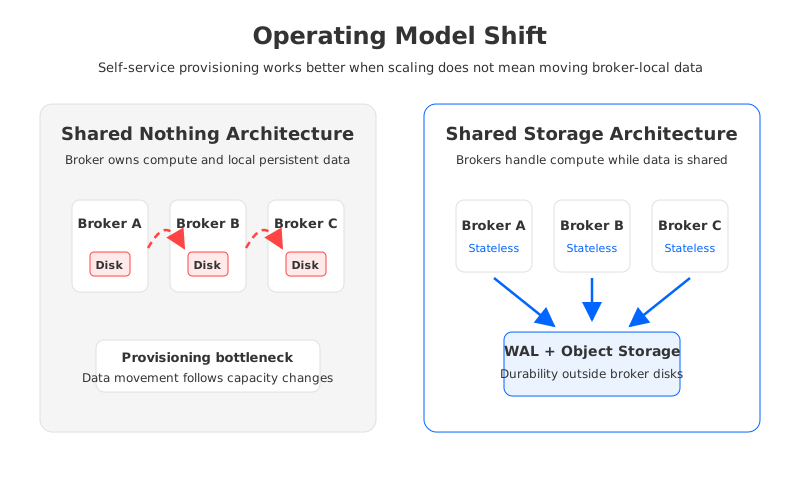
The issue is not only storage. Broker-local data ties together decisions that platform teams would rather manage independently:
- Capacity and durability become coupled. More storage often means more broker resources, even when the workload needs retained bytes more than CPU.
- Scaling changes carry migration work. Partition reassignment is a data operation, not only a scheduling operation, when data sits on broker disks.
- Multi-AZ resilience can create network exposure. Replication traffic, client routing, and cross-zone data flows need explicit cost and reliability review.
- Failure recovery touches application contracts. Producers, consumers, offsets, idempotence, transactions, and retry behavior all need predictable semantics during incidents.
This is why a self-service Kafka program should start with the operating model, not the portal. If every environment requires the platform team to forecast broker-local storage, plan rebalancing, and manually approve topology changes, then the workflow is self-service only at the edge. The core responsibility still sits with a small operations group.
3Architecture Options and Trade-offs
Platform teams usually face four broad options. None is universally right, and each changes the responsibility split between application teams, platform engineers, security reviewers, and vendors. A good evaluation makes those boundaries explicit before procurement or implementation begins.
| Option | What the platform team gains | What the platform team still owns |
|---|---|---|
| Self-managed Apache Kafka | Maximum control over versions, topology, networking, and operations | Broker sizing, upgrades, scaling, partition movement, security hardening, and on-call depth |
| Hosted Kafka service | Faster provisioning and reduced infrastructure management | Data boundary review, private networking design, cost model review, client compatibility testing, and incident escalation paths |
| BYOC Kafka platform | Customer-owned infrastructure boundary with managed or productized operations | Cloud-account permissions, network design, deployment lifecycle, cost attribution, and shared responsibility review |
| Private software deployment | Full placement control for regulated or isolated environments | More direct operational ownership, capacity planning, upgrade discipline, and support processes |
The key distinction is not "managed versus self-managed." That framing is too broad for Kafka. A platform team should ask where the control plane runs, where the data plane runs, where message data and logs are stored, who can access operational telemetry, and how much of the lifecycle is automated. A hosted service may be the right answer for a team that values speed and accepts the service boundary. A BYOC or private deployment may be the right answer when cloud-account ownership, data residency, auditability, or procurement structure matters more.
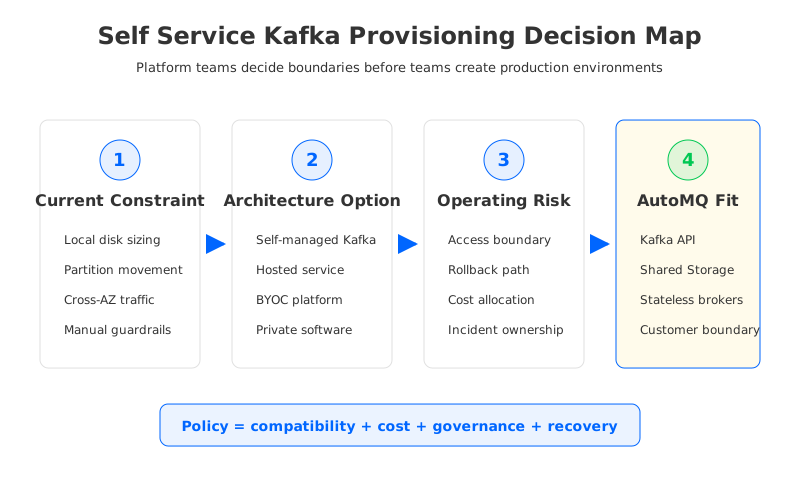
Architecture also affects cost in ways that are easy to miss during a feature comparison. Kafka cost is not a single line item. It includes compute, storage, network transfer, private connectivity, monitoring, backups, support, and incident work. Cloud provider pricing pages for object storage, network transfer, and private connectivity can change, so production decisions should use current prices for the target region and traffic pattern rather than copied assumptions from an old spreadsheet.
For self-service, the real cost question is: can the platform team expose a predictable unit model? If teams cannot see how retention, throughput, replication, network paths, and environment isolation map to spend, self-service can increase the number of environments while reducing financial clarity. That is a governance problem disguised as developer enablement.
4Evaluation Checklist for Platform Teams
A Kafka self-service program needs a checklist that reads like an operating contract. It should not stop at "Can a team create a cluster?" The platform team needs gates that prove each environment is compatible, observable, recoverable, and accountable before it is offered as a repeatable product.
Start with compatibility. Kafka compatibility is not only whether a producer can write and a consumer can read. It includes admin APIs, ACL behavior, offset management, consumer group rebalancing, transactional producers, idempotent producers, Kafka Connect, schema workflows, monitoring integrations, and the operational scripts teams already use. A Kafka-compatible platform should be tested against the client versions and workflows that matter inside the organization, not against a generic hello-world workload.
Then define the provisioning boundary. Application teams can safely own topic requests, quotas within limits, credentials, non-production environments, and retention choices within approved bands. Platform teams should retain ownership of production environment classes, network exposure, encryption and key policy, incident escalation, lifecycle rules, supported client versions, and cost guardrails. The boundary should be boring enough that a security reviewer can understand it without reading the implementation.
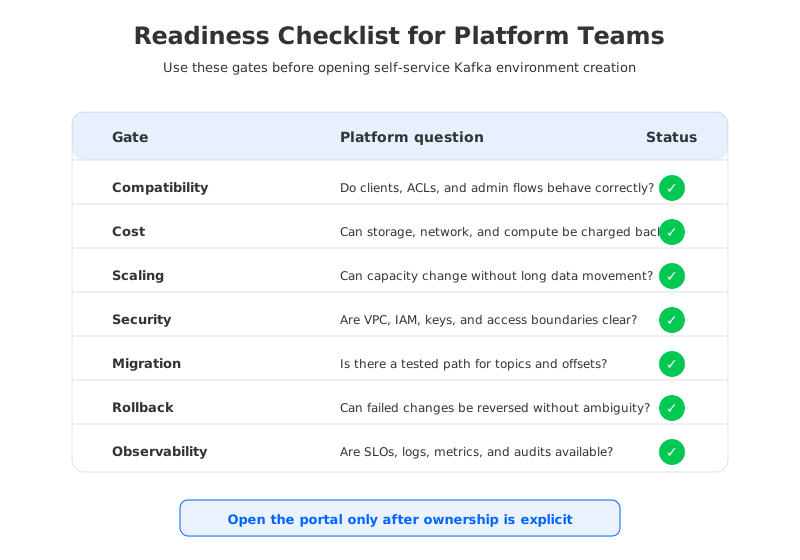
The practical checklist should include these gates:
- Compatibility gate. Validate producers, consumers, admin clients, connectors, ACLs, offset workflows, transactions if used, and operational tooling.
- Cost gate. Define how compute, storage, network transfer, private connectivity, support, and observability are measured and charged back.
- Scaling gate. Prove that adding or removing capacity does not create unacceptable data movement, rebalance duration, or client disruption.
- Security gate. Document VPC placement, IAM roles, encryption, secrets, audit events, maintenance access, and emergency support paths.
- Migration gate. Test topic creation, data sync, offset continuity, client cutover, backfill, and rollback before production traffic moves.
- Recovery gate. Define RPO, RTO, broker replacement behavior, regional assumptions, and who declares an incident.
- Observability gate. Give each consuming team useful metrics while preserving platform-level SLOs, logs, and audit evidence.
This checklist is also a procurement tool. It turns "Can this vendor provision Kafka?" into "Can this architecture support our operating model?" That shift matters because self-service failures rarely come from the first environment. They show up when the tenth team asks for longer retention, the twentieth team needs a private endpoint, or a hot partition forces the platform team to intervene during a peak period.
5How AutoMQ Changes the Operating Model
Once the evaluation framework is clear, a different architecture category becomes relevant: Kafka-compatible streaming with Separation of compute and storage. AutoMQ fits this category by keeping Kafka protocol compatibility while moving the storage layer away from broker-local disks and into Shared Storage architecture backed by object storage. The important point is not that the platform gets another product toggle. The operating model changes because brokers no longer need to be treated as the durable home of partition data.
In AutoMQ, AutoMQ Brokers handle Kafka-compatible compute responsibilities, while S3Stream writes durable data through WAL (Write-Ahead Log) storage and S3-compatible object storage. WAL storage acts as the low-latency durability and recovery layer, and object storage serves as the primary shared storage layer. With stateless brokers, capacity changes and broker replacement are much less tied to moving persistent partition data between local disks. That changes what a platform team can safely automate.
For self-service provisioning, the practical effects are concrete:
- Environment templates can focus on policy rather than disk math. Teams still need throughput, retention, and access limits, but broker-local disk ownership is no longer the central sizing axis.
- Scaling can be treated more like compute scheduling. Stateless brokers make the scaling conversation closer to adding or removing compute capacity, while the durable log remains in shared storage.
- Cost review becomes easier to decompose. Object storage, compute, WAL storage choice, networking, and product subscription can be modeled as separate layers.
- Failure recovery has a clearer boundary. Broker replacement does not require treating a failed broker's local disk as the authoritative place where a partition's latest durable state lives.
Deployment boundaries matter as much as storage architecture. AutoMQ BYOC places the control plane and data plane in the customer's own cloud account and VPC, which helps teams that need customer-owned infrastructure, explicit IAM review, private networking, and procurement through their existing cloud model. AutoMQ Software addresses private data center or isolated deployment requirements where both the control plane and data plane run in the customer's environment. In both cases, the platform team should still document the control channel, operational access, telemetry scope, and support workflow. BYOC is an ownership model, not a waiver for governance.
The responsible way to evaluate AutoMQ is to run the same checklist used for any platform candidate. Validate Kafka client behavior, run migration tests, model region-specific cloud costs, review WAL storage choices, verify observability, and define rollback. The architectural advantage is strongest when the platform team's bottleneck is the combination of Kafka compatibility, customer-controlled deployment boundaries, elastic capacity, and storage economics.
6FAQ
6.1What does self-service environment provisioning mean for Kafka?
It means application teams can request and manage approved Kafka environments or resources through a controlled workflow without waiting on manual platform tickets for every routine action. In production, it should include governance: approved templates, access control, quotas, observability, cost attribution, lifecycle rules, and escalation paths.
6.2Should every team get its own Kafka cluster?
Not always. A dedicated environment can improve isolation and ownership, but it can also increase operational overhead and cost. Platform teams should choose between shared clusters, dedicated environments, and domain-level isolation based on data sensitivity, traffic patterns, retention, SLOs, and incident boundaries.
6.3Is BYOC Kafka the same as self-managed Kafka?
No. BYOC means the platform runs in customer-owned cloud infrastructure, but the operational model depends on the product. Some BYOC models keep more lifecycle automation and vendor support; others leave more work to the customer. The review should focus on where the control plane runs, where the data plane runs, who can access what, and which operations are automated.
6.4What should be tested before offering Kafka through a service catalog?
Test client compatibility, ACLs, quotas, topic lifecycle, offset behavior, consumer group operations, connector workflows, monitoring, scaling, failure recovery, migration, and rollback. A service catalog entry is safe only when the platform team can predict both the normal path and the incident path.
6.5Where does AutoMQ fit in this decision?
AutoMQ fits when a team wants Kafka-compatible streaming, customer-controlled deployment boundaries, and an architecture that separates broker compute from durable storage. It should be evaluated after the platform team has defined the required operating model, not as a shortcut around governance.
7Closing the Loop
The first search for self service environment provisioning kafka is usually about speed. The production decision is about responsibility. A platform team can give developers a faster path only after it has turned architecture, cost, security, migration, and recovery into repeatable policy.
If your team is evaluating Kafka-compatible self-service provisioning with a customer-owned deployment boundary, start by mapping your current Kafka constraints against a Shared Storage operating model. Then test the checklist with a real workload rather than a demo topic. To evaluate AutoMQ BYOC or AutoMQ Software for that path, start a deployment review with AutoMQ.


