
Table of Contents
Table of Contents
Kafka governance usually fails between a ticket and a production change. A team asks for a topic, another asks for an ACL, and a platform engineer decides what is safe before the next deployment window closes. Kafka has the primitives. The hard part is making topics, configs, principals, ACLs, quotas, and consumer groups behave like a controlled product surface instead of emergency commands.
That is why teams search for policy as code kafka topics. They are not looking for another YAML wrapper around kafka-topics.sh. They want an operating model where ownership, access, retention, migration safety, and cost controls are reviewed before they become cluster state. Once Kafka becomes a shared data plane, every unmanaged topic becomes a governance exception.
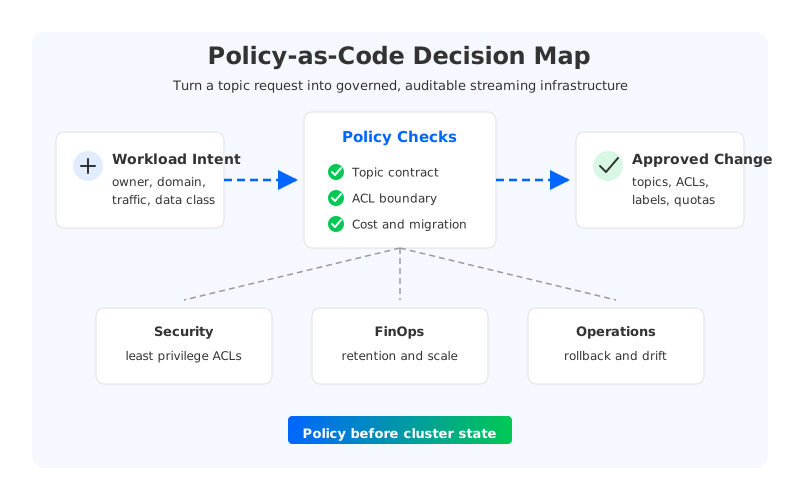
Policy-as-code turns those exceptions into explicit rules. It connects Kafka administration, identity management, and infrastructure-as-code. A useful policy system answers practical questions before a change is applied: Who owns this stream? Which services can produce and consume? Is retention aligned with the data class? Will this partition count force a capacity change?
1Why Kafka topic policy becomes a production issue
Kafka topic creation looks harmless when a cluster is small. A topic name, a partition count, a replication factor, and a retention setting are easy to reason about in isolation. The issue appears when the cluster becomes a platform for many teams. At that point, topic metadata becomes a contract. Producers depend on it, consumers build offset history around it, and security teams expect it to reflect the organization's access model.
The failure mode is subtle. One topic with too many partitions may not break a cluster, but hundreds of loosely governed topics change controller load, recovery behavior, storage demand, and cost allocation. One broad ACL may not trigger an incident, but broad access patterns make audits painful. A debugging retention setting can become a data exposure when the stream starts carrying user identifiers.
Policy-as-code treats these choices as reviewable changes. Instead of asking platform engineers to remember every rule during manual approval, it encodes rules in a system that can be tested, versioned, reviewed, and applied consistently. Teams may use Terraform, GitOps controllers, Open Policy Agent, service catalogs, or Kafka administration APIs.
A mature topic policy covers five control points:
- Ownership: team, service, cost center, and escalation path.
- Classification: public, internal, regulated, or sensitive data.
- Access: least-privilege producer and consumer ACLs.
- Lifecycle: retention, compaction, deletion protection, schema compatibility, and deprecation windows.
- Operations: partition count, throughput class, observability tags, migration plan, and rollback path.
These rules should not live only in a wiki. A wiki explains the policy, but it cannot stop a bad change at review time or prove cluster state still matches intent months later.
2Topics, ACLs, and data products are one governance surface
Kafka teams often manage topics and ACLs separately. Topic changes go through platform operations, ACL changes go through security workflows, and data product metadata lives in a catalog. That separation matches organization charts, but not how streaming systems behave. A stream is trustworthy only when all three layers line up.
Consider a payments authorization stream. The topic name declares the domain and event type. The ACLs determine which services can write and consume. The data product metadata explains freshness, retention, owner, schema, and downstream use. If any layer drifts, the contract becomes ambiguous: a correctly named topic can be overexposed, a least-privilege ACL can point to an orphaned owner, and a catalog entry can promise freshness the topic layout cannot sustain.
Policy-as-code should model a streaming data product as a bundle, not as disconnected resources. The bundle can stay compact, but it must be explicit enough to review.
| Policy area | Example declaration | Review question |
|---|---|---|
| Topic contract | Domain, partitions, retention, cleanup policy | Does the topic match the workload? |
| Access contract | Producer and consumer principals | Does each permission map to a real service? |
| Data product contract | Owner, classification, schema, downstream systems | Can another team trust this stream? |
| Operating contract | Throughput class, labels, migration plan | Can the platform run it safely? |
Kafka governance is not only security. It is capacity planning, cost allocation, and migration risk. A platform that approves topics without access review creates audit risk. A platform that approves access without retention review creates data exposure. A platform that approves both without architecture review can still become expensive to operate.
3The architecture behind the policy bottleneck
Traditional Kafka is a shared-nothing system. Brokers own local log segments, and replication keeps copies across brokers for durability. This design is proven, but it also means metadata policy and physical placement are tightly coupled. A topic decision can imply disk allocation, replica placement, traffic, recovery behavior, and reassignment work.
That coupling changes policy design. If every approved topic can create physical data movement later, the policy layer needs capacity and migration checks. A partition increase may pass security review and still create operational risk. A retention change may look like governance but also increase storage pressure.
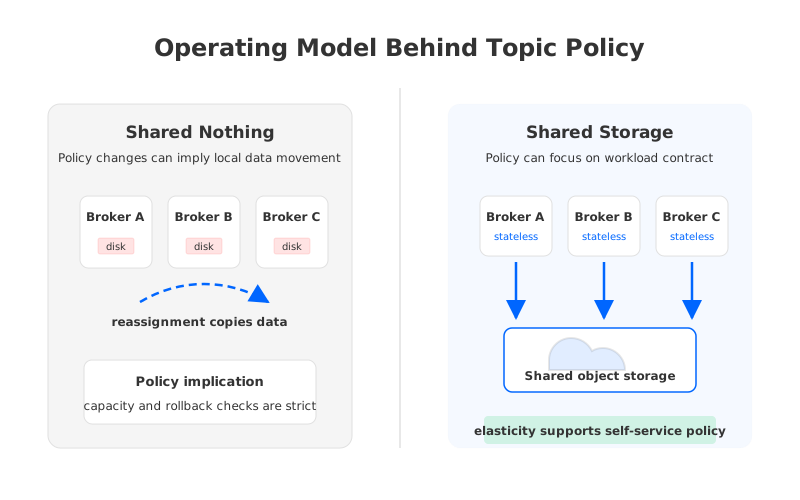
Shared storage changes this operating model. In a Kafka-compatible shared storage architecture, brokers are less tied to durable local log ownership because the durable data layer is moved to object storage or another shared substrate. Compute and storage can scale more independently, and broker replacement does not require the same broker-local data copy. Policy can focus more on stream contracts, access, and workload intent.
This is the right point to introduce AutoMQ. AutoMQ is a Kafka-compatible cloud-native streaming platform that keeps Kafka protocol semantics while moving the storage layer toward shared storage. Its documentation describes storage-compute separation, stateless brokers, shared object storage, and Kafka API compatibility. For policy-as-code programs, that architecture matters because governance rules often become blocked by operational friction.
Policy-as-code does not make a weak platform strong. It makes platform assumptions visible. If the underlying Kafka-compatible system needs long windows for routine expansion, encode that reality. If the system can scale compute and storage independently, expose richer self-service.
4A practical policy model for Kafka-compatible platforms
Start with a resource model that reflects how teams ask for streaming capacity. The useful unit is not "topic" alone. It is a streaming product request that includes the topic, principals, data classification, traffic, lifecycle, and owner. The model can compile down to Kafka topics, ACLs, Terraform resources, catalog entries, and monitoring labels, but review happens at the product boundary.
A policy request should answer:
- Which domain owns the stream, and who is accountable during an incident?
- Which producers can write, and which consumers can read?
- What data class does the stream carry, and how long should it be retained?
- What throughput and fan-out should the platform expect?
- Which environments, regions, or VPC boundaries may host it?
- What migration or rollback path exists if the change fails?
These fields create a contract that can be validated before deployment. Topic naming rules enforce domain boundaries. ACL policy rejects wildcard access except for approved platform services. Retention policy sets shorter defaults for sensitive data. Throughput classes map to partition guidance.
The enforcement layer can be built in several ways. Terraform is useful when Kafka resources are reviewed through pull requests. Open Policy Agent can run checks across CI, GitOps, Kubernetes, or internal control planes. Kafka administration APIs reconcile against live cluster state.
5Where cloud cost belongs in topic policy
Cost policy is often added after a Kafka estate has already become expensive. Topic policy is an early place to capture cost intent because partition count, retention, replication, fan-out, and placement all affect infrastructure demand. The policy file does not need to calculate a perfect bill. It should force workload classification before the platform commits capacity.
A low-throughput internal event stream should not receive the same partition defaults as a high-volume telemetry stream. A compacted state stream should not be reviewed like an append-only audit stream. A topic that must stay inside a specific VPC or region should declare that boundary.
Architecture affects this review. In shared-nothing Kafka, cost controls often become conservative pre-allocation rules because storage and compute are tied to broker capacity. In shared storage, teams can reason separately about compute throughput, storage retention, and network placement. AutoMQ's shared object storage and stateless brokers reduce the operational penalty of scaling and reassignment, so FinOps review can align with workload shape.
6Migration readiness should be part of policy
Kafka governance programs often discover migration risk only when a cluster needs to be replaced. The topic inventory is incomplete, ACL ownership is unclear, and consumer groups depend on behavior nobody documented. Policy-as-code reduces this risk by requiring migration metadata from the beginning.
At minimum, the policy should record whether a stream is eligible for migration, whether producers can dual-write, whether consumers can tolerate replay, and who signs off on cutover. For high-value streams, add schema compatibility, offset reset constraints, dependencies, and rollback criteria.
During platform modernization, the policy repository becomes a map of contracts instead of shell history. It shows which streams need careful sequencing, which principals must be recreated, which consumer groups are sensitive, and which topics can be retired.
7Evaluation checklist for platform teams
Evaluate policy-as-code by asking whether it can stop changes that create long-term pain. A useful system rejects ownerless topics, broad ACLs for sensitive streams, retention changes without classification, high-partition requests without throughput rationale, and production streams with no rollback path. It also detects drift from declared policy.
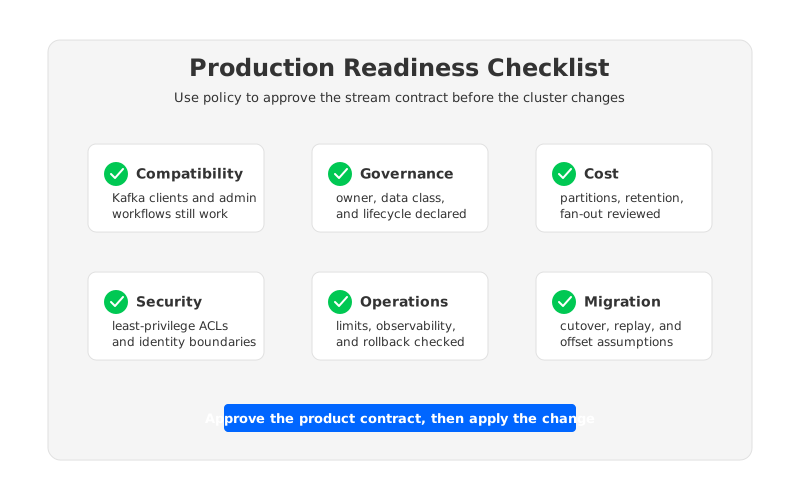
Use this decision matrix when comparing policy architectures and Kafka-compatible platforms:
| Evaluation area | Minimum requirement | Stronger pattern |
|---|---|---|
| Compatibility | Kafka clients and admin workflows still work | Policy maps to Kafka APIs, ACLs, and IaC |
| Governance | Owner, classification, and access are declared | Metadata, drift detection, and audit history are linked |
| Cost control | Partition and retention changes require review | Workload tiers map to cost models |
| Security | ACLs are explicit and least-privilege | Identity and environment boundaries are codified |
| Operations | Platform limits are documented | Scaling, rollback, and observability are policy inputs |
| Migration | Critical streams are identified | Cutover and replay assumptions are declared |
The stronger pattern is not needed on day one. Overbuilding policy creates a failure mode where teams bypass the process because every change feels like procurement. Start with rules that prevent expensive mistakes, then add richer checks where incidents or audits support them.
8How AutoMQ changes the operating model
AutoMQ should be evaluated as infrastructure, not as a policy engine. The policy engine decides what changes are allowed. The streaming platform determines what those changes cost to run.
In traditional Kafka, topic policy often becomes conservative because every approved change may consume broker-local disk, trigger reassignment, or increase recovery work. In AutoMQ's shared storage model, brokers are designed to be stateless relative to durable stream storage, and data is offloaded to shared object storage. AutoMQ documentation also describes Kafka protocol compatibility, scaling concepts, self-balancing, and inter-zone traffic optimization. Those properties lower the operational cost of enforcing precise policy.
For a platform team, the outcome is cleaner separation of concerns. Security teams focus on access. SREs focus on throughput, observability, and recovery. FinOps teams review storage, network, and compute assumptions. Application teams get self-service that is faster than tickets but stricter than ad hoc commands.
AutoMQ's BYOC deployment model is also relevant for regulated teams. When streaming infrastructure runs inside a customer-controlled cloud environment, policy can include VPC, region, identity, encryption, and operational access boundaries as first-class inputs. That does not make compliance automatic, but it helps streaming infrastructure fit existing cloud governance programs.
9A rollout path that does not freeze delivery
The fastest way to fail with policy-as-code is to make every existing topic noncompliant on the first day. Treat the first rollout as inventory and guardrails, not punishment. Import existing topics and ACLs, tag the unknowns, and apply strict enforcement only to new production changes. Once trusted, expand enforcement to sensitive data classes, high-throughput streams, and cross-environment access.
Good rollout plans follow this order:
- Inventory live topics, ACLs, owners, retention, and consumer groups.
- Define a minimal policy schema for new production streams.
- Add CI checks for naming, ownership, classification, and least-privilege access.
- Reconcile declared policy against live Kafka state and report drift.
- Add cost, migration, and rollback fields.
- Connect policy output to Terraform, GitOps, or the platform control plane.
The sequence keeps delivery moving because it does not require a perfect catalog before the first useful rule. It also gives platform teams evidence: ownerless topics, broad ACLs, and risky workloads.
When topic policy becomes a living contract, Kafka stops being a place where teams negotiate by exception. It becomes a platform surface where ownership, access, cost, and operations are visible before the cluster changes. If you are evaluating Kafka-compatible infrastructure for that model, review shared storage, elastic scaling, customer-controlled deployment, and migration alongside your policy engine. Start from the verified AutoMQ getting started page and map the checklist to your Kafka estate.
10References
- Apache Kafka documentation: Topics
- Apache Kafka documentation: Security
- Apache Kafka documentation: Authorization and ACLs
- HashiCorp Terraform documentation: Terraform language
- Open Policy Agent documentation: OPA docs
- AutoMQ documentation: Technical advantage overview
- AutoMQ documentation: S3Stream shared storage overview
- AutoMQ documentation: Manage Kafka ACLs
- AutoMQ documentation: Manage topics
- AutoMQ documentation: BYOC environment overview
11FAQ
11.1Is policy-as-code for Kafka topics the same as Terraform for Kafka?
Not exactly. Terraform can declare topics and ACLs, but policy-as-code is the review and enforcement layer around those declarations. A strong model can use Terraform for resource state, OPA for policy checks, GitOps for rollout, and Kafka admin APIs for drift detection.
11.2Which Kafka resources should be covered first?
Start with production topics and ACLs because they carry direct security and operational risk. Add retention, partition count, owner, data classification, and service principals before expanding into quotas, connectors, schema rules, and migration metadata.
11.3How strict should topic naming rules be?
Strict enough to encode domain ownership and environment boundaries, but not so strict that teams invent workarounds. A common pattern is domain.entity.event.version, with separate fields for owner, classification, and lifecycle.
11.4Does a shared storage Kafka architecture remove the need for policy?
No. Shared storage changes the operational cost of scaling, reassignment, and recovery, but it does not decide who owns a stream, who can access it, or how long data should live.
11.5Where does AutoMQ fit in a policy-as-code architecture?
AutoMQ fits as the Kafka-compatible streaming platform underneath the policy system. Platform teams can keep checks in CI, Terraform, GitOps, or internal portals while evaluating AutoMQ for shared storage, stateless brokers, BYOC deployment, and Kafka compatibility.


