
Table of Contents
Table of Contents
Teams search for agent policy enforcement streams kafka when agent systems stop being demos and start making production decisions. A support agent can approve a refund. A security agent can quarantine an endpoint. A data agent can trigger a workflow that changes downstream state. Once those actions carry business impact, the question is whether every policy decision, input, override, and rollback path is durable enough to audit and replay.
Kafka-compatible streams are a natural place to put that evidence trail because they already give teams ordered records, offsets, Consumer groups, retention, and replay. That does not make the architecture automatic. A policy enforcement stream carries state that may decide whether an autonomous action is allowed, delayed, escalated, or denied, so the platform must preserve both freshness and accountability under load.
Safe agent autonomy needs a durable event stream, but the stream must be evaluated as a policy control surface, not as a generic message bus. That evaluation starts with compatibility and governance, then moves into cost, elasticity, recovery, and migration.
1Why Agent Policy Enforcement Streams Need Kafka Semantics
An agent policy enforcement stream sits between fast-moving context and a slower control process. The agent proposes an action. A policy evaluator reads context, identity, risk score, tool permissions, and previous decisions. The evaluator emits a decision record, and downstream systems act on that record or require human review. The stream keeps those steps in order and gives operators a place to reconstruct what happened.
That reconstruction matters more than it first appears. A model response can be regenerated, but the exact production context at the moment of a decision can disappear. Feature flags change. Access policies change. A customer record is updated. A tool result is overwritten. If the policy event stream does not preserve enough context, the team may know that an agent acted but still fail to prove why the action was accepted.
The stream gives platform teams a clean boundary between independent services. Agent runtimes, policy engines, review queues, and audit exporters can subscribe as separate Consumer groups. Each group can move at its own pace without sharing one database transaction or request path.
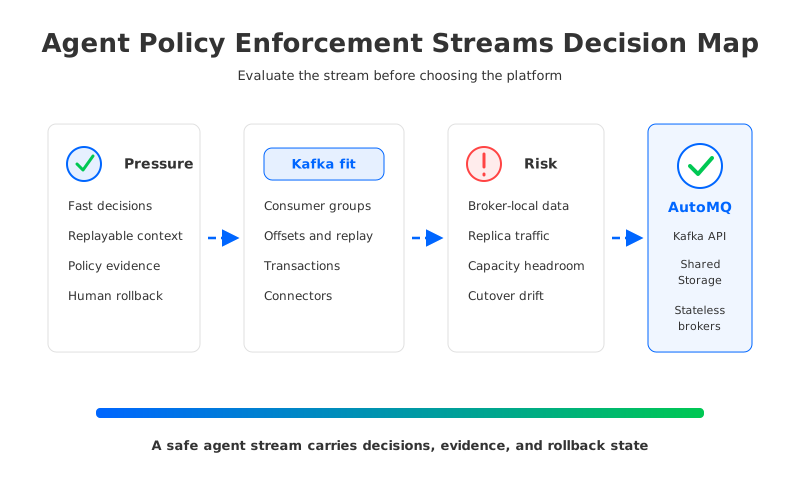
The hard part is deciding what must be in the stream. A production policy event should include the proposed action, the policy version, the subject identity, the target boundary, the decision result, and enough correlation IDs to join the event with logs and downstream side effects. Teams often add prompt excerpts, retrieval document IDs, approval metadata, and rollback references, but those fields need explicit retention and privacy review.
2The Freshness and Governance Problem Behind AI Event Streams
Policy enforcement has an awkward timing problem. The stream must be fresh enough to stop a bad action before it propagates, but durable enough to support later replay. If the platform team optimizes only for latency, it may lose evidence. If it optimizes only for retention, the enforcement path may become too slow for interactive agents.
Kafka solves part of this tension with topics, partitions, offsets, Consumer groups, and transactions. Producers write ordered records, consumers commit progress, and multiple services can read the same decision log independently. Kafka Connect can move policy records into warehouses, search systems, or compliance archives without every application team building its own exporter.
Those mechanics are necessary, but they are not the whole design. A policy stream also needs governance choices outside the Kafka API:
- Retention by decision type. A denied tool call and an approved payment action may need different retention windows, even if both came from the same agent runtime.
- Policy versioning. Replay is not useful unless the event says which policy version made the decision and whether that version is still valid.
- Side-effect correlation. The stream should connect a policy decision to the external action it allowed, such as a ticket update, database write, or cloud API call.
- Privacy minimization. The event should preserve enough evidence for audit without turning the Kafka topic into a long-lived store for sensitive prompts or raw customer data.
- Rollback semantics. A rollback event should identify what is being reversed and which downstream systems have acknowledged the reversal.
These choices decide whether the system is governable. A team can run a technically healthy Kafka cluster and still fail a policy audit because the event contract does not describe the decision boundary. The right question is whether the stream can prove policy control.
3Architecture Options for Durable, Replayable AI Context
Most teams begin with three architectural options: keep policy decisions in an application database, write them to a traditional Kafka cluster, or use a Kafka-compatible streaming platform with a cloud-native storage model. Each option is defensible in the right context, but the trade-offs change once agent autonomy increases write rate, read fanout, and retention pressure.
An application database is attractive when the policy engine is small and the number of subscribers is limited. The schema is familiar, point lookups are convenient, and transactions are direct. The problem appears when multiple systems need independent replay. Audit exports, real-time monitors, human review tools, and recovery jobs start competing with the enforcement database. The database becomes both source of truth and distribution mechanism, which is a poor fit for high-fanout event history.
Traditional Kafka improves the distribution problem. It gives each subscriber its own offset, lets teams replay by partition, and keeps event history separate from request-serving state. The trade-off moves into operations. In a Shared Nothing architecture, each broker owns local storage and Kafka uses replication to keep partitions available. Capacity changes, broker failures, and partition reassignments can become data movement events, and multi-AZ deployments can amplify replica traffic across Availability Zones.
Tiered Storage changes part of the cost profile by moving older segments to object storage while keeping hot data on local broker storage. That helps long-retention workloads, but it does not fully remove the broker-local storage model. Hot data still needs local capacity planning, and some scaling or reassignment work still depends on data that lives near a broker.
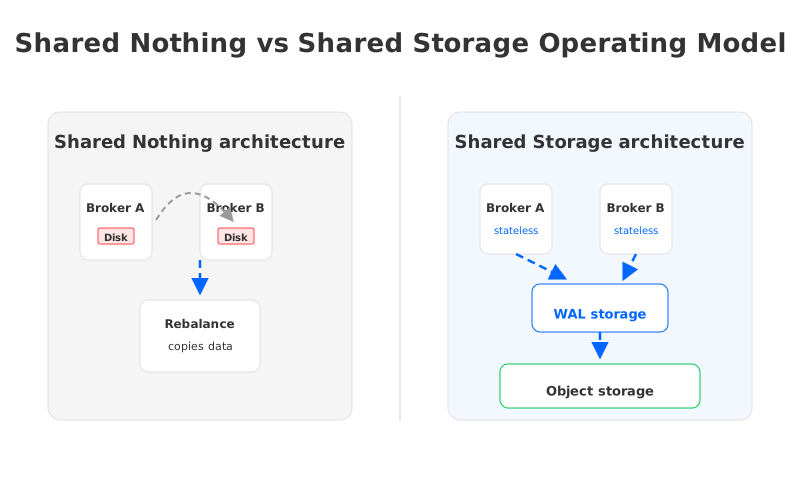
A Shared Storage architecture takes a different path. Durable retained data is separated from broker lifecycle, and brokers can be treated more like compute nodes than storage owners. It changes the operating question from "How much data must move when the cluster changes?" to "How do we move ownership, traffic, and metadata while durable data remains in shared storage?"
4Evaluation Checklist for Platform Teams
The safest way to evaluate an agent policy stream is to start with workload behavior rather than vendor categories. A topic that carries policy decisions may need lower write latency than an audit archive, stronger replay discipline than an observability stream, and clearer ownership than an experimentation feed.
Use this matrix before choosing the platform:
| Evaluation area | What to verify | Why it matters for agent autonomy |
|---|---|---|
| Kafka compatibility | Client versions, producer configs, Consumer group behavior, transactions, compaction, and connector support. | Agent infrastructure should not force application teams to rewrite stable Kafka integrations. |
| Event contract | Required fields for action, policy version, identity, decision, correlation IDs, and rollback references. | The stream must prove what happened, not merely record that something happened. |
| Cost model | Broker storage, object storage, cross-AZ traffic, egress, PrivateLink, and retained data growth. | Policy streams can grow quietly because audit records are retained longer than operational events. |
| Elasticity | Scaling behavior under spikes, broker replacement, partition reassignment, and hot partitions. | Agent workloads often move from quiet periods to bursts when automated workflows converge. |
| Security boundary | VPC placement, IAM, encryption, access control, audit logs, and support access. | Policy events may contain sensitive intent, identity, and authorization context. |
| Recovery | Replay plan, offset recovery, poisoned events, human override, and rollback confirmation. | Safe autonomy depends on reversing or explaining decisions after the fact. |
| Observability | Lag, produce latency, failed decisions, denied actions, connector status, and policy version drift. | The stream is part of the control loop, so monitoring must cover business and platform signals. |
The matrix forces a useful separation. Kafka compatibility is a requirement, not the entire answer. A platform can pass client checks and still create operational risk if it requires large data movement during scaling, hides network costs, or makes it hard to keep policy events inside the approved cloud boundary.
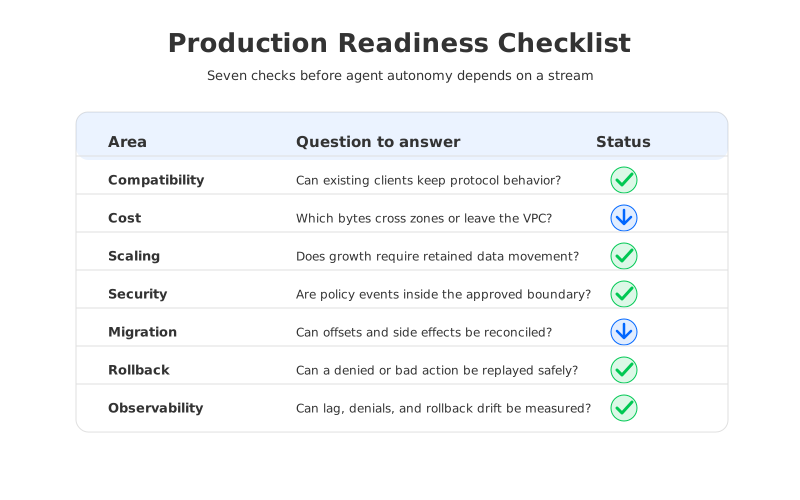
The readiness score should also include migration risk. Teams with existing Kafka estates should test producer idempotence, transactions, Consumer group offsets, compaction, retention, connector behavior, schema workflows, and rollback under the exact client versions they run. Re-consuming an "approve action" event is not safe unless downstream systems can identify duplicates or replay-mode commands.
5How AutoMQ Changes the Operating Model
After the neutral checklist is written, a sharper platform requirement emerges: keep Kafka-compatible behavior for applications, but reduce the broker-local state that turns scaling and recovery into data movement. AutoMQ fits this category as a Kafka-compatible streaming platform built around a Shared Storage architecture. It keeps the Kafka protocol surface while replacing broker-local durable log storage with S3Stream, WAL storage, and S3-compatible object storage.
In AutoMQ, brokers are stateless from the perspective of durable stream data. Writes enter the Kafka-compatible data path, pass through WAL (Write-Ahead Log) storage, and are organized in object storage as durable retained data. Because partitions are not permanently bound to a broker's local disk, broker replacement and scaling can focus on traffic ownership and metadata rather than copying retained data between brokers.
That model changes the economics of policy enforcement streams. Traditional Kafka-style replication stores and moves multiple copies at the application layer. In cloud deployments, that can introduce broker-attached storage costs and cross-AZ transfer paths. AutoMQ's Shared Storage architecture uses S3-compatible object storage for retained data and is designed for Zero cross-AZ traffic patterns. The exact cost outcome still depends on workload shape, region, read fanout, and deployment choices, so it should be validated against the team's own traffic profile.
The governance boundary is equally important. AutoMQ BYOC runs the control plane and data plane inside the customer's cloud environment, and AutoMQ Software is designed for customer-managed private environments. For agent policy streams, this affects where policy events, metrics, logs, credentials, and administrative actions live.
Migration still deserves discipline. Kafka compatibility reduces application change, but it does not remove the need to test offset behavior, transactional workflows, compaction, connector delivery, and rollback. AutoMQ commercial editions include Kafka Linking for migrations that need byte-level message synchronization and offset consistency, while open-source migration paths can use Apache Kafka ecosystem tools where they fit.
6A Production Pattern for Safe Agent Autonomy
A practical agent policy enforcement architecture usually has four streams rather than one overloaded topic: proposed actions, policy decisions, human overrides, and side-effect confirmations. Some teams combine these into fewer topics, but the conceptual split keeps responsibilities visible.
The enforcement service should produce decision records only after it has enough context to explain the decision. Downstream executors should act on the decision stream, not on the agent proposal stream. Audit, analytics, and human review tools can subscribe as separate Consumer groups without changing the control path.
The pattern becomes safer when every policy decision includes a rollback pointer. That pointer might reference a compensating command, a workflow instance, a ticket, or a side-effect event. It is not a guarantee that rollback is possible; it is evidence of the intended recovery path and whether downstream systems acknowledged it.
Before going live, platform teams should run a failure drill:
- Produce a valid action, an invalid action, and a duplicate action.
- Confirm that the policy stream records allow, deny, and duplicate handling with the correct policy version.
- Restart consumers and verify offsets, idempotence, and replay behavior.
- Simulate a broker or node failure and measure whether enforcement latency and lag stay inside the service objective.
- Execute rollback for one approved action and confirm that the rollback evidence appears in the stream.
The drill is deliberately small. A team learns more from replaying three controlled decisions end to end than from reviewing a large architecture diagram. Once it passes, the same contract can be expanded to higher throughput, more agents, more policy versions, and more downstream tools.
Safe agent autonomy is not a model capability alone. It is an operating model where decisions are durable, policy versions are visible, side effects are correlated, and rollback is testable.
If your team is evaluating Kafka-compatible infrastructure for agent policy enforcement, start with the checklist above, then test the storage and migration assumptions against a real workload. To see how AutoMQ handles Kafka-compatible streams inside your cloud boundary, talk to the AutoMQ team.
7References
- Apache Kafka documentation
- Apache Kafka producer configuration
- Apache Kafka consumer configuration
- Apache Kafka message delivery semantics and transactions
- Apache Kafka Connect documentation
- Apache Kafka KRaft documentation
- Apache Kafka Tiered Storage documentation
- AutoMQ compatibility with Apache Kafka
- AutoMQ Shared Storage architecture
- AutoMQ Zero cross-AZ traffic overview
- AutoMQ migration overview
- AWS S3 data durability documentation
- AWS S3 pricing
- AWS PrivateLink documentation
8FAQ
8.1Is Kafka required for agent policy enforcement streams?
No. A small agent system can use a database, queue, or workflow engine. Kafka-compatible streaming becomes more attractive when several services need replay, ordered decisions, Consumer group isolation, long retention, and connector-based export.
8.2What should an agent policy event contain?
At minimum, it should contain the proposed action, policy version, subject identity, target resource, decision result, timestamp, correlation IDs, and rollback reference. Sensitive prompt or customer data should be minimized and governed through retention policy.
8.3How does Shared Storage architecture help policy enforcement streams?
Shared Storage architecture separates durable retained data from broker-local disks. That can reduce data movement during scaling, broker replacement, or partition reassignment.
8.4Does AutoMQ remove the need for migration testing?
No. AutoMQ is Kafka-compatible, but production migration still requires testing clients, Consumer groups, offsets, transactions, compaction, connectors, observability, and rollback. Kafka Linking in AutoMQ commercial editions can help with synchronization and offset consistency.
8.5How should teams monitor agent policy enforcement streams?
Monitor Kafka-level signals such as produce latency, Consumer lag, failed writes, connector status, and broker health. Add policy-level signals such as denied actions, override rate, policy version drift, duplicate action handling, rollback acknowledgements, and downstream side-effect failures.


