
Table of Contents
Table of Contents
Teams search for post quantum streaming platform when cryptography stops feeling like a library detail. A Kafka estate may already protect traffic with TLS, authenticate clients with SASL or mTLS, encrypt storage with cloud-managed keys, and restrict network paths with private connectivity. That is good hygiene, but post-quantum readiness asks a harder question: can the platform change cryptographic assumptions without breaking producers, consumers, governance, replay, or migration plans?
The pressure is not that quantum computers are suddenly part of daily platform operations. The pressure is inventory and agility. NIST finalized the first three post-quantum cryptography standards in 2024, and security agencies have been telling organizations to identify where public-key cryptography is used, which data has a long confidentiality lifetime, and which systems will be hard to migrate. Streaming platforms sit directly in that blast radius because they are both transport systems and historical data systems. They move current events, retain old events, and connect hundreds of applications whose owners may not upgrade on the same schedule.
1Why post quantum streaming platform matters now
Post-quantum planning usually starts with TLS certificates, key exchange algorithms, and vendor roadmaps. That is necessary, but it is too narrow for streaming platforms. Kafka-compatible systems also expose long-lived client configurations, embedded bootstrap addresses, connector credentials, schema registry calls, administrative APIs, inter-broker communication, backup paths, metrics exporters, and object storage policies. Each path may have a different owner and a different upgrade window.
The hardest workloads are the ones where data remains sensitive after it is captured. Fraud streams, identity events, medical context, financial transactions, AI prompt context, audit evidence, and regulated telemetry may have value for years. If an attacker records encrypted traffic today and decrypts it later after cryptographic assumptions change, the platform's retention model becomes part of the security model. Long retention is no longer only a cost and compliance discussion; it becomes a cryptographic exposure discussion.
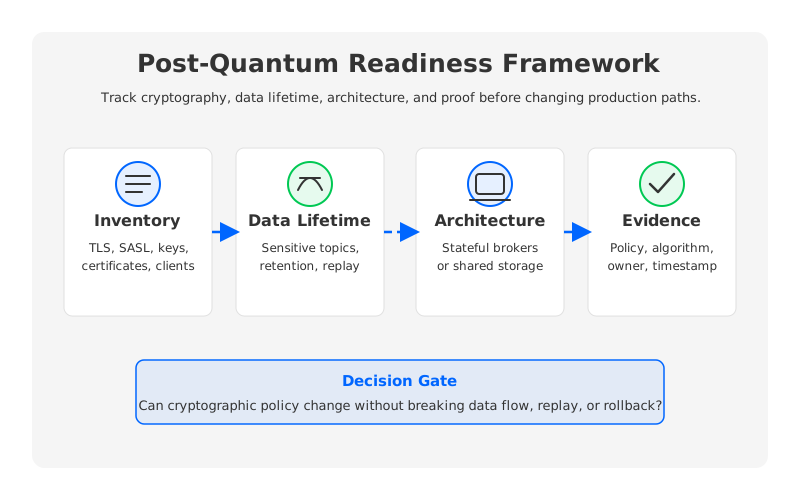
The practical question is not "does this streaming vendor support a post-quantum algorithm?" Production teams need a wider readiness model:
- Inventory: where does the streaming platform use asymmetric cryptography, signatures, certificates, key exchange, or cloud key management?
- Data lifetime: which topics, backups, snapshots, exports, and replay paths carry data whose confidentiality must survive for years?
- Upgrade control: which clients, connectors, libraries, brokers, controllers, proxies, and operators can be upgraded without coordinated downtime?
- Rollback: what happens if an updated cryptographic policy breaks a producer, a consumer group, or a cross-cluster migration?
- Evidence: can the platform prove which algorithm, certificate, identity, and policy protected a given data path at a given time?
That frame turns post-quantum readiness into platform engineering. The cryptographic primitives matter, but the migration surface determines whether the organization can adopt them without freezing its data flows.
2The production constraints behind the search
Traditional Kafka deployments often grow through application demand rather than security architecture. A team starts with a few topics, adds more partitions, enables TLS, introduces ACLs, connects stream processors, and later adds replication, Tiered Storage, observability, and governance layers. Over time, the platform becomes a dependency graph. Security changes are no longer local because every producer and consumer encodes assumptions about endpoints, certificates, client libraries, authentication mechanisms, retry behavior, and timeout budgets.
Shared Nothing architecture amplifies that operational coupling. Brokers own local log storage, partitions are assigned to brokers, and high availability depends on replicated partition data. When a platform team upgrades brokers, replaces nodes, moves partitions, or changes storage policy, the work often touches both compute and persistent data placement. That does not make the architecture wrong; it is the model Kafka used successfully for years. It does mean a crypto migration competes with capacity planning, reassignment windows, recovery behavior, and broker-local retention pressure.
Post-quantum readiness adds three production constraints that platform teams should surface early:
| Constraint | Why it matters for streaming |
|---|---|
| Cryptographic agility | The platform needs a way to change algorithms, certificate chains, libraries, and policy without every application team moving in the same maintenance window. |
| Retention-aware risk | Long-lived topics, exports, object-store copies, and replay workflows may keep sensitive data valuable long after the original produce request. |
| Operational separability | Security upgrades should avoid unnecessary data movement, cluster reshaping, or storage emergencies when the change is mostly about endpoints and policy. |
These constraints explain why a readiness program cannot stop at a TLS checklist. TLS is the visible layer, but streaming platforms also include storage encryption, key rotation, inter-service trust, administrative identity, cloud IAM, connector secrets, and migration tools. A platform that cannot separate those concerns will treat every security improvement as a high-risk infrastructure project.
3Architecture patterns teams usually compare
The baseline pattern is a conventional self-managed Kafka cluster. It gives teams direct control over brokers, listeners, TLS, SASL, ACLs, client policies, network routes, and upgrade timing. That control is valuable for security teams that want to test updated cryptographic stacks in a lab before production. The trade-off is operational burden: every broker upgrade, certificate rotation, listener change, partition movement, and client compatibility issue lands on the platform team.
Managed Kafka services shift some of that operational burden to a provider. That can help when the provider delivers security updates, certificate management, private networking, and compliance evidence faster than an internal team could. It can also reduce direct control. Post-quantum readiness then depends on the provider's roadmap, exposed configuration surface, deployment regions, client compatibility guidance, and support for customer-controlled keys or network boundaries.
Tiered Storage is often evaluated for long-retention workloads because Apache Kafka's Tiered Storage moves older log segments to remote storage while preserving the Kafka log model. That can reduce pressure on broker disks for historical data, which matters for topics with long confidentiality lifetimes. Still, Tiered Storage extends the traditional broker model; it does not automatically make broker replacement, scaling, or security policy changes independent from the hot path.
A Kafka-compatible Shared Storage architecture changes the ownership model. Brokers continue to serve Kafka protocol traffic, but durable stream data is stored in shared object storage rather than being permanently tied to broker-local disks. The platform still needs a low-latency WAL (Write-Ahead Log), caching, metadata management, and strong recovery behavior. The difference is that brokers can behave more like compute nodes, which gives security teams a cleaner place to test endpoint, image, runtime, and policy changes without treating durable data as broker-local baggage.
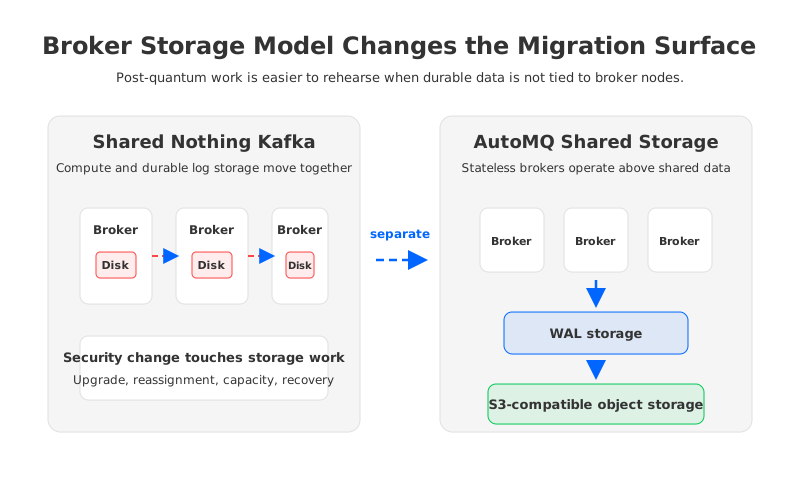
This is not a claim that one architecture magically solves post-quantum migration. Cryptographic readiness still depends on standards, libraries, client support, key management, certificate policy, identity, and evidence. The architecture question is narrower and more practical: when cryptographic policy changes, how much of the streaming platform has to move with it?
4Evaluation checklist for platform teams
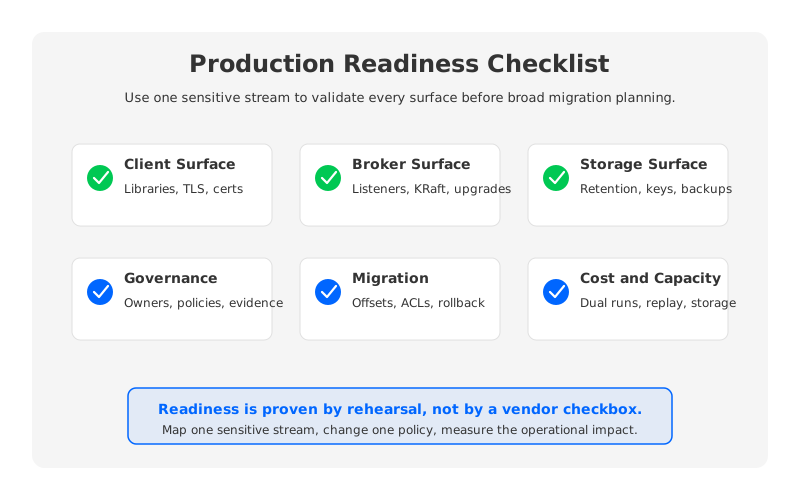
Start with a real data path, not a generic platform diagram. Pick one topic that carries long-lived sensitive data and trace the path from producer to broker, storage, consumer, export, observability, and incident replay. The exercise should include the client library versions, authentication mechanisms, certificate chains, network routes, key management services, storage encryption controls, and operational owners.
The checklist below is intentionally vendor-neutral. It helps teams compare self-managed Kafka, managed Kafka, Tiered Storage designs, and shared-storage Kafka-compatible platforms using the same questions.
| Area | What to track |
|---|---|
| Client surface | Producer and consumer libraries, TLS stacks, SASL mechanisms, mTLS usage, certificate pinning, retry behavior, and supported algorithm updates. |
| Broker and controller surface | Listener configuration, inter-broker communication, administrative APIs, KRaft metadata path, rolling upgrade behavior, and policy rollback. |
| Storage surface | Topic retention, remote storage, object storage encryption, key rotation, snapshots, backups, and exported copies of retained events. |
| Governance surface | Ownership of identities, certificates, cloud IAM, secrets, audit evidence, exception approvals, and compliance mapping. |
| Migration surface | Cross-cluster replication, offset continuity, ACL mapping, schema compatibility, cutover rehearsals, and fallback strategy. |
| Cost and capacity surface | Whether readiness testing requires duplicate clusters, extra broker storage, prolonged dual writes, or excessive historical data movement. |
The last row deserves attention because security programs often underestimate it. A crypto-readiness rehearsal may need a parallel environment, mirrored topics, long-running consumers, replay tests, and additional observability. If the platform's storage model makes every rehearsal expensive, teams will rehearse less. That is not a cryptographic weakness by itself, but it becomes a readiness weakness because untested migration plans are rarely the ones that survive production.
5Where AutoMQ changes the operating model
After the evaluation separates cryptographic readiness from ordinary Kafka administration, AutoMQ becomes relevant as a Kafka-compatible, cloud-native streaming platform built around Shared Storage architecture. AutoMQ keeps Kafka protocol compatibility for producers, consumers, and ecosystem tools while replacing broker-local durable log storage with S3Stream on S3-compatible object storage. WAL storage provides the low-latency persistence path before data is uploaded to object storage, and stateless brokers reduce the amount of persistent data tied to compute nodes.
For post-quantum readiness, the point is not that object storage is a cryptographic primitive. It is not. The point is operational separability. If durable stream data lives in shared object storage and brokers are stateless, platform teams can reason about broker image upgrades, runtime hardening, listener policy, scaling, and failure recovery with less dependency on broker-local data movement. That can make readiness drills more practical: create a test environment, validate Kafka client compatibility, rehearse cutover, prove rollback, and measure operational impact without turning every test into a storage migration.
Deployment boundary also matters. AutoMQ BYOC runs control plane and data plane components in the customer's own cloud account VPC, while AutoMQ Software targets customer-operated private environments. Those models let teams align Kafka data paths, object storage, encryption policy, private networking, cloud audit trails, and key management with their own governance boundary. For security and compliance owners, that boundary is part of readiness evidence because it determines who controls configuration, logs, keys, and infrastructure policy.
AutoMQ-specific capabilities should still be tested, not assumed. Validate Kafka compatibility for your producers and consumers, confirm topic configuration behavior, test authentication and authorization policies, rehearse migration with AutoMQ Linking if you need zero-downtime movement from an existing Kafka cluster, and inspect observability around tail reads and historical reads. Shared Storage architecture changes the operating model, but production trust comes from evidence gathered under the workload you plan to run.
6Decision table for post-quantum planning
Different organizations will land on different timelines. A platform with short-lived data, centralized client ownership, and mature broker operations may start by tightening inventory and certificate automation on the current Kafka estate. A regulated platform with long retention, many independent application teams, and frequent replay requirements may need a deeper architecture review before cryptographic standards become a forced migration.
| Situation | Likely direction |
|---|---|
| Most topics carry short-lived operational data and clients are centrally managed | Improve cryptographic inventory, certificate automation, and upgrade testing on the existing platform. |
| Long-retention topics carry sensitive data but historical reads are rare | Evaluate Tiered Storage, object-storage retention controls, key rotation, and data-classification policy. |
| Security drills require parallel clusters, replay, and long cutover windows | Test migration tooling, offset continuity, and rollback using a representative workload. |
| Broker-local storage makes every upgrade or rehearsal expensive | Evaluate Kafka-compatible Shared Storage architecture with stateless brokers. |
| Governance requires customer-controlled networking, keys, logs, and storage | Include BYOC or private deployment boundaries in the readiness evaluation. |
Post-quantum readiness can look like a future cryptography problem. For streaming teams, it is better treated as an inventory and migration discipline that starts now. The platform has to know where cryptography is used, which data remains sensitive, how clients will upgrade, and how the team will prove that the updated policy protected the right path at the right time.
If your Kafka environment cannot answer those questions without a spreadsheet hunt, start with one sensitive stream and map its cryptographic dependency chain. For teams evaluating whether Shared Storage architecture can make future security transitions less disruptive, the next useful step is to compare your own retention, migration, and governance requirements against AutoMQ's Kafka-compatible operating model: review AutoMQ for cloud-native streaming.
7References
- NIST: NIST Releases First 3 Finalized Post-Quantum Encryption Standards
- NIST FIPS 203: Module-Lattice-Based Key-Encapsulation Mechanism Standard
- NIST FIPS 204: Module-Lattice-Based Digital Signature Standard
- NIST FIPS 205: Stateless Hash-Based Digital Signature Standard
- CISA: Quantum-Readiness: Migration to Post-Quantum Cryptography
- Apache Kafka Documentation: https://kafka.apache.org/documentation/
- Apache Kafka Tiered Storage: https://kafka.apache.org/39/operations/tiered-storage/
- AutoMQ Docs, Architecture Overview: https://docs.automq.com/automq/architecture/overview?utm_source=blog&utm_medium=reference&utm_campaign=post-quantum-readiness-streaming-platforms
- AutoMQ Docs, Compatibility with Apache Kafka: https://docs.automq.com/automq/what-is-automq/compatibility-with-apache-kafka?utm_source=blog&utm_medium=reference&utm_campaign=post-quantum-readiness-streaming-platforms
8FAQ
8.1What is a post quantum streaming platform?
A post quantum streaming platform is a streaming architecture prepared to adopt post-quantum cryptography as standards, libraries, cloud services, and client ecosystems mature. In practice, it needs cryptographic inventory, upgrade control, long-lived data classification, evidence, and migration rehearsal around Kafka-compatible data paths.
8.2Does Kafka need post-quantum cryptography?
Kafka deployments rely on cryptography for TLS, authentication, certificates, cloud networking, storage encryption, and administrative access. Post-quantum readiness does not mean every Kafka cluster must change algorithms immediately. It means teams should identify where public-key cryptography is used and prepare upgrade paths for data whose confidentiality lifetime is long.
8.3How should teams start post-quantum planning for Kafka?
Start with one sensitive topic and trace the producer, broker, storage, consumer, export, and replay path. Record client libraries, TLS stacks, identities, certificates, storage encryption, retention policy, key management, and operational owners. That inventory shows which changes are local and which require cross-team migration.
8.4Is Tiered Storage enough for post-quantum readiness?
Tiered Storage can help long-retention topics by moving older log segments to remote storage, which may improve storage economics and retention control. It does not by itself solve client cryptography, certificate policy, broker upgrade behavior, migration rehearsal, or governance evidence.
8.5Where does AutoMQ fit in post-quantum readiness?
AutoMQ fits as a Kafka-compatible Shared Storage architecture with stateless brokers and S3-compatible object storage. It does not replace cryptographic standards or security process, but it can reduce the operational coupling between durable stream data and broker compute when teams rehearse future security upgrades or migrations.


