
Table of Contents
Table of Contents
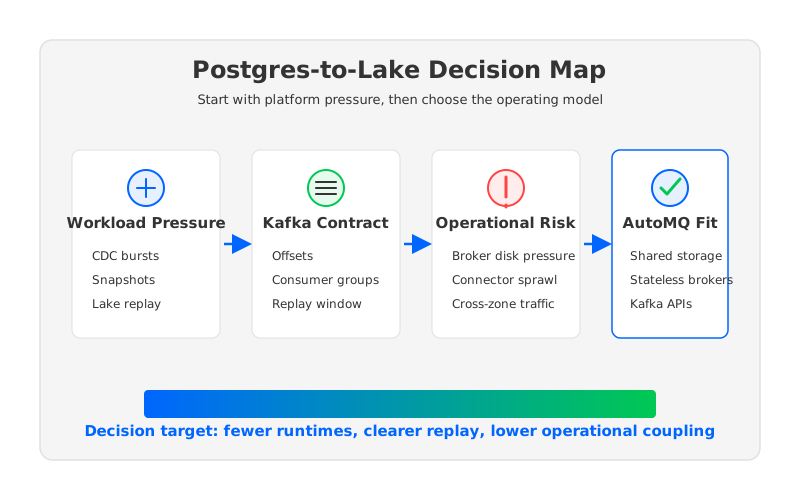
Teams usually search for postgres to lake kafka pipeline after the first version already works. A Postgres change data capture stream is landing in Kafka. A sink connector is writing files to object storage. A lakehouse table is beginning to serve analytics, machine learning features, or operational reporting. The architecture looks reasonable on a whiteboard, but the production system is starting to accumulate more moving parts than the team expected.
The pressure rarely comes from one connector. It comes from the edges between systems: WAL retention in Postgres, connector offsets, Kafka topic retention, schema evolution, object naming, failed file commits, consumer replay, private networking, and ownership boundaries between database, streaming, and lake teams. When each edge gets its own patch, the pipeline turns into connector sprawl. Every source table, downstream lake format, environment, and backfill path adds another runtime to watch.
A durable Postgres-to-lake design should treat Kafka as the operational buffer between change capture and lake ingestion, not as a convenient pipe. CDC is not only about moving rows. It is about preserving ordering assumptions, recovering from partial failures, and replaying history when downstream logic changes.
1Why teams search for postgres to lake kafka pipeline
The search query sounds implementation-focused, but the underlying question is usually architectural: how do we get reliable database changes into a lake without coupling every producer, connector, and table format together? Postgres is the source of truth for many operational systems, while the lake offers cost-effective retention, open formats, analytics, and lower coupling. Kafka sits between them because it gives the organization a replayable log and a familiar integration surface.
The first version often follows a direct pattern. Debezium or another CDC connector reads Postgres logical replication and writes change events into Kafka topics. A sink layer writes those topics to object storage or a table format such as Iceberg. A schema registry, catalog, or transformation job sits nearby to keep the lake readable.
The production version has a different success condition. It must answer questions that a happy-path demo avoids:
- What happens when the lake writer is down for hours? Kafka retention, topic throughput, broker storage, and consumer lag all become part of the recovery budget.
- Can the team replay a table after changing partitioning or file layout? Replay requires stable offsets, enough retained history, and a sink design that can avoid duplicates or make them harmless.
- Who owns schema breaks? CDC events expose database changes quickly, which is useful only when the producer and lake teams agree on compatibility rules.
- Can network boundaries stay private? Production CDC often crosses VPCs, accounts, regions, or data zones, and each boundary changes the security model.
Those questions are platform properties. A pipeline that answers them with a growing list of special-purpose connectors may work for one table, but it becomes hard to reason about across hundreds of tables.
2The operational constraint behind connector-heavy platforms
Connector-heavy platforms usually begin with a reasonable goal: keep each system close to its native integration path. Postgres CDC has a source connector, object storage has a sink connector, and the lakehouse catalog has a writer or compaction job. The problem is that each component stores progress differently, fails differently, and exposes different operational signals.
Kafka is supposed to reduce that coupling by centralizing the event log. But traditional Kafka deployments can push a different kind of statefulness back onto the platform team. Broker-local storage means retained CDC history lives on broker disks. Scaling storage means adding broker capacity or expanding disks. Rebalancing partitions moves data across brokers. Multi-AZ replication sends broker traffic between zones. A long replay by one lake writer can compete with foreground traffic unless capacity planning accounts for catch-up reads.
That is where connector sprawl and broker statefulness reinforce each other. If a sink falls behind, the streaming team may increase retention. More retention raises broker disk pressure, which can trigger partition movement or broker expansion. The connector team may respond by splitting tasks or creating separate pipelines for large tables. Each local fix is defensible, but the whole system becomes harder to operate.
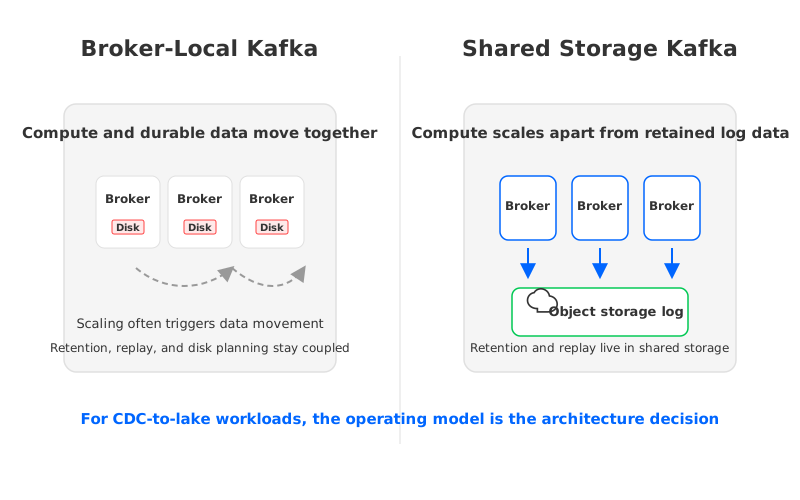
The key trade-off is not whether Kafka should be in the design. For many CDC-to-lake workloads, a Kafka-compatible log is the right abstraction. The trade-off is whether the Kafka layer behaves like a storage appliance that must be nursed table by table, or like a shared streaming substrate for durability, replay, and scaling.
3Failure handling, schema, and replay trade-offs
Postgres-to-lake pipelines fail in ways that look small until they combine. A source connector may stop because a replication slot is lagging or a schema change cannot be serialized. A Kafka topic may retain less history than a downstream reprocessing job needs. A sink connector may write duplicate files after a task restart. Each failure creates a question about where truth lives.
The safest design makes three state boundaries explicit. Postgres owns transactional truth. Kafka owns change-event ordering, offsets, and replay windows. The lake owns analytic layout, table snapshots, compaction, and query semantics. Blurring those boundaries creates fragile recovery plans. If Kafka retention is too short, the team has to return to Postgres snapshots or backups for backfill.
This is also where exactly-once language needs care. Kafka supports idempotent producers and transactions, and Kafka Connect has its own offset and task model. A lake sink may offer idempotent writes, transactional table commits, or deduplication by primary key. These guarantees are valuable, but they do not erase the need to test connector restarts, task rebalances, catalog timeouts, and schema changes with the actual tools in the pipeline.
A useful production review asks for evidence instead of labels:
| Concern | What to verify | Why it matters |
|---|---|---|
| Source continuity | Replication slot behavior, initial snapshot policy, and connector offset storage | Prevents silent gaps when Postgres or the source connector restarts |
| Kafka replay | Topic retention, committed offsets, consumer group reset workflow, and catch-up read capacity | Makes downstream reprocessing a planned operation instead of an incident |
| Lake writes | File commit semantics, partitioning, table snapshot behavior, and duplicate handling | Keeps analytic tables consistent after retries and partial failures |
| Schema governance | Compatibility rules, owner approval, registry workflow, and breaking-change alerts | Stops database changes from becoming lake outages |
| Rollback | Cutover plan, replay boundary, connector pause/resume, and legacy pipeline coexistence | Gives teams a way back when the target path behaves differently |
The point of this table is to prevent hidden state from becoming tribal knowledge. Once each boundary has an owner and a testable recovery path, the platform can reduce connector count without reducing control.
4Evaluation checklist for platform teams
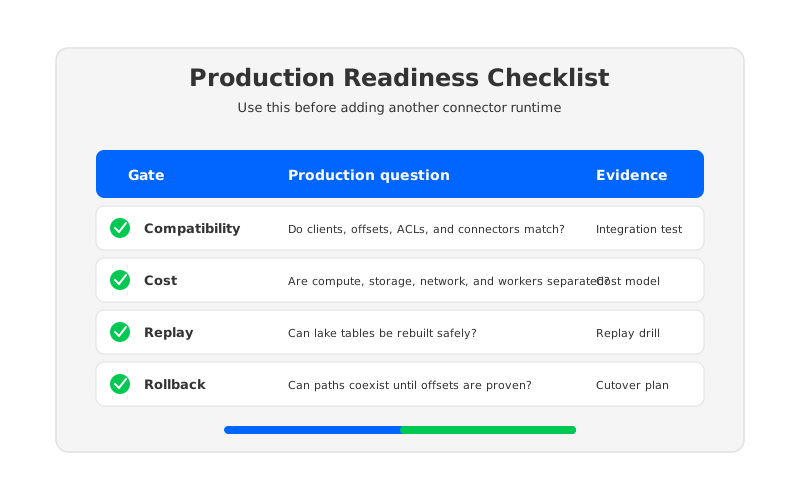
A Postgres-to-lake Kafka pipeline should be evaluated as a platform decision, not as a connector procurement exercise. The better question is "Which operating model lets us add tables, replay data, change schemas, and recover failures without multiplying bespoke runtimes?"
Start with compatibility. The Kafka layer should support the client behavior, consumer group semantics, offsets, transactions, ACLs, monitoring tools, and Kafka Connect patterns that the organization already depends on. If the platform requires client rewrites or connector-specific workarounds, migration risk moves from the data platform team to every application team that touches the log.
Then evaluate cost as a function of workload shape. CDC traffic is bursty because database writes are bursty, snapshots can be large, and downstream replays happen at inconvenient times. A cost model should include broker compute, durable storage, object storage requests, cross-AZ traffic, private connectivity, connector workers, observability volume, and operational time.
Governance deserves the same treatment. A pipeline that writes raw CDC topics, curated topics, and lake tables should define data classes, retention rules, schema ownership, encryption, access control, and audit evidence. Once a raw change event lands in a lake, access policy and deletion requirements become harder to retrofit.
The final checklist should be short enough to use in a design review:
- Compatibility: Can existing Kafka clients, connectors, schemas, ACLs, observability, and admin automation run without semantic surprises?
- Elasticity: Can the platform absorb snapshots, bursty CDC, and lake replays without long partition movement or emergency disk expansion?
- Cost control: Are storage, compute, cross-zone traffic, connector workers, and object storage operations modeled separately?
- Failure recovery: Can teams pause, resume, replay, and roll back with documented offset and table boundaries?
- Governance: Are schema, data classification, encryption, private networking, and audit controls enforced before the lake becomes the system of record for analytics?
- Team boundaries: Does the architecture let database, streaming, and lake teams own their layers without debugging one another's runtime state?
5How AutoMQ changes the operating model
If the evaluation points toward Kafka compatibility but away from broker-local storage as the long-term operating model, a shared-storage Kafka-compatible architecture becomes interesting. AutoMQ fits that category: it keeps the Kafka API and ecosystem contract while redesigning the storage layer around object storage and stateless brokers. For Postgres-to-lake pipelines, that changes the question from "How many brokers and disks do we need for every replay window?" to "How should we separate compute, durable history, and lake ingestion responsibilities?"
AutoMQ's Shared Storage architecture moves Kafka log storage into object storage through its S3Stream layer, with WAL options used for low-latency writes before data is persisted to object storage. Broker nodes become largely stateless, so scaling compute is less tied to moving retained data between brokers. That matters for CDC because long retention and replay are normal parts of schema migration, lake table redesign, feature backfill, and incident recovery.
The architectural benefit is practical rather than cosmetic. A source connector can keep writing Kafka-compatible topics. A lake writer can consume from Kafka with familiar offsets and consumer group behavior. The platform team can reason about retained history on object storage, broker compute around active traffic, and connector workers around source and sink throughput. Those are still engineering decisions, but they are no longer forced into one broker-local disk budget.
AutoMQ's cloud deployment model is also relevant because data boundaries matter. BYOC and private deployment options let teams keep infrastructure in customer-controlled cloud accounts or private environments, while Kafka compatibility keeps the connector and client ecosystem familiar. For multi-AZ deployments, AutoMQ documents an inter-zone traffic optimization model designed to reduce cross-zone data transfer by using S3-based shared storage and zone-aware access paths.
There is another important boundary: AutoMQ does not remove the need to design CDC semantics. You still need schema rules, source snapshot plans, lake commit guarantees, connector observability, and rollback workflows. What changes is the cost of keeping those controls disciplined. When storage and broker compute can scale independently, the platform team has more room to standardize pipelines instead of creating one-off connector fleets for each replay, table group, or retention exception.
For teams that want to evaluate this path, the useful proof of concept is not a produce-consume demo. Use a representative Postgres table set, a real CDC connector, realistic topic retention, a lake sink, a schema change, a forced connector restart, and one replay exercise. Measure throughput and operator actions: how many systems were touched, how offsets were proven, and whether lake output stayed correct.
6Migration scorecard
A migration scorecard turns the architecture review into a decision the organization can defend. Give each row a status of green, yellow, or red, and require a written remediation plan for every red item before production cutover.
| Area | Green signal | Red signal |
|---|---|---|
| Source CDC | Replication slots, snapshots, schema changes, and connector offsets are tested | Initial load and streaming mode have different undocumented recovery paths |
| Kafka layer | Compatibility, retention, replay, ACLs, and observability match production needs | The platform passes a simple client test but fails connector or admin workflows |
| Lake ingestion | Retries, duplicate handling, table commits, and compaction are rehearsed | File output is correct only under uninterrupted sink execution |
| Cost model | Compute, storage, object operations, networking, and connector workers are separated | Capacity is planned only from average daily change volume |
| Rollback | Legacy and target paths can coexist until offsets and lake output are verified | Cutover assumes a one-way switch |
This scorecard is deliberately operational. A Postgres-to-lake pipeline succeeds when it keeps changing safely after launch. Tables will appear, schemas will evolve, consumers will ask for backfills, and incidents will happen across the source, streaming layer, and lake. The architecture that ages well gives teams fewer places to improvise.
If your current postgres to lake kafka pipeline is already showing signs of connector sprawl, start by testing the Kafka compatibility and replay boundary rather than adding another runtime. AutoMQ's Kafka-compatible shared-storage architecture is one option worth evaluating for that specific operating model. A practical next step is to review the AutoMQ compatibility documentation and run a PoC that includes CDC restart, lake replay, and rollback evidence, not only a throughput benchmark.
7References
- Apache Kafka Documentation
- Kafka Connect Documentation
- Debezium PostgreSQL Connector Documentation
- Amazon S3 User Guide
- AutoMQ Compatibility with Apache Kafka
- AutoMQ Shared Storage Architecture Overview
- AutoMQ S3Stream Shared Streaming Storage
- AutoMQ Inter-Zone Traffic Overview
- AutoMQ Table Topic Overview
8FAQ
8.1Is Kafka required for a Postgres-to-lake pipeline?
No. Some teams use direct ELT tools or database-to-lake connectors. Kafka becomes valuable when multiple downstream consumers need the same change stream, when replay matters, when source and sink teams need decoupling, or when the organization already standardizes on Kafka-compatible infrastructure for streaming workloads.
8.2What is connector sprawl in CDC pipelines?
Connector sprawl is the accumulation of source connectors, sink connectors, custom tasks, recovery scripts, and one-off runtimes that each solve a local problem but make the whole pipeline harder to operate. It usually appears when replay, schema changes, retention exceptions, or downstream lake formats are handled per pipeline instead of through shared platform rules.
8.3How much Kafka retention should a Postgres-to-lake pipeline keep?
Retention should be based on recovery objectives, replay needs, source snapshot cost, and downstream lake rebuild requirements. A pipeline that must replay a table after a schema or layout change needs enough Kafka history to cover that operation, or it needs a documented fallback to a Postgres snapshot or backup.
8.4Does shared storage replace lake sink connectors?
No. Shared storage changes how the Kafka-compatible streaming layer stores and scales log data. Lake sink connectors, stream processors, or table writers still decide how records become files, table snapshots, partitions, and queryable lake data.
8.5What should a production PoC include?
Use real CDC sources, representative schemas, realistic topic retention, the intended lake sink, private networking, monitoring, a connector restart, a schema change, a replay exercise, and a rollback plan. A PoC that only produces and consumes records is not enough for a production Postgres-to-lake decision.


