
Table of Contents
Table of Contents
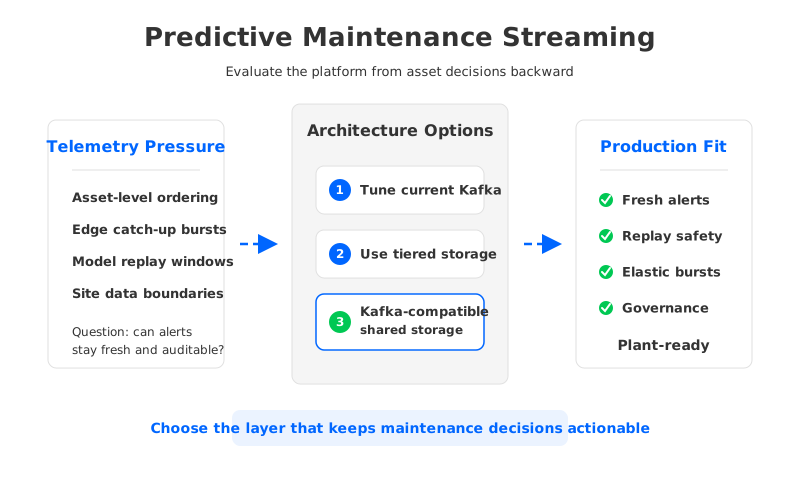
Teams search for predictive maintenance streaming when the maintenance model is no longer the hard part. The first pilot usually proves that vibration, pressure, temperature, acoustic, or current readings can predict a likely failure. The production problem appears later: the model needs fresher signals, the plant needs fewer false alarms, the data team needs replayable history, and the platform team has to absorb sensor bursts without turning them into capacity incidents.
That is where streaming architecture becomes a maintenance decision, not only a data-platform decision. A predictive maintenance system has to preserve event order, tolerate intermittent devices, enrich telemetry with asset metadata, and trigger alerts fast enough for a technician to act. Batch ingestion may still help long-term analytics, but the operational loop depends on events arriving while the machine state is still relevant.
1Why predictive maintenance streaming is different from generic IoT ingestion
Generic IoT ingestion often optimizes for collecting device messages at scale. Predictive maintenance cares about what those messages mean for a physical asset under production pressure. A pump does not fail because one metric crossed a threshold; it fails because signals, workload, maintenance history, and context point toward degradation. The streaming system has to keep those signals close enough in time for detection logic to make sense.
That requirement changes the shape of the pipeline. Raw telemetry may arrive through MQTT, OPC UA gateways, industrial historians, edge collectors, or cloud IoT services. The streaming layer then has to normalize those signals, join them with asset metadata, route them to feature generation, and retain history for model retraining and incident review. The same event stream may serve alerting, a digital twin, a feature store, and a reliability dashboard.
The architecture gets uncomfortable when teams treat that path as a thin transport layer. Transport is necessary, but predictive maintenance also needs:
- Temporal consistency. Events from the same asset should be processed in a predictable order, with a clear way to reason about late or duplicate readings.
- Replayable history. Model changes, feature changes, and root-cause analysis often require replay from known offsets rather than ad hoc data exports.
- Elastic fan-out. Data scientists, reliability engineers, operations tools, and AI assistants may consume the same telemetry at different rates.
- Governed data movement. Industrial telemetry can reveal production volume, maintenance practices, and site-level operational patterns, so access boundaries matter.
Kafka-compatible streaming is attractive because these mechanics already exist in the Kafka ecosystem: topics, partitions, offsets, consumer groups, retention, and mature connectors. The question is how to run them when the workload is continuous, bursty, and tied to physical operations.
2The production constraints behind the search
A prototype pipeline can publish sensor readings to a topic, consume them with a stream processor, and trigger an alert when a model score crosses a threshold. Production systems have to survive less polite behavior. A line may emit steady telemetry most of the day, then create bursts during shift changes, calibration windows, or abnormal states. Edge connectivity may drop and recover, producing catch-up traffic. A new model version may require reprocessing weeks of telemetry.
These are not edge cases. They are the normal operating profile of predictive maintenance, which is why the streaming platform has to be evaluated as a system of record for machine signals.
| Constraint | Why it matters for predictive maintenance | Architecture question |
|---|---|---|
| Freshness | Alerts lose value when they arrive after the maintenance window has passed. | Can consumers keep up during telemetry bursts and edge catch-up? |
| Ordering | Asset-level patterns depend on the sequence of readings and derived events. | Are partitioning and key strategy aligned with asset identity? |
| Replay | Feature logic, model versions, and thresholds change over time. | Can teams replay from offsets without destabilizing live traffic? |
| Governance | Plant telemetry can be operationally sensitive. | Can access, residency, audit, and deletion workflows be enforced? |
| Cost | Retention and fan-out can dominate the bill after the pilot succeeds. | Does storage and network cost grow predictably with history and consumers? |
The table is a failure-mode checklist, not a vendor checklist. If the platform cannot replay safely, a model migration becomes a risky one-off project. If it cannot isolate consumers, a slow analytics job can interfere with alerting. If storage cost makes long retention painful, the team loses the history needed to improve the model.
3Architecture patterns teams usually compare
Most teams start with a conventional Kafka deployment because Kafka is already the event backbone for telemetry, CDC, operational events, and data products. In the traditional shared-nothing architecture, brokers own local log storage, partitions are replicated across brokers, and durability comes from in-sync replicas. This model is proven, and it gives predictive maintenance pipelines the Kafka semantics they need. It also couples storage, broker capacity, and replication traffic.
That coupling matters when telemetry history grows. Longer retention means more broker storage. More brokers can improve capacity, but they may also require partition reassignment and data movement. Replication across availability zones improves resilience, but it turns durability traffic into cloud network traffic. Traditional Kafka can still be the right choice; the team should know which part of the maintenance workload will push the platform first.
Tiered storage is a common improvement. Older log segments can move to object storage while brokers keep hot data locally. For predictive maintenance, that can reduce long-retention pressure. The trade-off is that active data is still broker-local, so scaling and recovery may continue to involve broker storage and partition movement. If the main pressure is old-history retention, tiered storage may be enough. If the main pressure is elastic capacity and replay-heavy operations, the team may need a deeper change.
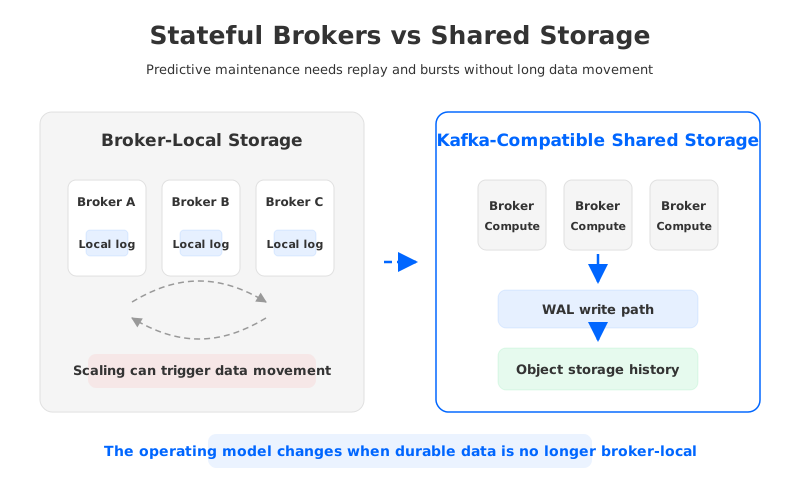
Kafka-compatible shared storage changes the operating model by separating broker compute from durable stream storage. Brokers still speak Kafka protocol and preserve Kafka-facing semantics, but durable data lives in shared storage rather than being permanently bound to broker-local disks. A write-ahead log handles the low-latency write path, while object storage provides the durable data plane. The result is closer to stateless broker operations: capacity changes and broker recovery are less dominated by copying partition data from one disk fleet to another.
This distinction matters because the workload is not only high-volume. It is uneven. A plant rollout, model backtest, equipment incident, or edge reconnect can create temporary pressure that should not force a long storage reshuffle. The platform should absorb bursts, keep live alerts moving, and make replay a controlled operation.
4Build the pipeline from asset identity backward
The most useful design starting point is not the broker count. It is the asset key. Predictive maintenance streams should usually partition by stable asset identity, line identity, or equipment group so related readings can be processed in order. That does not solve every late-data problem, but it gives the stream processor a coherent unit of work and gives downstream systems a way to trace a recommendation back to source events.
A production pipeline often looks like this:
- Edge collectors or cloud IoT services ingest raw equipment signals and normalize timestamps, units, and device identifiers.
- Kafka-compatible topics separate raw telemetry, enriched asset events, model features, anomaly scores, and maintenance actions.
- Stream processors join telemetry with asset metadata and calculate rolling features, windows, and model inputs.
- Alerting, ticketing, digital twin, lakehouse, and AI assistant consumers read from the same durable event history through independent consumer groups.
- Replay workflows reprocess historical windows when models, feature definitions, or governance policies change.
This shape keeps the streaming platform central without making it a monolith. Each consumer group can advance at its own pace. Each topic can carry a different retention and governance policy. Each downstream workflow can be tested against the same event history. Kafka offsets become more than operational counters; they become the audit trail for how a model-driven recommendation was produced.
5Evaluation checklist for platform teams
Before selecting a platform, test the behaviors that will break the system after the proof of concept. Run a replay while live telemetry is flowing. Add a slow consumer. Simulate edge catch-up after an outage. Replace a broker. Roll the stream processor version. Then watch freshness, lag, recovery time, and cloud network traffic, not only peak throughput.
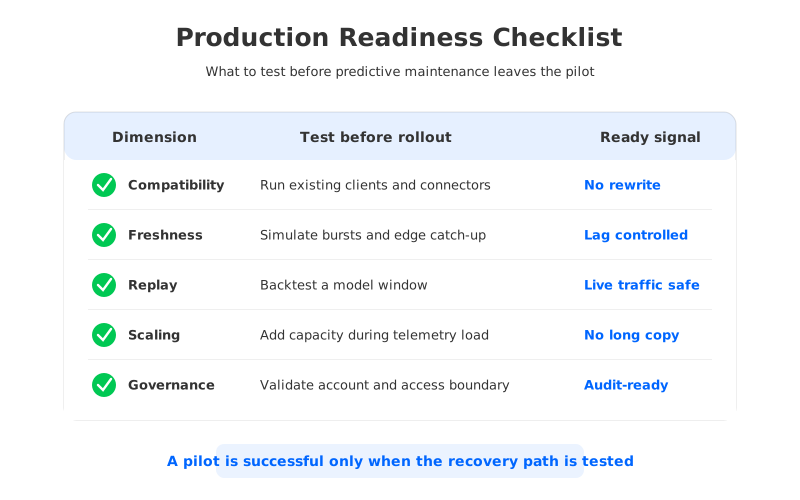
Compatibility should be the first gate. Kafka compatibility should cover client behavior, partition semantics, offsets, consumer groups, idempotent producers, transactions when needed, connectors, and observability conventions. A predictive maintenance architecture usually integrates plant systems, cloud services, data science tools, and operational applications. Rewriting producers and consumers is rarely the best use of engineering time.
Retention and replay are the next gate. Predictive maintenance improves through iteration: feature logic changes, models are retrained, thresholds are adjusted, and false positives are investigated. The platform should make retention cost transparent and replay safe. A team should know whether catch-up reads compete with live alerts, whether history sits on broker disks or object storage, and how long broker recovery takes.
Governance deserves the same priority. Industrial data can reveal production schedules, equipment utilization, and site-level patterns. Teams should evaluate account boundaries, network isolation, access control, audit logs, and deletion processes before expanding from a pilot to multiple sites. If data cannot cross a boundary, the architecture has to respect that boundary by design rather than by exception.
6Where AutoMQ changes the operating model
Once those constraints are clear, AutoMQ is worth evaluating as a Kafka-compatible, cloud-native option rather than as a replacement for the whole maintenance stack. AutoMQ keeps Kafka protocol compatibility while moving the storage architecture toward shared storage: stateless brokers, WAL storage for the write path, and S3-compatible object storage for durable stream data. That changes the infrastructure layer underneath producers, consumers, connectors, and stream processors without forcing the application architecture to abandon Kafka-facing APIs.
For predictive maintenance, the fit is strongest when replay, retention, and elastic operations are becoming recurring concerns:
- Kafka-compatible integration path. Existing Kafka clients, stream processors, and connector-oriented workflows remain the center of the architecture, which lowers migration friction for industrial data teams.
- Shared Storage architecture. Durable stream data is stored in S3-compatible object storage, making long retention and replay less tied to broker-local disk expansion.
- Stateless broker operations. Broker replacement and scaling are less dominated by partition data copying, which helps when telemetry bursts or model backtests create temporary capacity pressure.
- Customer-controlled deployment options. AutoMQ BYOC and AutoMQ Software can fit environments where cloud account, VPC, storage, and operational boundaries are part of the governance model.
This is not an argument that every predictive maintenance project needs a new streaming platform. A small deployment with stable telemetry, short retention, and a simple alerting path may be better served by tuning the current Kafka environment. AutoMQ becomes more relevant when storage grows faster than expected, replay interrupts live operations, broker changes trigger data movement, or governance pushes the team toward a customer-controlled boundary.
7Decision table: optimize, redesign, or evaluate shared storage
The decision should follow the operating pressure. If the current Kafka deployment is healthy, start with topic design, key strategy, consumer lag monitoring, schema discipline, and replay runbooks. If the workload keeps pushing broker storage and partition movement, redesign the storage model. If governance limits where telemetry can live, choose an architecture that respects that boundary from the beginning.
| Situation | Best next move | Why |
|---|---|---|
| One line, one alerting workflow, short retention | Optimize the current Kafka deployment. | Keep scope small and prove the maintenance loop before changing the platform. |
| Multiple sites with independent consumers and model teams | Strengthen topic, schema, and consumer-group governance. | Fan-out and ownership become harder than ingestion volume alone. |
| Frequent model backtests and feature reprocessing | Redesign retention and replay around shared storage. | Historical reads should not destabilize live telemetry processing. |
| Broker scaling or replacement causes long data movement | Evaluate stateless broker architecture. | Capacity operations should not depend on copying large local logs. |
| Plant telemetry must remain inside a controlled cloud boundary | Evaluate BYOC or software deployment models. | Security review is easier when account, VPC, and storage boundaries are explicit. |
Predictive maintenance streaming is really a question about operational time. Can the platform move fast enough for maintenance decisions, retain enough history to improve models, and remain stable enough for plant operations to trust it? If broker-local storage, replay friction, or cloud network cost is slowing that loop, AutoMQ offers a Kafka-compatible path to evaluate shared-storage streaming without throwing away the Kafka ecosystem you already use.
8References
- Apache Kafka Documentation
- Apache Kafka Consumer Groups and Offsets
- Apache Kafka Transactions
- Apache Kafka KRaft Mode
- AWS IoT SiteWise Documentation
- Azure IoT reference architecture
- AutoMQ Architecture Overview
- AutoMQ Native Apache Kafka Compatibility
- AutoMQ Stateless Broker
- AutoMQ Zone Traffic Optimization
9FAQ
9.1Is Kafka required for predictive maintenance streaming?
No. Predictive maintenance can be built with several streaming and IoT ingestion technologies. Kafka-compatible streaming becomes attractive when teams need durable event history, ordered partitions, independent consumer groups, replay from offsets, and a large ecosystem of connectors and stream processors. The more downstream consumers and replay workflows you have, the more valuable those mechanics become.
9.2How should sensor events be partitioned?
Partition by a stable identity that matches the way maintenance decisions are made, usually asset ID, equipment group, or production line. The goal is to keep related readings in a predictable sequence for windowed features and anomaly detection. Very high-cardinality or uneven assets may require a more careful key strategy, but random partitioning usually makes root-cause analysis and replay harder.
9.3When is tiered storage enough?
Tiered storage can be enough when the main pressure is retaining older Kafka log segments at lower storage cost. It may not solve the full problem if live scaling, broker replacement, and active replay are still dominated by broker-local storage and partition data movement. Platform teams should test the actual replay and failure scenarios before assuming retention alone is the bottleneck.
9.4Where does AutoMQ fit in a predictive maintenance architecture?
AutoMQ fits at the Kafka-compatible streaming platform layer. It does not replace edge collectors, model training, stream processing, alerting, or maintenance applications. Its role is to provide Kafka-compatible APIs with a Shared Storage architecture and stateless broker operations, which can help when retention, replay, elasticity, and customer-controlled deployment boundaries become important.


