
Table of Contents
Table of Contents
Privacy review gets harder when personal data stops living in one database and starts moving through event streams. A topic might carry user identifiers, device metadata, payment decisions, support actions, fraud signals, or application logs that were never designed as a regulated data product. The engineering team sees a normal Kafka topic. The privacy team sees a processing activity with retention, access, residency, purpose limitation, and audit questions attached to every downstream consumer.
That gap is why teams search for privacy review workflow kafka before an event-driven application reaches production. They are not looking for a generic compliance lecture. They need a workflow that fits how Kafka-compatible platforms actually run: producers evolve schemas, consumers appear over time, offsets define replay behavior, retention settings change the exposure window, and migration plans can create duplicate data paths if they are not reviewed carefully.
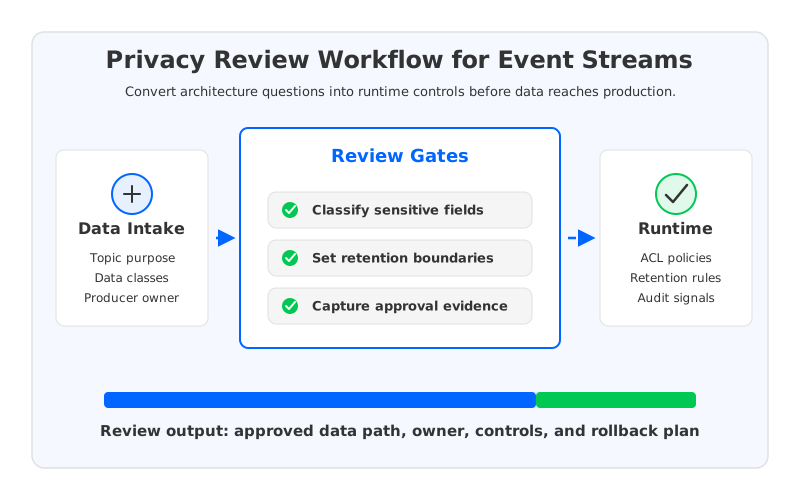
The useful starting point is to treat privacy review as an operating model, not a ticket template. A review should answer four concrete questions before the topic becomes a dependency for other teams: what data enters the stream, who can read it, how long it remains recoverable, and what evidence proves that the answer stayed true after deployment. In event-driven systems, those answers must survive scale, failure, schema evolution, and platform migration.
1Why Privacy Review Looks Different in Kafka
Kafka changes the privacy review problem because it separates data production from data consumption. A relational application often has a clear owning service and a visible query path. An event stream can have many consumers with different purposes, different retention requirements, and different operational owners. Consumer groups make this powerful because each group tracks its own progress through offsets, but the same feature also means that replay is part of the platform contract rather than an exception path.
That replay capability is valuable for recovery, backfills, and additional analytics use cases. It also changes the review question. A privacy reviewer should not only ask whether a consumer can read a record today. They should ask whether a later consumer can reprocess historical records, whether a retained topic still matches the original purpose, and whether deleted or minimized data in source systems remains recoverable from the stream.
Three Kafka mechanics deserve explicit review:
- Topic and schema ownership. A topic name is not enough evidence. Reviewers need the producer owner, business purpose, field-level classification, schema compatibility policy, and the expected set of consumers.
- Retention and replay. Retention is a privacy control as much as an availability control. Longer retention increases recovery options, but it also increases the time window in which personal data remains available for replay.
- Authorization and consumer boundaries. Kafka ACLs and identity integration can restrict access, but access review must cover service accounts, connector identities, operational users, and emergency procedures.
The mistake is to perform review once at topic creation and then assume the system remains reviewed. Event-driven applications keep changing. Consumers are added because the stream is useful. Schemas gain fields because product teams need more context. Retention grows because backfills become operationally convenient. A privacy workflow that cannot detect those changes becomes paperwork detached from the system it is supposed to govern.
2The Production Constraint Behind the Workflow
The practical constraint is that privacy controls must work during normal operations, not only during design review. A topic may pass an architecture review with a clean data classification, but the platform still needs to handle broker replacement, partition expansion, consumer lag, failover, and incident investigation. Every operational action can affect where data moves, how long it remains available, and who can observe it.
Traditional Kafka deployments make this more complicated because brokers are stateful. Broker-local storage is not only an implementation detail; it becomes part of the privacy and recovery boundary. When data is replicated between brokers, moved during partition reassignment, or restored after disk failure, platform teams need to know whether the movement stays inside approved networks, regions, accounts, and operational procedures.
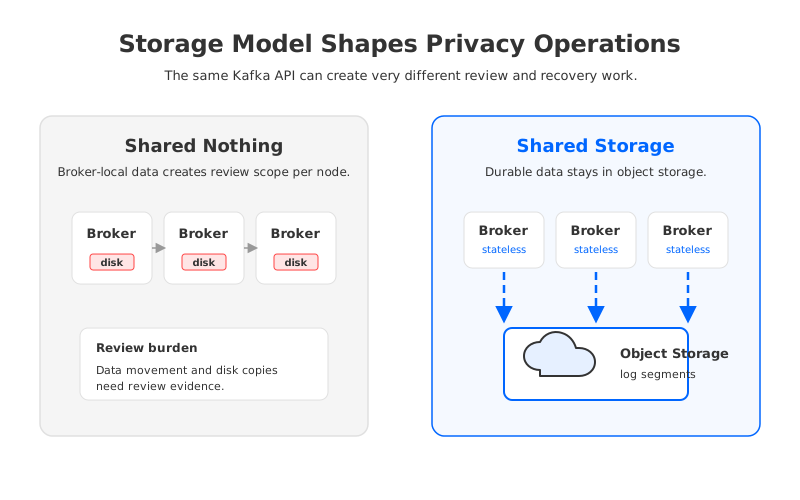
This is where architecture starts to matter. A review workflow should evaluate the platform model behind the Kafka API. Shared-nothing Kafka ties durable data to broker disks, so capacity planning, rebalance operations, and disk lifecycle management all become part of the evidence trail. A shared-storage design separates compute from durable storage, so brokers can be treated more like replaceable compute while the data boundary is governed around object storage, write-ahead logging, networking, and access controls.
Neither model removes the need for privacy review. The difference is where the review work lands. In a stateful broker model, teams spend more review effort on local disk copies, replica movement, and scaling events. In a shared-storage model, teams spend more effort validating storage account ownership, network paths, encryption, metadata controls, and the operational boundary between control plane and data plane. That shift is useful only if the workflow makes it explicit.
3A Practical Privacy Review Workflow for Kafka-Compatible Platforms
A privacy review workflow for event streams should be close enough to engineering reality that teams can run it before every production launch, not only during annual audits. The workflow below is intentionally platform-neutral. It works for self-managed Kafka, managed Kafka, BYOC deployments, and cloud-native Kafka-compatible systems.
| Review step | Engineering evidence | Privacy question |
|---|---|---|
| Data intake | Topic purpose, producer owner, schema, sample records | What personal or sensitive data enters the stream? |
| Runtime access | ACLs, service accounts, connector identities, break-glass policy | Who can read, write, administer, or replay the data? |
| Retention and replay | Topic retention, compaction policy, backup path, consumer lag policy | How long can records be recovered or reprocessed? |
| Infrastructure boundary | Region, VPC, storage account, key ownership, network path | Where does the data physically and operationally move? |
| Change control | Schema review, consumer onboarding, migration plan, rollback path | What changes require privacy re-approval? |
The table is deliberately short because privacy review fails when it becomes a 60-question document that nobody can connect to production behavior. Each row should map to evidence that already exists in platform automation: topic manifests, Terraform modules, IAM policies, Kafka ACLs, schema registry history, deployment approvals, observability dashboards, and incident records.
The most important workflow decision is the approval trigger. Topic creation is only one trigger. Adding a field that changes data classification should trigger review. Extending retention should trigger review. Adding a sink connector to a warehouse, search index, or AI feature store should trigger review. Moving the platform to a different deployment model should trigger review because the data boundary changes even when the application code does not.
4Architecture Options and Trade-Offs
Platform teams usually compare four deployment patterns when they design privacy-sensitive streaming infrastructure. Self-managed Kafka gives the team direct control, but it also leaves them responsible for disk lifecycle, patching, balancing, upgrades, and disaster recovery evidence. A cloud-provider managed Kafka service reduces some operational burden, but the data plane, networking model, scaling limits, and cost model still need review. A SaaS Kafka service can simplify adoption, but regulated teams must inspect where data is processed, how support access works, and whether private networking and residency controls fit policy.
BYOC and customer-controlled deployments sit in a different part of the design space. The provider may operate or automate the platform, but the data plane runs in the customer cloud account or controlled environment. For privacy review, this model is attractive when the organization needs clearer evidence around VPC boundaries, storage account ownership, cloud IAM, data residency, and procurement controls. It does not remove operational responsibility; it changes how responsibility is divided.
The evaluation should not stop at deployment labels. Ask what the architecture does under pressure:
- During a broker failure, does recovery copy large volumes of data across zones or rebuild local disks, or can compute be replaced while durable data remains in shared storage?
- During a retention increase, does the platform require more broker-local capacity, or can storage scale independently from compute?
- During a consumer audit, can the team identify every identity that can read historical records, including connectors and operational tooling?
- During migration, can the team run dual paths, compare offsets, and roll back without creating an unreviewed duplicate processing activity?
This is the point where AutoMQ enters the discussion naturally. AutoMQ is a Kafka-compatible cloud-native streaming platform that uses shared storage and stateless broker architecture to change the operating model behind the Kafka API. For privacy-sensitive workloads, the relevant claim is not that a product makes compliance automatic. The useful architectural property is that durable data can be governed around object storage and customer-controlled deployment boundaries while broker compute scales and recovers with less state attached to each node.
That distinction matters in review meetings. Privacy teams care about evidence. Platform teams care about operability. Finance teams care about cost exposure from over-provisioned disks, replication traffic, and idle capacity. A Kafka-compatible shared-storage architecture gives those teams a common object of review: where durable data lives, which identities can access it, which network paths carry it, and how compute changes affect the approved boundary.
5Evaluation Checklist for Platform Teams
The checklist below is a practical gate for any event-driven application that carries personal, sensitive, or regulated data. It is written for platform teams because the evidence usually lives in platform systems, not in privacy documents.
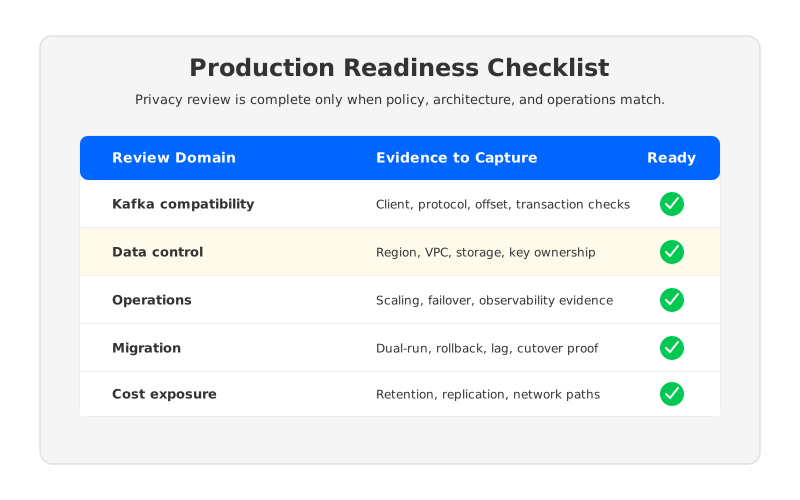
First, validate compatibility before discussing governance. If the platform claims Kafka compatibility, test the application behavior that affects privacy and recovery: producer idempotence where used, consumer group behavior, offset commits, transactions where required, client version support, and connector behavior. A migration that changes these semantics can create invisible review problems because downstream systems may replay, skip, or duplicate records differently than expected.
Second, turn data classification into controls. A field marked sensitive should map to a topic-level policy, schema review rule, access boundary, and retention decision. If the classification lives only in a spreadsheet, it will drift. The workflow should store enough metadata for automation to catch risky changes, such as an added field in an event envelope or another consumer group attached to a restricted topic.
Third, review cost as a governance risk. Cost is not usually framed as privacy work, but uncontrolled cost drives bad privacy decisions. Teams shorten review cycles to ship faster, extend retention because storage planning is painful, or avoid proper dual-run migration because capacity is expensive. A platform that scales storage and compute independently can reduce some of that pressure, but the review still needs explicit cost guardrails.
Fourth, make rollback part of the privacy plan. If a consumer mishandles data, can the team revoke access, stop replay, identify affected offsets, and preserve evidence for incident review? If a platform migration is rolled back, do duplicate topics or connectors remain? Privacy review should include the operational path back to a known-good state, not only the happy path to launch.
6How AutoMQ Changes the Operating Model
AutoMQ's role in this framework is architectural rather than procedural. It keeps Kafka protocol compatibility while moving durable stream storage toward a cloud-native shared-storage model. Brokers become less tied to local disks, and object storage becomes the durable data layer. For platform teams, that changes the questions they bring to privacy review.
The first change is evidence concentration. Instead of reviewing many broker-local copies as the main durability boundary, teams can focus on the customer-controlled storage layer, networking, encryption, and deployment account. That is especially relevant for BYOC and private deployments where security teams want cloud-native evidence from their own environment.
The second change is operational elasticity. Privacy review often gets blocked by operational fragility: teams hesitate to right-size, rebalance, or isolate workloads because stateful changes are risky. Stateless broker operation can make compute changes less disruptive, which helps teams keep approved boundaries aligned with real workload growth rather than freezing old capacity decisions.
The third change is migration review. Kafka compatibility means teams can plan migration around familiar clients, topics, consumer groups, and operational checks. The privacy workflow still needs dual-run evidence, topic mapping, access mapping, and rollback criteria, but it does not need to treat every application as a rewrite. That lowers migration risk without pretending that migration is only a tooling exercise.
AutoMQ should still be evaluated with the same checklist as any other platform. Review the official Kafka compatibility documentation, deployment model, storage architecture, network path, access controls, observability model, and support boundary. The benefit of a neutral framework is that it keeps the conversation honest: if a platform cannot produce evidence for a review gate, the gate fails regardless of the architecture label.
For a deeper architecture review, start with the AutoMQ overview and map the same privacy gates to your workload, deployment account, storage boundary, and migration plan: https://docs.automq.com/automq/what-is-automq/overview?utm_source=blog&utm_medium=cta&utm_campaign=rpb-0116-privacy-review-workflows
7References
- Apache Kafka Documentation: https://kafka.apache.org/documentation/
- Apache Kafka Operations Documentation: https://kafka.apache.org/42/operations/
- NIST Privacy Framework: https://www.nist.gov/privacy-framework
- AWS Amazon S3 User Guide: https://docs.aws.amazon.com/AmazonS3/latest/userguide/Welcome.html
- AWS S3 Strong Consistency: https://aws.amazon.com/s3/consistency/
- AutoMQ Kafka Compatibility: https://docs.automq.com/automq/what-is-automq/difference-with-apache-kafka?utm_source=blog&utm_medium=reference&utm_campaign=rpb-0116-privacy-review-workflows
- AutoMQ Architecture Overview: https://docs.automq.com/automq/architecture/technical-advantage/overview?utm_source=blog&utm_medium=reference&utm_campaign=rpb-0116-privacy-review-workflows
- AutoMQ Zero Cross-AZ Traffic Overview: https://docs.automq.com/automq-cloud/eliminate-inter-zone-traffics/overview?utm_source=blog&utm_medium=reference&utm_campaign=rpb-0116-privacy-review-workflows
- AutoMQ BYOC VPC Preparation: https://docs.automq.com/automq-cloud/getting-started/install-byoc-environment/aws/prepare-vpc?utm_source=blog&utm_medium=reference&utm_campaign=rpb-0116-privacy-review-workflows
8FAQ
Is a privacy review workflow the same as a Kafka security checklist?
No. A security checklist usually focuses on authentication, authorization, encryption, and network exposure. A privacy review includes those controls, but it also asks why data is processed, how long it remains recoverable, who can replay it, what downstream purpose is approved, and what evidence proves those decisions remained true after launch.
Should every Kafka topic go through privacy review?
Not every topic needs the same depth of review. A topic that contains infrastructure metrics may need a lightweight owner and retention check. A topic that carries user identifiers, behavioral events, payment context, health data, location data, or support transcripts needs field-level classification, access review, retention approval, and consumer onboarding controls.
Does shared storage automatically solve privacy compliance?
No. Shared storage changes the operating model; it does not replace governance. Teams still need classification, access control, encryption, retention policy, audit evidence, and incident procedures. The advantage is that durable data can be governed around a clearer storage and deployment boundary instead of being spread primarily across broker-local disks.
How should teams handle privacy review during Kafka migration?
Treat migration as a separate processing path until proven otherwise. Map topics, schemas, consumers, identities, retention settings, and network paths. Run dual-read or dual-write validation only under approved controls, track offset and lag behavior, and define rollback criteria before cutover. Migration is complete only when duplicate paths are removed or formally approved.
Where should AutoMQ fit in the review process?
AutoMQ fits after the team has defined its review gates and evidence requirements. Use the checklist to evaluate whether Kafka compatibility, shared storage, stateless brokers, BYOC deployment boundaries, networking, and observability reduce operational risk for your workload.


