
Table of Contents
Table of Contents
Private cloud Kafka usually starts as a security requirement, not an infrastructure preference. A bank wants event streams inside a controlled network boundary. A healthcare platform needs auditable handling for sensitive data. A public-sector team cannot route production telemetry through a vendor-operated SaaS region. The question is whether a provider can deliver operational relief while keeping the Kafka data plane private enough for approval.
That tension is why the phrase "private cloud Kafka" needs careful definition. Some vendors use it to mean dedicated SaaS capacity. Some mean bring-your-own-cloud deployment in a public cloud account. Some mean software installed into a private Kubernetes platform or virtualized data center. Procurement may see all of these as private, but security teams will not. The real distinction is where brokers run, where durable Kafka data is stored, who owns the network path, who can access logs and metrics, and how upgrades or incident response happen.
For architects, the value of a private Kafka provider is not secrecy for its own sake. It is control over the parts of Kafka that carry business risk: records, keys, headers, offsets, audit logs, storage objects, identities, and network routes. A good private cloud Kafka evaluation therefore starts with boundaries before it starts with feature lists.
1Why Enterprises Need Private Cloud Kafka
Kafka often sits in the center of regulated data movement. It may carry payment authorization events, claims updates, identity signals, industrial telemetry, trading activity, fraud decisions, or audit trails. Even when every message is encrypted, those records can be sensitive because they describe business activity in real time. Security teams care where the stream flows, which identities can reach it, and whether the enterprise can prove what happened later.
Four drivers tend to push teams toward private cloud Kafka:
- Data residency. The enterprise may need Kafka records, backups, retained log segments, and operational artifacts to stay in a defined jurisdiction, cloud account, region, or private facility. The requirement may come from regulation, contract language, or internal risk policy.
- Network isolation. Kafka clients often run inside private application networks. Keeping broker endpoints, DNS, routing, and storage access inside the same controlled boundary can reduce approval friction and avoid extra inter-account paths.
- Auditability. Regulated teams need evidence: who changed broker configuration, who accessed secrets, which identities touched object storage, which upgrade ran, and how incidents were handled. A private deployment can plug into existing audit pipelines.
- Procurement and operating model. Some organizations cannot buy a pure SaaS data platform for critical streams, even if the service has strong controls. They need a deployment that fits existing cloud contracts, security review practices, and support procedures.
These drivers do not mean every Kafka cluster must be private. SaaS managed Kafka can fit less sensitive workloads or teams that value speed over placement control. Private cloud Kafka becomes compelling when data-plane placement is a requirement, not a preference.
2Private Cloud vs BYOC vs On-Prem vs Self-Managed
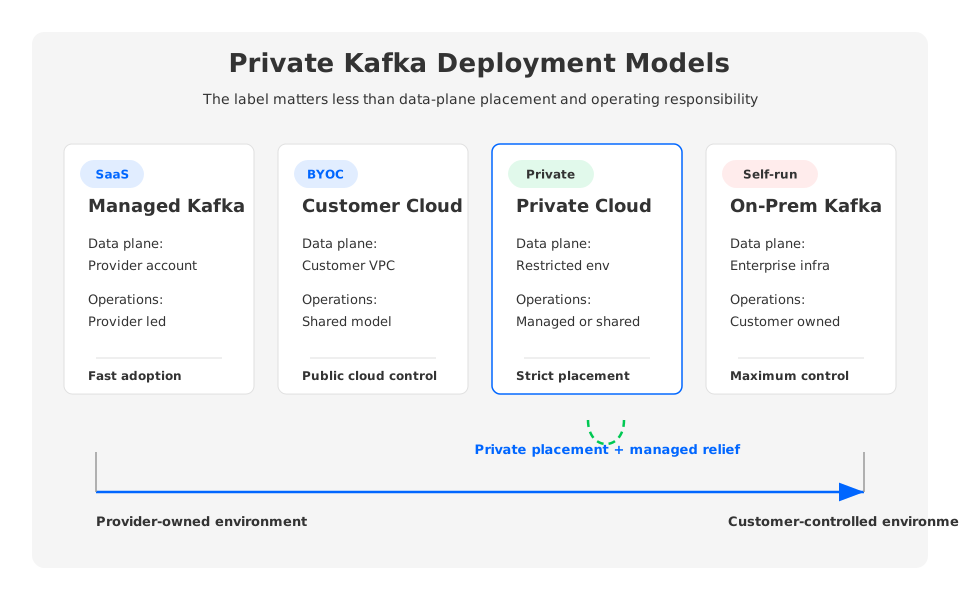
The hardest part of evaluating private cloud Kafka providers is that the words overlap. A useful shortlist separates deployment model from operating responsibility. The environment answers "where does it run?" The operating model answers "who keeps it healthy?"
| Model | Where the data plane runs | Who operates Kafka | Best fit |
|---|---|---|---|
| SaaS managed Kafka | Provider account or provider cloud environment | Provider | Fast adoption when SaaS placement is acceptable |
| BYOC Kafka | Customer cloud account, VPC, VNet, or project | Provider plus customer-defined permissions | Public cloud teams that need data-plane ownership |
| Private cloud Kafka | Customer-controlled private cloud, dedicated cloud, or restricted enterprise environment | Provider, customer, or shared model | Regulated workloads needing strict placement and network control |
| On-premises Kafka | Enterprise data center hardware or virtualization | Usually customer or systems integrator | Facilities with physical residency or legacy integration constraints |
| Self-managed Kafka | Any environment selected by customer | Customer | Teams that need full control and can carry operations burden |
This table exposes a common misconception: private does not always mean managed, and managed does not always mean private. Self-managed Kafka in a private data center gives maximum control and maximum operational responsibility. Dedicated SaaS may provide strong isolation while still placing the data plane in a provider-owned environment. BYOC can keep resources in the customer's cloud account, but control-plane telemetry and support access still need review.
Private cloud Kafka sits at the intersection. It should give the enterprise private placement while preserving managed-service value. Lifecycle automation, monitoring, upgrades, support, and failure handling must work without quietly moving sensitive data into a vendor environment.
3Provider Evaluation Criteria
A private cloud Kafka provider should be evaluated like critical infrastructure, not like a dashboard tool. Kafka is sticky because producers, consumers, connectors, stream processors, schemas, ACLs, offsets, and retention policies accumulate around it. A weak provider choice can lock the platform into a network model, storage design, or operating process that is expensive to unwind.
3.1Data Control and Network Isolation
Start with the data map. Ask the provider to label Kafka records, keys, headers, schemas, offsets, broker logs, metrics, audit events, configuration metadata, support bundles, and object storage artifacts. Then ask where each category is stored, transmitted, retained, encrypted, and deleted. "Data stays private" is not enough because operational metadata can still be sensitive.
Network isolation deserves the same precision. Kafka clients need bootstrap endpoints, advertised listeners, TLS certificates, authentication, authorization, DNS, and routing that remain stable during broker replacement and zone failure. If the provider uses Kubernetes, review ingress, service exposure, NetworkPolicy behavior, secrets management, RBAC, and observability agents. Kubernetes gives strong building blocks, but isolation still depends on policy, CNI support, and namespace boundaries.
The provider should be able to answer questions such as:
- Which endpoints are reachable from application subnets, management subnets, and vendor support systems?
- Are Kafka payloads ever inspected by the provider control plane, support tooling, or telemetry pipeline?
- Which IAM roles, service accounts, secrets, or access tokens are delegated to provider automation?
- Can the customer enforce private DNS, firewall inspection, private endpoints, and egress restrictions?
- Where are audit logs written, and can the enterprise retain them in its own system of record?
These questions are not paperwork. They predict incident behavior. During lag, upgrades, or broker failure, the team needs to know which system can act and which path carries the evidence.
3.2Storage Architecture and Scaling
Traditional Kafka binds durable log data to broker-local disks. That model is proven, but private environments make its operational cost more visible. Scaling may require partition movement. Replacing a broker may involve replica catch-up. Extending retention can increase disk pressure. In a private cloud, those tasks compete with change windows, security approvals, and capacity planning.
Private cloud Kafka providers therefore differ most sharply in storage architecture. Some package conventional Kafka with automation around disks and replicas. Some use tiered storage to offload older segments while keeping hot data on brokers. Some use Kafka-compatible shared-storage or diskless patterns where durable data is placed in object storage and brokers act more like compute. The right model depends on latency, throughput, recovery objectives, retention, and operational maturity.
Object storage changes the private Kafka conversation when it is available inside the approved environment. S3-compatible storage can exist in a public cloud account, a private cloud platform, or an enterprise object-storage system. If the Kafka-compatible platform is designed around that layer, retained data is less tied to individual broker disks, and broker scaling becomes less dependent on large data movement. That is the architectural reason AutoMQ belongs in private Kafka evaluations: AutoMQ Software can run in private environments, uses S3-compatible object storage as the durable storage foundation, and uses stateless brokers to reduce coupling between compute nodes and local disks.
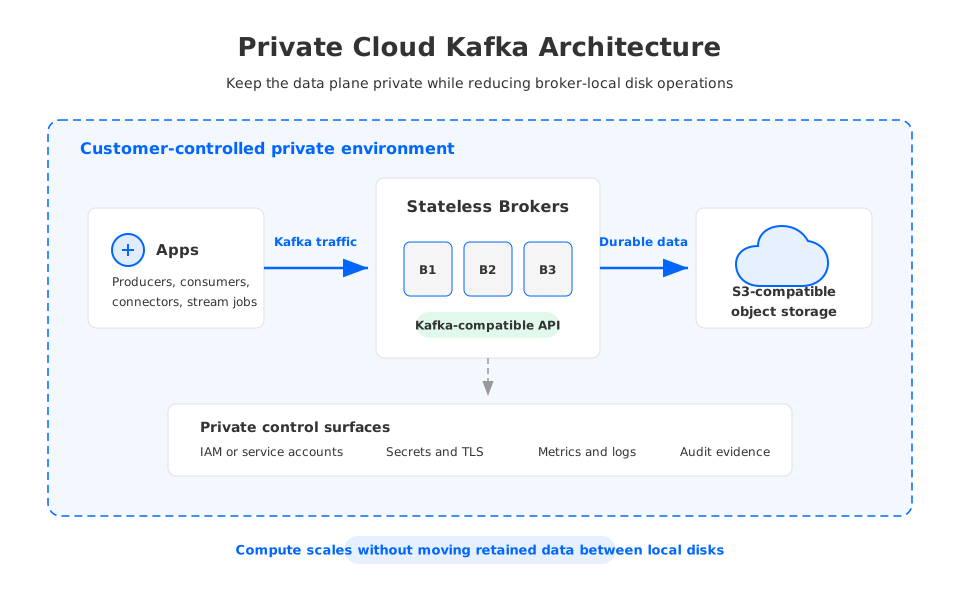
This does not remove the need for validation. Object storage must be reachable through approved network paths, protected by IAM or equivalent controls, monitored, and sized for the workload. Teams still need to test produce latency, fetch behavior, recovery time, rebalance behavior, and failure modes. The useful point is narrower: a provider's storage model determines whether private Kafka operations feel like disk lifecycle management or elastic infrastructure management.
3.3Operations and Support
Managed Kafka is valuable only if the operating model survives the private boundary. A provider may not be able to SSH into nodes, inspect data, open broad egress paths, or push emergency changes without approval. That is often a feature, but it forces the support model to be designed upfront.
A private cloud Kafka provider should document how it handles:
- Provisioning. What infrastructure is created, which identities create it, and how configuration is reviewed before production use.
- Upgrades. How versions are rolled forward, how client compatibility is assessed, and how rollback is handled if an application depends on a specific Kafka behavior.
- Observability. Which broker, topic, partition, consumer group, storage, network, and controller metrics are visible to the customer and provider.
- Incident response. Who receives alerts, who can change configuration, what support access is granted, and how evidence is recorded.
- Backup, restore, and deletion. How retained data, metadata, object storage, logs, and support artifacts are recovered or removed.
Apache Kafka's operational surface is broad: security, monitoring, topic configuration, broker health, client behavior, and controller state all matter. Private cloud does not shrink that surface. It changes where the tools run and who is allowed to touch them. Strong providers make this shared responsibility model explicit because ambiguity becomes painful during incidents.
4How AutoMQ Fits Private Kafka Deployment Models
AutoMQ should not be evaluated as "managed Kafka, but private" in a generic sense. The more relevant lens is architecture. AutoMQ is Kafka-compatible, so existing Kafka clients and ecosystem assumptions remain central to the evaluation. Its private-environment story comes from separating the Kafka-compatible broker compute layer from durable storage and using S3-compatible object storage as the shared storage layer.
That design has practical implications for private cloud teams. If brokers are stateless, replacing or scaling broker compute is less tied to moving retained log data between local disks. If durable data sits in customer-controlled object storage, the enterprise can apply its own access, retention, encryption, and audit controls. If the deployment runs as AutoMQ Software in a private environment, the team can map the platform to its own Kubernetes, storage, network, IAM, secrets, and observability standards.
The important caveat is that private deployment is not a blanket compliance claim. AutoMQ, like any provider, should be reviewed against the specific control set: where the control plane runs, what metadata flows out, how support access is granted, how object storage credentials are handled, and which logs or metrics are collected. For many regulated teams, that specificity is more valuable than a polished "enterprise Kafka" label.
AutoMQ is most relevant when the RFP contains requirements like these:
- Kafka protocol compatibility is required because applications, connectors, and stream processors already depend on Kafka behavior.
- Customer-controlled deployment is required because production records cannot live in a provider-hosted SaaS data plane.
- S3-compatible object storage is available or planned inside the approved environment.
- Platform teams want managed lifecycle and observability without inheriting all traditional broker-local disk operations.
- Scaling, recovery, and retention are strategic pain points rather than minor operational details.
This is a natural place for AutoMQ to appear in the evaluation set: not as the only answer, but as a concrete Kafka-compatible architecture for private or customer-controlled environments where object storage is part of the infrastructure strategy.
5RFP Checklist for Private Cloud Kafka Providers
An effective RFP should force every provider to draw the same boundary diagram. Marketing names can differ; the answers should be comparable.
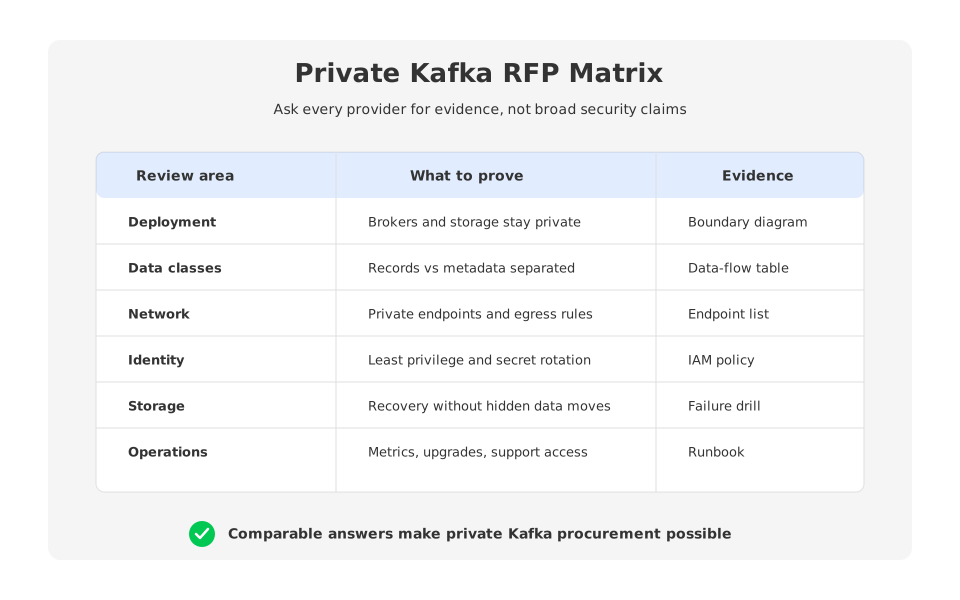
| Area | Questions to ask | Evidence to request |
|---|---|---|
| Deployment boundary | Where do brokers, controllers, connectors, storage, control agents, and consoles run? | Architecture diagram with trust boundaries |
| Data classification | Which artifacts contain customer records or sensitive metadata? | Data-flow table and retention policy |
| Network isolation | How are bootstrap endpoints, advertised listeners, DNS, ingress, egress, and support access controlled? | Network diagram, firewall rules, endpoint list |
| Identity and secrets | Which IAM roles, service accounts, RBAC roles, and secrets are required? | Least-privilege policy examples |
| Storage | Is durable data on local disks, tiered storage, or object storage? How does broker recovery work? | Failure drill results and storage access model |
| Observability | Which metrics and logs are collected, where are they stored, and who can query them? | Sample dashboards and log schemas |
| Upgrades | How are Kafka version changes, rolling upgrades, and rollback handled? | Runbook and maintenance process |
| Support | What access does the provider need during incidents? | Support access approval workflow |
The strongest answers are boring in the right way: specific diagrams, explicit permissions, current runbooks, documented failure tests, and clear customer responsibilities. The weakest answers lean on phrases such as "enterprise-grade security" without showing how Kafka actually runs.
6References
- AutoMQ Cloud: Manage Environments Overview
- AutoMQ Cloud: Prepare VPC for AWS BYOC
- AutoMQ Architecture Overview
- Apache Kafka Security Documentation
- Apache Kafka Monitoring Documentation
- Kubernetes Network Policies
- Kubernetes Secrets
- Kubernetes RBAC
- Kubernetes Resource Metrics Pipeline
- AWS IAM Best Practices
- MinIO Object Storage CLI Reference
7FAQ
7.1What is private cloud Kafka?
Private cloud Kafka is Kafka or a Kafka-compatible streaming platform deployed inside a customer-controlled private environment, such as a private cloud, restricted cloud account, enterprise Kubernetes platform, or dedicated infrastructure boundary. The key point is not the label; it is where the data plane, storage, network endpoints, logs, metrics, and support access paths live.
7.2How is private cloud Kafka different from BYOC Kafka?
BYOC Kafka usually means the Kafka data plane runs in the customer's public cloud account, VPC, VNet, or project while a provider supplies management automation. Private cloud Kafka is broader: it may include BYOC public cloud, private cloud platforms, dedicated regulated environments, or on-premises infrastructure. BYOC is one deployment pattern inside the larger private Kafka category.
7.3Is private cloud Kafka always self-managed?
No. A private Kafka deployment can be self-managed, provider-managed, or jointly operated. The important question is which responsibilities are retained by the enterprise and which are handled by the provider. Provisioning, upgrades, monitoring, support access, storage management, and incident response should all be spelled out before production use.
7.4Why does object storage matter for private Kafka?
Object storage matters because it can reduce the dependence between broker compute nodes and durable Kafka log data. In traditional Kafka, local disks shape scaling, recovery, and retention operations. A Kafka-compatible architecture that uses S3-compatible object storage and stateless brokers can make private deployments easier to scale and recover, provided the storage system meets the workload's latency, throughput, durability, and governance requirements.
7.5Where does AutoMQ fit in a private cloud Kafka provider evaluation?
AutoMQ fits when teams need Kafka compatibility, private or customer-controlled deployment, S3-compatible object storage, and reduced operational dependence on broker-local disks. It should be evaluated with the same RFP discipline as every provider: data boundaries, network isolation, IAM, secrets, observability, upgrade process, support access, and workload performance.


