
Table of Contents
Table of Contents
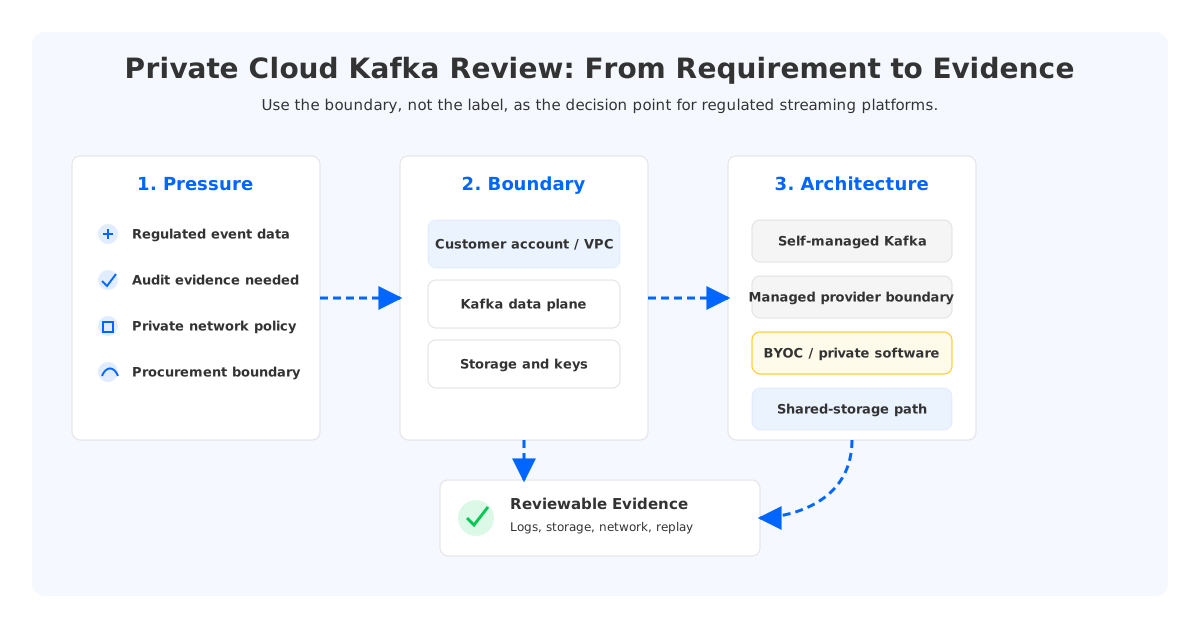
A regulated team searching for private cloud kafka regulated is usually not asking whether Kafka can be installed behind a firewall. That part is familiar. The harder question is whether the streaming platform can pass a security review, a procurement review, and a day-two operations review without forcing every application team back into self-managed infrastructure.
Kafka often sits close to the most sensitive movement in the business: payment events, identity signals, claims updates, fraud decisions, patient workflows, industrial telemetry, audit trails, and AI context pipelines. The platform may be private because brokers run in a customer-controlled network, but privacy is not a binary attribute. Reviewers need to know where records are stored, who can operate the data plane, which private network path clients use, how keys and logs are handled, and whether the team can prove those answers during an incident.
That is why private cloud Kafka should be evaluated as a control system, not as a deployment label. The useful question is not "is it managed?" or "is it private?" The useful question is whether the architecture gives security, platform, and procurement teams a clear boundary they can inspect and operate.
1Why Private Cloud Kafka Matters for Regulated Teams
Traditional Kafka infrastructure decisions were often made by platform engineers alone. The team sized brokers, chose disks, configured replication, set retention, and handed application teams a bootstrap endpoint. Regulated environments add more parties. Security asks whether raw events leave an approved network path. Compliance asks whether retained data and audit logs meet policy. Procurement asks whether the vendor operating model matches contractual obligations. SRE asks whether the cluster can scale and recover without manual data movement becoming a weekend project.
Those concerns are not separate from Kafka architecture. They are expressed through Kafka architecture. A topic's retention period becomes a storage and evidence question. A consumer group's replay ability becomes a data access question. A broker replacement becomes a data movement question. A support access policy becomes an operational control question. If the architecture cannot answer these questions concretely, the review tends to drift into screenshots, assurances, and exception tickets.
The pressure is sharper because Kafka records are both data in motion and retained data. A stream may be written in milliseconds, consumed by several systems, retained for days or months, and replayed during an investigation. A private cloud design has to govern the whole lifecycle:
- Steady-state data path. Producers, brokers, write-ahead storage, durable log storage, consumers, connectors, processors, and observability exports should all fit an approved boundary.
- Operational access path. Provisioning, scaling, upgrades, credential rotation, emergency support, and configuration changes should be governed and logged.
- Evidence path. Logs, metrics, cloud audit records, object storage access records, and Kafka authorization events should prove that the intended boundary was used.
A public cloud managed service can satisfy many regulated workloads when the provider boundary is acceptable. A self-managed cluster can satisfy strict placement requirements when the organization has the operating capacity. Private cloud Kafka earns its place when it gives the customer more direct control over the data plane without turning every operational task into bespoke infrastructure work.
2The Production Constraints Behind the Search
Apache Kafka's default storage model is shared-nothing: brokers own local log segments for the partitions they host, and durability is achieved through replication across in-sync replicas. This model is mature and well understood. It also couples storage ownership, broker capacity, recovery behavior, and partition movement. For a regulated team, that coupling becomes part of the control review.
Broker-local storage creates three practical constraints. First, retention policy becomes broker sizing policy. If sensitive event streams require long retention, the cluster needs more disk capacity or a remote storage strategy. Second, recovery and reassignment can move large amounts of data through the broker fleet. That movement is normal Kafka operations, but it still matters when reviewers ask where data lived during failure recovery. Third, scaling compute is not independent from scaling retained data, so elasticity requires careful partition planning, reassignment windows, and storage headroom.
Apache Kafka Tiered Storage addresses part of this by allowing log segments to be offloaded to remote storage. That can reduce pressure on local disks for longer retention and cold reads. It is useful when existing Kafka deployments need a less disruptive path toward better retention economics. But Tiered Storage does not automatically make the broker fleet stateless, and teams still need to test hot-path behavior, recovery behavior, storage policies, and operational evidence under their own workload.
Private cloud Kafka reviews therefore need to separate four layers:
| Layer | Review question | Evidence to collect |
|---|---|---|
| Kafka API and semantics | Will existing clients, topics, consumer groups, ACLs, transactions, and operational workflows behave as expected? | Compatibility matrix, migration tests, representative produce/fetch/replay tests |
| Data-plane boundary | Where do brokers, storage, endpoints, and runtime services operate? | Account or subscription inventory, VPC/VNet design, private endpoint design, DNS and route evidence |
| Storage architecture | Where are retained records, write-ahead data, snapshots, backups, and logs stored? | Storage policies, encryption settings, access logs, lifecycle rules, failure-domain design |
| Operating model | Who can change, support, upgrade, and recover the platform? | IAM roles, support access process, change logs, break-glass workflow, audit export |
This table often reveals the real decision: a team may need private cloud Kafka only for streams where the evidence package must come from the customer's environment and governance systems.
3Architecture Patterns Teams Usually Compare
The first pattern is self-managed Kafka in a private environment. It gives the organization maximum direct control over infrastructure, network, storage, and operations. It also puts patching, scaling, observability, incident response, partition reassignment, capacity forecasting, and compatibility testing on the internal team. This can be right for teams with strong Kafka SRE maturity, but it is rarely the lowest-friction path for a broad enterprise streaming platform.
The second pattern is managed Kafka in an approved provider boundary. This can be attractive when the regulated workload is allowed to run in a provider-operated service and the provider supplies sufficient controls around private networking, encryption, access management, audit evidence, and contractual commitments. The review should be specific: which data artifacts are stored by the provider, what metadata leaves the customer environment, who can access logs, how support actions are approved, and what happens during service incidents.
The third pattern is bring-your-own-cloud or private software deployment. In this model, the Kafka-compatible data plane runs in the customer's cloud account, VPC, Kubernetes environment, or private infrastructure, while the provider may supply automation, support, lifecycle management, or software. The appeal is not that the phrase sounds private. The appeal is that storage, network, identity, logging, and cost controls can align with the customer's existing cloud governance.
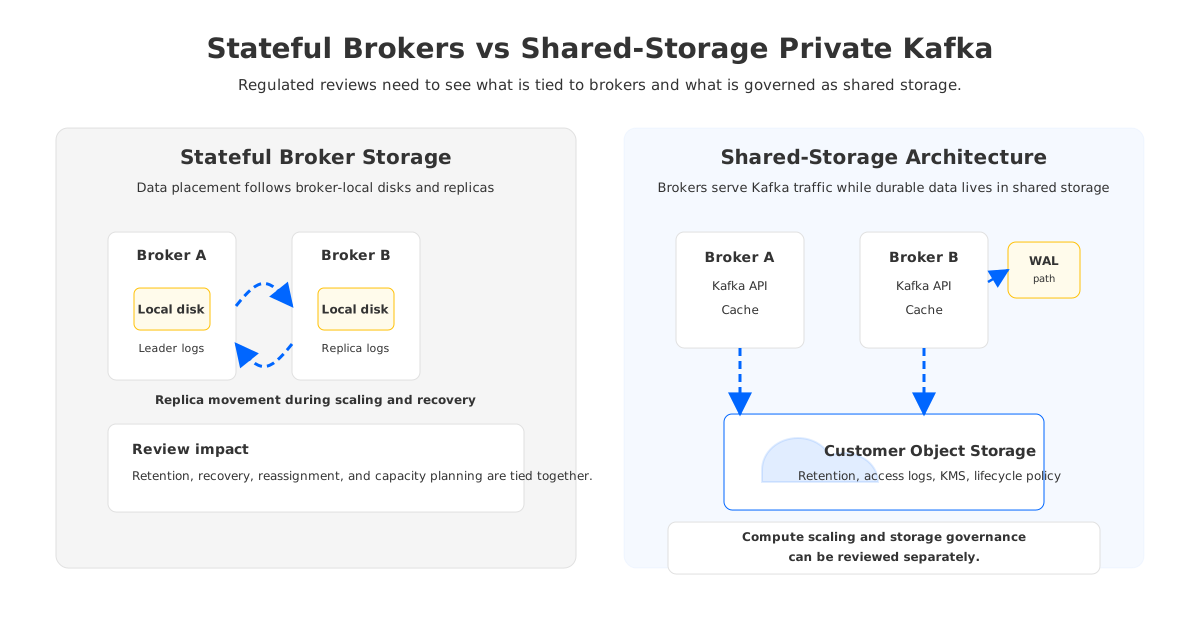
There is also an architectural distinction inside private deployments: stateful brokers versus Shared Storage architecture. In a stateful-broker design, retained data remains tightly bound to broker-local disks and replication across brokers. In a Shared Storage architecture, brokers serve Kafka-compatible traffic while durable stream data is placed in customer-controlled object storage or S3-compatible storage, with a write-ahead path and cache strategy for low-latency writes and reads.
That difference matters because regulated teams often care about evidence more than slogans. Object storage can bring familiar controls into the Kafka review: bucket policy, KMS policy, access logs, lifecycle controls, region constraints, backup procedures, and cloud-native audit trails.
4Evaluation Checklist for Platform Teams
Start with one regulated stream, not a generic cluster. Pick a workload where the data classification, identities, retention policy, replay requirement, and downstream export are known. Then draw the data path and the operational access path. If those diagrams cannot be drawn, the architecture is not ready for procurement language.
The review should include questions that force precision:
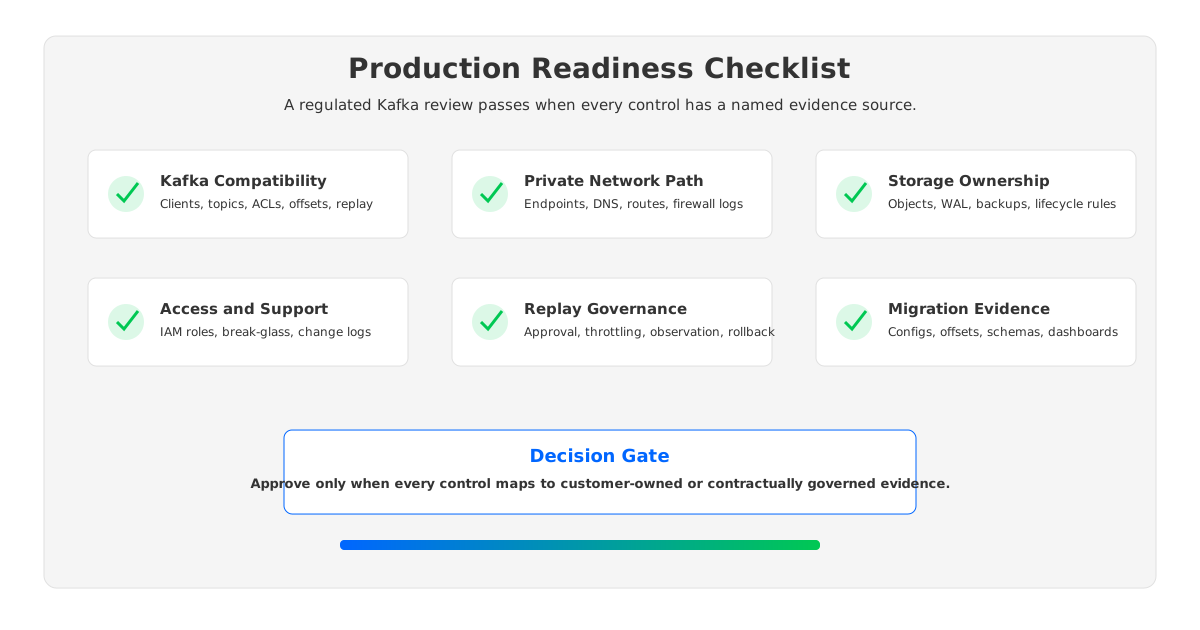
- Data classification. Which topics carry regulated data, operational metadata, or mixed payloads? Are keys, headers, schemas, and logs included in the classification model?
- Private network path. Do clients use private connectivity such as VPC endpoints, PrivateLink-style services, private endpoints, or private service connectivity? Are DNS, routes, and firewall rules auditable?
- Storage ownership. Which account, bucket, volume, or storage system owns retained records, write-ahead data, backups, and operational logs?
- Encryption and keys. Are encryption keys customer-managed, provider-managed, or service-managed? Which identities can decrypt data or access storage objects?
- Operator access. Who can create topics, change ACLs, scale brokers, upgrade software, access logs, or perform emergency support?
- Replay governance. Can historical reads be approved, throttled, observed, and rolled back if a replay exposes sensitive data to the wrong downstream system?
- Migration and exit. Can topics, configs, ACLs, offsets, schemas, monitoring, and storage evidence move without losing the audit trail?
Private connectivity deserves special attention because it is easy to overstate. AWS PrivateLink, Azure Private Link, and Google Cloud Private Service Connect are all designed to provide private connectivity patterns between consumers and services without exposing traffic through ordinary public internet paths. They do not by themselves prove that Kafka data is governed correctly. They are one layer in a larger evidence chain that includes broker placement, storage placement, identity, logs, and support controls.
For procurement, ask vendors to answer in nouns, not adjectives. "Secure," "private," and "enterprise-ready" are not reviewable. A stronger answer names the account, VPC, endpoint type, storage service, key owner, log source, support role, and rollback process.
5Where AutoMQ Changes the Operating Model
After the boundary is clear, a Kafka-compatible Shared Storage architecture becomes worth evaluating. AutoMQ fits this category: it keeps Kafka protocol compatibility for clients and ecosystem tools while redesigning the storage layer around shared storage and stateless brokers. For regulated teams, the important part is not a generic claim that it is cloud-native. The important part is how the deployment boundary and storage model can line up with customer-controlled infrastructure.
In AutoMQ BYOC, the environment is deployed into the user's cloud account, and the documentation describes the data plane as running in the user's VPC. AutoMQ Software addresses private deployment scenarios where teams want to operate the software in their own environment. In both cases, the practical review question is concrete: can the team keep Kafka records, storage policies, private endpoints, cloud audit evidence, and operational controls inside the environment it already governs?
The storage model changes the day-two conversation. Traditional Kafka scaling and recovery often involve moving partition data between brokers. AutoMQ's Shared Storage architecture separates broker compute from durable stream storage, so brokers can behave more like elastic compute nodes while data remains in shared object storage. The platform still needs a write-ahead path, cache behavior, and compatibility validation, but compute nodes, WAL path, object storage, metadata, private network, and operator access can each be reviewed as a layer.
This is also where cost and governance meet. Regulated teams often overprovision Kafka because failed recovery, slow replay, disk exhaustion, or a rejected audit is expensive. A Shared Storage architecture can reduce some of that coupling by letting retention and broker compute be evaluated separately.
6Decision Table for Regulated Kafka Reviews
The right answer depends on the workload tier and the organization's operating maturity. A marketing analytics stream and a payment authorization stream should not be forced into the same deployment model because both happen to use Kafka-compatible clients.
| If this is true | Prefer this path | Why |
|---|---|---|
| The workload is low risk and speed matters more than account-level control | Managed Kafka in an approved provider boundary | Operational simplicity may outweigh deeper infrastructure ownership |
| The workload requires customer-owned storage, private network evidence, and cloud-native audit trails | BYOC or private cloud Kafka | The data plane can align with existing governance and procurement controls |
| The organization has strong Kafka SRE capability and strict infrastructure isolation | Self-managed Kafka or private software deployment | Direct control may be worth the operational burden |
| Long retention, replay, and elastic scaling dominate the risk model | Kafka-compatible Shared Storage architecture | Storage governance and broker compute can be evaluated separately |
| The migration must preserve application compatibility | Kafka-compatible platform with staged migration tests | Client behavior, offsets, ACLs, and operational tooling need validation before cutover |
Private cloud Kafka is not a trophy architecture. It is a way to make the streaming platform reviewable. The strongest design lets platform, security, procurement, and SRE teams point to the same evidence: where records live, how they move, who can operate the system, how replay is governed, and how the team exits if requirements change.
For teams evaluating that boundary, the next useful step is to test a representative Kafka workload against the actual controls: private networking, storage policy, identity, ACLs, replay, observability, migration, and rollback. AutoMQ's Kafka-compatible Shared Storage architecture is one option when customer-controlled deployment and cloud-native storage governance are central requirements.
7References
- Apache Kafka Security Documentation
- Apache Kafka Tiered Storage Documentation
- AWS PrivateLink Documentation
- Azure Private Link Documentation
- Google Cloud Private Service Connect Documentation
- NIST SP 800-53 Rev. 5 Security and Privacy Controls
- AutoMQ Technical Advantage Overview
- AutoMQ Cloud Environment Overview
- AutoMQ Migration Overview
8FAQ
8.1Is private cloud Kafka the same as self-managed Kafka?
No. Self-managed Kafka usually means the internal team operates the full Kafka stack. Private cloud Kafka can include self-managed Kafka, BYOC models, or private software deployments where the data plane remains in a customer-controlled environment while automation or support may come from a vendor.
8.2Does private networking make Kafka compliant?
Private networking helps, but it is not enough. A regulated Kafka review also needs storage ownership, encryption policy, identity control, audit logs, support access rules, replay governance, and migration evidence. Private connectivity is one part of the control chain.
8.3When should a regulated team consider Shared Storage architecture?
Shared Storage architecture is worth evaluating when long retention, replay, elastic scaling, cloud-native audit evidence, or broker recovery are important review points. The goal is to separate durable stream storage from broker-local disk operations while preserving Kafka-compatible client behavior.
8.4Where does AutoMQ fit in a private cloud Kafka evaluation?
AutoMQ fits when a team wants Kafka-compatible streaming with a Shared Storage architecture and customer-controlled deployment options such as BYOC or private software deployment. It should be evaluated after the team has defined its data-plane boundary, storage controls, network path, and migration requirements.
8.5What should procurement ask before approving private cloud Kafka?
Procurement should ask for specific answers about where the data plane runs, who owns storage, which private endpoints are used, who can operate the platform, how support access is approved, what audit evidence is available, and how the organization can migrate or exit without losing control of retained data.


