
Table of Contents
Table of Contents
Teams searching for private endpoint governance kafka usually already run Kafka in production, or they are close enough to production that network diagrams have become contract documents. The question is no longer whether producers and consumers can reach a broker. The harder question is who can create that path, which data can cross it, how endpoint cost is reviewed, and what happens when the platform team scales the cluster during an incident.
That pressure appears first as a security review, but it rarely stays there. A private endpoint decision affects DNS, certificates, IAM, Kafka ACLs, bootstrap configuration, audit logging, cross-account ownership, and recovery. If those controls are reviewed separately, the system may look compliant on paper while remaining difficult to operate. A governed event streaming platform needs one model that connects private connectivity to Kafka semantics and production behavior.
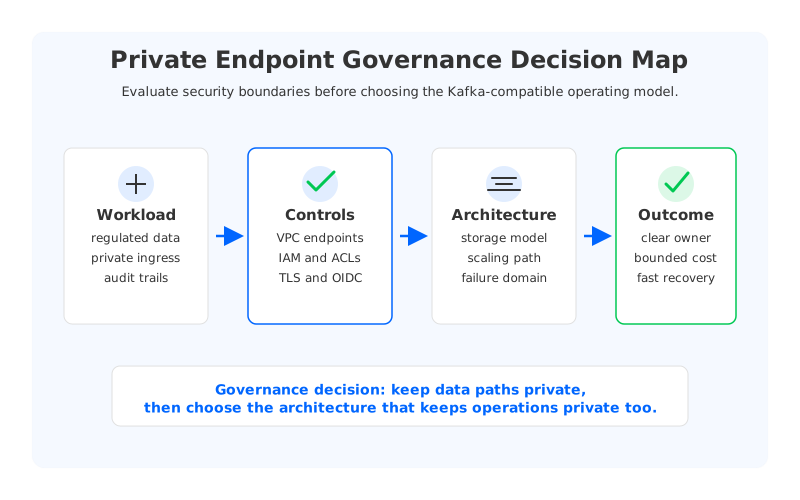
The goal is not to make every streaming connection private by default. A private path that nobody can explain is still a governance failure. The goal is to make the data path private, the ownership model explicit, and the operating model predictable enough for security, platform, and application teams to reason about the same system.
1Why teams search for private endpoint governance kafka
Kafka is often the boundary between systems that would otherwise never talk to each other directly. Payment events, telemetry, identity changes, fraud signals, model features, and operational logs may all move through the same streaming estate. Once those streams are used across accounts, regions, or business units, the endpoint becomes part of the control plane for data governance.
The search usually starts after one of three events. A security team asks whether brokers are reachable from the public internet. A compliance team asks where regulated data crosses account or network boundaries. A platform team discovers that every tenant, connector, or analytics workload requires another firewall, route table, or access policy exception. None of these are Kafka protocol problems, but Kafka makes them visible because every client depends on the same shared substrate.
Private endpoint governance should answer four questions before approval:
- Which network identities can reach the streaming endpoint, and who can approve changes to that reachability?
- Which Kafka identities can read, write, administer, or observe each topic after the network path exists?
- Which cloud resources carry the cost of endpoint hours, data processing, cross-AZ transfer, storage, and compute?
- Which team owns rollback if an endpoint, DNS record, certificate, broker, connector, or client library change fails?
These questions are deliberately cross-functional. A VPC endpoint can restrict traffic to a private cloud network, but it does not decide whether a producer should write to payments.authorized. Kafka ACLs can restrict topic operations, but they do not decide whether traffic should traverse a provider-owned service link, a peered VPC, or a customer-owned VPC boundary. Governance begins when those controls are evaluated together.
2The production constraint behind the problem
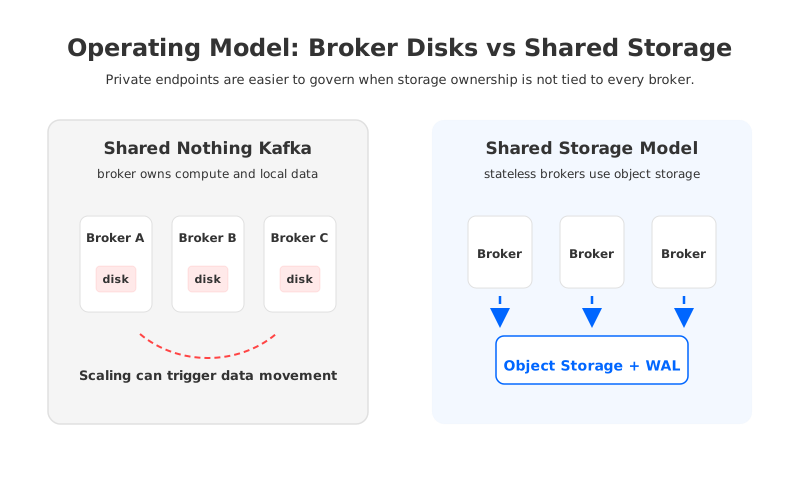
Traditional Kafka deployments were designed around brokers that own both compute and local persistent storage. That shared-nothing model is robust and familiar: partitions live on broker disks, replicas are assigned to other brokers, and availability is achieved through replication. It becomes more awkward when private endpoint governance forces teams to reason about where data moves, not only where clients connect.
Consider a multi-AZ cluster serving internal applications through private connectivity. The security diagram may show producers talking to private broker endpoints, but the storage diagram still shows data being replicated between brokers across availability zones. Scaling the cluster may trigger partition movement, and replacing a broker may require re-replication. Endpoint governance then inherits storage operations because the network boundary is attached to a stateful cluster whose data placement changes over time.
This is the part many checklists miss. Private endpoints reduce exposure at the edge of the system, but they do not remove the internal movement created by the storage architecture. The cost and risk of that internal movement may show up as cross-AZ data transfer, long rebalance windows, larger rollback plans, or delayed security changes because the cluster cannot be changed safely during business hours.
The same issue appears in migration planning. A team may want to move from one Kafka-compatible platform to another without changing client code, but private endpoint governance adds a second migration surface. Bootstrap addresses, certificates, DNS, authorization policies, connector paths, observability agents, and runbooks all move with the cluster. If broker storage and broker identity are tightly coupled, the migration plan has to protect data placement and connectivity at the same time.
3Architecture options and trade-offs
There is no single private endpoint architecture that fits every Kafka estate. The right choice depends on the trust boundary, the number of tenants, the cloud provider model, and how much operational responsibility the platform team is willing to keep. What matters is making the trade-off explicit instead of hiding it behind a private DNS name.
| Architecture choice | Governance strength | Operational trade-off |
|---|---|---|
| Self-managed Kafka in a customer VPC | Strong customer control over network, IAM, encryption, and audit integration | Platform team owns broker lifecycle, storage sizing, partition movement, endpoint changes, and incident recovery |
| Managed Kafka with private connectivity | Lower infrastructure burden with private access patterns | Governance depends on provider features, service limits, account boundaries, and how much control remains with the customer |
| Kafka-compatible shared storage architecture | Separates client connectivity from broker-local data ownership | Requires validation of compatibility, WAL behavior, object storage permissions, and recovery procedures |
| Cross-account endpoint service pattern | Useful for central platform teams serving many internal tenants | Requires strict ownership for endpoint acceptance, DNS, chargeback, and tenant deprovisioning |
The matrix is not a ranking. It is a way to prevent a common mistake: treating private connectivity as a replacement for architecture review. A platform can expose only private endpoints and still be hard to govern if every scale-out event moves data across failure domains. Another platform can provide strong Kafka protocol compatibility but still fail a governance review if its endpoint ownership, access logging, and rollback process are unclear.
For production Kafka-compatible workloads, architecture review should start with the primitives Kafka applications already depend on: producer acknowledgments, consumer groups, committed offsets, transactional writes, topic metadata, partition leadership, and connector behavior. If a private endpoint design changes how clients discover brokers or how consumers recover, it is a streaming behavior change.
4Evaluation checklist for platform teams
A useful private endpoint governance review has to be narrow enough to execute and broad enough to catch production risk. The checklist below is written for platform teams that own Kafka-compatible streaming as a shared internal service, and for security reviewers who need architecture evidence next to access policy.
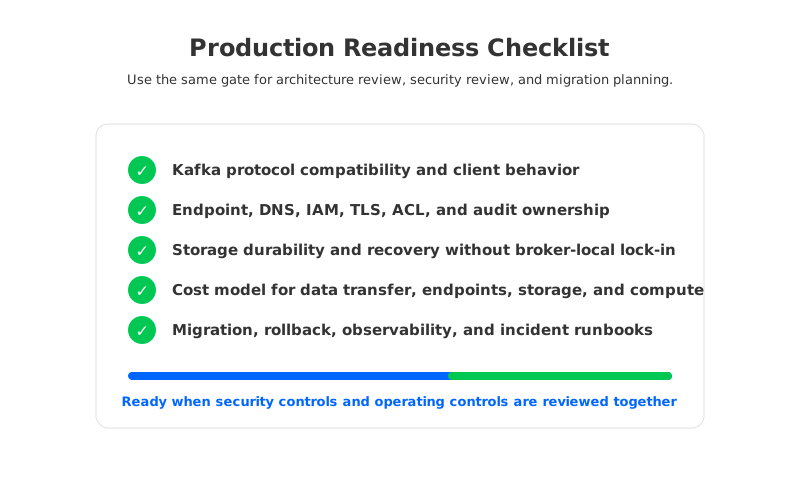
Start with compatibility. Kafka clients depend on consumer group coordination, offset commits, idempotent producers, transactions, admin APIs, metadata refreshes, and connector frameworks. A platform that is Kafka-compatible at the basic produce-consume level still needs testing against the client versions, libraries, and operational tools used in the organization.
Then test private connectivity as an operating path, not a diagram. Endpoint creation, acceptance, DNS resolution, certificate rotation, security group changes, and log collection should be exercised in staging. The review should identify which team can make each change, which approval system records it, and how quickly the platform can reverse it.
Cost needs its own review because private endpoints can move spend into places application teams do not expect. Cloud providers may charge for endpoint hours, data processing, cross-AZ transfer, NAT gateways, inter-region traffic, and storage requests. The right answer is to know which workload dimension drives each charge, then decide whether the platform can scale without turning the endpoint into an unbounded shared bill.
Security controls should be mapped across layers:
- Network layer: private endpoint ownership, subnet placement, routing, security groups, DNS, and endpoint acceptance.
- Identity layer: cloud IAM, service accounts, OIDC integration, certificate issuance, secret rotation, and break-glass access.
- Kafka layer: authentication, ACLs, topic ownership, consumer group permissions, admin operations, and auditability.
- Data layer: retention, encryption, object storage policy, backup expectations, and deletion procedures.
- Operations layer: alerts, runbooks, change windows, rollback paths, and evidence collection for audits.
The ordering matters less than the completeness. Many incidents happen in the gaps between layers. A producer has network reachability but no ACL. A connector has topic access but no route to the sink. A broker replacement is approved by the platform team but breaks a DNS assumption owned by the security team. Governance should make those boundaries visible before a production change depends on them.
5How AutoMQ changes the operating model
Once the evaluation framework is clear, the architectural requirement becomes sharper: a governed Kafka-compatible platform should keep the client-facing surface compatible while reducing the state tied to each broker. This is where AutoMQ belongs in the discussion. AutoMQ is a Kafka-compatible cloud-native streaming system that keeps Kafka protocol semantics while using shared object storage and stateless brokers to change the storage and scaling model.
In a traditional shared-nothing Kafka cluster, the broker is both the request handler and the owner of local log data. That coupling makes endpoint governance harder because broker identity, storage placement, and failure recovery are entangled. In AutoMQ's shared storage architecture, durable stream data is backed by object storage, and brokers are designed to be stateless from the perspective of long-lived data ownership. Fewer governance decisions are forced to follow broker-local disks.
That change matters for private endpoint governance in several concrete ways. Scaling compute no longer has to imply the same kind of broker-local data movement. Recovery planning can focus on restoring service capacity and metadata correctness rather than rebuilding large local disks. Storage policy can be reviewed through cloud object storage controls, which are already familiar to many security and compliance teams. In multi-AZ designs, AutoMQ's architecture can also reduce server-side replica traffic and support zero cross-AZ traffic patterns when the documented deployment constraints are met.
The BYOC model is equally important for governance. For organizations that need customer-controlled deployment boundaries, AutoMQ BYOC places the data plane in the customer's cloud environment rather than asking every stream to leave the customer's account boundary. That does not remove the need for security review; it gives security teams the primitives they usually want to review: VPC layout, endpoint access, object storage policy, IAM role design, audit integration, and regional control.
Evaluate AutoMQ the same way you would evaluate any Kafka-compatible platform for regulated workloads. Run compatibility tests with producers, consumers, connectors, schema tooling, and observability agents. Exercise endpoint creation and rollback. Validate object storage policy, WAL configuration, encryption, and region boundaries. Test failure recovery while clients continue to use private bootstrap paths.
6Migration and readiness scorecard
A private endpoint migration should not start with DNS. DNS is the visible part of the move, which is why it often gets too much attention. The migration really starts with evidence: client compatibility, endpoint ownership, topic and ACL mapping, connector paths, offset strategy, observability parity, rollback timing, and the business rules for when traffic is allowed to shift.
Use a readiness scorecard before moving production workloads:
| Gate | Ready signal | Common failure mode |
|---|---|---|
| Client compatibility | Critical producers and consumers pass load, rebalance, and failover tests | A library or admin tool depends on behavior that was not tested |
| Endpoint ownership | DNS, endpoint acceptance, security groups, and certificates have named owners | Rollback requires manual changes across multiple teams |
| Kafka authorization | Topic ACLs, consumer group permissions, and admin roles are mapped and reviewed | Network access works, but application permissions fail at cutover |
| Cost review | Endpoint, transfer, storage, and compute drivers have accountable budgets | Spend shifts from the platform team to application accounts without notice |
| Recovery test | Broker failure, endpoint failure, and client reconnect behavior are rehearsed | The design works during deploys but not during an incident |
| Observability | Metrics, logs, traces, and audit evidence are available before traffic moves | The new private path hides the signals needed to debug it |
This scorecard protects teams from overfitting the migration to a happy path. Private endpoint governance is not proven when the first client connects. It is proven when a team can rotate a certificate, block a compromised producer, expand capacity, recover from a zone event, and explain the bill afterward.
For teams evaluating whether shared storage and stateless brokers fit their governance model, the next useful step is to test a representative workload rather than debate architecture in the abstract. AutoMQ's BYOC deployment model is designed for teams that want Kafka compatibility while keeping the data plane inside their own cloud boundary. You can review the BYOC approach and deployment model here: Explore AutoMQ BYOC.
7References
- Apache Kafka Documentation for Kafka client behavior, consumer groups, transactions, configuration, Kafka Connect, KRaft, and tiered storage references.
- AWS PrivateLink documentation for private connectivity concepts such as VPC endpoints and endpoint services.
- AWS PrivateLink pricing for endpoint-hour and data-processing pricing dimensions.
- AutoMQ overview for AutoMQ's Kafka-compatible cloud-native streaming architecture.
- AutoMQ BYOC Environment for customer-controlled deployment boundaries.
- AutoMQ cross-AZ traffic best practice for documented deployment constraints and traffic-reduction behavior.
- AutoMQ migration guide for migration planning from Apache Kafka to AutoMQ.
8FAQ
8.1Is private endpoint governance only a networking problem?
No. Networking is the first control surface, but Kafka-compatible streaming adds protocol behavior, topic authorization, consumer group ownership, connector egress, storage policy, and recovery operations.
8.2What should be tested before moving Kafka clients to private endpoints?
Test bootstrap discovery, DNS behavior, TLS certificates, authentication, ACLs, consumer group rebalances, producer retries, connector access, observability, and rollback. The test should include at least one failure scenario because private connectivity often behaves differently during reconnects and incident response.
8.3How does shared storage help with private endpoint governance?
Shared storage separates long-lived data ownership from individual brokers. That can reduce the operational coupling between endpoint changes, broker scaling, and broker-local disk recovery. Governance teams still need to review storage policy and access controls.
8.4Does AutoMQ replace Kafka clients or Kafka APIs?
AutoMQ is Kafka-compatible, so the evaluation should begin with existing Kafka clients and tools. Teams should still run compatibility tests before production migration.
8.5When is BYOC useful for private endpoint governance?
BYOC is useful when the organization wants the streaming data plane to run inside its own cloud environment while still using a managed or cloud-native operating model. It is especially relevant for teams with strict VPC, IAM, regional, audit, or data sovereignty requirements.


