
Table of Contents
Table of Contents
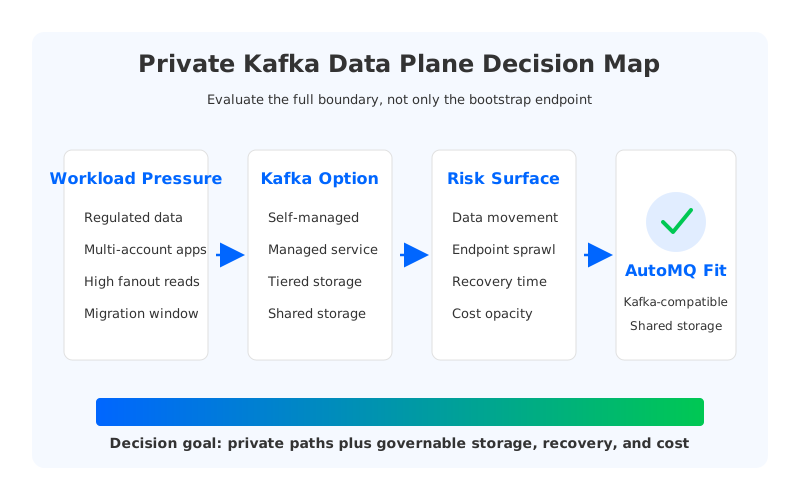
Teams search for private networking kafka when a Kafka endpoint has become a security review, a cloud bill, and an operations question at the same time. The bootstrap address may be private, but the streaming system behind it still moves retained data, offsets, metadata, connector traffic, replication traffic, and observability signals. That is why a private Kafka design cannot stop at "clients do not use the public internet." The real question is whether the full data plane can run inside the boundary your security, compliance, platform, and FinOps teams are willing to own.
This becomes visible during production reviews. A fraud service runs in one VPC, a data lake sink runs in another account, internal applications span several Availability Zones, and the platform team needs to prove which paths are private. At the same time, Kafka is not a stateless API. It is a storage-backed log with Consumer group state, retained topics, broker metadata, client compatibility requirements, and operational workflows that continue long after the first connection succeeds.
1Why Teams Search for private networking kafka
The search phrase usually hides several different buying and architecture questions. Security asks whether producers, consumers, connectors, admin APIs, and metrics exporters can avoid public paths. Compliance asks where data and operational metadata live. Platform engineering asks who manages DNS, certificates, routing, Kafka ACLs, quotas, scaling, and incident response. Finance asks which private endpoints, inter-zone transfers, NAT gateways, storage requests, and provider fees show up on which bill.
Those questions are easy to mix together because "private networking" sounds like one feature. In practice, it is a system boundary. AWS PrivateLink, Azure Private Link, and Google Cloud Private Service Connect describe private access patterns for services. They are useful primitives, but they do not decide where the Kafka data plane runs, who owns the durable log, how broker replacement works, or whether a migration can be rolled back without moving large local disks.
For Kafka-compatible infrastructure, the private networking review should cover four paths:
- Client path: producers, consumers, admin clients, schema tooling, and stream processors need reachable private endpoints, stable DNS, TLS policy, and authentication that matches the application's runtime environment.
- Storage path: durable log data, WAL storage, tiered storage, snapshots, and backups need clear residency, encryption, IAM, and network access rules.
- Operations path: metrics, logs, control APIs, support tooling, upgrades, and emergency access must be documented because they often cross a different boundary than client traffic.
- Migration path: replication workers, cutover validation, rollback clients, and offset checks need private reachability during the transition, not only after the target cluster is live.
The important shift is to review private networking as an operating model. If the design only proves the bootstrap endpoint is private, the review will miss the data movement that actually creates risk and cost.
2The Production Constraint Behind the Problem
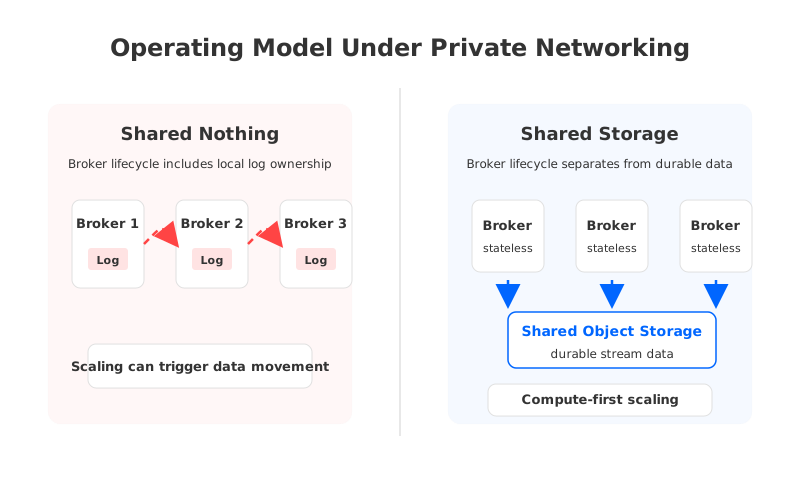
Traditional Apache Kafka was designed around brokers that own local log segments. Replication, leader election, retention, and recovery all assume that broker-local storage is part of the cluster's durable state. This design has served Kafka well for years, and the Kafka project continues to evolve it with features such as KRaft and tiered storage. The constraint is not that Kafka is flawed. The constraint is that cloud private networking makes every byte path explicit.
In a multi-AZ deployment, broker-local storage creates several operational consequences. Replicas move between brokers. Reassignment can consume bandwidth. Rebalancing ties compute changes to data placement. Replacement of a broker is not only a compute lifecycle event; it is also a storage and replication event. Private networking does not remove those mechanics. It gives the platform team a narrower set of paths through which those mechanics must flow.
That is where cost and governance become entangled. A topology can satisfy a private access requirement while still creating cross-zone traffic from replication, high-fanout reads, connector placement, or migration tooling. A security team may approve the route, but FinOps may still see a cost pattern that scales with retained data and Consumer fanout. A platform team may approve the Kafka API, but SREs may still inherit long windows for expansion, broker replacement, and incident recovery.
The same issue shows up in data governance. Kafka holds more than event payloads. Consumer offsets are stored in internal topics. Transactions and idempotent producers depend on broker-side coordination. Kafka Connect can add connector offsets, task configuration, dead-letter queues, and sink-specific retry paths. A private data-plane design has to keep those surfaces inside the same review model, or the architecture diagram becomes cleaner than production reality.
3Architecture Options and Trade-Offs
There are several ways to build private networking for Kafka-compatible data planes, and each option optimizes a different boundary. Self-managed Kafka inside a customer VPC gives direct infrastructure control. The trade-off is operational ownership: broker sizing, disk growth, replication, upgrades, rack awareness, monitoring, and recovery remain the platform team's responsibility. This can fit organizations with strong Kafka operations teams, but it usually requires conservative capacity planning.
A managed Kafka service with private connectivity can reduce day-two work. The service provider handles much of the cluster operation while the customer configures private access from applications. The review then shifts from "can we run Kafka?" to "do we accept the provider's data-plane boundary?" That includes regions, support access, control-plane access, private endpoint model, service limits, connector placement, and how the provider bills traffic and storage.
Kafka with tiered storage changes part of the storage conversation. Apache Kafka tiered storage separates remote log storage from local broker disks for older log segments, which can improve retention economics and recovery behavior for supported workloads. It does not automatically make brokers stateless, and it does not remove the need to design private networking for clients, internal replication, metadata, and operations. Tiered storage is valuable, but it should not be treated as the same thing as a fully shared-storage data plane.
The cleanest evaluation usually compares options across operating consequences rather than feature names:
| Dimension | What to Ask | Why It Matters |
|---|---|---|
| Compatibility | Do existing producers, consumers, transactions, Consumer groups, and admin workflows keep Kafka semantics? | Private networking is not useful if application behavior changes in hidden ways. |
| Data boundary | Where do payloads, offsets, metadata, WAL records, tiered data, logs, and metrics live? | Regulated workloads need a map of every durable and operational surface. |
| Elasticity | Can compute scale without moving large broker-local datasets? | Private networks make data movement a capacity and cost planning item. |
| Cost model | Which line items cover compute, storage, inter-zone traffic, private endpoints, and operations? | Kafka cost is rarely one meter, especially under private connectivity. |
| Recovery | What happens when a broker, zone, route table, certificate, or control action fails? | Private designs need testable failure modes, not only private paths. |
| Migration | Can replication, validation, rollback, and client cutover run inside the target boundary? | The riskiest traffic often appears before the steady state begins. |
This matrix prevents a common mistake: treating private connectivity as a yes-or-no checkbox. For Kafka, the harder question is whether the architecture keeps data, operations, and change management inside a boundary the organization can explain.
4Evaluation Checklist for Platform Teams
A practical private networking Kafka review starts with a diagram, but it should end with evidence. Draw the network paths first, then attach ownership, data type, failure mode, and billable meter to each path. That exercise often changes the shortlist because it exposes which options rely on private access only at the edge and which options make the data plane itself easier to govern.
Use this checklist before a production migration, procurement decision, or security exception review:
- Endpoint scope: List bootstrap servers, broker endpoints, schema tooling, connector workers, stream processors, admin APIs, metrics endpoints, and support access paths. Mark which ones are private, public, or routed through shared services.
- Kafka semantics: Test Consumer group rebalances, committed offsets, idempotent producers, transactions where used, ACLs, quotas, topic configuration, and client versions against the target platform.
- Network placement: Place high-volume producers and consumers near the data plane where the application design allows it. Private access does not make repeated cross-zone or cross-region reads free.
- Storage ownership: Identify who owns the durable log, WAL storage, object storage buckets, encryption keys, lifecycle rules, and audit logs.
- Failure drills: Rehearse broker replacement, zone impairment, certificate rotation, private endpoint misconfiguration, DNS failure, and rollback from a failed migration step.
- Cost review: Separate private endpoint charges, inter-zone traffic, object storage, block or file storage, compute, observability, connector runtime, support, and engineering time.
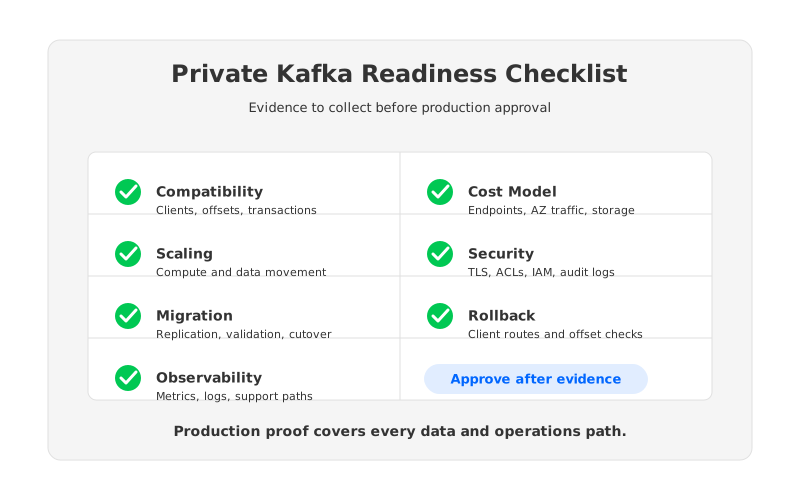
The checklist is intentionally operational. A private networking design that cannot be tested under failure will become a diagram that everyone trusts until the first incident. Kafka's value comes from durable replay and high fanout, so the platform must behave predictably when clients reconnect, consumers lag, partitions move, and operators change infrastructure.
5How AutoMQ Changes the Operating Model
Once the review is framed around the whole data plane, a different architecture category becomes relevant: Kafka-compatible streaming with shared storage and stateless brokers. AutoMQ fits this category by keeping Kafka protocol compatibility while moving durable stream storage to object storage and reducing the amount of broker-local state that governs operations. The result is not "private networking as a feature." It is a data-plane model that is easier to place inside a customer-controlled cloud boundary.
The architectural difference matters because broker lifecycle and durable data lifecycle are no longer welded together in the same way. In a broker-local model, scaling and replacement are tied to local log ownership and replica movement. In a shared-storage model, brokers primarily handle Kafka protocol processing, scheduling, caching, metadata interaction, and request routing, while durable data is governed through shared storage. That changes how a platform team thinks about private networks: compute nodes can be treated more like replaceable workers, while storage policy can be reviewed through cloud-native controls such as buckets, IAM, encryption, and private access.
For private deployments, AutoMQ's relevance is strongest when the organization wants Kafka-compatible behavior without moving the data plane outside its account, VPC, or private environment. AutoMQ BYOC is designed for customer cloud ownership, and AutoMQ Software addresses private environment deployments. Teams still need to design TLS, authentication, Kafka ACLs, IAM, WAL storage, observability, and migration plans. The point is narrower and more useful: the architecture reduces the amount of broker-local data movement that private networking has to absorb.
AutoMQ's documented approach to reducing cross-AZ traffic is also relevant to this discussion. Private networking and cross-AZ cost are separate topics, but they meet in the same topology. If the platform can avoid unnecessary server-side cross-AZ replication traffic under supported designs, the private network is not forced to carry a replication pattern that only exists because brokers own local durable replicas. Teams should still validate the result against their workload, cloud provider, region, and client placement, but the evaluation starts from a more cloud-native assumption.
The right mental model is not "replace every Kafka decision with one product decision." It is "separate the decisions that traditional Kafka couples together." Keep the Kafka API contract visible. Keep private endpoint design visible. Keep storage ownership visible. Keep operations and support access visible. Then decide which architecture makes those boundaries easiest to prove, operate, and pay for.
6A Practical Next Step
Return to the original search: private networking kafka. A useful answer is not a single endpoint type. It is a data-plane architecture that lets security, SRE, platform engineering, and FinOps look at the same diagram and agree on what moves, who owns it, how it fails, and how it is billed.
If your team is evaluating a private Kafka-compatible deployment, use the checklist above against your current topology and one target design. To see how a shared-storage, Kafka-compatible architecture changes the private data-plane boundary, review AutoMQ BYOC for Kafka-compatible streaming with your security and platform teams.
7References
- Apache Kafka documentation: Consumers
- Apache Kafka documentation: Security
- Apache Kafka documentation: Tiered Storage
- AWS documentation: AWS PrivateLink concepts
- Google Cloud documentation: Private Service Connect
- Microsoft Azure documentation: Azure Private Link overview
- AutoMQ documentation: Architecture overview
- AutoMQ documentation: Save cross-AZ traffic costs with AutoMQ
8FAQ
8.1Is private networking for Kafka the same as PrivateLink?
No. PrivateLink and similar cloud services provide private access patterns. A Kafka private networking design also needs to cover the data plane behind the endpoint: brokers, storage, replication, offsets, connectors, operations, observability, migration tooling, and support access.
8.2Does private networking remove Kafka network cost?
No. Private networking controls the path; it does not automatically remove billable data movement. Teams still need to model private endpoint charges, inter-zone traffic, inter-region traffic, NAT or gateway usage, storage requests, connector placement, and high-fanout consumer reads.
8.3What should security teams ask before approving a private Kafka deployment?
They should ask where client traffic, durable data, WAL records, offsets, metadata, logs, metrics, admin APIs, and support actions travel. They should also require evidence for TLS, authentication, authorization, IAM, encryption, DNS, certificate rotation, audit logs, and failure drills.
8.4How is shared storage different from Kafka tiered storage?
Tiered storage moves eligible log data to remote storage while brokers still retain important local responsibilities. A shared-storage architecture goes further by making shared storage the durable foundation of the data plane and reducing the operational impact of broker-local data ownership.
8.5Where does AutoMQ fit in a private Kafka architecture?
AutoMQ fits when teams want Kafka-compatible APIs with a cloud-native shared-storage architecture and customer-controlled deployment boundaries. It does not remove the need for private networking design, but it changes the operating model by separating durable storage from broker lifecycle.


