
Table of Contents
Table of Contents
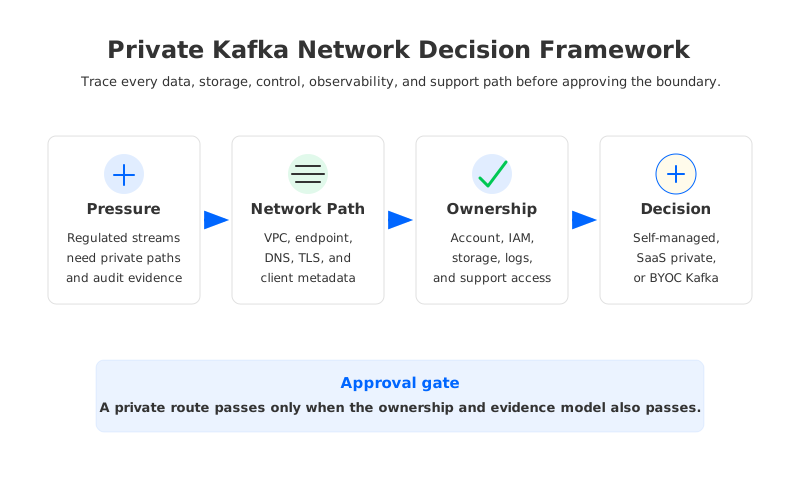
Teams search for private networking kafka byoc when the Kafka decision has moved beyond throughput and broker sizing. The security team wants to know whether producers and consumers cross the public internet. The governance team wants to know which account owns the data plane, keys, logs, and storage. The platform team wants private endpoints that do not turn routing, DNS, certificate issuance, and incident response into a permanent exception process.
That is the hard part of Kafka private networking: it is not one checkbox. A private endpoint can protect the client connection while leaving storage, control-plane access, observability export, support access, or connector paths in a different boundary. A VPC can host brokers while still depending on public egress for cloud APIs. BYOC can put runtime resources in the customer account while still requiring a precise responsibility model. The design has to make every path visible.
1Why private networking kafka byoc matters now
Kafka often carries the data that security reviewers care about most: payment events, identity changes, customer activity, fraud signals, operational telemetry, and AI context updates. Those streams are not static records sitting in a database subnet. They move between applications, connectors, stream processors, monitoring systems, and recovery tools. Private networking for Kafka therefore has to describe motion, not only location.
The first mistake is treating "private" as a synonym for "inside a cloud region." A producer in one VPC, a managed Kafka endpoint in another account, a connector worker in a third network, and a sink in a different cloud can all use private-looking addresses while still creating governance questions. Who owns the endpoint policy? Which DNS resolver chooses the route? Which logs prove that traffic used the intended path? Which team can revoke access during an incident?
The second mistake is evaluating private networking apart from the Kafka storage model. Traditional Kafka brokers own local log storage and replicate partitions across brokers for durability. That architecture is proven, but it makes broker placement, zone topology, storage growth, and recovery traffic part of the network review. A private listener alone does not explain where durable data lives or how much intra-cluster movement the platform needs when brokers fail, scale, or rebalance.
2The production constraints behind the search
Private Kafka designs usually begin with client access. That is reasonable because producers and consumers are the visible edge of the platform. Yet the client path is only one plane in the architecture. A production review should separate at least five paths before selecting VPC peering, AWS PrivateLink, Private Service Connect, VPN, transit gateways, or a BYOC deployment.
| Plane | Security question | Operational question |
|---|---|---|
| Client data plane | How do producers and consumers reach Kafka APIs? | Can routing, DNS, TLS, and ACLs be tested before cutover? |
| Storage plane | Where do durable records, WAL data, and backups live? | Does retention force broker-local storage growth? |
| Control plane | Who can create, scale, upgrade, or delete the platform? | Can automation work without broad public egress? |
| Observability plane | Where do metrics, logs, audit trails, and traces go? | Can incident teams correlate VPC flow logs with Kafka metrics? |
| Support plane | What access can the vendor or operator request? | Is emergency access time-bounded, logged, and revocable? |
This table is useful because it prevents a common false pass. A platform may use PrivateLink for clients and still send telemetry through a route the customer has not reviewed. A cluster may run in a private subnet and still depend on NAT for object storage or cloud API access. A BYOC service may keep data resources in the customer account and still need a documented support path. None of those patterns is automatically wrong; they are wrong only when the design hides them.
Kafka adds another production constraint: clients are stateful in their own way. They cache metadata, use bootstrap addresses to discover broker endpoints, authenticate through SASL or TLS mechanisms, and join consumer groups whose offsets represent business continuity. A private-network migration therefore touches application configuration, DNS, certificates, identity, ACLs, firewall rules, and rollback planning. Network engineers and Kafka operators have to plan together.
3Architecture patterns teams usually compare
The baseline option is self-managed Kafka inside a customer VPC. It gives the customer direct control over subnets, route tables, security groups, IAM roles, keys, and logs. It also gives the customer the full operational burden: broker patching, capacity planning, partition reassignment, storage expansion, replication health, and incident response. For teams with strong Kafka operations, this can be a rational choice. For teams trying to reduce platform toil, the operational load becomes part of the risk model.
The second pattern is SaaS managed Kafka with private connectivity. In this model, the provider operates the Kafka data plane in its service environment while customers connect through private connectivity options such as PrivateLink-style endpoints, peering, transit gateways, or cloud-specific private service mechanisms. This can reduce operational burden and keep application traffic off public internet paths. The trade-off is boundary clarity: the customer must review where the provider-operated data plane runs, what metadata and payload controls exist, how support access works, and which service features are available over the selected private path.
The third pattern is BYOC Kafka. BYOC means the data plane or runtime resources are deployed into the customer's cloud account or VPC while the vendor provides automation, lifecycle management, or managed operations. In a strong BYOC design, the customer can use familiar cloud controls for networking, IAM, KMS, object storage, flow logs, endpoint policies, and security posture management. The trade-off shifts from "Can we trust a remote service boundary?" to "Can we govern this vendor-operated software inside our boundary?"
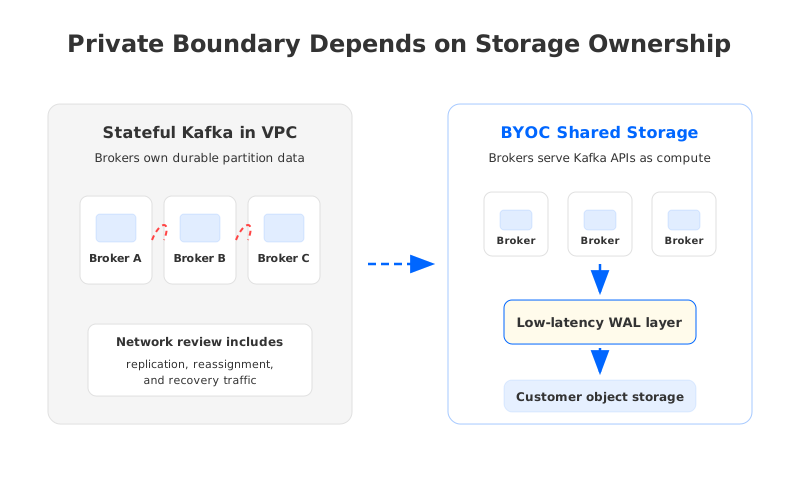
The storage architecture determines how far BYOC can go. If brokers remain stateful owners of local durable data, network design still has to accommodate replication, reassignment, and disk recovery behavior. If the platform uses a Kafka-compatible Shared Storage architecture, durable records can be governed through shared object storage while brokers behave more like compute. That does not remove the need for private networking; it changes what the private boundary must protect.
4Evaluation checklist for platform teams
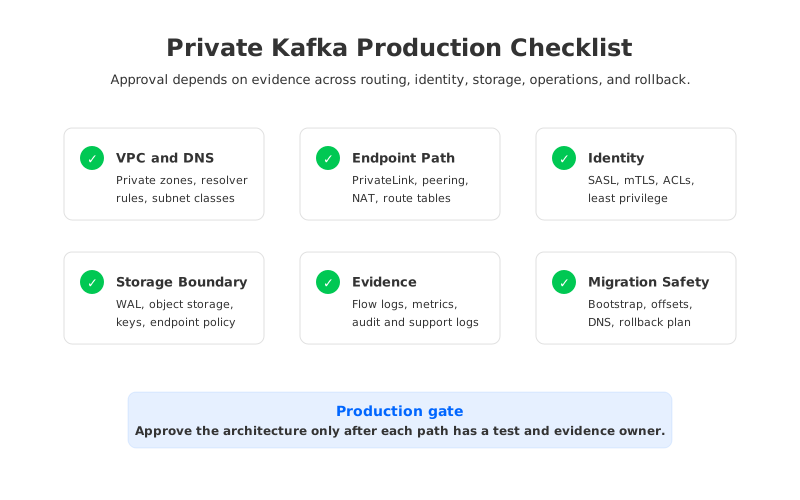
A useful evaluation starts with a packet walk, not a product matrix. Pick one producer, one consumer group, one administrative action, one monitoring export, one replay scenario, and one vendor support scenario. Trace each path across accounts, VPCs, subnets, endpoints, DNS zones, certificates, IAM roles, and logs. If the team cannot draw the path, it cannot approve the path.
Use this checklist before committing to a private-network architecture:
- Define the private boundary in cloud primitives. Name the account, region, VPC, subnet classes, private hosted zones, endpoint policies, security groups, IAM roles, and KMS keys involved in the Kafka platform.
- Separate client privacy from data ownership. Private connectivity to a provider endpoint protects the route, while BYOC changes where runtime resources and storage live. They answer related but different questions.
- Validate DNS and certificate behavior under failure. Private Kafka endpoints often fail in dull places: stale metadata, split-horizon DNS, certificate names that do not match private records, or clients that keep old broker addresses longer than expected.
- Map storage and recovery traffic. Include object storage access, WAL or local disk writes, broker replacement, partition reassignment, catch-up reads, and backup paths. These flows affect both security evidence and cost.
- Tie identity to Kafka resources. SASL, mTLS, and Kafka ACLs should map principals to topics, consumer groups, transactional IDs, and administrative actions. Network controls should reduce exposure, not replace authorization.
- Rehearse migration and rollback. A private-network cutover should test client bootstrap changes, ACL parity, offset continuity, monitoring, rate limits, rollback DNS, and incident escalation before production traffic moves.
The checklist is intentionally concrete. Private networking problems are rarely caused by one missing diagram box. They come from mismatched assumptions between teams: security reviews endpoints, network teams review routes, Kafka teams review broker behavior, and application teams review bootstrap strings. The architecture has to force those assumptions into one shared artifact.
5Where AutoMQ changes the operating model
Once the requirement becomes "Kafka-compatible streaming with customer-side network and data control," the architecture needs more than private endpoints. It needs a deployment model where the Kafka data plane, storage path, and operational evidence can be mapped to customer-controlled cloud resources. That is where AutoMQ fits as a Kafka-compatible cloud-native streaming platform built around Shared Storage architecture and BYOC deployment options.
In AutoMQ's BYOC model, the environment is deployed in the user's cloud account and VPC, and the data plane supports private network access. AutoMQ documentation describes the BYOC environment as placing the control-plane system and Kafka service cluster in the user-defined network environment, with underlying resources owned by the user. For security reviewers, that means the conversation can use cloud-native evidence: VPC configuration, private DNS, endpoint routes, IAM policies, storage location, metrics export, and maintenance authorization.
The storage model matters as much as the deployment model. AutoMQ replaces Kafka's broker-local log storage with S3Stream, a shared streaming storage layer backed by WAL storage and object storage. Brokers no longer need to be the permanent owners of all durable log data. In private-network terms, this lets platform teams reason about three distinct boundaries: Kafka API access through private listeners, low-latency WAL behavior for writes, and durable object storage governed by the customer's cloud controls.
This is not a blanket compliance guarantee. No Kafka architecture can turn policy, contracts, access review, incident process, and evidence retention into a single product claim. The practical value is narrower and more useful: AutoMQ BYOC can make the data plane, storage plane, and operating boundary easier to map to the customer's existing cloud security model while preserving Kafka protocol compatibility for applications.
6Decision table for private Kafka architecture
Teams do not need the same answer for every workload. A low-risk operational telemetry topic, a regulated payment stream, and a cross-cloud AI feature pipeline may justify different trade-offs. The right decision is the one where the private path, ownership boundary, and operating model match the data risk.
| Requirement | Strong fit | Watch closely |
|---|---|---|
| Maximum customer control over data resources | BYOC Kafka in the customer account or VPC | Vendor support access, automation permissions, and upgrade process |
| Least platform operations burden | SaaS managed Kafka with private connectivity | Data plane location, feature availability, and provider-side evidence |
| Existing Kafka operations maturity | Self-managed Kafka in private subnets | Broker storage growth, patching, reassignment, and recovery load |
| Long retention with controlled storage | Kafka-compatible shared storage or tiered storage patterns | Replay controls, object storage access, and read amplification |
| Strict private client access | PrivateLink-style endpoints, peering, or private service access | DNS, certificate naming, endpoint policy, and client metadata behavior |
The important distinction is between private routes and private control. Private routes answer how packets travel. Private control answers who owns the resources, who can inspect them, who can change them, and which logs prove the design. Kafka platform reviews need both.
If your Kafka platform is entering a security or governance review, start with the path map: client data, storage, control, observability, and support. When that map points toward Kafka compatibility plus customer-cloud ownership, talk to the AutoMQ team with your VPC, endpoint, identity, and storage requirements.
7References
- Apache Kafka documentation: security and authorization
- Apache Kafka documentation: SSL configuration
- AWS PrivateLink documentation
- AWS Gateway VPC endpoints documentation
- AutoMQ documentation: BYOC environment overview
- AutoMQ documentation: security overview
- AutoMQ documentation: prepare AWS VPC for BYOC
- AutoMQ documentation: architecture overview
8FAQ
8.1Is PrivateLink the same as BYOC Kafka?
No. PrivateLink-style connectivity creates a private route between customer applications and a service endpoint. BYOC changes the deployment boundary by placing runtime resources in the customer's cloud account or VPC, depending on the vendor architecture. Many teams evaluate both because private client access and customer-side data control solve different parts of the same risk review.
8.2Does private networking remove the need for Kafka ACLs?
No. Network controls reduce exposure, but Kafka still needs identity and authorization at the resource level. SASL, mTLS, and Kafka ACLs help map principals to topics, consumer groups, transactional IDs, and administrative actions. A private subnet should not be treated as proof that every client has the right level of Kafka permission.
8.3What should security teams ask before approving BYOC Kafka?
Ask where the data plane runs, where durable data and metadata are stored, how clients connect, which cloud identities the platform uses, what the control plane can change, where logs and metrics go, and how support access is granted and revoked. The answer should be a diagram plus cloud policies, not a paragraph in a vendor summary.
8.4Where does AutoMQ fit in a private Kafka architecture?
AutoMQ fits when teams want Kafka protocol compatibility, shared-storage architecture, and a BYOC operating boundary that can align with customer-controlled VPC, IAM, object storage, private DNS, and observability practices. It should be evaluated as an architecture option alongside existing Kafka operations, SaaS managed Kafka with private connectivity, and other BYOC designs.


