
Table of Contents
Table of Contents
Searches for vpc contained streaming kafka usually start after a security review has outgrown the phrase "private networking." The team is asking whether event records, offsets, connector state, storage artifacts, operational logs, and lifecycle actions can stay inside a boundary that cloud, security, and audit teams already understand. That is a different problem from putting a bootstrap address in a private subnet.
Regulated Kafka workloads make this distinction painful because Kafka is rarely a sidecar system. It carries payment events, identity changes, market data, fraud signals, customer activity, and operational telemetry. Those streams are not equally sensitive, and they do not all need the same isolation model. A useful architecture therefore starts with the workload event plane: the concrete path that a specific stream takes through producers, brokers, durable storage, consumers, connectors, control operations, and evidence systems.
1Why teams search for vpc contained streaming kafka
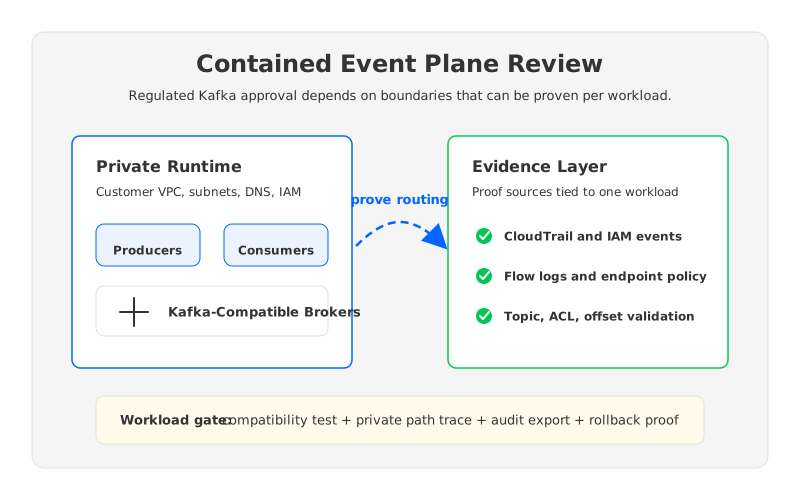
The search term is clumsy because the underlying requirement is clumsy. Security teams may say "VPC contained." Platform teams may say "customer-owned data plane." Procurement may say "BYOC." Application owners may only care that producers and consumers keep using Kafka clients. They are pointing at the same missing artifact: an event-plane map that separates runtime traffic from control-plane authority and backs each boundary with evidence.
Apache Kafka already defines many of the application semantics teams want to preserve: topics, partitions, offsets, consumer groups, transactions, ACLs, producer and consumer configuration, Kafka Connect, and controller metadata. The Apache Kafka documentation is still the baseline for those behaviors. The regulated deployment question is not whether the workload can be described in Kafka terms. The question is whether the infrastructure around those terms can pass a security and operations review.
Three things tend to trigger the search:
- A data residency review reaches Kafka. The team can explain where databases live, but Kafka durable logs, offset state, connector dead-letter topics, and observability exports are harder to trace.
- A managed streaming option leaves an unclear responsibility boundary. Private connectivity may protect the client path, while storage, control-plane actions, diagnostics, or support access still need separate answers.
- A self-managed cluster has become too expensive to isolate well. Keeping spare brokers, overprovisioned disks, and manual recovery playbooks may satisfy ownership requirements, but it can turn every regulated workload into its own operations program.
The common failure is treating all of those as network questions. Private routing is necessary, but it is not sufficient. A VPC can prove where packets flowed; it does not automatically prove which team controlled broker lifecycle actions, which policy protected durable data, or whether an offset migration can be reversed during a failed cutover.
2The production constraint behind the problem
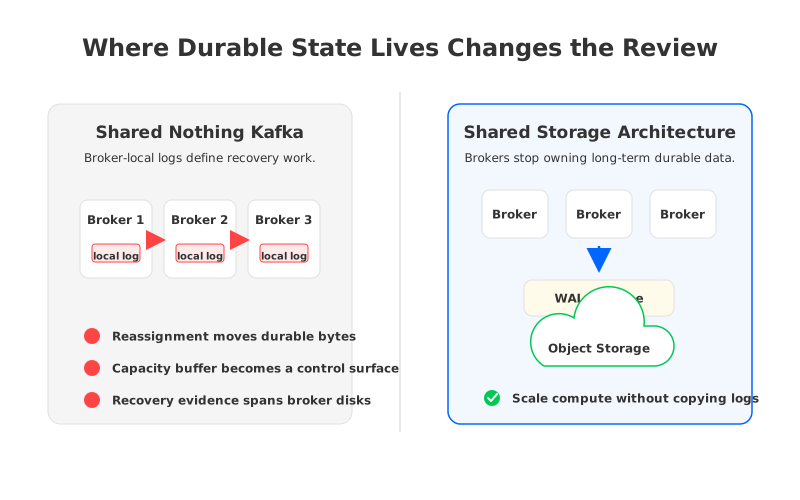
Traditional Kafka's Shared Nothing architecture binds durable log ownership to brokers. Each broker owns local storage for its partition replicas, and Kafka maintains durability through replication across brokers. That model is coherent, mature, and widely understood. It also means that scaling, replacing, rebalancing, and recovering brokers are not only compute operations; they are durable-state operations.
For ordinary platform operations, that coupling already creates work. For regulated workloads, it creates review scope. If a broker replacement triggers replica movement, the platform team has to reason about network paths, availability-zone placement, disk encryption, recovery windows, and audit evidence. If a consumer group is mission-critical, offset continuity becomes part of the compliance story because a bad migration can replay or skip regulated events.
This is why a private VPC event plane should be drawn with two paths, not one. The data plane covers producers, consumers, brokers, WAL or log storage, object storage, connector workers, and downstream sinks. The control plane covers cluster lifecycle, topic administration, ACL changes, certificates, upgrades, support access, monitoring, and audit export. A platform can be private on the data path while still being vague on the control path.
The evidence plane is the third part that security reviewers care about, even if the architecture diagram forgets it. AWS documents primitives such as VPC Flow Logs, CloudTrail event records, PrivateLink, and VPC endpoints for Amazon S3 because cloud teams need inspectable proof. A Kafka platform evaluation should use the same discipline.
3Architecture options and trade-offs
Most private Kafka discussions collapse into a false choice between "self-managed" and "managed." Regulated teams need a more precise comparison. The useful axis is where the event plane runs, where durable state is stored, what the control plane can change, and what evidence the customer can collect without asking a vendor to interpret the system for them.
| Architecture pattern | Event-plane boundary | Evidence strengths | Review risk |
|---|---|---|---|
| Self-managed Kafka in customer VPC | Brokers, disks, network, logs, and operations stay in the customer account | Direct access to infrastructure logs, IAM, storage policy, and network traces | Stateful broker operations, staffing load, data movement during reassignment, upgrade risk |
| Managed Kafka with private connectivity | Client traffic may use private paths to a provider-operated service | Private endpoint configuration and client-side network logs | Durable data placement, provider support access, control-plane authority, cross-account evidence gaps |
| BYOC Kafka-compatible platform | Data plane runs in customer cloud while automation may be externally coordinated | Customer-side cloud logs, storage policy, network controls, and deployment artifacts | Control-plane permissions, telemetry sharing, lifecycle ownership, contract clarity |
| Private software deployment | Runtime and control surface can be fully customer-operated | Strong local policy control and direct audit integration | Hardware lifecycle, object-storage design, support process, slower elasticity |
This table is not a ranking. A small internal analytics workload may be fine with managed Kafka and private connectivity. A high-value payment event stream may require customer-owned storage, private object-store access, and explicit support-access procedures. The platform decision should follow the workload's evidence requirement, not the other way around.
The same discipline applies to Kafka compatibility. A regulated platform should not accept a single produce-consume test as proof. It should test the Kafka surfaces used by the workload: producers, transactions if used, consumer group rebalancing, offset commits, ACL enforcement, topic configuration, Admin API calls, connector state, lag monitoring, and rollback behavior. Compatibility is an event-plane property, not a marketing label.
4Evaluation checklist for platform teams
A private VPC event-plane review should produce a short design record that security, platform, audit, and application owners can all sign. The record does not need to be elegant. It needs to be reproducible. If a row has no proof source, the workload is not ready for regulated production even if the network diagram looks clean.
Start with the workload rather than the cluster. A shared Kafka cluster may host streams with very different obligations. One topic may carry clickstream events with high retention. Another may carry account status changes where replay behavior and access history matter. Treating all of them as one "Kafka security posture" is how teams over-isolate low-risk workloads and under-verify critical ones.
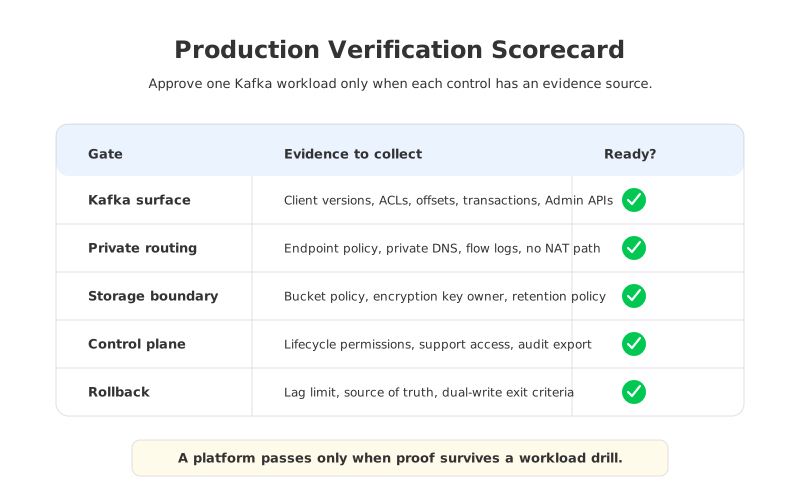
Use five gates before approving a workload:
- Kafka surface gate. Record the client libraries, protocol features, topic settings, ACLs, transactions, offset behavior, connector dependencies, and operational scripts that the workload uses.
- Private routing gate. Prove the client path, broker path, storage path, and connector path with route tables, endpoint policies, private DNS, flow logs, and the absence of unintended NAT or public egress.
- Storage boundary gate. Identify where durable logs, WAL data, object-storage objects, snapshots, connector offsets, dead-letter topics, metrics, and logs persist.
- Control-plane gate. Name which identities can create clusters, modify topics, change ACLs, rotate certificates, trigger upgrades, inspect diagnostics, or access support tooling.
- Rollback gate. Define the source of truth, acceptable lag, offset handling, dual-write or mirror strategy, failure trigger, and cleanup process.
Those gates also prevent the review from becoming a generic security checklist. A topic that never uses transactions should not spend review time pretending transaction compatibility is the decisive issue. A workload with strict replay rules should spend serious time on offsets, retention, and rollback. A connector-heavy pipeline should prove connector credentials and dead-letter routing. The point is not to make every workload pass the same exam; the point is to make each workload pass the right exam.
Cost belongs in the same record because cost often changes the security decision. Cross-zone data movement, private endpoint processing, NAT paths, observability retention, overprovisioned disks, and idle broker capacity can all push a team toward shortcuts later. Use workload assumptions such as write throughput, read fanout, retention, availability-zone layout, recovery behavior, and connector volume instead of unsupported savings percentages.
5How AutoMQ changes the operating model
Once the evaluation framework is written down, the architecture requirement becomes clearer: keep Kafka semantics, keep the regulated event plane inside a customer-controlled boundary when required, and reduce the durable state trapped on individual brokers. AutoMQ fits that category as a Kafka-compatible cloud-native streaming platform built around Shared Storage architecture.
AutoMQ changes the private-event-plane discussion because brokers are not the long-term owners of durable stream data. AutoMQ uses S3Stream with WAL storage and S3-compatible object storage, while brokers handle Kafka protocol traffic, scheduling, caching, and runtime work. The AutoMQ architecture overview describes this Shared Storage model.
That does not make regulated review disappear. It changes the review's center of gravity. Instead of asking how to move broker-local partition data every time compute changes, teams can focus on object-storage policy, WAL placement, private storage access, control-plane permissions, audit export, and workload migration tests. Those are still serious controls, but they map more naturally to cloud governance than broker disk movement does.
For BYOC-style cloud deployments, the important question is whether the data plane and its evidence live in the customer's environment. AutoMQ Cloud's BYOC model is relevant when teams want a customer-side deployment boundary with managed automation. AutoMQ Software is relevant when the private environment is not a public-cloud VPC. In both cases, the buyer should still demand workload proof: route traces, storage policy, identity scope, compatibility tests, observability export, and rollback drills.
One AutoMQ capability deserves attention in multi-AZ reviews: reducing cross-AZ traffic. AutoMQ documents a Zero Cross-AZ Traffic design for relevant deployment patterns. The governance value is not only lower network cost. Fewer routine cross-zone data paths can make the event plane easier to reason about when the team verifies the actual workload route and failure behavior.
AutoMQ becomes interesting when a team wants Kafka compatibility, customer-controlled deployment boundaries, object-storage-backed durability, stateless brokers, elastic operations, and evidence that can be collected from the customer's cloud environment. That is a specific operating model, not a universal replacement for every Kafka deployment.
6A workload-specific verification path
The strongest way to evaluate a private VPC event plane is to run one production-shaped workload through the target architecture before making a platform-wide decision. Pick a workload important enough to expose real constraints but narrow enough that the team can finish the test. A payment authorization stream, identity-change topic, or regulated audit feed is usually better than a synthetic benchmark topic.
The test should generate artifacts that survive review. Produce and consume records with the real client libraries. Validate consumer group behavior and offset continuity. Apply the actual ACL model. Exercise the connector or downstream sink. Trace the network path. Inspect storage policy and encryption ownership. Capture the control-plane actions used during deployment and upgrade. Run a rollback drill with a defined lag threshold.
A regulated Kafka platform is ready when the workload can be explained from event record to durable storage to audit evidence without relying on trust in the diagram.
This is where private VPC event planes differ from generic VPC security. The unit of approval is not the subnet. It is the workload. A private endpoint can be approved while support access remains vague. A cluster can be Kafka-compatible enough for one producer and still fail a transaction-heavy workload. Workload-specific verification keeps the architecture honest.
Return to the original search term: vpc contained streaming kafka. The useful answer is not a bigger private-networking diagram. It is an event-plane record that proves data path, control path, storage boundary, and rollback behavior for the streams that matter. If your team is evaluating that model with Kafka compatibility and customer-controlled deployment boundaries in mind, compare the checklist above against AutoMQ's BYOC path: evaluate AutoMQ for a private Kafka event plane.
7References
- Apache Kafka documentation
- Apache Kafka security documentation
- Apache Kafka KRaft documentation
- AWS PrivateLink documentation
- AWS VPC endpoints for Amazon S3
- AWS S3 bucket policies for VPC endpoints
- AWS CloudTrail record contents
- AWS VPC Flow Logs
- AutoMQ Shared Storage architecture
- AutoMQ compatibility with Apache Kafka
- AutoMQ WAL storage
- AutoMQ Cloud BYOC overview
- AutoMQ Zero Cross-AZ Traffic
8FAQ
8.1Is vpc contained streaming kafka the same as using PrivateLink?
No. PrivateLink is a private connectivity primitive. A VPC-contained Kafka event plane also needs answers for durable storage, connector state, control-plane authority, operational logs, support access, audit evidence, and workload rollback. Private connectivity can be one part of the design, but it does not prove the whole event plane.
8.2What is the difference between a data plane and a control plane in regulated Kafka?
The data plane handles event movement: producers, brokers, storage, consumers, connectors, and downstream sinks. The control plane changes or observes the platform: provisioning, upgrades, topic administration, ACL changes, certificate rotation, diagnostics, support access, and audit export.
8.3Why is workload-specific verification better than a cluster-level checklist?
A cluster-level checklist hides differences between workloads. One stream may depend on transactions, another on connector credentials, and another on strict replay behavior. Workload-specific verification tests the Kafka features, routing paths, storage policies, and rollback behavior that the workload actually uses.
8.4Where does Shared Storage architecture help?
Shared Storage architecture reduces the long-term durable state tied to individual brokers. That can make broker replacement, scaling, and storage governance easier to reason about because the review shifts from broker-local disk movement to object-storage policy, WAL placement, and compute isolation.
8.5When should AutoMQ enter the evaluation?
AutoMQ should enter after the team has defined the event-plane requirements. It is relevant when the workload needs Kafka compatibility, customer-controlled deployment boundaries, object-storage-backed durability, stateless brokers, elastic operations, and cloud-side evidence collection. Teams should validate it with the same checklist they use for self-managed or managed Kafka options.


