
Table of Contents
Table of Contents
The confusing part of an Amazon MSK bill is rarely the broker line item. Platform teams can see broker-hours, provisioned storage, and sometimes the obvious data transfer line. The harder question is why a Kafka workload that looked local on an architecture diagram still produced network charges. In managed Kafka, "same Region" is not the same as "same Availability Zone," and "private connectivity" is not the same as "free connectivity." Those distinctions are where many traffic costs Amazon MSK investigations begin.
The production question is broader than a single pricing page. You need to know where producers run, where consumers run, which broker they reach, how replicas are distributed, and whether AWS PrivateLink is in the path. A FinOps review that starts with only GB/month of Kafka traffic will miss the topology multiplier behind that traffic.
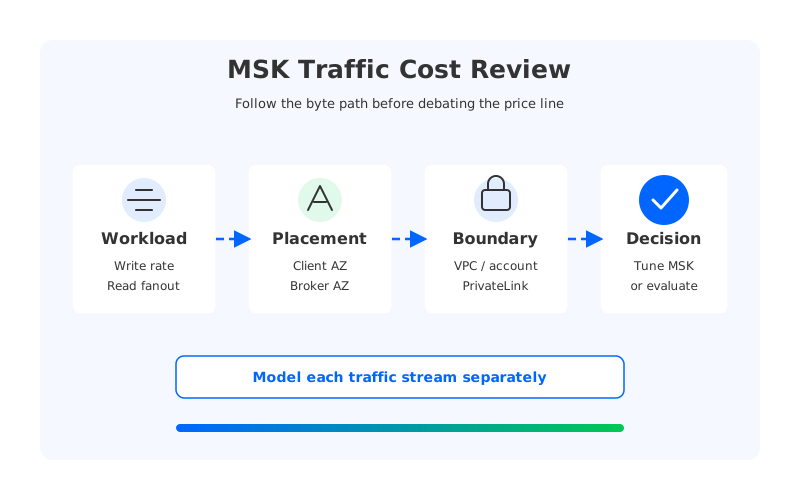
The goal is to separate workload traffic, placement choices, and storage architecture so platform owners can decide whether to tune the current MSK topology, change client placement, or evaluate a Kafka-compatible shared-storage system.
1Why Amazon MSK Traffic Cost Is a Topology Problem
Kafka makes data movement look simple at the API layer. Producers send records to topic partitions, brokers replicate and serve the log, and consumers fetch from offsets. Underneath that abstraction, the cloud network sees a set of flows between ENIs, subnets, Availability Zones, VPCs, and sometimes accounts. The bill follows those flows, not the conceptual Kafka diagram.
AWS states on the Amazon MSK pricing page that standard AWS data transfer charges apply for data transferred in and out of MSK clusters. That single sentence is easy to skim past, but it is the hinge of the cost model. MSK does not make Kafka traffic exempt from the normal cloud network rules. If clients sit in a different Availability Zone from the broker they use, or if traffic crosses VPC boundaries through PrivateLink, the Kafka workload inherits those network economics.
Three placement decisions usually create the gap between expected and actual cost:
- Client-to-broker placement: Producers and consumers may be in the same Region but not the same Availability Zone as the broker endpoint they contact. Consumer fanout can magnify this effect because one written byte may be read by many groups.
- Broker-to-broker replication: Multi-AZ Kafka clusters place replicas across zones for availability. That improves resilience, but it also means the write path can create inter-zone traffic before downstream consumers read anything.
- Connectivity boundary: MSK multi-VPC private connectivity uses AWS PrivateLink. PrivateLink is valuable when teams need private access across VPCs or accounts, but it adds endpoint-hour and data-processing dimensions to the cost model.
The architecture review should start by drawing these flows before assigning numbers. Otherwise the team debates pricing in the abstract and discovers too late that the expensive part is not the one they were optimizing.
2The Four Traffic Streams to Model
A useful MSK cost model splits traffic into streams that behave differently. This matters because the mitigation for one stream can increase another. Moving consumers into the same VPC may reduce one category of transfer, but if they still connect to brokers in a different Availability Zone, the topology is only partially fixed.
| Traffic stream | Typical source | What changes the cost curve |
|---|---|---|
| Producer ingress | Applications, CDC jobs, connectors | Producer placement, partition leadership, acknowledgments, compression |
| Replication traffic | Leaders sending data to followers | Replication factor, zone layout, leader distribution, workload write rate |
| Consumer egress | Services, Flink jobs, data lake sinks | Read fanout, consumer placement, rack awareness, lagged catch-up reads |
| Private connectivity | Cross-VPC or cross-account access | PrivateLink endpoint count, endpoint hours, processed GB, client concentration |
This table is intentionally topology-first. A team can know the write rate precisely and still be wrong about the bill if it does not know which side of the zone boundary the traffic crosses. The same problem appears with PrivateLink. A cross-account consumer may be secure and operationally clean, yet every GB through the endpoint still belongs in the model.
Avoid averaging all traffic into one "Kafka GB" number. Producer ingress is bounded by application write rate. Consumer egress depends on fanout and replay behavior. Replication is tied to durability policy and partition leadership. PrivateLink depends on access boundaries and endpoint design. Each stream needs its own owner, because each stream is controlled by a different team.
3PrivateLink Solves Access Boundaries, Not Placement Economics
MSK multi-VPC private connectivity is useful because it lets clients in other VPCs connect privately to a cluster without exposing brokers to the public internet. Shared platform teams often serve application teams across accounts, and network teams want predictable private access with fewer bespoke peering routes. PrivateLink gives them that control plane.
But PrivateLink should be modeled as an access pattern, not as a cost escape hatch. AWS PrivateLink pricing includes dimensions such as endpoint hours and data processing. A design with many VPCs, many Availability Zones, and heavy consumer traffic can look very different from a design where a few applications access MSK inside the cluster VPC. The decision is whether the security and ownership boundary is worth the traffic shape it creates.
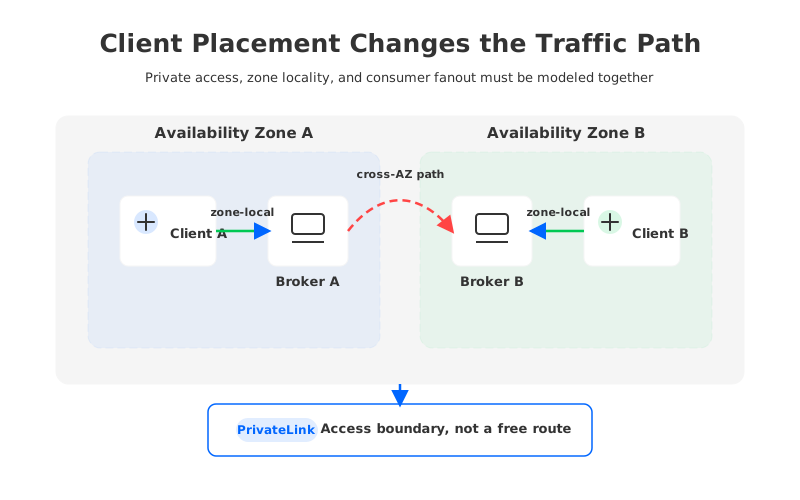
The practical review has two questions. Does the client truly need to be in a separate VPC or account, or is that boundary an artifact of how teams organized AWS accounts? If the boundary is required, can clients and endpoints be placed so traffic stays as zone-local as possible? A multi-account platform can still be cost-aware, but placement has to be part of the API contract.
Kafka's own rack-awareness concepts make the same point. AWS has published guidance on reducing MSK consumer network traffic costs with rack awareness, using client placement and replica selection so consumers can prefer replicas in their own Availability Zone. The lesson is not one configuration flag; Kafka cost optimization is partly a scheduling problem.
4Client Placement Is a Reliability Choice Too
Cost reviews often push teams toward zone-local traffic. Reliability reviews push them toward zone diversity. A platform owner has to hold both ideas at once. Pinning every client to one zone may lower cross-zone traffic, but it can weaken resilience. Allowing every client to reach any broker may improve availability, but it can create a steady stream of inter-zone transfer.
The right design depends on workload role. A stateless consumer group that can run one task per Availability Zone has a different answer from a stateful service that cannot easily rebalance during a zone event. Treating all Kafka clients as one placement class creates both cost surprises and brittle failure behavior.
A stronger placement model uses workload classes:
- Zone-local steady state: Clients prefer brokers or replicas in the same Availability Zone during normal operation, reducing unnecessary inter-zone reads.
- Cross-zone failover path: Clients have a tested path to continue during zone impairment, with explicit expectations for temporary cost increase and latency.
- Replay-aware consumers: Jobs that frequently catch up from older offsets are modeled separately because read volume can dominate their cost.
- Boundary-aware access: Cross-VPC and cross-account clients use PrivateLink when the security boundary is required, with endpoint placement and ownership reviewed upfront.
This framing prevents a common mistake: optimizing the happy path while leaving the failure path unpriced. A recovery drill that pulls large volumes across zones can create both operational pressure and a visible cost spike. The model should show which cost is steady state and which cost is the price of resilience.
5A Worksheet for MSK Traffic Cost Reviews
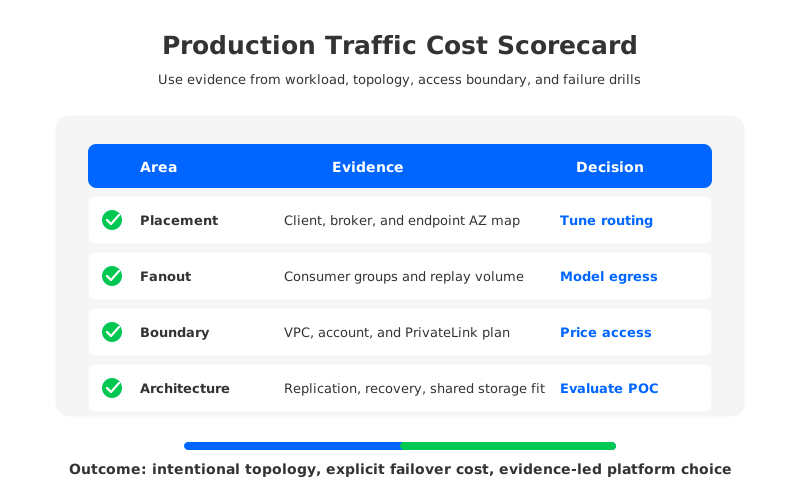
The worksheet below is designed for architecture reviews, not only spreadsheets. Each row asks for a technical input, the billing dimension it affects, and the engineering decision that can change it. The outcome is a decision record that says which topology and cost are intentional.
| Review input | Measurement to collect | Decision it informs |
|---|---|---|
| Write throughput by topic | MiB/s after compression, peak and p95 | Broker sizing, replication traffic, producer placement |
| Consumer fanout | Number of groups and replay frequency | Egress model, zone-local consumers, catch-up capacity |
| Availability Zone map | Client subnet, broker subnet, endpoint subnet | Cross-AZ exposure and failover behavior |
| VPC/account boundary | Which clients require separate ownership | PrivateLink, peering, or in-VPC deployment choice |
| Retention and replay | Hot-read vs historical-read volume | Cache expectations, tiered storage, alternative architecture evaluation |
| Failure drills | Zone loss, broker loss, endpoint impairment | Temporary traffic shifts and operational readiness |
The worksheet also makes one uncomfortable point visible: some MSK traffic costs are not accidental. Replication across zones exists because production Kafka needs durable copies. Private connectivity exists because many companies separate accounts for good reasons. The problem is when no one can say which costs are required and which are leftovers from a topology that no longer matches the workload.
6Architecture Choices That Change the Cost Curve
There are three broad ways to respond when traffic costs become material. The first is to tune the existing MSK deployment: client placement, rack-aware consumers, compression, partition leadership review, endpoint placement, and replay controls. It is the right first move when the current architecture is sound and the cost issue is mostly accidental routing.
The second path is to change the access architecture. Some teams consolidate clients into the same VPC as the MSK cluster. Others standardize PrivateLink endpoint patterns so every application team does not invent its own route. This can improve governance, but security should review whether simplification collapses useful ownership boundaries.
The third path is to question the storage and replication architecture itself. Traditional Kafka durability is built around broker-local log replicas. That model is proven, but in cloud environments it can make brokers responsible for both compute and durable data placement. When cross-zone replication and local storage dominate the model, a Kafka-compatible shared-storage architecture becomes a legitimate evaluation track.
This is where AutoMQ can enter the discussion naturally. AutoMQ is a Kafka-compatible, cloud-native streaming system that moves durable user data into S3-compatible shared storage through its S3Stream architecture while keeping brokers closer to stateless compute. Its documentation also describes approaches for eliminating inter-zone traffic by changing how data durability and broker placement work. The evaluation question is not whether the architecture sounds elegant; it is whether it preserves the Kafka behavior your applications require while changing the traffic and recovery model enough to matter.
For an MSK-heavy organization, AutoMQ belongs in a proof-of-concept when three conditions are true. Traffic cost is driven by structural data movement rather than a fixable subnet mistake. The workload can be tested with real producer and consumer behavior, including replay and failure drills. The team is willing to evaluate compatibility, latency, governance, and operational ownership together. A shared-storage system should not be adopted because a spreadsheet says "less network." It should be adopted because the workload proves that the new durability boundary is operationally better.
Migration risk still needs a visible exit path. Run existing clients against the candidate platform, measure latency with the same compression and consumer patterns, simulate broker loss, and rehearse rollback before broad cutover. This applies whether the answer is "tune MSK" or "evaluate AutoMQ." Tuning also needs evidence: a rack-aware placement change should show traffic moved where expected, and a PrivateLink redesign should be tested with endpoint failure behavior.
7What to Put in the Decision Record
The final artifact should be short enough that procurement, architecture, SRE, and application owners can all read it. It should state the workload class, the traffic streams measured, the topology options compared, and the decision. It should also include the costs the team intentionally accepts. "Zero cross-AZ traffic" is not always the right target for every workload; sometimes the correct answer is to pay for a failover path and make it explicit.
Use the decision record to separate three outcomes. Some workloads only need MSK placement tuning. Some need PrivateLink standardization because the access boundary is real and worth paying for. Some deserve a Kafka-compatible shared-storage proof-of-concept because the cost and operations issue is structural. When those outcomes are mixed inside one platform, that is not inconsistency. It is mature infrastructure governance.
Back to the confusing MSK bill: the answer is rarely hidden in a single line item. It is in the route a byte takes from producer to broker, broker to replica, broker to consumer, and VPC to VPC. If that route is shaping your Kafka roadmap, build the traffic worksheet, run a placement review, and include shared-storage Kafka-compatible systems in the evidence set. AutoMQ's architecture docs are a practical next step when you want to test whether a storage-layer redesign can reduce the data movement your current topology treats as unavoidable: review AutoMQ architecture.
8References
- Amazon MSK pricing: https://aws.amazon.com/msk/pricing/
- Amazon MSK multi-VPC private connectivity: https://docs.aws.amazon.com/msk/latest/developerguide/mvpc-cluster-owner-action-turn-on.html
- AWS PrivateLink pricing: https://aws.amazon.com/privatelink/pricing/
- AWS guidance on reducing MSK consumer network traffic costs with rack awareness: https://aws.amazon.com/blogs/big-data/reduce-network-traffic-costs-of-your-amazon-msk-consumers-with-rack-awareness/
- Apache Kafka documentation for consumer configuration: https://kafka.apache.org/documentation/#consumerconfigs_client.rack
- AutoMQ documentation, S3Stream shared streaming storage: https://docs.automq.com/automq/architecture/s3stream-shared-streaming-storage/overview?utm_source=blog&utm_medium=reference&utm_campaign=gs100-0094
- AutoMQ documentation, eliminating inter-zone traffic: https://docs.automq.com/automq/eliminate-inter-zone-traffics/overview?utm_source=blog&utm_medium=reference&utm_campaign=gs100-0094
9FAQ
9.1Does Amazon MSK charge separately for Kafka traffic?
Amazon MSK pricing states that standard AWS data transfer charges apply for data transferred in and out of MSK clusters. The practical impact depends on topology: client placement, cross-AZ paths, cross-VPC access, PrivateLink usage, and consumer fanout all shape the final bill.
9.2Is PrivateLink required for every Amazon MSK client?
No. PrivateLink is useful for private connectivity across VPCs or accounts, especially in shared platform models. Clients inside the same VPC as the MSK cluster may not need that boundary. The right choice depends on security ownership, account structure, routing policy, and cost model.
9.3Can rack awareness reduce MSK traffic costs?
It can help when consumer traffic is crossing Availability Zones unnecessarily. Rack-aware placement and replica selection can keep more reads zone-local during normal operation. Teams still need to test failover behavior because availability requirements may intentionally move traffic across zones during an incident.
9.4Should every team replace MSK to reduce traffic costs?
No. Many teams should first tune client placement, compression, endpoint layout, and consumer behavior. A Kafka-compatible shared-storage alternative becomes worth evaluating when traffic cost is structural, tied to replication and local-storage architecture, or coupled with operational pain such as slow broker recovery.
9.5How does AutoMQ relate to Amazon MSK traffic cost evaluation?
AutoMQ changes the evaluation by using a Kafka-compatible shared-storage architecture backed by S3-compatible object storage. That can reduce the need for traditional broker-local data replication patterns, but it should be tested with the same clients, workload shape, failure drills, and governance requirements used for MSK.


