
Table of Contents
Table of Contents
Teams rarely search for confluent alternatives because they dislike Kafka. More often, they already depend on Kafka APIs, connectors, consumer groups, transactions, schemas, and operational patterns. The search begins when the commercial or control model around a managed streaming platform no longer matches how the organization wants to buy, govern, or operate infrastructure.
That makes this query more serious than a product shortlist. It is usually a procurement control question disguised as a vendor comparison. The buyer wants to know whether the current platform is still the right abstraction boundary: should the team keep paying for a full managed service, move to another managed Kafka provider, operate Apache Kafka directly, adopt a Kafka-compatible engine, or split responsibilities between an internal platform team and a vendor-supported data plane?
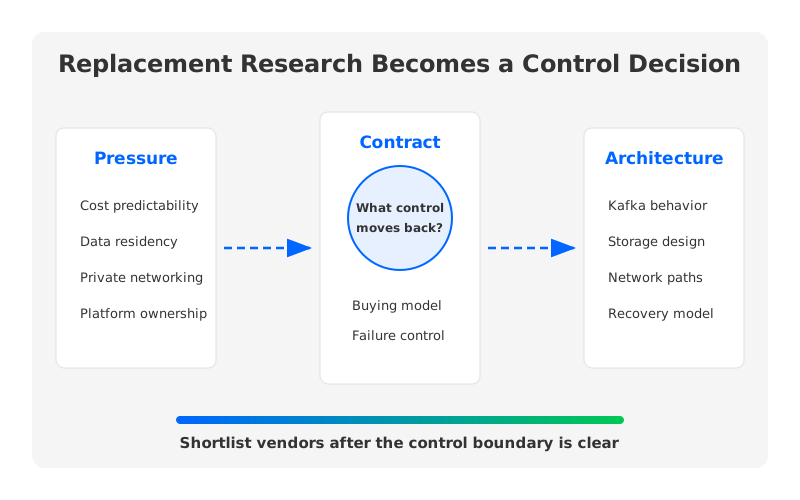
The wrong evaluation starts with feature tables. The better evaluation starts with the contract you are trying to regain: data-plane control, cost predictability, deployment location, network boundaries, operational responsibility, or Kafka semantic compatibility. Those dimensions decide whether a replacement path is realistic before any pricing spreadsheet becomes useful.
1Why Teams Search for Confluent Alternatives
Confluent Cloud is a mature event streaming service with managed clusters, networking options, governance features, and ecosystem integrations. For many teams, that is exactly the value proposition: offload Kafka operations and standardize around a platform maintained by a Kafka-focused vendor. A respectful evaluation should acknowledge that value before discussing alternatives, because replacing a managed streaming platform is not the same as swapping a library.
The search usually appears when one of four pressures becomes hard to ignore. Procurement may want clearer unit economics across business units. FinOps may want more direct control over storage, network, and deployment choices. Security teams may require stricter data residency or private connectivity patterns. Platform teams may want Kafka compatibility without accepting a fully externalized control plane for every production decision.
Those pressures overlap, but they point to different outcomes. A team unhappy with invoice predictability may still want a managed Kafka service. A team constrained by VPC routing, private networking, or regional data placement may care more about deployment topology than headline price. A platform team with deep Kafka expertise may accept more operational ownership if it gains architectural flexibility. The word "alternative" hides these differences, and that is why replacement projects stall.
2A Shortlist Is Not a Decision Model
Most teams can name several categories quickly: managed Kafka services, self-managed Apache Kafka, cloud-provider offerings such as Amazon MSK, and Kafka-compatible systems that preserve the client protocol while changing parts of the storage or operations model. That shortlist is useful, but it does not answer the procurement question. Each category moves a different boundary.
| Evaluation path | What you gain | What you still need to test |
|---|---|---|
| Fully managed Kafka platform | Lower day-to-day operations burden and integrated platform services | Billing shape, deployment control, private network design, exit path |
| Cloud-provider managed Kafka | Closer cloud account alignment and familiar procurement | Kafka operations limits, version cadence, networking and storage cost behavior |
| Self-managed Apache Kafka | Maximum software control and broad ecosystem familiarity | Operational staffing, broker storage management, scaling friction, recovery drills |
| Kafka-compatible cloud-native engine | Kafka APIs with a different storage and scaling architecture | Compatibility coverage, latency profile, migration plan, governance integration |
The table is deliberately plain. There is no universal winner because the decision is not one-dimensional. A team optimizing for offloaded operations may make a different choice from a team optimizing for data-plane ownership inside its cloud account. The procurement mistake is treating those choices as if they were all variants of the same managed service contract.
Kafka compatibility also deserves more precision than it usually gets. Compatibility is not a logo next to a protocol name. It includes producer and consumer behavior, offset management, transactions where required, ACL and authentication integration, client version tolerance, error behavior, observability expectations, and how the platform handles rebalancing, recovery, and retention under load. The Apache Kafka protocol documentation and Kafka operations docs are the baseline, but production compatibility is proven by workload tests, not assertions.
3Architecture Criteria Behind the Shortlist
The architecture discussion begins with storage. Traditional Kafka couples brokers, local disks, partition leadership, replication, and recovery into one operational unit. That design is battle-tested, but it creates cloud cost and elasticity side effects: broker sizing is tied to storage, rebalancing data can become expensive, and multi-AZ replication can add predictable network traffic when replicas span availability zones.
Tiered storage changes part of that story by moving older log segments to remote storage while brokers continue to serve the hot path. Apache Kafka documents tiered storage as a way to shift older data away from local broker disks. That can reduce local storage pressure, but it does not automatically make brokers stateless, remove every recovery bottleneck, or erase all cross-AZ traffic from the write path. The procurement implication is subtle: tiered storage may improve retention economics, while a diskless or shared-storage design changes the ownership model of broker failure and scaling.
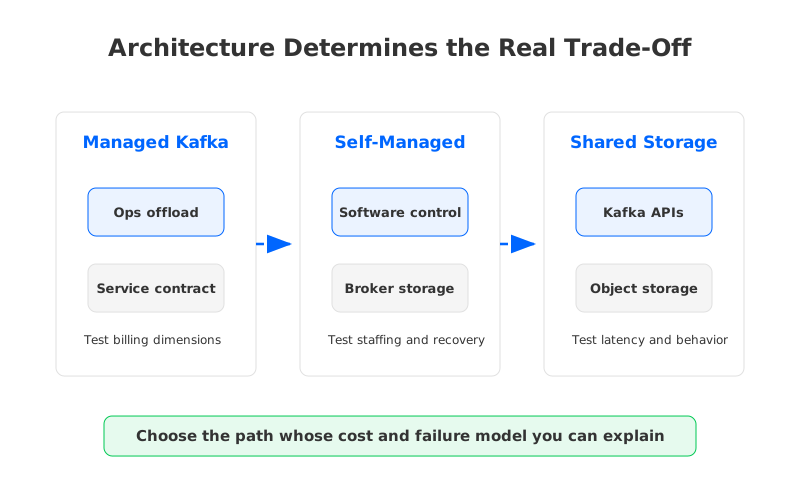
That distinction matters when a team is trying to regain control. If storage remains operationally attached to brokers, then scaling, replacement, and recovery still require care around data movement. If durable log storage is moved into object storage and brokers become closer to stateless compute, the platform can reason about compute and storage as separate procurement units. The trade-off moves from "how many broker disks do we need?" to "what storage service, write-ahead log design, and cache behavior meet our latency and durability requirements?"
Network design is the second architecture criterion. On AWS, cross-AZ data transfer and PrivateLink have explicit pricing models, and managed streaming platforms may also expose billing dimensions tied to networking, throughput, storage, partitions, or cluster class. A replacement evaluation should model the actual topology: producer AZs, broker placement, consumer fan-out, replication traffic, private endpoints, and whether the platform can keep common traffic paths local. The right question is not "which service is lower cost?" It is "which architecture gives us control over the expensive paths?"
The third criterion is failure recovery. Procurement teams care about cost, but SREs inherit the failure modes. If a replacement reduces invoice variance but makes broker replacement, partition movement, or disaster recovery harder, the savings are fragile. A serious evaluation includes restore tests, AZ failure tests, consumer lag behavior during broker loss, and rollback plans for migration. Paper savings do not survive the first incident review.
4Migration and Ownership Questions for Platform Teams
The migration plan should be written before the purchase order. Kafka replacement projects fail when the technical team treats compatibility as a binary property and the procurement team treats migration as a one-time cutover. In practice, event streaming is full of long-lived producers, consumer groups with independent release cycles, schema evolution, ACL assumptions, observability dashboards, and client libraries that may be several versions apart.
Five questions reveal most of the hidden work:
- Which Kafka features are business-critical rather than incidental? Transactions, compaction, large messages, quotas, ACLs, and idempotent producers should be tested against real workloads.
- Which traffic paths determine cost? Producer ingress, consumer egress, replication, cross-AZ movement, private endpoints, and mirroring can matter more than broker list price.
- Who owns the data plane? Some teams want a vendor-operated service; others need deployment inside their own cloud account for governance, latency, or procurement reasons.
- What is the rollback path? A credible migration plan defines dual writes, consumer catch-up, topic mirroring, validation windows, and the conditions for stopping the cutover.
- What changes for day-two operations? Capacity planning, incident response, upgrades, quota management, and cost attribution must be easier to explain after the move, not harder.
This is where procurement control becomes concrete. A platform team is not buying a lower number on a spreadsheet; it is buying the ability to predict, explain, and change the streaming layer without renegotiating every architectural constraint. The replacement path should make that control measurable.
5How AutoMQ Fits the Evaluation
Once the decision is framed this way, AutoMQ belongs in a specific category: a Kafka-compatible cloud-native streaming engine that separates broker compute from durable storage. It is not positioned as a generic "managed Kafka versus managed Kafka" swap. The architectural claim is narrower and more technical: keep Kafka protocol compatibility for applications while changing how the data plane stores, scales, and recovers data in cloud environments.
AutoMQ uses object storage as the durable storage foundation and designs brokers to be stateless around shared storage. In procurement terms, that changes the control surface. Storage durability can be anchored in cloud object storage, compute can scale with less dependence on local broker disks, and network traffic can be optimized around cloud topology. AutoMQ documentation also describes practices for reducing cross-AZ traffic costs, which is relevant for teams whose Kafka bill is shaped by replication and fan-out paths rather than compute alone.
The more important point is where AutoMQ should enter the evaluation. It should appear after the team has defined its compatibility test suite, cost model, network topology, ownership requirements, and migration path. That order keeps the conversation honest. If a workload depends on a Kafka behavior that has not been validated, the answer is not a sales claim; it is a test. If the team needs a specific deployment model, the answer is not a feature checklist; it is an architecture review.
For organizations comparing Confluent alternatives, AutoMQ is most relevant when the target outcome is Kafka compatibility with stronger control over cloud infrastructure economics and data-plane placement. Teams evaluating that path should run a proof of concept against representative topics, client versions, retention policies, consumer fan-out, and incident scenarios. The useful result is not a vendor ranking. It is a decision record that states which constraints moved, which risks remain, and which operating model the team is choosing.
6A Practical Evaluation Worksheet
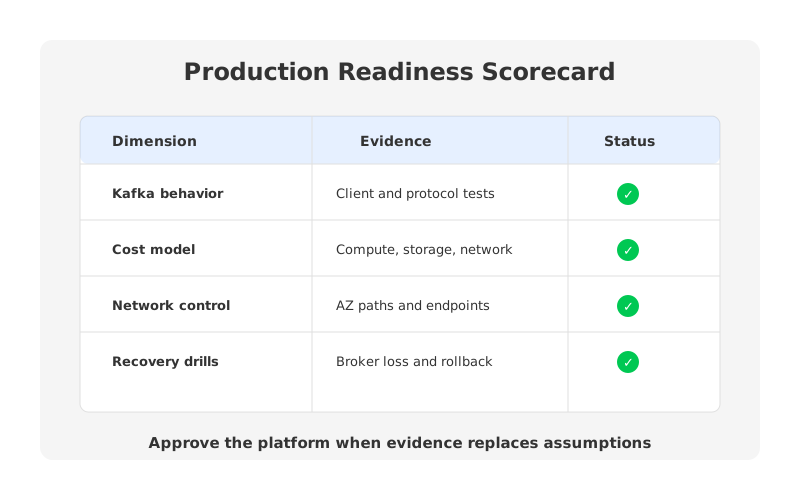
The procurement team, platform team, and security team should share one worksheet instead of maintaining separate scorecards. When each group optimizes in isolation, the result is predictable: procurement sees price, SRE sees risk, security sees data boundaries, and engineering sees migration effort. A shared worksheet forces trade-offs into the open.
| Dimension | Evidence to collect | Red flag |
|---|---|---|
| Kafka behavior | Client tests, protocol features, offset and transaction validation | "Compatible" with no workload evidence |
| Cost model | Monthly forecast by storage, compute, network, support, and migration | One blended price with no traffic assumptions |
| Network control | AZ placement, private connectivity, endpoint design, egress paths | Unknown cross-AZ or endpoint billing exposure |
| Recovery | Broker loss, AZ disruption, restore, replay, and rollback tests | Migration plan without failure drills |
| Governance | Cloud account boundary, IAM, audit, encryption, data residency | Data-plane ownership unclear to security reviewers |
| Operations | Upgrade, scaling, quota, observability, and incident procedures | Day-two tasks depend on vendor-specific manual steps |
This worksheet also prevents a common mistake: over-weighting migration day and under-weighting the next 24 months. A smooth migration into an opaque operating model is still a bad trade. A more involved migration into an architecture the team can reason about may be the stronger long-term choice, provided the compatibility and recovery tests are real.
7Closing the Procurement Loop
The original search starts with a simple phrase: confluent alternatives. The decision behind it is not simple. It asks where Kafka should live, who should control the data plane, how cloud network costs should be governed, and how much operational responsibility the platform team is ready to own.
If your team is evaluating Kafka-compatible architecture options and wants to test a shared-storage data plane against your own workload, review AutoMQ's technical materials and talk through a migration path with the engineering team: contact AutoMQ.
8References
- Apache Kafka protocol documentation: https://kafka.apache.org/protocol/
- Apache Kafka tiered storage operations documentation: https://kafka.apache.org/40/operations/tiered-storage/
- Apache Kafka security documentation: https://kafka.apache.org/documentation/#security
- Amazon MSK pricing: https://aws.amazon.com/msk/pricing/
- AWS EC2 data transfer pricing: https://aws.amazon.com/ec2/pricing/on-demand/#Data_Transfer
- AWS PrivateLink pricing: https://aws.amazon.com/privatelink/pricing/
- Confluent Cloud networking overview: https://docs.confluent.io/cloud/current/networking/overview.html
- Confluent Cloud billing overview: https://docs.confluent.io/cloud/current/billing/overview.html
- Confluent Cloud Cluster Linking documentation: https://docs.confluent.io/cloud/current/multi-cloud/cluster-linking/index.html
- AutoMQ architecture overview: https://docs.automq.com/automq/architecture/overview?utm_source=blog&utm_medium=reference&utm_campaign=gs100-0027
- AutoMQ migration overview: https://docs.automq.com/automq-cloud/migrate-to-automq/overview?utm_source=blog&utm_medium=reference&utm_campaign=gs100-0027
- AutoMQ cross-AZ traffic cost practices: https://docs.automq.com/automq-cloud/best-practice/save-cross-az-traffic-costs-with-automq?utm_source=blog&utm_medium=reference&utm_campaign=gs100-0027
9FAQ
9.1Is a Confluent alternative always a lower-cost option?
No. The cost outcome depends on workload shape, retention, networking, support model, deployment topology, and migration effort. The right comparison separates compute, storage, network, support, and operational ownership instead of relying on a single monthly estimate.
9.2Can a Kafka-compatible platform replace Apache Kafka clients without application changes?
Sometimes, but the answer must be proven against the application's actual Kafka usage. Producers, consumers, transactions, ACLs, schema workflows, monitoring, and error handling should all be tested before a production cutover.
9.3How is tiered storage different from a shared-storage Kafka-compatible architecture?
Tiered storage usually moves older Kafka log segments to remote storage while brokers still manage the hot path and local storage responsibilities. A shared-storage architecture changes the broker-storage relationship more deeply by placing durable log storage outside broker-local disks and treating brokers more like elastic compute.
9.4Where does AutoMQ fit in a Confluent alternatives evaluation?
AutoMQ fits when the team wants Kafka-compatible APIs with a cloud-native data plane based on shared object storage, stateless brokers, and more direct control over cloud deployment and network economics. It should be evaluated with representative workloads and explicit compatibility, cost, and recovery tests.
9.5What should procurement ask before approving a replacement?
Ask for a decision record that includes the compatibility test plan, migration and rollback design, cost model assumptions, data-plane ownership boundary, private networking design, and day-two operations plan. Those artifacts are more useful than a feature checklist.


