
Table of Contents
Table of Contents
A Kafka producer acknowledgment policy looks like a small client-side setting until a payment event, inventory update, fraud signal, or CDC record disappears in the gap between a successful send() call and durable replication. That is why teams search for producer acknowledgment policy kafka after they already know the basics. They are not asking what an acknowledgment is. They are asking where the real boundary sits between latency, durability, cost, and operational failure.
The uncomfortable part is that the producer alone cannot make an event durable. It can only define the condition under which the broker may tell the producer, "I accepted this record." Whether that answer survives a broker crash depends on the leader, the in-sync replica set, the topic settings, the storage layer, and the recovery behavior of the platform. Treating acks as a performance knob hides the fact that it is also a business-risk knob.
1Why teams search for producer acknowledgment policy kafka
The search usually starts when one of three things happens. An application team wants lower publish latency and asks whether acks=1 is acceptable. A platform team notices write throughput flattening after enabling stronger durability. Or an incident review finds that a producer reported success while downstream state did not reflect the expected event. Each case points to the same question: what exactly did the producer wait for?
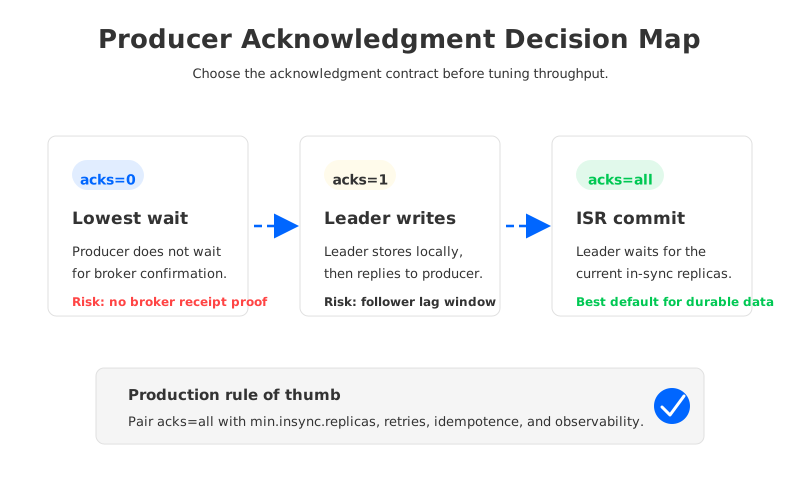
Kafka exposes three common acknowledgment modes. With acks=0, the producer does not wait for broker confirmation, so the application gets minimal waiting but no proof that the broker received the record. With acks=1, the partition leader writes the record and replies before waiting for all current in-sync followers. With acks=all, the leader waits for the current in-sync replica set before acknowledging the request. That last phrase matters. It is not "all assigned replicas forever"; it is the set considered in sync at that moment.
For durable event pipelines, acks=all is usually the starting point, not the entire answer. The broker can still accept writes with too few in-sync replicas if the topic allows it. That is why production teams pair producer acknowledgments with min.insync.replicas, sane retry behavior, idempotence, monitoring on under-replicated partitions, and a clear policy for unclean leader election. The producer policy defines the handshake; the platform policy defines the safety envelope around that handshake.
| Producer policy | What the producer waits for | Typical use | Main failure concern |
|---|---|---|---|
acks=0 | No broker response | Telemetry that can be sampled or recomputed | Producer cannot know whether the broker received the record |
acks=1 | Leader append and response | Low-latency workloads with acceptable loss window | Leader can fail before followers catch up |
acks=all | Current ISR acknowledgement | Business events, CDC, audit streams, financial workflows | Durability depends on ISR health and topic policy |
The table is deliberately blunt because many outages begin with vague language. "Kafka acknowledged it" is not precise enough. A durable pipeline needs to know which broker acknowledged it, which replicas had the record, what happens if the leader dies, and whether writes should pause when the replication set is no longer healthy.
2The production constraint behind the problem
Producer acknowledgments sit on top of Kafka's replicated log. A partition leader orders records, followers copy from the leader, and the in-sync replica set tracks replicas that are caught up closely enough to be eligible for safe leadership. A write becomes meaningfully durable only when the acknowledgment condition overlaps with a recovery path that can elect a leader containing the acknowledged record.
That is the clean model. Production adds messier constraints. Brokers restart, disks degrade, followers fall behind, cloud zones fail, and operators rebalance partitions while applications keep publishing. The producer sees the system through request latency and exceptions. The platform team sees the same system through ISR shrinkage, controller events, disk pressure, network saturation, and recovery time. A good acknowledgment policy has to work for both views.
The most common mistake is to optimize the producer path without measuring the storage and replication path. If acks=all causes latency spikes, the fix might be batching, compression, quota work, partition placement, or storage throughput. Dropping to acks=1 may hide the symptom by moving risk into the failure window after the leader reply. That may be acceptable for clickstream sampling. It is a poor trade for a ledger event or a CDC stream feeding a lakehouse table.
3Architecture options and trade-offs
Traditional Kafka uses a shared-nothing model: each broker owns local storage, and durability comes from replicating partition data across brokers. This model is efficient when local disks are predictable and broker capacity changes slowly. It also makes producer acknowledgments operationally expensive in cloud environments because the durability path is tied to broker-local replicas. More writes mean more replica traffic. More retention means more local disk planning. More broker changes mean more partition movement.
The practical implication is that a producer acknowledgment policy is not isolated from infrastructure cost. If your default is acks=all with multiple replicas across availability zones, write durability also creates network and storage effects. Some of those effects are exactly what you want: independent copies, zone resilience, and leader failover. Others are operational side effects: longer reassignment windows, cross-zone traffic, larger recovery surfaces, and capacity buffers sized for failure days rather than normal days.
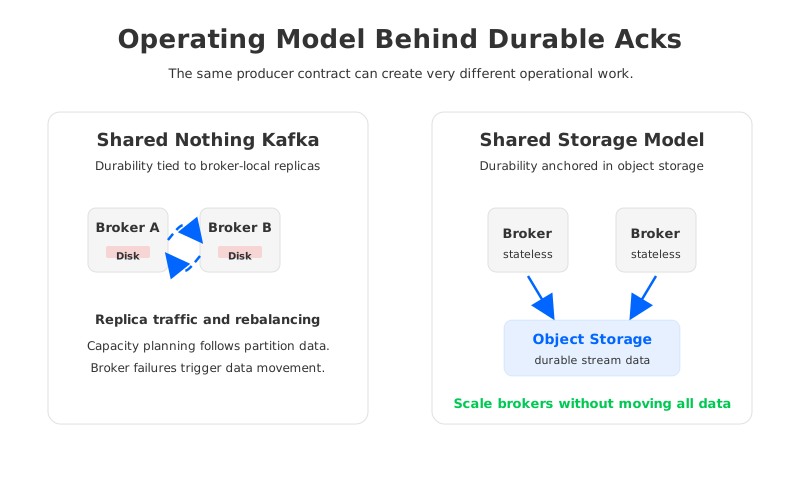
A shared-storage architecture changes the shape of that trade-off. Instead of treating broker-local disks as the durable home of stream data, the system uses object storage as the persistent layer and keeps brokers closer to stateless compute. The producer still uses Kafka-compatible APIs and acknowledgment semantics, but the operating model behind the broker changes. Scaling compute no longer has to mean moving the full data set from one broker disk to another.
This does not remove the need for a producer policy. It makes the policy easier to reason about because durability, compute scaling, and data placement are less entangled. The platform still has to validate write-ahead logging, object storage behavior, metadata recovery, client compatibility, and failure drills. The difference is that adding or replacing brokers can be treated more like changing serving capacity than reshuffling the durable source of truth.
4Evaluation checklist for platform teams
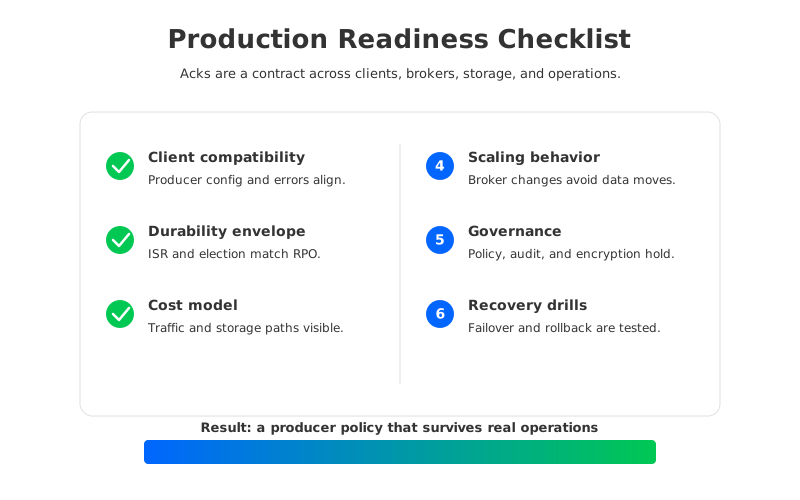
A durable producer policy should be approved the same way you approve a database write policy: with explicit semantics, failure tests, and rollback expectations. The following checklist is a good starting point for platform teams that support many producer teams with different risk profiles.
- Define the event class before choosing
acks. Audit events, financial transactions, schema-change records, and CDC streams usually deserve stronger durability than derived metrics or lossy telemetry. - Pair
acks=allwith broker-side guardrails.min.insync.replicasis what prevents the cluster from silently accepting "durable" writes with an unacceptably small ISR. - Keep retries and idempotence in the same discussion. Retrying without clear duplicate and ordering semantics can turn a durability improvement into a correctness problem.
- Monitor the conditions that make the acknowledgment meaningful. ISR shrinkage, under-replicated partitions, request latency, produce error rates, and throttling are part of the producer policy, even when they live outside producer code.
- Test the failure you claim to tolerate. Kill a leader, isolate a zone, force a broker restart under load, and verify what the producer observes and what downstream consumers can replay.
The checklist should end in a decision matrix, not a universal rule. A trading event and a mobile analytics event can both use Kafka, but they should not inherit the same acknowledgment policy by accident. Platform teams should publish a small number of approved profiles, such as "loss-tolerant telemetry," "durable business event," and "regulated audit stream," then map each profile to producer configs, topic configs, observability, and recovery expectations.
5How AutoMQ changes the operating model
If the core problem is that producer durability becomes tangled with broker-local storage operations, the architectural escape hatch is not another producer flag. It is a storage model that keeps Kafka protocol compatibility while reducing the amount of durable state bound to individual brokers. AutoMQ fits that category as a Kafka-compatible cloud-native streaming platform built around shared storage and stateless broker operation.
For an application team, the important point is compatibility: existing Kafka producer concepts such as acks, batching, retries, and client libraries remain the language of the write path. For a platform team, the more interesting change is operational. Object-storage-backed durability and stateless brokers reduce the pressure to size every broker as both compute and long-lived storage. That separation helps when the team needs to scale write capacity, replace failed nodes, or rebalance workloads without treating every operation as a data migration project.
There is still engineering work to do. A team evaluating AutoMQ should verify Kafka client compatibility, latency targets, WAL configuration, object storage access boundaries, security controls, observability integration, and migration rollback. Those checks are healthy. They keep the evaluation grounded in workload reality instead of product labels.
The payoff is that producer acknowledgment policies can be managed as part of a cleaner platform contract. The contract can say: producers use Kafka-compatible durable settings; the platform enforces ISR and recovery behavior; the storage layer is designed for cloud durability and elastic operations; and application teams do not need to learn another event API to get that operating model.
6A practical policy template
For durable event pipelines, a conservative baseline looks like this:
acks=all
enable.idempotence=true
delivery.timeout.ms=120000
request.timeout.ms=30000
retries=2147483647
The exact values should come from load testing, but the direction is intentional. The producer waits for the strongest broker acknowledgment, idempotence protects retry behavior, and timeouts are set so transient failures have room to recover without hiding indefinite stalls. On the topic side, configure replication and min.insync.replicas so the broker refuses writes when the durability envelope has collapsed below your risk tolerance.
This policy should be documented with two extra fields: the accepted loss scenario and the accepted unavailability scenario. For example, a profile might say, "No acknowledged record loss during a single broker failure; writes pause when the ISR falls below the minimum." That sentence is more useful than a config snippet because it tells application owners what the system is promising when the page goes off at 02:00.
Producer acknowledgments are small settings with large blast radius. Start with the event's loss tolerance, map that tolerance to Kafka's acknowledgment and ISR mechanics, then choose an operating model that lets the platform keep the promise under failure. To evaluate the shared-storage model behind AutoMQ with Kafka-compatible producer semantics, start from the AutoMQ Cloud getting started guide and test it against one durable producer profile from your own environment.
7References
- Apache Kafka Producer Configs: https://kafka.apache.org/22/configuration/producer-configs/
- Apache Kafka Design: Replication and Availability Guarantees: https://kafka.apache.org/25/design/design/
- AutoMQ Architecture Overview: https://docs.automq.com/automq/architecture/overview?utm_source=blog&utm_medium=reference&utm_campaign=rpb-0167-producer-acks
- AutoMQ Compatibility with Apache Kafka: https://docs.automq.com/automq/what-is-automq/compatibility-with-apache-kafka?utm_source=blog&utm_medium=reference&utm_campaign=rpb-0167-producer-acks
8FAQ
8.1Is acks=all enough to guarantee no data loss?
No. acks=all means the leader waits for the current in-sync replicas, but the strength of that guarantee also depends on replication factor, min.insync.replicas, leader election policy, storage behavior, and whether at least one sufficiently up-to-date replica remains available after failure.
8.2When is acks=1 acceptable?
acks=1 can be acceptable for workloads where lower latency matters more than the possibility of losing records in the leader-failure window. Examples include lossy telemetry, sampling streams, or events that can be recomputed from another source. It should not be the default for business-critical events without an explicit risk decision.
8.3How does idempotence relate to acknowledgments?
Acknowledgments define when the broker may report success. Idempotence helps the producer retry without creating duplicates within the supported producer semantics. Durable pipelines usually need both: a strong acknowledgment policy and retry behavior that does not corrupt ordering or duplicate-sensitive workflows.
8.4Does shared storage change Kafka producer configuration?
Not at the API level for Kafka-compatible platforms such as AutoMQ. Producers still use Kafka concepts such as acks, batching, retries, and idempotence. The change is in the operating model behind the brokers: durable data is anchored in shared storage, which can reduce the operational coupling between broker lifecycle and stream data placement.
8.5What should SREs monitor after changing producer acknowledgments?
Monitor produce latency, produce error rate, request timeout rate, under-replicated partitions, ISR shrinkage, broker restarts, throttling, and consumer replay behavior after failures. The goal is to observe both sides of the contract: what producers experience and whether the platform can still recover acknowledged records.


