
Table of Contents
Table of Contents
Teams searching for producer compatibility testing kafka are rarely asking whether a producer can connect to a bootstrap server. That test is useful, but it proves only the smallest part of the contract. The real concern is whether production producers can keep their ordering, retry, partitioning, security, and failure behavior when the platform team changes the Kafka backend, moves clusters, or evaluates a Kafka-compatible streaming platform.
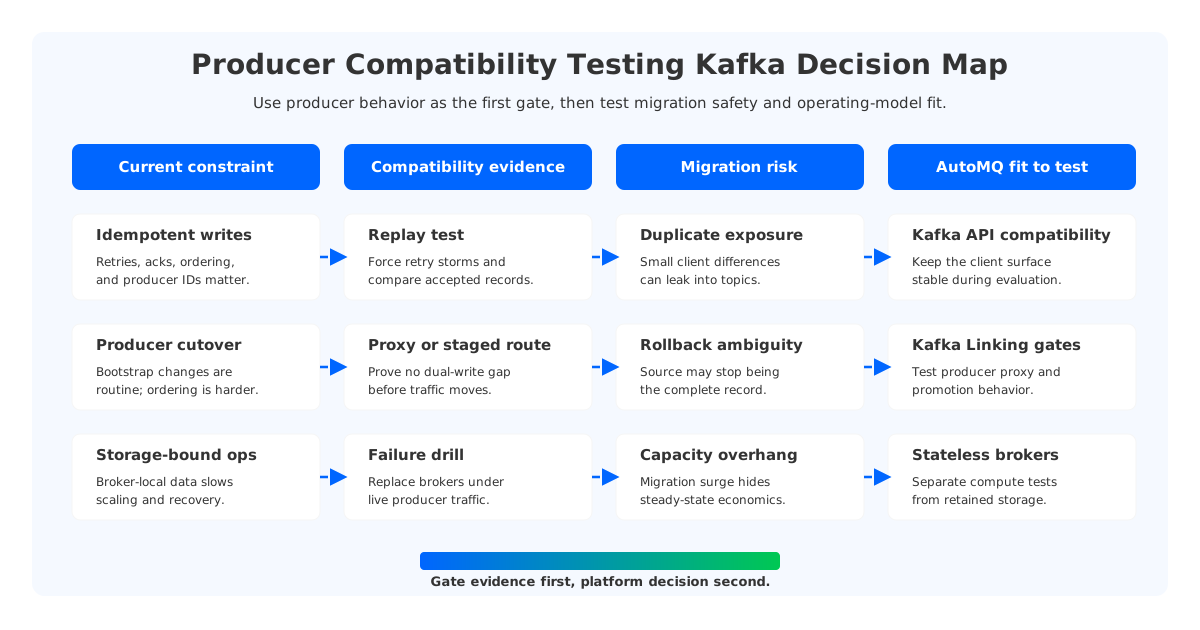
A producer is usually the first application component touched by migration pressure. Consumers can sometimes run in shadow mode for a while. Producers decide where new records enter the system, and once they write to the target, rollback becomes a data-position problem rather than a configuration problem. That is why producer compatibility testing should be treated as a migration gate, not a smoke test. The goal is to prove that the target behaves like Kafka for the exact producer behavior your applications rely on, then decide whether the target architecture improves the operating model enough to justify the move.
1Why teams search for producer compatibility testing kafka
The phrase looks narrow, but the search intent is broad. Platform teams are usually in the middle of a decision: migrate from self-managed Apache Kafka, consolidate clusters, evaluate managed Kafka, replace a disk-heavy architecture, or introduce a Kafka-compatible platform that claims application portability. A producer test is the first place where a vendor promise meets a production dependency.
Kafka producers hide more operational meaning than they appear to. A single application may depend on idempotent writes, specific acknowledgments, compression, custom partitioning, message headers, transactional boundaries, quotas, authentication mode, and topic-level defaults. Some dependencies are explicit in configuration. Others live in assumptions, such as "this key always lands in the same partition" or "a retry cannot reorder records for this workflow."
The practical test plan should separate three questions:
- Can the producer speak to the target? This covers client version, bootstrap metadata, authentication, authorization, TLS, and network reachability.
- Can the producer behave the same way under stress? This covers retries, request timeouts, batching, compression, partitioning, idempotence, transactions, and error handling.
- Can the platform team move and reverse traffic safely? This covers route changes, dual-write prevention, offset continuity for downstream consumers, observability, and rollback instructions.
Those questions belong in that order. A target platform may look attractive because it reduces storage cost, simplifies scaling, or changes who owns operations. None of that matters if the producer path introduces duplicate records, invalid ordering, or a rollback plan that depends on guesswork.
2The production constraint behind producer testing
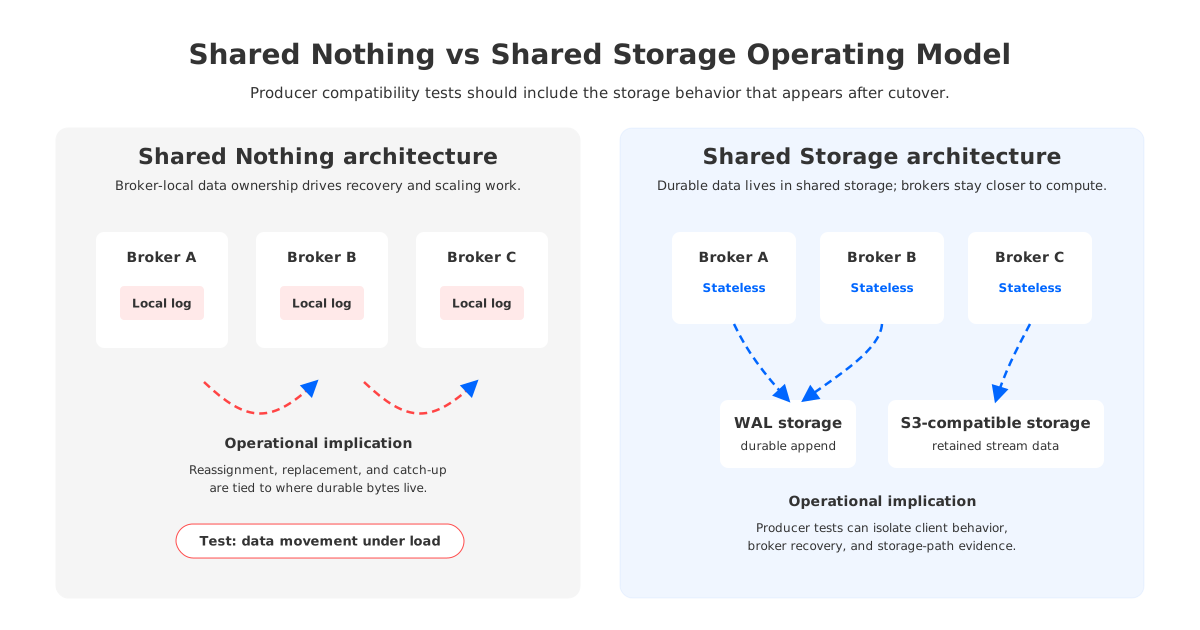
Traditional Kafka uses a Shared Nothing architecture: each broker manages local log segments for its partitions, and reliability is achieved through leader and follower replicas. The design has served production systems for years. It also means that many platform changes are tied to broker-local data ownership. Scaling, replacement, reassignment, and migration all have to respect where the durable bytes live.
Producer compatibility testing feels like a client-side exercise, but the storage model leaks into the plan. If a migration target still depends on broker-local disks, the team must provision enough headroom for source traffic, target traffic, replication traffic, validation reads, and failure recovery. If a broker fails during the test, the producer may see throttling, leader movement, metadata refresh churn, or retry behavior that looks like a client issue but is really an operating-model issue.
This is why the test should cover both the Kafka client contract and the platform behavior behind it. Apache Kafka documents producer configuration such as acks, enable.idempotence, max.in.flight.requests.per.connection, retries, serializers, compression, and transactions. A credible compatibility run does not reduce that surface to "we produced 100 messages." It tests the paths where production producers usually break: retry storms, metadata changes, broker failure, quota pressure, authorization drift, and cutover timing.
The hidden risk is rollback. Before producers move, the source cluster is still the obvious system of record. After producers write to a target, the source may no longer contain all accepted records. If the test plan cannot explain how to stop writes, reverse routing, reconcile records, and protect downstream offsets, the producer compatibility gate is not ready.
3Architecture options and trade-offs
Producer compatibility testing becomes clearer when the team names the target architecture. The same producer tests are useful across options, but the risk profile changes. A traditional Kafka target keeps the application contract familiar and the storage model familiar. A managed Kafka target may reduce infrastructure ownership but introduces provider limits, network rules, and support boundaries. A Kafka-compatible shared-storage target keeps the Kafka-facing API in scope while changing how durable data, broker recovery, and scaling work behind the scenes.
Use a comparison table before writing the test plan:
| Evaluation area | Traditional Kafka target | Managed Kafka target | Kafka-compatible shared-storage target |
|---|---|---|---|
| Producer API | Closest when versions and broker configs match | Strong for supported client versions and service limits | Must be validated against workload behavior and supported Kafka surface |
| Migration path | Usually replication plus client route changes | Service tooling may help, but cutover still needs gates | May include platform-specific migration tooling and producer proxy paths |
| Storage behavior | Broker-local durable data remains central | Depends on provider implementation | Durable data is separated from broker-local compute after migration |
| Recovery tests | Broker failure and reassignment can involve data movement | Provider handles part of operations, with visibility trade-offs | Broker replacement can focus more on metadata, cache, and shared storage paths |
| Governance | Highest control, highest operational burden | Shared responsibility with the provider | Depends on BYOC, private deployment, or software boundary |
The table is not a ranking. It is a way to keep the test honest. If the team wants less operational labor, managed Kafka may be the right branch. If the team wants to keep Kafka compatibility while reducing broker-local storage constraints, shared storage deserves a deeper test. If the team must keep full infrastructure control, the migration plan must budget for the operational work that comes with that control.
The producer test should then mirror the architecture decision. For a traditional Kafka target, emphasize version alignment, partition leadership behavior, and replication lag. For a managed Kafka target, add service quotas, private connectivity, support boundaries, and observability access. For a shared-storage target, add WAL storage behavior, object storage path validation, broker replacement, and scaling under producer load.
4Evaluation checklist for platform teams
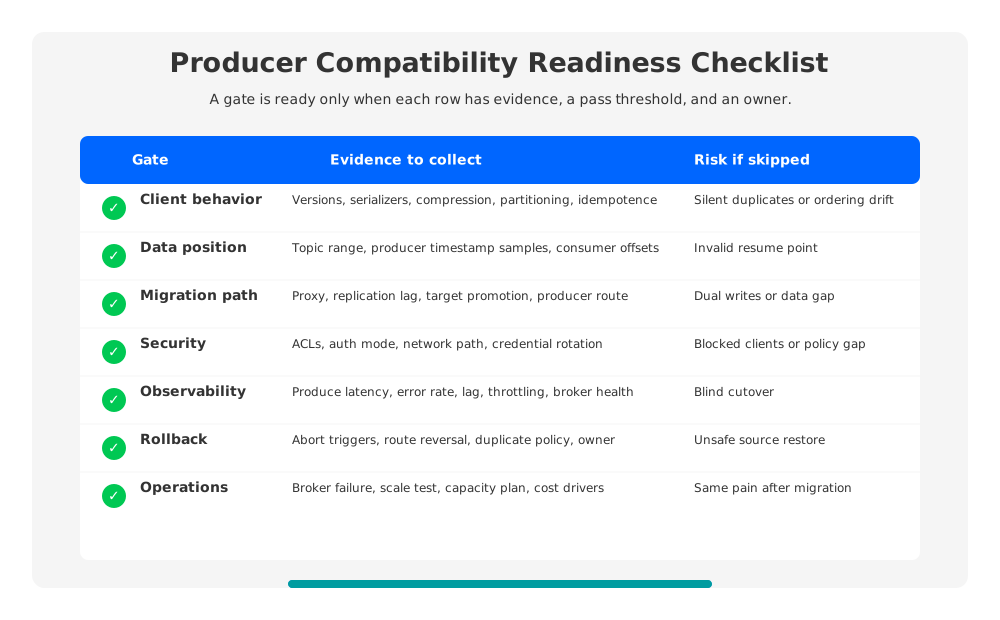
A useful compatibility gate is written as evidence, not intent. "Producer tests passed" is too vague. "The payment producer passed idempotent retry, custom partitioner, compression, SASL authentication, ACL, quota, and broker-failure tests against the target endpoint" gives the team something to review and repeat.
Start with an inventory. Record producer application owners, client versions, serializers, compression settings, topic list, partitioning logic, key distribution, transactions, idempotence settings, required throughput, authentication mode, network path, quotas, and dashboards. Then divide producers into waves by blast radius. An internal metrics producer should not share a first cutover with a payments, fraud, or order-state producer.
A practical test sequence looks like this:
- Client surface gate. Validate the exact producer client versions, bootstrap metadata flow, TLS or SASL settings, ACLs, topic authorization, serializers, compression, and message header behavior.
- Ordering and retry gate. Inject broker interruption, network delay, retry storms, request timeout changes, and metadata refreshes. Compare accepted records, partition placement, and ordering guarantees for keyed workflows.
- Throughput and quota gate. Run representative batching, compression, linger, request-size, and quota scenarios. The goal is not a record-setting benchmark; it is proving the target does not fail in a way the application cannot handle.
- Migration route gate. Test how producers move from source to target. Include DNS or config changes, proxy behavior if used, dual-write prevention, and the timing of topic promotion.
- Rollback gate. Rehearse abort triggers, route reversal, duplicate handling, target-side write reconciliation, and downstream consumer offset policy before production traffic moves.
- Operations gate. Run broker failure, broker replacement, scaling, observability, and alert tests while producers are active.
The rollback gate is usually the most revealing. If the plan assumes downstream consumers can tolerate duplicates, name the owners who approved it. If the plan assumes the source cluster can receive traffic again, explain how target-side records will be handled. If the plan assumes offsets remain usable, prove the target has the data range those offsets reference.
Cost belongs in the checklist, but it should not dominate the first test. Producer compatibility testing is about correctness under change. The cost review should ask what extra capacity is needed during migration, how long source and target overlap, whether cross-zone traffic changes, and whether retained storage grows during validation. A cost-effective target that forces unsafe producer behavior is not a production-ready target.
5How AutoMQ changes the operating model
Only after the neutral evaluation framework is in place does a specific platform belong in the discussion. AutoMQ is a Kafka-compatible cloud-native streaming platform built around Shared Storage architecture, S3Stream, WAL storage, and stateless brokers. It keeps the Kafka protocol and ecosystem surface in scope while changing the storage layer that traditional Kafka binds to broker-local disks.
That matters for producer compatibility testing because the client contract and the operating model can be tested separately. The producer still needs to prove Kafka-facing behavior: acks, retries, idempotence, partitioning, transactions where used, authorization, and observability. Behind that surface, AutoMQ stores durable stream data in S3-compatible object storage and uses WAL storage for durable appends and recovery. Brokers remain important for request handling, leadership, routing, caching, and metrics, but they are not the long-term home of retained partition data.
The practical effect is not that compatibility testing disappears. It becomes more targeted. A platform team can keep producer behavior constant, then test whether stateless brokers change the recovery and scaling parts that made the migration attractive. Add brokers under load. Remove a broker during a producer retry test. Validate that cache behavior, WAL storage, object storage, and metadata signals are visible in dashboards. The test should prove both the application contract and the new failure model.
AutoMQ's Kafka Linking documentation is also relevant for migration planning. It describes byte-level synchronization, source and target topic mapping, Producer proxy behavior, and Consumer group progress synchronization. Treat those as testable migration mechanics rather than marketing claims. A producer cutover gate should verify source topic data range, target topic parity, producer routing behavior, Consumer group resume position, and rollback instructions for the workload being moved.
Governance is another reason to test architecture, not only clients. AutoMQ BYOC keeps control-plane and data-plane components in the customer's cloud environment, while AutoMQ Software addresses private data center deployments. For regulated teams, that changes the review from "trust an external data plane" to "inspect the VPC or private environment, IAM permissions, object storage buckets, network paths, audit logs, and operational access." That boundary still needs security review, but it gives the review concrete infrastructure to examine.
6A producer compatibility test template
The test template should be short enough to use during a change window and strict enough to stop a risky migration. Each row needs an owner, evidence, pass threshold, and abort trigger.
| Gate | Owner | Evidence | Pass threshold | Abort trigger |
|---|---|---|---|---|
| Client surface | App owner | Client version, config, auth, ACL, serializer results | No unsupported producer behavior | Failed auth, missing ACL, or incompatible config |
| Retry and ordering | Platform engineer | Retry storm logs, keyed record samples, partition comparison | Ordering and idempotence match workload requirement | Duplicate or reordered records outside policy |
| Throughput | SRE | Produce latency, error rate, request size, quota metrics | Stable under representative load | Sustained errors or throttling without owner sign-off |
| Migration route | Migration owner | Source-to-target route test, promotion notes, dashboard links | No dual-write gap or unknown route | Ambiguous route or missing target records |
| Rollback | Change commander | Rehearsal notes, duplicate policy, offset policy | Reversal path tested with owners present | Target-side writes cannot be reconciled |
| Operations | SRE | Broker failure, scale, WAL or storage-path signals | Alerts and recovery match runbook | Blind spot in failure or storage visibility |
The template is deliberately plain. Producer compatibility testing fails when it becomes ceremonial. A gate should either pass, pause, or roll back the project. If the team cannot name the evidence and abort trigger, it has a checklist, not a production control.
The original search may have been about producers, but the answer is an operating-model decision. Keep the producer contract narrow and exact. Keep the architecture evaluation broad enough to include storage, scaling, rollback, governance, and cost. If you want to test Kafka-compatible streaming with stateless brokers and customer-controlled deployment boundaries, start with the producer gates above and run them against a representative workload in AutoMQ Cloud.
7FAQ
7.1What is producer compatibility testing in Kafka?
Producer compatibility testing verifies that a Kafka producer behaves correctly against a target Kafka or Kafka-compatible platform. It should cover client version, authentication, authorization, serializers, compression, partitioning, retries, idempotence, transactions if used, quotas, observability, cutover, and rollback behavior.
7.2Is a successful produce-and-consume smoke test enough?
No. A smoke test proves basic connectivity and topic access. Production compatibility requires testing retry behavior, ordering, partition placement, broker failure, quota pressure, route changes, and rollback. The risky cases appear when the platform changes under active producer traffic.
7.3How should teams test idempotent producers?
Test idempotent producers under broker interruption, request timeout changes, retry storms, metadata refreshes, and controlled duplicate detection. Compare accepted records and partition order against the source system or expected workload behavior. The target should preserve the application contract instead of treating message acceptance as the whole test.
7.4Where does AutoMQ fit in producer compatibility testing?
AutoMQ should be tested after the team defines neutral compatibility gates. It fits teams that want Kafka protocol compatibility while evaluating a Shared Storage architecture with stateless brokers, object-storage-backed durability, and customer-controlled deployment boundaries through AutoMQ BYOC or AutoMQ Software.


