
Table of Contents
Table of Contents
Teams do not search for insurance quote streams kafka because they need a textbook definition of event streaming. They search for it when a quoting path has become a production system: requests arrive from web, partner, agent, and mobile channels; rating engines must respond quickly; underwriting signals keep changing; and every quote event may later matter for pricing analysis, dispute review, compliance, or model training. At that point, Kafka is no longer a convenient buffer between services. It becomes part of the insurance operating model.
The hard part is that quote traffic is uneven by design. A campaign, renewal window, weather event, regulatory change, or aggregator integration can create sudden bursts, while the rest of the month may look ordinary. The platform team still has to preserve ordering where it matters, keep consumer lag under control, retain enough history for audit and analytics, and make changes without interrupting producers that are tied to revenue. The core question is not "Can Kafka move quote events?" It is whether the architecture around Kafka can absorb insurance-specific pressure without turning capacity, governance, and recovery into recurring incidents.
1Why teams search for insurance quote streams kafka
An insurance quote stream usually starts as an integration pattern. A quote request enters the system, a rating service calculates options, enrichment services add risk or eligibility signals, and downstream systems consume the result for bind flows, agent dashboards, data lakes, or customer follow-up. Kafka fits that shape because topics, partitions, offsets, and Consumer groups give teams a durable event log with parallel processing and independent consumers.
Production changes the meaning of each of those primitives. A partitioning key that looked harmless in a pilot can create a hotspot when a single carrier, region, product line, or partner generates a large share of traffic. A Consumer group that worked for enrichment may lag during backfill because downstream APIs throttle. A retention policy chosen for application replay may be too short for audit review and too long for broker-local disks. These are not Kafka mistakes. They are signs that quote streams have crossed from application plumbing into shared infrastructure.
A useful production checklist starts with the workflow rather than the platform:
- Quote intake must tolerate bursty arrivals without creating duplicate customer actions or losing request context.
- Rating and underwriting consumers must track offsets carefully so retries do not turn into repeated premium calculations.
- Analytics and compliance consumers need historical access without starving the tailing workloads that serve live applications.
- Platform owners need a migration and rollback path because quote traffic is usually connected to revenue and customer experience.
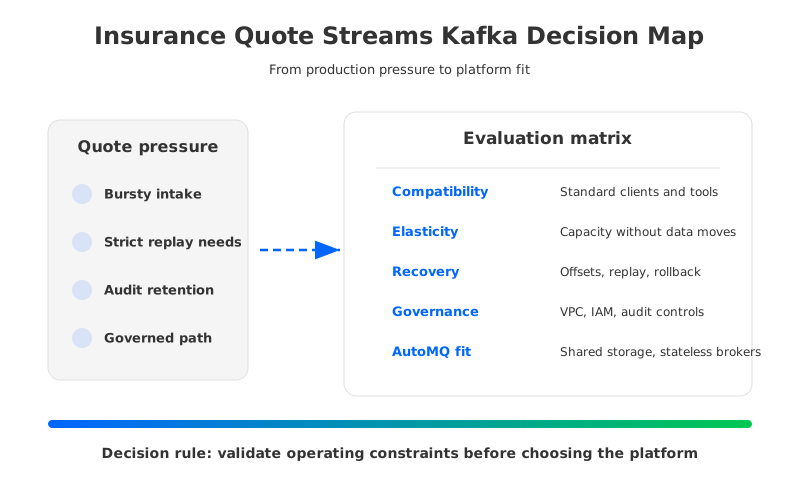
That list already hints at the real constraint. The business problem is real-time quoting, but the platform problem is durable, elastic, governed streaming under uneven load.
2The production constraint behind the problem
Traditional Kafka uses a Shared Nothing architecture: each Broker owns local storage, and durability is achieved through replication across Brokers. That model is battle-tested, but it makes data placement a first-class operational concern. When quote volume grows, adding Brokers does not merely add compute. It also introduces partition reassignment, replica movement, disk planning, and the risk that a workload spike will turn into a storage-balancing project.
This is where insurance quote streams expose a gap between application needs and cluster mechanics. The application wants fast elasticity because quote volume moves with the business calendar. The cluster wants careful movement because partition data is bound to broker-local storage. If the team over-provisions, it pays for idle compute and disk capacity. If it under-provisions, lag appears in precisely the workflows that are most visible to agents, customers, and operations teams.
Tiered Storage helps with a specific part of the problem: older log segments can move from local disks to remote storage, while the local tier continues to serve active data. That can reduce pressure from long retention, but it does not make Brokers stateless. The local tier, leadership, replicas, and hot partitions still need operational care. For quote streams, Tiered Storage is useful when the main pain is historical retention; it is less complete when the main pain is burst elasticity, placement, and recovery.
The platform decision therefore needs to separate three questions that often get blended together:
| Question | What it reveals | Production risk if ignored |
|---|---|---|
| Where is durable data stored? | Whether capacity planning is tied to broker-local disks | Scaling becomes a data movement event |
| How do consumers recover? | Whether offsets, idempotency, and replay windows are well defined | Backfill or retry creates inconsistent quote outcomes |
| Who controls the operating boundary? | Whether data, network, identity, and observability stay in the right environment | Governance review blocks production rollout |
These questions are deliberately more boring than feature checklists. Boring is good here. Insurance quote streams fail in the gaps between application semantics and infrastructure mechanics, not in the glossy parts of a platform demo.
3Architecture options and trade-offs
The first architecture option is self-managed Kafka on virtual machines or Kubernetes. It gives experienced teams full control over broker configuration, storage media, networking, security, and upgrade cadence. The trade-off is ownership. The same team that tunes partitions and Consumer groups also owns broker replacement, disk expansion, reassignment planning, cross-Availability Zone traffic analysis, monitoring, and incident response.
The second option is a managed Kafka-compatible service. This reduces some cluster operations and may speed up procurement, but the team still needs to understand how the service handles storage, networking, version compatibility, access control, and migration. A managed label does not remove the need for production design. It changes which controls are exposed and which ones become provider behavior.
The third option is a cloud-native Kafka-compatible architecture that separates compute from storage. In this model, Brokers keep Kafka protocol and compute responsibilities, while durable log data lives in shared object storage or related cloud storage primitives. The appeal is not abstract elegance. It changes what happens when capacity shifts: adding compute does not require moving the full data footprint with it.
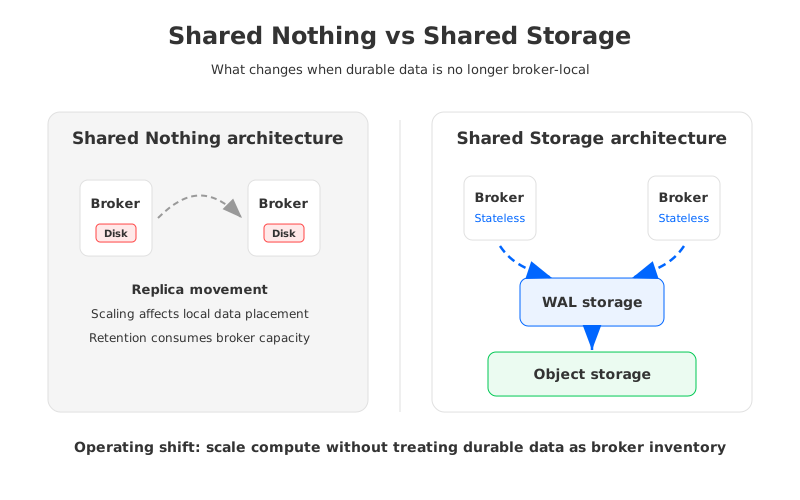
The trade-off is that teams must inspect the write path, cache behavior, failure recovery, and compatibility surface carefully. Object storage has different latency and consistency characteristics from local disks, so a production-ready design needs a WAL (Write-Ahead Log), hot data caching, metadata coordination, and clear recovery behavior. A credible platform should explain those mechanics plainly instead of hiding them behind the phrase "cloud-native."
For insurance quote streams, this architecture discussion becomes concrete in four places. First, can producers and consumers use standard Kafka clients without code changes? Second, can the platform add compute capacity during quoting bursts without turning scaling into a partition-copy operation? Third, can audit and analytics consumers read older events without destabilizing live quote processing? Fourth, can the deployment fit the insurer's boundary for customer data, VPC (Virtual Private Cloud), IAM, encryption, and observability?
4Evaluation checklist for platform teams
Start evaluation with compatibility because quote systems rarely live in isolation. They usually include existing Kafka clients, stream processors, connectors, schema tooling, observability agents, and data lake ingestion paths. A Kafka-compatible platform should be tested with the clients and operational tools that already exist in the environment, not only with a producer and consumer smoke test.
The next check is data modeling. Quote streams often contain multiple event types: request received, risk attributes enriched, rating completed, quote presented, bind started, quote expired, and policy created. Keeping all events in one topic may simplify ingestion but make partitioning and retention messy. Splitting by event family may improve governance but increase the number of topics and Consumer groups. The right answer depends on ordering requirements, replay behavior, and the downstream teams that consume the log.
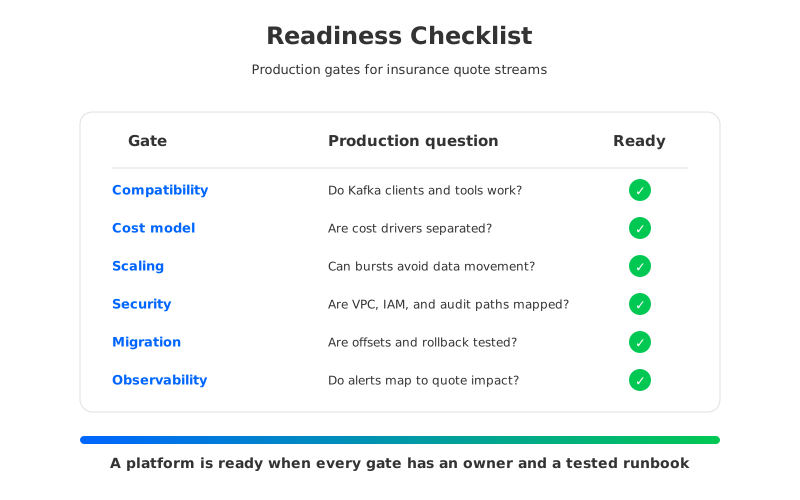
Use the checklist below as a practical readiness scorecard:
| Area | What to verify | Strong signal |
|---|---|---|
| Compatibility | Kafka client, connector, schema, and monitoring tools | Existing clients run without application rewrites |
| Partitioning | Key choice, hotspot risk, ordering scope | Hot keys are visible before production launch |
| Retention | Replay, audit, analytics, and deletion needs | Retention policy is mapped to business use cases |
| Elasticity | Scale-out and scale-in behavior under bursts | Capacity changes do not depend on large data movement |
| Governance | Network, IAM, encryption, audit logs, and data locality | Data paths match the insurer's control boundary |
| Recovery | Broker failure, consumer restart, offset reset, and rollback | Runbooks describe exact failover and replay steps |
| Observability | Lag, throughput, error rate, storage, and broker health | Alerts map to application impact, not only broker symptoms |
This table is intentionally platform-neutral. A team that cannot answer these questions is not ready for production, regardless of which streaming system it chooses. A team that can answer them has a clean basis for comparing self-managed Kafka, a managed service, and a shared-storage Kafka-compatible platform.
5How AutoMQ changes the operating model
Once the evaluation framework is clear, AutoMQ becomes relevant as a specific architectural answer rather than a shortcut around design work. AutoMQ is a Kafka-compatible, cloud-native streaming platform that keeps the Kafka protocol surface while replacing broker-local persistent storage with a Shared Storage architecture. The key shift is that AutoMQ Brokers are stateless brokers: they handle Kafka requests, leadership, caching, and scheduling, while durable data is stored through S3Stream on shared object storage with WAL storage in the write path.
For quote streams, that separation changes the scaling conversation. If the bottleneck is compute, the platform can add Brokers without making durable data placement the main event. If a Broker fails, recovery focuses on ownership, leadership, and WAL-backed durability instead of rebuilding local broker data as the first-order concern. If retention grows for audit or analytics, object storage becomes the durable footprint rather than every Broker carrying the full capacity burden.
AutoMQ also changes the governance conversation. AutoMQ BYOC runs the control plane and data plane in the customer's cloud account and VPC, while AutoMQ Software supports private data center deployment. That matters for insurers because quote events can contain personal, underwriting, and pricing context. The architecture should let security teams reason about where data lives, which identities can reach it, how observability is exported, and which network paths exist.
Migration is the last place where architecture has to meet reality. A quote platform cannot pause producers casually while a streaming backend changes. AutoMQ Open Source recommends MirrorMaker2 for migration, while AutoMQ commercial editions provide Kafka Linking for migrations that need byte-to-byte message synchronization, offset consistency, and controlled traffic switching. The practical takeaway is not that migration risk disappears. It is that migration design should be evaluated as part of the platform, not postponed until after selection.
6Production checklist
Before an insurance quote stream goes live, run the checklist as a workshop with application, data, SRE, security, and platform owners in the same room. If one group cannot answer its part, the gap will probably show up later as lag, reprocessing confusion, access review delay, or an emergency capacity change.
- Define the quote event contract: event names, schema evolution rules, required headers, correlation IDs, and idempotency keys.
- Choose partition keys based on ordering and hotspot analysis, not only on available identifiers.
- Map every Consumer group to an owner, an SLO, a replay window, and a lag alert.
- Separate live quoting consumers from analytics and backfill consumers when their latency profiles differ.
- Validate retention against audit, analytics, deletion, and replay requirements before sizing storage.
- Test burst scaling with production-like traffic shapes, including aggregator spikes and renewal windows.
- Document the recovery path for Broker failure, consumer failure, partial downstream outage, and failed deployment.
- Prove migration and rollback using real offsets, representative topics, and the same security controls planned for production.
The search phrase that began this exercise, insurance quote streams kafka, sounds narrow. In practice, it opens a larger architecture review: how to keep real-time quoting fast without making Kafka operations fragile. If your team is evaluating a Kafka-compatible platform for quote workloads, use the checklist to identify the constraints first, then compare architectures against those constraints. For a deeper look at a shared-storage operating model, explore AutoMQ on GitHub or review the deployment path through AutoMQ Cloud.
7FAQ
7.1Is Kafka a good fit for insurance quote streams?
Kafka can be a strong fit when quote events need durable fan-out, replay, independent consumers, and integration with analytics or workflow systems. The production question is whether the surrounding architecture handles partitioning, retention, lag, governance, and recovery well enough for the insurer's operating model.
7.2What partition key should quote streams use?
There is no universal key. Teams commonly evaluate quote ID, customer ID, policy ID, region, product line, or partner ID, then test for ordering needs and hotspot risk. A production-ready key preserves the ordering the application needs while avoiding concentrated traffic on a small set of partitions.
7.3How long should insurance quote events be retained?
Retention should follow business requirements, not a default cluster setting. Live replay, dispute review, pricing analysis, regulatory review, and data deletion requirements may point to different retention windows. Many teams separate hot operational streams from longer-lived analytical copies.
7.4Does Tiered Storage solve quote stream scaling?
Tiered Storage can reduce local disk pressure for older data, but it does not by itself make Brokers stateless or remove the need to manage hot partitions, leaders, and local storage for active data. It is most useful when retention is the main bottleneck.
7.5When should teams consider a shared-storage Kafka-compatible platform?
Consider it when burst elasticity, storage growth, cross-Availability Zone traffic, and partition movement have become recurring operational concerns. The key evaluation point is whether compatibility, WAL design, caching, recovery, and deployment boundaries meet production requirements.


