
Table of Contents
Table of Contents
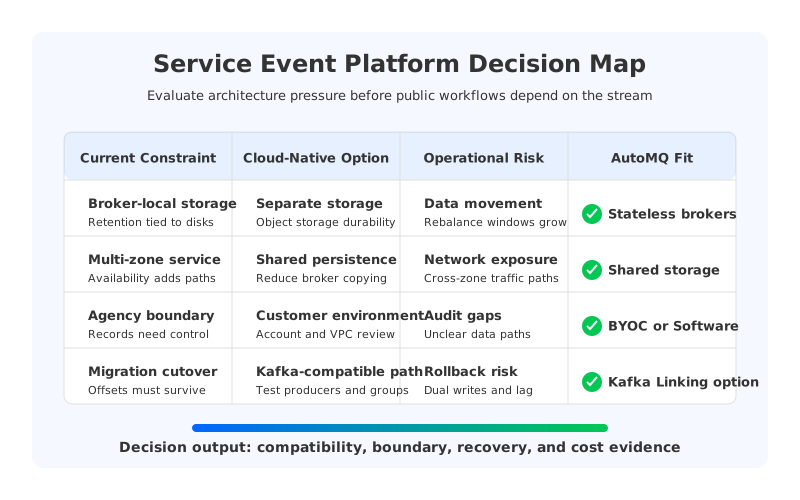
Teams do not search for public sector service events kafka because they want another streaming primer. They search because an event stream has crossed the line from an integration convenience into public infrastructure. A benefits portal publishes eligibility updates, a permit system emits status changes, a 311 application routes service requests, and a case management platform needs the same event within seconds. Once those flows become production dependencies, the question stops being whether Kafka can move events. The question becomes whether the operating model can survive procurement boundaries, audit reviews, regional constraints, bursty demand, and failure drills without turning every release into a capacity project.
That pressure is different from a consumer analytics pipeline. Public sector service events often represent state transitions that agencies, contractors, and downstream systems must trust. Losing order, replay context, or offset continuity can affect case handling. Over-retaining data can violate policy; under-retaining it can weaken investigations or recovery. The practical answer is not a single product feature. It is a checklist that lets platform teams evaluate compatibility, cost exposure, security boundaries, operational recovery, and migration risk before they commit a workload to production.
1Why teams search for public sector service events kafka
Public sector systems are full of service events: application submitted, appointment scheduled, inspection assigned, license renewed, address verified, alert acknowledged, payment accepted, and case closed. These events travel across systems owned by different teams and sometimes different organizations. Kafka is attractive because it gives those teams a durable commit log, partitions for parallel processing, consumer groups for independent readers, and offsets that let applications resume from a known position. Those mechanics are covered in the Apache Kafka documentation, but production use depends on how they are operated.
The hard part is that public workflows combine high accountability with uneven traffic. A tax deadline, public safety incident, weather event, or policy change can compress months of normal demand into a short window. The platform must absorb writes, let downstream systems catch up, and keep enough history for replay without forcing every agency application to understand broker internals. Kafka helps by separating producers from consumers, but the platform team still owns the cluster capacity, storage growth, replication behavior, network exposure, and upgrade path.
That is why the search intent is usually architectural. A team already knows that event streaming can connect service systems. They need to know whether their Kafka-compatible platform can meet the constraints that come with public operations:
- Compatibility: Existing producers, consumers, Kafka Connect jobs, stream processors, and observability tools should keep working with limited application change.
- Control boundaries: Message data, credentials, logs, and operational metadata need clear placement across accounts, VPCs, regions, and managed service boundaries.
- Recovery behavior: The platform needs a tested answer for broker failure, zone impairment, backlog replay, offset movement, and rollback.
- Cost exposure: Storage, replication, cross-zone traffic, private endpoints, and reserved capacity must be visible before the workload scales.
- Governance: Teams need retention, access control, audit, schema discipline, and change management that match the sensitivity of public services.
2The production constraint behind the problem
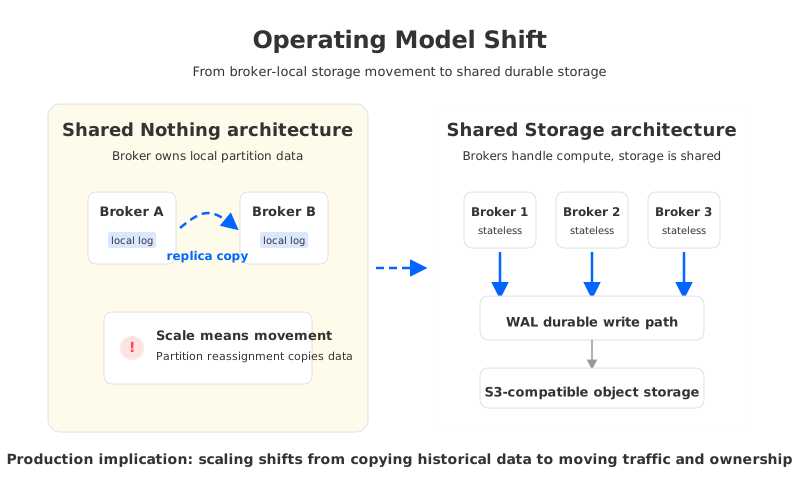
Traditional Kafka follows a Shared Nothing architecture. Each broker owns local storage, and Kafka uses leader/follower replication to place copies of partition data on other brokers. This design is proven and still appropriate for many environments, but it turns storage locality into an operational constraint. If a broker fails, the cluster must elect replacement leaders from replicas. If partitions need to move, data has to be copied. If retention grows, the team has to provision enough local or block storage before the next burst.
In a public sector service event pipeline, that coupling shows up in ordinary operations. Adding brokers is not only a compute action; it can trigger partition reassignment and data movement. Extending retention is not only a policy change; it can change disk sizing and recovery time. Adding an Availability Zone can improve fault isolation, but the platform has to account for the data that moves between zones. Even when the application team sees a simple topic, the infrastructure team sees a matrix of disks, replicas, network paths, and maintenance windows.
Kafka's own evolution acknowledges part of this pressure. KRaft removes ZooKeeper from the metadata path, and Tiered Storage can move older log segments to remote storage while recent data remains local. Those capabilities are useful, but they do not make brokers stateless. A platform team still needs to ask what remains tied to the broker, what happens during leader movement, and whether storage growth still drives compute planning.
The production constraint is therefore not "Kafka is too complex." The constraint is that a broker-local storage model makes several public-sector requirements compete with each other. Availability wants replicas. Cost control wants less duplicated data and less cross-zone transfer. Governance wants retention and replay. Elasticity wants fast scale-out and scale-in. Migration wants offset continuity and rollback. A production checklist has to expose those trade-offs before they are buried in a procurement or architecture review.
3Architecture options and trade-offs
There are three broad ways to run service event streams. The first is self-managed Kafka on virtual machines or Kubernetes. This gives the platform team deep control over versions, networking, storage classes, encryption, and operational policy. It also makes the team responsible for capacity planning, upgrades, partition balancing, broker replacement, and incident response. For agencies with strong infrastructure teams and strict environment requirements, that control can be worth the operational load.
The second option is a managed Kafka service. It reduces some cluster operations, but the evaluation should not stop at the word "managed." Platform teams still need to understand data storage, endpoint exposure, cross-zone transfer, upgrades, client support, and exit paths. The more sensitive the data, the more important it becomes to separate control convenience from data placement.
The third option is a Kafka-compatible platform with cloud-native storage separation. The API surface stays compatible with Kafka clients, while durable data moves away from broker-local disks into shared object storage or another shared persistence layer. Brokers can become more replaceable, storage capacity can grow independently, and scaling decisions can focus more on current traffic than on historical data placement. The trade-off is that the team must evaluate the write path, cache behavior, object storage dependency, and deployment boundary with the same rigor they apply to Kafka itself.
| Evaluation area | Broker-local Kafka | Managed Kafka service | Kafka-compatible shared storage |
|---|---|---|---|
| Storage growth | Plan disk or block storage with broker capacity | Governed by service limits and pricing model | Object storage can scale separately from brokers |
| Broker replacement | Depends on replicas and leader movement | Abstracted, but service behavior matters | Stateless brokers can reduce data movement |
| Multi-zone design | Improves resilience but adds replication paths | Depends on service topology and pricing | Shared storage can reduce broker-to-broker copying |
| Governance boundary | Customer controlled if self-managed | Must review provider data and control paths | Customer-controlled deployments are possible |
| Migration risk | Tooling and offsets require careful planning | Exit path varies by service | Kafka compatibility plus migration tooling matters |
This table is not a ranking. It is a way to prevent architecture reviews from collapsing into feature comparison. A public sector service event platform has to fit the team's boundary conditions. Some teams value full operational ownership. Some want a managed service boundary. Others need Kafka compatibility with a storage model that reduces data movement and capacity coupling.
4Evaluation checklist for platform teams
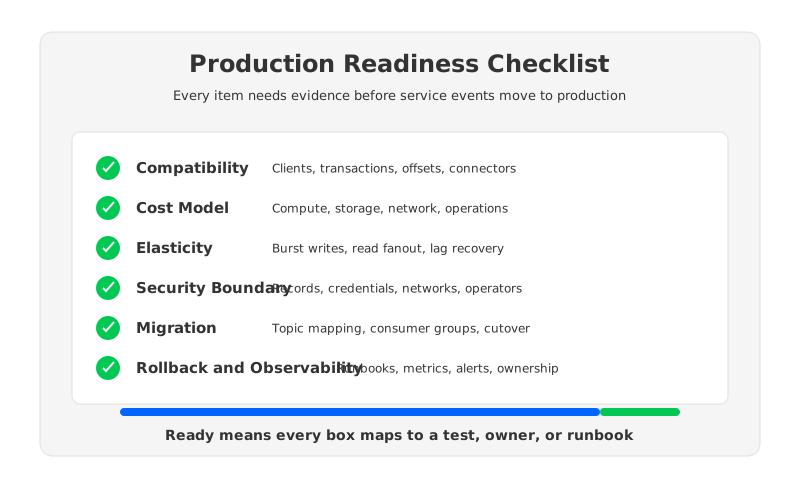
The useful checklist starts with compatibility because application change is usually the hidden cost of a streaming migration. Confirm the Kafka protocol level, client versions, authentication methods, topic configurations, transactional behavior, offset management, and Kafka Connect requirements. If the workload uses stream processors, verify how they rely on offsets, consumer group state, exactly-once semantics, and replay windows. A platform that looks compatible at the produce/consume layer can still fail the migration if it changes operational assumptions around offsets or topic behavior.
The second checkpoint is data placement. Public sector teams should document where records are written, where durable storage lives, where control services run, and which operators can access each layer. This is especially important for BYOC, government cloud, and private network deployments. "Inside the cloud" is not the same as "inside the same boundary." Architecture reviews should trace the actual data path, not only the product name.
Separate cost drivers before the first production topic:
- Compute: Broker or instance capacity for write throughput, read fanout, compaction, and catch-up reads.
- Storage: Retention duration, replay requirements, object storage or block storage class, and operational snapshots or backups.
- Network: Cross-zone replication, client traffic paths, private endpoint processing, NAT, egress, and observability export.
- Operations: On-call load, upgrades, incident drills, capacity planning, and tooling that has to be maintained by the platform team.
Recovery review needs specificity. "Multi-zone" is not a recovery plan. Define behavior for broker loss, zone impairment, storage errors, metadata recovery, consumer lag spikes, topic deletion, schema mistakes, and failed migration cutover. For each case, record data loss objective, recovery time target, owner, dashboard, runbook, and rollback step.
Governance review should be concrete enough for application teams to follow. Topics need naming rules, retention rules, ownership metadata, ACL patterns, schema gates, consumer group ownership, and deprecation policy. Observability needs broker health, topic throughput, consumer lag, request latency, storage behavior, and cost indicators. Public service events are rarely owned by one team end to end, so the platform has to make responsibility visible.
5How AutoMQ changes the operating model
Once the checklist exposes broker-local storage as the recurring source of data movement, capacity coupling, and multi-zone cost exposure, the architecture question becomes sharper: can the platform keep the Kafka API while changing where durable data lives? AutoMQ is a Kafka-compatible cloud-native streaming platform built around that idea. It keeps Kafka protocol and ecosystem compatibility while using a Shared Storage architecture, where stateless brokers handle compute and S3-compatible object storage holds persistent stream data.
The important change is not that object storage exists somewhere in the stack. The important change is that brokers no longer have to be the long-term owners of partition data. AutoMQ writes incoming data through a WAL (Write-Ahead Log) path for durable acknowledgement and then stores stream data in S3-compatible object storage. Because persistent data is not tied to a broker's local disk, broker replacement, scaling, and partition reassignment can be treated more like compute operations than storage relocation projects. The AutoMQ architecture overview explains this model in more detail.
For public sector service events, that operating model maps to several checklist items. Kafka compatibility reduces migration pressure. Shared storage reduces the need to size brokers around long retention windows. Stateless brokers help during replacement and elasticity events. AutoMQ BYOC keeps control plane and data plane components in the customer's cloud account. AutoMQ Software supports private environments that use S3-compatible object storage.
The migration story is also part of the operating model. A service event platform cannot assume every producer and consumer can stop at the same time. AutoMQ's Kafka Linking is designed for migration from Apache Kafka-compatible sources while preserving message data and consumer progress. Teams should still test representative topics, authentication, offsets, consumer groups, and rollback paths before production cutover.
6Readiness scorecard
Use this scorecard before launch or migration. A "yes" answer should point to a real configuration, runbook, test result, or owner.
| Question | Why it matters | Ready signal |
|---|---|---|
| Can existing Kafka clients connect without code changes? | Reduces application migration risk | Client versions, auth, and topic behavior verified |
| Are records stored inside the required boundary? | Supports security and procurement review | Data path diagram reviewed by platform and security teams |
| Is retention independent of broker replacement? | Prevents replay policy from becoming a disk project | Storage model and recovery behavior documented |
| Can the platform absorb burst traffic and catch-up reads? | Protects service workflows during public demand spikes | Load test covers writes, read fanout, and lag recovery |
| Are failure drills tied to runbooks? | Converts architecture claims into operable behavior | Broker, zone, backlog, and migration drills completed |
| Is the migration rollback path tested? | Protects service continuity during cutover | Offsets, producer switch, consumer switch, and rollback validated |
| Are cost drivers visible to owners? | Prevents surprise spend after adoption | Compute, storage, network, and operations reviewed separately |
7FAQ
7.1Is Kafka a good fit for public sector service events?
Kafka is a strong fit when multiple systems need durable, ordered, replayable events with independent consumers. It is less useful when the workflow is a simple request/response integration with no replay requirement, no fanout, and no need for an event history. The decision should start with the workflow's recovery and audit needs, not with the popularity of Kafka.
7.2What should teams verify first in a Kafka-compatible platform?
Start with client compatibility, authentication, topic behavior, offsets, consumer groups, and operational tooling. Then review data placement, retention, failure recovery, scaling behavior, and migration rollback. Compatibility at the protocol layer is necessary, but production readiness depends on the whole operating model.
7.3Does Tiered Storage solve the public sector service event problem?
Tiered Storage can help with historical log storage, but it does not automatically make brokers stateless or remove every operational coupling between compute and storage. Teams should verify what data remains local, how hot reads behave, how failures recover, and how partition movement works in their chosen Kafka version and deployment model.
7.4Where does AutoMQ fit?
AutoMQ fits teams that want Kafka-compatible streaming with a Shared Storage architecture, stateless brokers, customer-controlled deployment options, and a migration path from existing Kafka-compatible systems. It is still important to test representative workloads, security boundaries, and recovery runbooks before moving public service event traffic.
7.5What is the next practical step?
Pick one high-value service event flow and run the checklist against it: producer path, topic policy, consumer groups, replay window, failure behavior, cost drivers, and migration plan. To evaluate the AutoMQ operating model in your own environment, start from the AutoMQ Cloud Console.


