
Table of Contents
Table of Contents
Teams search for real time compliance workflows kafka when the compliance system has moved from periodic reporting into the production path. A card transaction, login event, access-policy change, payment instruction, healthcare update, or internal admin action needs to be captured, classified, routed, retained, and sometimes blocked while the business is still moving. Kafka is a common backbone because producers emit records, consumers process them in order, offsets describe progress, and downstream systems can replay history when a rule changes.
The difficult part is making the workflow boring enough for a regulator, auditor, and SRE to trust it at the same time. Compliance workloads combine sensitive data, long retention, and small operational error budgets. That changes the platform question from “Can Kafka carry this stream?” to “Can the operating model survive growth, failover, audit requests, and cost review without becoming a special-case system?”
That is the core thesis: evaluate a real-time compliance workflow as an operating system for evidence, not only as a message pipeline. Kafka compatibility matters, but so do storage ownership, network boundaries, scaling behavior, recovery drills, migration mechanics, and control ownership.
1Why teams search for real time compliance workflows kafka
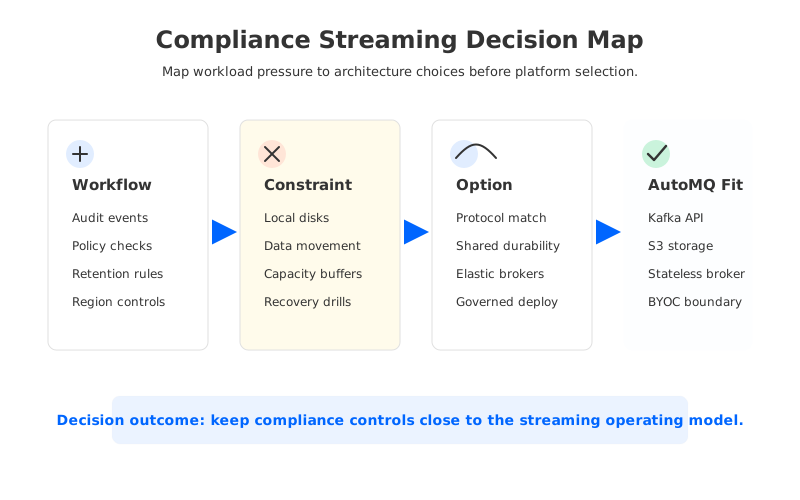
The search intent usually starts with a concrete workflow. A fraud team wants rule decisions to land beside transaction events. A security team wants audit logs to feed incident response. A platform team wants data access events to be available to policy engines before a batch job would even start. The shared pattern is that compliance logic is moving closer to the event, and the event stream becomes the place where evidence is produced, not merely stored after the fact.
Kafka is a natural fit for that pattern. A Topic gives the workflow a durable stream of records. A Partition gives ordering within a key space, such as account, tenant, device, or employee ID. A Consumer group lets workers divide work while preserving partition order. Offsets make progress explicit, which helps teams replay from a known point when a policy version changes or a downstream store needs rebuilding.
Compliance workflows add requirements that are easy to underestimate:
- Evidence must be replayable. The platform has to retain enough history to reconstruct a decision, reprocess a policy change, or prove that an event was handled.
- Control ownership must be explicit. Security, platform, application, data, and audit teams need to know who owns identities, network paths, schema changes, retention, and access logs.
- Recovery cannot create ambiguity. After a broker failure, zone event, deployment rollback, or connector incident, the team needs a clear answer to what was processed, what was committed, and what can be replayed.
- Cost has to remain explainable. Long retention and multi-zone availability can turn storage and network into recurring cost centers that are hard to assign to a business owner.
Those requirements are why a checklist is more useful than a generic diagram. The architecture has to expose failure modes before production traffic arrives.
2The production constraint behind the problem
Traditional Kafka was designed around Shared Nothing architecture. Each broker owns local storage for the partitions it hosts, and durability is achieved by replicating partition data across brokers. That design is mature and works well when teams can provision stable broker fleets, keep disk headroom, and absorb rebalancing work as workload changes.
Compliance workloads stress that model because storage and operations grow together. Longer retention means more local or attached disk. Higher ingest means more replica traffic. More partitions mean more placement and rebalance planning. The platform starts with an application-level compliance requirement, but the day-to-day pressure lands on brokers, disks, replication, and network topology.
The coupling matters most when the workload changes shape. A compliance stream may be quiet for weeks and then spike during a product launch, fraud campaign, market event, or incident response window. In a broker-local model, adding compute is not enough if added brokers also need partition data moved to them. The operational question remains tied to data placement: where does the log live, and how much data must move?
Tiered Storage changes part of this picture by moving older log segments to remote storage while keeping the active working set on broker-local disks. It can help with long retention and local disk pressure. It does not fully remove operational coupling for hot data, broker recovery, and partition leadership.
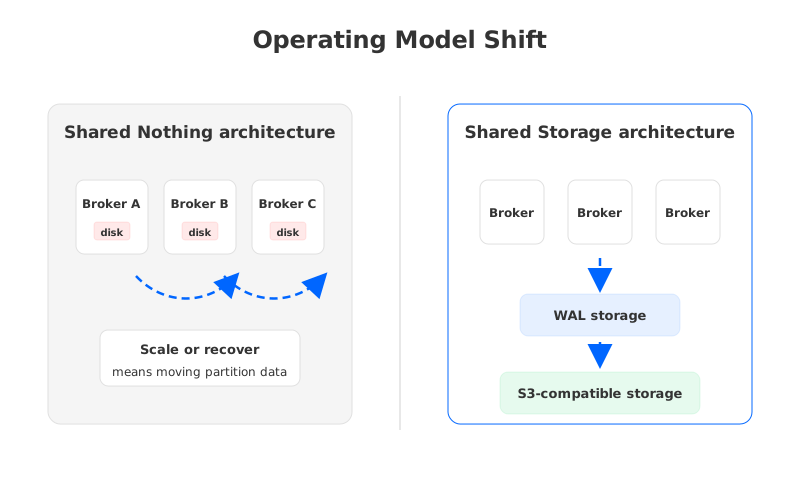
The compliance implication is direct. If your evidence stream depends on broker-local data placement, capacity planning, failure recovery, and migration planning are compliance concerns too.
3Architecture options and trade-offs
Platform teams usually have four options when they move compliance workflows onto Kafka-compatible streaming. None is universally right, and the correct answer depends on workload shape, regulatory boundary, team maturity, and migration tolerance.
| Option | What it optimizes | What to examine before production |
|---|---|---|
| Operate Kafka with local storage | Maximum control and familiar operations | Disk headroom, partition rebalancing time, replica traffic, upgrade playbooks, and incident staffing |
| Use Tiered Storage | Longer retention with less local disk pressure | Hot data behavior, recovery model, object storage permissions, and remote read performance |
| Adopt a managed Kafka-compatible service | Lower infrastructure ownership | Region availability, networking model, data residency, audit access, connector operations, and cost attribution |
| Move to a cloud-native Kafka-compatible architecture | Elastic operations and shared durability | Protocol compatibility, deployment boundary, WAL type, object storage controls, migration plan, and rollback path |
This table is deliberately neutral. A regulated team should not choose a platform because a diagram looks cleaner. It should choose the operating model whose trade-offs are easiest to defend during an incident review. For example, a fully managed service may be attractive if the organization wants the provider to own broker operations, but it may be a poor fit if the compliance program requires all data plane resources to stay in the customer’s own account and network. A self-managed Kafka cluster may satisfy control requirements, but the team must be honest about the ongoing cost of disk sizing, cross-zone replication, and partition maintenance.
Cloud networking deserves a separate line in the review. In multi-Availability Zone deployments, replica traffic, client traffic, connector traffic, and private service access can all have different paths and cost rules. The important point is not a universal price number; compliance workflows often require multi-zone or private-network designs, and those designs must be costed as part of the architecture.
4Evaluation checklist for platform teams
A useful production review turns architecture into yes-or-no gates. The questions below are intentionally practical. If the team cannot answer them before launch, the missing answer will usually appear during an incident, an audit, or a cost review.
Compatibility gate. Are producers, consumers, admin tools, connectors, serializers, ACL assumptions, and transaction semantics compatible with the target platform? For Kafka-compatible platforms, do not stop at “the client connects.” Test offset commits, consumer group rebalances, idempotent producers, transactional producers if you use them, and the operational tools your SREs rely on.
Retention and replay gate. What is the required retention window for each stream, and who can approve changes to it? Compliance teams often need different retention classes for raw events, enriched decisions, alerts, and audit summaries. Treat replay as a product requirement: define who can start a replay, which policy version is used, how duplicate downstream writes are prevented, and how the replay is logged.
Cost gate. Can the team explain storage, compute, network, and operational cost separately? This is where local storage architectures and shared storage architectures diverge. Broker-local retention tends to grow with disk provisioning and replica traffic. Object-storage-backed designs shift more durability cost into cloud storage, but they still need WAL storage, caching, request pricing review, and network-path design.
Security and governance gate. Where are encryption keys managed, which identities can read the stream, how are schema changes approved, and how are access events logged? A real-time compliance workflow should not become an exception to the organization’s normal identity and audit model. The streaming platform should fit into the governance boundary rather than asking the governance team to accept a side channel.
Recovery gate. What happens when a broker disappears, a zone becomes unavailable, a connector writes malformed data, or a policy service deploys a bad rule? The recovery plan needs more than restart instructions. It needs a decision tree for pausing consumers, replaying from offsets, validating downstream state, and proving what changed during the incident.
Migration gate. How will you move from the existing cluster or service without losing offsets, breaking consumer groups, or forcing a long write outage? For compliance workflows, the migration plan should include dual-read or dual-write validation, schema freeze windows, rollback criteria, and a reconciliation report that business owners can understand.
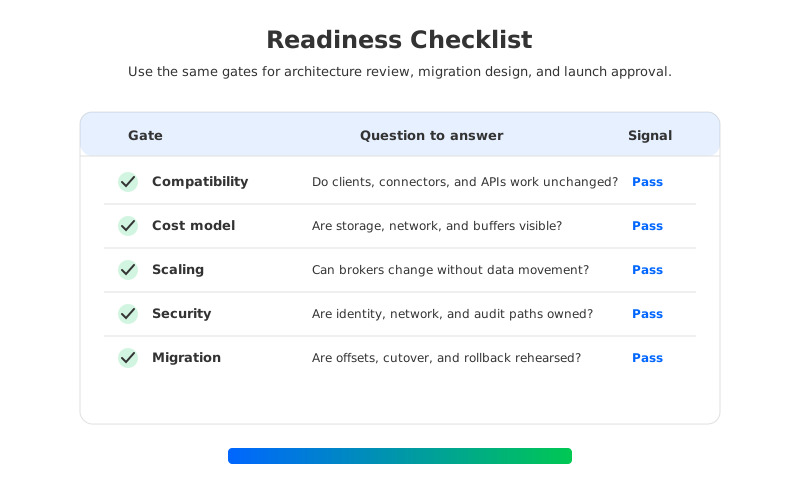
These gates turn platform selection into an evidence exercise. The key is that each choice should come with an explicit operating contract.
5How AutoMQ changes the operating model
Once the evaluation framework is clear, the architectural question becomes sharper: can the streaming platform keep Kafka’s application model while reducing the operational coupling between brokers and stored data? AutoMQ is a Kafka-compatible, cloud-native streaming platform built around that question. It keeps Kafka protocol and API compatibility as the application-facing layer, while changing the storage layer to a Shared Storage architecture.
In AutoMQ, brokers are stateless from the perspective of persistent Kafka data. The durable stream is stored through S3Stream with WAL storage and S3-compatible object storage, while brokers handle protocol processing, leadership, caching, and scheduling. Adding or replacing brokers is less about moving local log data and more about changing ownership, metadata, and traffic placement.
For compliance workflows, the practical effect is a cleaner separation of concerns:
- Application teams keep the Kafka programming model for producers, consumers, offsets, and ecosystem tools.
- Platform teams can reason about broker capacity separately from long-term durable storage.
- Security teams can evaluate deployment boundaries, object storage permissions, network paths, and identity controls in the customer-owned environment.
- SRE teams can design recovery around stateless broker replacement, Self-Balancing, and fast partition reassignment rather than treating every capacity change as a data movement project.
AutoMQ BYOC is especially relevant when the compliance requirement is organizational as well as technical. In BYOC, the customer operates within their own cloud account and VPC boundary, which aligns with customer-owned data plane resources, private networking, and direct cloud governance controls. AutoMQ Software serves private data center environments.
This does not remove the need for engineering review. WAL type, object storage configuration, IAM policy, region design, observability, connector operations, and rollback planning still matter. The difference is that these controls are reviewed directly instead of being hidden behind broker-local disk behavior.
6Production checklist
Use this final checklist before a real-time compliance workflow moves from pilot to production.
- Define the compliance object. Name the exact event streams that count as evidence, the policy versions that process them, and the downstream systems that become systems of record.
- Prove Kafka compatibility under real behavior. Test consumer group rebalances, offset commits, producer retries, transactions if used, ACLs, schema changes, and connector failure cases.
- Separate retention classes. Do not give every topic the same retention window because it is easier to configure. Raw events, enriched decisions, alerts, and audit summaries usually have different replay and legal requirements.
- Model storage and network cost before launch. Include local or WAL storage, object storage, cross-zone traffic, private connectivity, replay traffic, and operational labor.
- Write the recovery playbook around evidence. The playbook should say how the team proves which events were processed, which offsets were committed, and which downstream writes were produced.
- Rehearse migration and rollback. A migration is not complete when producers switch endpoints. It is complete when offsets, downstream state, audit logs, and rollback criteria have been validated.
- Assign every control to an owner. Identity, encryption, schema approval, retention changes, connector deployment, and replay permissions should each have a named team.
The checklist is intentionally plain because production compliance work rewards plainness. If a platform decision cannot be explained with these gates, it is not ready for audit.
7FAQ
7.1Is Kafka a good fit for real-time compliance workflows?
Kafka is a strong fit when the workflow needs durable event capture, ordered processing within keys, replay, and multiple consumers reading the same evidence stream. It is weaker when the team treats the broker as a black box and does not define retention, replay, security, and recovery ownership.
7.2Do compliance workflows require exactly-once semantics?
Some do, but many need broader correctness: idempotent writes, clear offset handling, deterministic policy versions, downstream reconciliation, and audit logs for replay actions. Exactly-once semantics can help in specific transactional paths, but it does not replace workflow design.
7.3Does Tiered Storage solve long-retention compliance needs?
Tiered Storage can reduce local disk pressure for older data and is worth evaluating for long retention. It does not remove all broker-local coupling for hot data, recovery, and scaling, so review it as one option rather than a complete operating-model change.
7.4Where should AutoMQ appear in a platform evaluation?
AutoMQ belongs after the team has defined compatibility, governance, cost, scaling, recovery, and migration gates. It is a fit when the team wants Kafka-compatible streaming with a Shared Storage architecture, stateless brokers, object-storage-backed durability, and customer-controlled deployment boundaries.
7.5What should teams test first in a pilot?
Start with one high-value stream and run it through producer retries, consumer group rebalances, offset replay, schema evolution, access-control checks, broker replacement, and downstream reconciliation. A happy-path throughput pilot will miss the risks that matter most.
If your team is evaluating a Kafka-compatible platform for regulated, replay-heavy workflows, start with the gates above and then test the architecture under failure. To evaluate AutoMQ in your cloud boundary, use the AutoMQ BYOC entry point.
8References
- Apache Kafka documentation
- Apache Kafka KRaft operations
- Apache Kafka message delivery semantics
- Apache Kafka Tiered Storage operations
- Apache Kafka Connect overview
- AutoMQ compatibility with Apache Kafka
- AutoMQ Shared Storage architecture
- AutoMQ S3Stream shared streaming storage
- AutoMQ stateless broker architecture
- AutoMQ partition reassignment in seconds
- AutoMQ continuous Self-Balancing
- AutoMQ BYOC environment documentation
- AutoMQ cross-AZ traffic cost best practice
- AWS PrivateLink documentation
- AWS EC2 On-Demand pricing


