
Table of Contents
Table of Contents
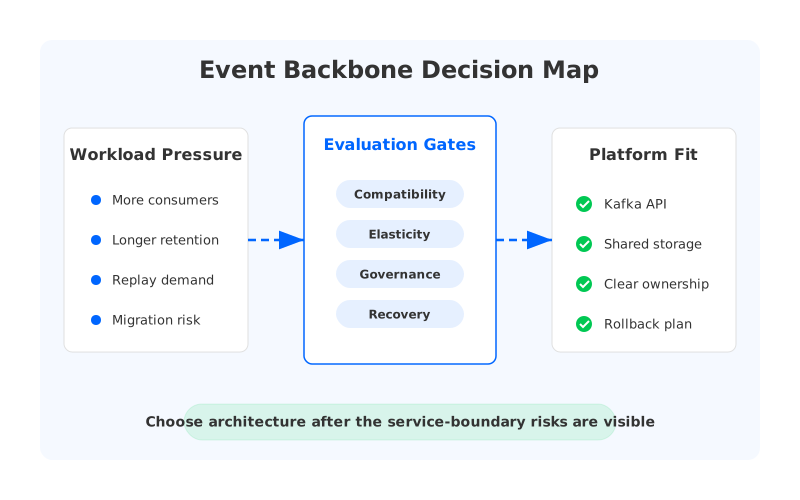
Teams rarely search for event driven architecture kafka patterns because they need another definition of events. They search because service boundaries have started to hurt. A checkout service publishes an order event, a risk service enriches it, a fulfillment service waits for it, a data platform consumes it, and a product team asks why replaying the same stream is harder than creating a new one.
Apache Kafka is often the natural backbone for that situation because it gives services a shared log, durable records, consumer groups, offsets, partitioned ordering, transactions, Kafka Connect, and a large client ecosystem. The hard part is not proving that Kafka can carry events. The hard part is designing the event backbone so service boundaries, data ownership, replay, migration, and cloud operations do not collapse into one overloaded platform team.
1Why Teams Search for event driven architecture kafka patterns
The search intent usually appears after the first successful event-driven architecture becomes a production dependency. Early topics are created around obvious needs: user activity, order status, payment state, inventory updates, device telemetry, or database change events. A few teams subscribe, latency improves, and the architecture feels cleaner than point-to-point API calls.
Then the topology changes. A topic becomes a contract between five teams instead of two. A consumer group depends on a schema field that the producer considered internal. A downstream job needs to replay six months of events, but the original retention policy assumed seven days. A migration project discovers that topic names, ACLs, offsets, connector state, and service ownership are all part of the same dependency graph.
That is the point where event-driven architecture stops being only an application pattern. It becomes infrastructure. The backbone must preserve Kafka semantics for clients while giving platform owners a way to control cost, elasticity, governance, and failure recovery. Without that layer, every new service boundary adds more operational state to the Kafka cluster.
2The Integration Constraint Behind the Pipeline
Service boundaries are useful because they let teams change systems independently. Events make that independence possible only when the contract is clear. A record is not a private function call; it is a durable fact that may be consumed by services, analytics systems, connectors, stream processors, and future migrations the producer team has never seen.
That creates a stricter integration model than many teams expect:
- Ownership must follow the event contract. The team that owns an event should own schema evolution, data quality, retention expectations, and consumer communication.
- Replay must be designed before it is needed. Reprocessing records through offsets is powerful, but replaying a side-effecting workflow can duplicate emails, reservations, or external writes.
- Connectors are part of the boundary. Kafka Connect jobs that move data into warehouses, object storage, search indexes, or operational databases need the same ownership and observability as application consumers.
- Cloud placement changes economics. Multi-AZ durability, network paths, broker disks, object storage, and PrivateLink-style boundaries can turn a clean architecture into a cost and capacity problem.
The integration constraint is that the event backbone has to satisfy application teams and platform teams at the same time. Application teams want stable APIs, low-friction subscriptions, and replay. Platform teams need bounded storage growth, predictable scaling, access controls, migration paths, and incident runbooks.
3Shared Nothing Architecture Turns Boundaries Into Broker State
Traditional Kafka uses a Shared Nothing architecture. Brokers own local storage for their assigned partitions, and replicas are distributed across brokers for availability. This model is proven, widely understood, and still a strong default for many environments. It also means that event architecture decisions eventually become broker-local storage and data movement decisions.
When a team adds retention to support audit or model training, the retained bytes live on broker disks. When traffic moves from one service domain to another, partition and leader placement affect broker load. When a cluster needs more capacity, reassignment may move replicas between brokers. When the platform spans Availability Zones, durability and locality decisions can create cross-zone traffic that has to be modeled as part of the production cost.
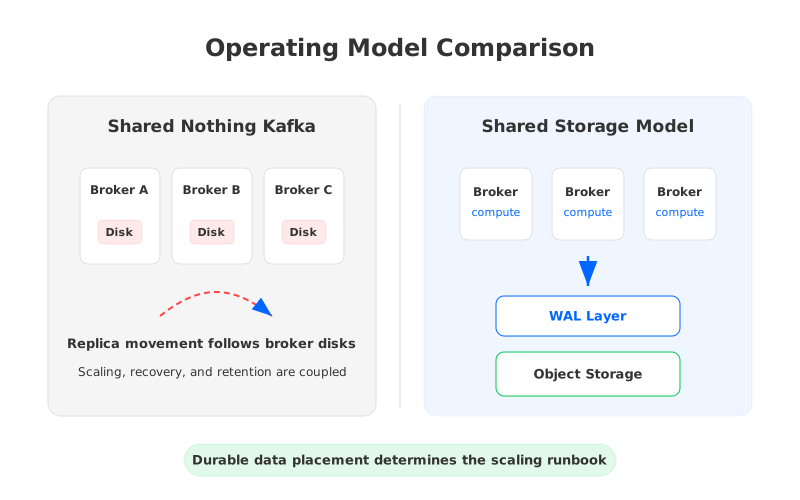
This coupling matters most at service boundaries because boundaries tend to multiply consumers. An order event may feed fraud detection, customer notifications, fulfillment, analytics, finance reconciliation, and data lake ingestion. Even if each consumer is well behaved, the aggregate read fan-out, replay demand, and connector pressure can change the infrastructure profile of a topic long after the producer team considered the work finished.
Tiered Storage helps with part of this problem by moving older log segments to remote storage. It can reduce pressure from long retention, especially for workloads where cold reads are less frequent. It does not fully remove the operational dependency on broker-owned hot storage, replica placement, leader movement, and reassignment behavior. For platform teams evaluating event backbone patterns, the key question is not whether remote storage exists; it is which layer owns durability, elasticity, and recovery.
4Connector, Schema, Replay, and Stream Processing Trade-Offs
The most visible event-driven architecture patterns are often application patterns: event notification, event-carried state transfer, event sourcing, command events, domain events, and stream processing. In production Kafka estates, the more durable patterns are operational. They decide who owns a topic, where schemas are governed, which consumers can replay safely, and how connectors move facts across system boundaries.
Kafka Connect is a good example. A source connector may turn database changes into events that several services treat as product facts. A sink connector may write events into Snowflake, object storage, search systems, or operational stores. The connector looks like integration plumbing, but it has offset state, error handling, task parallelism, credentials, dead-letter behavior, and destination-side semantics. Treating it as background infrastructure is how teams end up with two versions of the same business fact.
Schema and replay decisions deserve the same level of care. A schema registry or compatibility policy can protect consumers, but only if topic ownership is explicit. Replay through offsets can rebuild derived state, but only if side effects are isolated. Stream processing with Kafka Streams, Flink, or another engine can keep service boundaries clean, but only if enrichment logic is not scattered across one-off jobs.
| Pattern Area | Production Question | Failure Mode If Ignored |
|---|---|---|
| Domain events | Which team owns the meaning of each event? | Topic contracts drift into undocumented shared state. |
| Connectors | Which systems are sources of truth, sinks, or derived views? | Integration jobs disagree during incidents and migrations. |
| Replay | Which consumers can reprocess records safely? | Recovery work creates duplicate external side effects. |
| Stream processing | Where are joins, enrichment, and materialized views owned? | Business logic spreads across services and pipelines. |
| Governance | Who can publish, subscribe, retain, and delete data? | Access policy lags behind event adoption. |
The table is intentionally not a product comparison. It is the minimum architecture review before choosing any Kafka-compatible platform. If the team cannot answer these questions on the current cluster, changing infrastructure will only move the ambiguity.
5Evaluation Checklist for Data Platform Teams
Start with workload shape rather than platform category. Measure write rate, read fan-out, message size, partition count, retention, consumer lag tolerance, schema change frequency, connector count, and replay requirements. Then map those numbers to service ownership. A payment event, a page-view event, and a machine telemetry event may all use Kafka, but they should not share the same operational policy.
Use the checklist below as a design gate:
- Kafka compatibility. Validate producer and consumer clients, admin APIs, Kafka Connect, stream processors, transactions if used, compaction if used, authentication, authorization, metrics, and tooling.
- Elasticity. Test what happens when a service domain doubles write traffic, adds consumers, increases retention, or needs broker replacement during peak load.
- Cost model. Include broker compute, storage, replication, cross-zone network paths, connector workers, object storage, observability, and operational labor.
- Governance. Attach owners, schemas, ACLs, retention, data classification, audit expectations, and deletion rules to topic domains rather than individual tickets.
- Recovery. Define how consumer offsets, connector state, replay windows, dead-letter topics, and rollback steps behave during incidents.
- Migration risk. Inventory topic names, partitions, offsets, schemas, ACLs, clients, connectors, and routing changes before deciding the cutover shape.
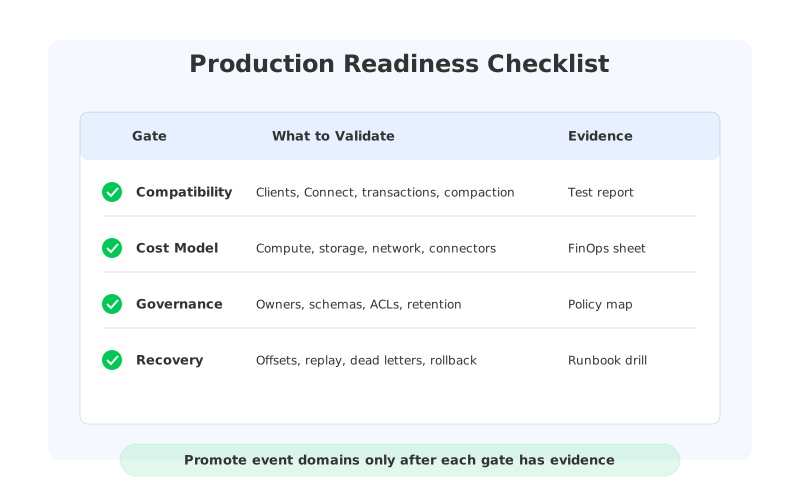
The output should be a workload decision record. It should say which event domains need strict ordering, which can tolerate relaxed latency, which require long retention, which are safe to replay, and which service teams must sign off before a schema or retention change. That record gives platform teams a way to separate architectural preference from production risk.
6How AutoMQ Changes the Operating Model
Once the evaluation is framed around operating model, a different architecture becomes relevant. AutoMQ is a Kafka-compatible cloud-native streaming system that keeps the Kafka protocol surface while replacing broker-local durable storage with a Shared Storage architecture backed by object storage and WAL storage. The important shift is that brokers become more stateless, while durable stream data is no longer treated as permanently attached to one broker's disk.
For event-driven service boundaries, that changes the platform conversation. Scaling compute for producer load or consumer fan-out does not have to mean moving the same volume of durable partition data between brokers. Broker replacement becomes less tied to local disk recovery. Partition balancing can focus more on traffic and compute pressure, because durable data is held in shared storage rather than duplicated through broker-local replicas.
AutoMQ's WAL layer also makes the object-storage model practical for streaming writes. The WAL absorbs the low-latency persistence path and supports recovery for data not yet uploaded to object storage. Object storage then serves as the durable data layer for retained streams. That separation is the architectural reason AutoMQ can talk about independent compute and storage scaling without asking application teams to abandon Kafka clients and Kafka semantics.
The cost model changes in the same direction. Traditional Kafka deployments in the cloud can amplify traffic through broker-to-broker replication and cross-zone placement. AutoMQ's Zero cross-AZ traffic design uses shared object storage and zone-aware routing so production, replication, and consumption paths do not depend on the same broker-to-broker replica movement pattern. The financial result still depends on cloud region, traffic shape, retention, and deployment design, so teams should model it with their own telemetry.
Deployment boundaries matter as much as storage mechanics. AutoMQ BYOC is relevant when the platform team wants the data plane inside the customer's cloud environment, and AutoMQ Software is relevant for teams that need private deployment control. For service-boundary workloads that carry customer, financial, operational, or regulated data, where the system runs can be part of the architecture decision, not a procurement detail.
7Migration Readiness for an Event Backbone
Migration should be planned by service domain, not by cluster inventory. Moving an event backbone one topic at a time can split a workflow across platforms if producers, consumers, schemas, and connectors do not move together. A safer plan groups topics by business chain: for example, order intake, risk review, fulfillment, notification, and analytics exports.
The readiness review should answer three questions before any cutover. First, can producers be routed to the target platform in a controlled way? Second, can consumers resume from the intended offsets without silent duplication or data loss? Third, can connectors and stream processors be paused, mirrored, restarted, or rolled back without corrupting downstream systems?
MirrorMaker 2 and similar replication approaches can be useful building blocks, but they do not remove the need for ownership decisions. Offset mapping, schema parity, ACL parity, connector state, dead-letter topics, and observability all need explicit checks. AutoMQ Linking is designed for migration into AutoMQ with coordinated data movement and traffic switching, but the architecture team still has to decide which service domain moves first and where rollback stops being clean.
The right pilot is not the smallest topic. It is the smallest domain that exercises the real risks: a producer, at least one consumer group, one connector or processing job, a schema change path, a replay drill, and an operational dashboard. If that pilot cannot be explained as a runbook, the migration is not ready for a core service boundary.
8The Decision Is About Service Boundaries
Kafka-based event-driven architecture succeeds when service boundaries remain understandable under growth. The durable log gives teams replay, decoupling, and shared facts. The platform architecture decides whether those benefits stay manageable when retention expands, consumers multiply, connectors become critical, and cloud infrastructure becomes a material part of the bill.
If your team is searching for event driven architecture kafka patterns, use the checklist above against a real service domain before selecting infrastructure. When the review shows that broker-local storage, cross-zone traffic, slow reassignment, or migration risk is the limiting factor, test whether a Kafka-compatible Shared Storage architecture changes the operating model. To evaluate that path with your own event domains, start with the AutoMQ Cloud Console and validate compatibility, scaling, replay, and rollback with production-shaped traffic.
9References
- Apache Kafka documentation: Core concepts and APIs
- Apache Kafka documentation: Consumer configuration
- Apache Kafka documentation: Kafka Connect
- Apache Kafka wiki: KIP-405: Kafka Tiered Storage
- Apache Kafka wiki: KIP-1150: Diskless Topics
- AWS documentation: Amazon S3 User Guide
- AWS documentation: Amazon VPC User Guide
- AutoMQ documentation: Architecture overview
- AutoMQ documentation: Compatibility with Apache Kafka
- AutoMQ documentation: Eliminate inter-zone traffic
- AutoMQ documentation: Migrating from Apache Kafka to AutoMQ
10FAQ
10.1What are the most important Kafka patterns for event-driven architecture?
The most important production patterns are domain event ownership, stable schemas, consumer group design, replay boundaries, connector governance, and stream processing ownership. Application patterns matter, but operational patterns decide whether the event backbone stays reliable as teams and consumers grow.
10.2Is Kafka required for event-driven microservices?
No. Some service boundaries work well with synchronous APIs, queues, or database-native change streams. Kafka becomes attractive when multiple consumers need a durable shared log, replay, partitioned ordering, and a mature ecosystem around connectors and stream processing.
10.3How should teams decide topic boundaries?
Topic boundaries should follow event ownership and consumption semantics. A topic should have a clear producer owner, schema policy, retention expectation, access model, and replay meaning. Creating topics only around current implementation details usually creates migration and governance problems later.
10.4When does Shared Storage matter for Kafka-compatible event backbones?
Shared Storage matters when broker-local disks, replica movement, retention growth, cross-zone traffic, or slow scaling become central operational risks. It is most relevant for platforms that want Kafka compatibility while changing how durability and elasticity are handled underneath the broker layer.
10.5How should teams test migration readiness?
Test a complete service domain instead of a disconnected topic. Include producers, consumer groups, schemas, ACLs, connectors, stream processors, offset behavior, replay drills, dashboards, and rollback steps. The test should produce a runbook that service owners and platform owners can both execute.


