
Table of Contents
Table of Contents
Teams usually search for large cluster metadata pressure kafka after the cluster starts behaving differently from the tidy architecture diagram. Controller events take longer to settle. Partition movements become risky change windows. Client metadata refreshes create spikes at the wrong time. The cluster may still look healthy from a throughput perspective; the pressure appears in the control path before it becomes a clean data-plane outage.
That distinction matters for platform teams. A Kafka cluster can have enough CPU, disk bandwidth, and network headroom while still becoming hard to operate because topics, partitions, replicas, client connections, access policies, Connect tasks, and rolling operations outgrow the operational model. Metadata pressure is not one metric. It is the way cluster state, broker-local storage, and day-two operations amplify one another.
1Why teams search for large cluster metadata pressure kafka
The search phrase is clumsy, but the production scenario is precise. Someone owns a large Kafka estate and needs to decide whether the next fix is tuning, partition cleanup, broker expansion, topology redesign, or platform migration. They are asking why a once-predictable cluster now turns routine changes into coordinated events across brokers, controllers, clients, storage, and the network.
Large clusters put pressure on metadata in several ways. More partitions increase leaders, replicas, ISR transitions, log directories, fetch sessions, and leader election decisions. More topics increase policy, retention, ACL, and quota surface area. More clients increase metadata refresh fan-out and connection churn. More Connect workers and stream processing jobs add group coordination, offset tracking, and rebalance behavior. The failure mode appears when normal growth makes every administrative operation touch too many stateful objects.
The first mistake is to treat this as a controller-only issue. Apache Kafka has moved from ZooKeeper-based metadata management to KRaft, where Kafka metadata is managed by a Kafka quorum rather than an external ZooKeeper ensemble. But KRaft does not remove the downstream work triggered by metadata changes. When a partition moves, a leader changes, a broker drains, or retention shifts the data footprint, the cluster still reconciles metadata with physical data placement and clients.
The practical question is broader than "how large can the metadata quorum be?" Ask: when metadata changes, how much data, network traffic, local disk state, and client disruption must follow?
2The production constraint behind the problem
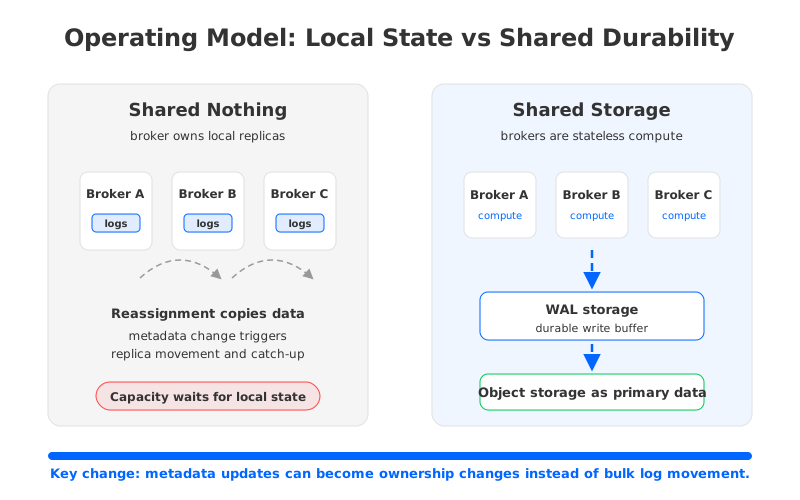
Traditional Kafka uses a Shared Nothing architecture. Each broker owns local log storage, and each partition replica is physically placed on specific brokers. This fit clusters where servers, disks, and network capacity were planned together. It also gives clear locality: if a partition replica is on broker 12, its durable data is on broker 12's storage.
The same locality becomes expensive when the cluster changes shape. An added broker does not help until partitions are reassigned to it. Reassignment creates data movement. A broker drain requires replicas to catch up elsewhere. A retention increase expands the storage footprint on brokers that already own the partitions. In a large cluster these operations start competing with the workload they protect.
Metadata pressure therefore becomes visible through production symptoms rather than one neat dashboard panel:
- Slow change convergence. Rolling restarts, broker replacement, partition reassignment, and topic expansion take longer because each step must respect leadership, replication, ISR health, and local data movement.
- Operational blast radius. A single broker or rack-level event affects the partitions physically attached to that failure domain, so recovery planning must account for both metadata and data placement.
- Capacity coupling. Compute, storage, and network capacity are purchased and operated together, even when the workload only needs one of them to change.
- Client-side instability. Metadata refresh storms, group rebalances, and bootstrap dependency issues can turn a control-plane disturbance into application-visible latency or errors.
- Cost side effects. In cloud deployments, broker-local replication and cross-Availability Zone (AZ) traffic can grow as a side effect of durability and availability design.
This is why "add brokers" is sometimes right and sometimes a trap. Adding brokers can increase aggregate CPU and network capacity, but the cluster is not balanced until partitions and traffic move. Creating relief can create more work for the same control and storage paths already under pressure.
3Architecture options and trade-offs
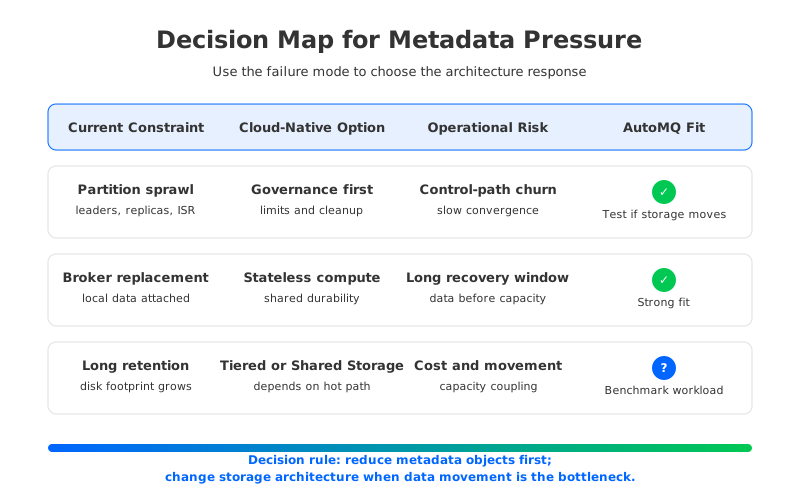
The right response depends on whether metadata pressure comes from workload shape, cluster topology, or the architecture's state model. Separate fixes that reduce pressure from changes that alter how pressure propagates.
| Option | What it improves | What it does not remove |
|---|---|---|
| Partition and topic hygiene | Reduces unnecessary metadata objects, small partitions, and idle topic sprawl. | Does not change broker-local storage or replica movement for active partitions. |
| Better quotas, client tuning, and governance | Reduces metadata refresh storms, unbounded topic creation, and noisy tenants. | Does not decouple scaling from physical data placement. |
| KRaft-based Kafka upgrades | Improves Kafka metadata management and removes ZooKeeper dependency. | Does not make brokers stateless or eliminate local log movement. |
| Tiered Storage | Moves older log segments to remote storage and can reduce local disk retention pressure. | Recent data, leaders, replicas, and hot-path operations still depend on broker-local storage. |
| Shared Storage architecture | Moves persistent stream data to shared object storage and makes brokers stateless. | Requires evaluating WAL design, object storage behavior, compatibility, and operational ownership. |
This table should keep teams honest. Hygiene matters. KRaft matters. Tiered Storage matters when long retention is the pain. But each option works at a different layer. If the largest risk is the number of metadata objects, reduce object count and governance sprawl. If the largest risk is that every topology change forces data movement, the storage architecture is part of the problem.
Tiered Storage deserves a careful look because it is often confused with a fully shared-storage model. Apache Kafka Tiered Storage allows older log segments to be stored remotely while brokers retain local log segments for the active hot path. That can reduce local storage pressure for long retention. It does not make a broker interchangeable like a stateless service instance, because the broker still participates in local log ownership, leadership, replication, and hot-path recovery.
The distinction is operational, not semantic. Both approaches can preserve Kafka APIs and client behavior. The difference is what happens when the platform team changes the cluster underneath those APIs. In Shared Nothing architecture, metadata changes often imply local state movement. In Shared Storage architecture, metadata changes can often be handled as ownership, routing, cache, or leadership changes because durable data is already outside the broker.
4Evaluation checklist for platform teams
Before choosing a platform path, write down the failure modes you are trying to prevent. "Metadata pressure" is too broad. A useful evaluation starts with the production action that causes pain: creating thousands of partitions, replacing brokers, expanding retention, draining an AZ, onboarding tenants, running Connect at scale, or recovering after a bad client rollout.
Use the same questions across every option:
- Compatibility: Which Kafka client versions, consumer group behavior, transactions, idempotent producers, offset semantics, Kafka Connect patterns, and admin APIs must work without application rewrites?
- Elasticity: When brokers are added or removed, how much durable data has to move before the cluster reaches the desired state?
- Recovery: During broker loss, AZ impairment, or controller failover, what state must be reconstructed locally before traffic can settle?
- Cost: Which costs scale with logical data volume, which scale with replica count, and which scale with cross-AZ or private network traffic?
- Governance: Can the platform team prevent uncontrolled topic, partition, ACL, quota, and connector growth before it becomes a reliability issue?
- Observability: Are controller latency, metadata request rates, partition movement, client refresh patterns, group rebalances, WAL health, and storage tail latency visible together?
- Migration risk: Can the team migrate topic by topic, validate offsets, keep a rollback path, and avoid a synchronized cutover across every application?
The answer does not have to be the same for every cluster. A compact, latency-sensitive cluster may need better governance and a KRaft upgrade plan. A long-retention analytics cluster may benefit from Tiered Storage. A multi-tenant platform with tenant churn, uneven partitions, and frequent broker resizing may have a state model that is too heavy for its rate of change.
5How AutoMQ changes the operating model
This is where AutoMQ fits into the evaluation. AutoMQ is a Kafka-compatible, cloud-native streaming platform that keeps Kafka protocol and ecosystem compatibility while replacing broker-local log storage with S3Stream, a shared streaming storage layer backed by S3-compatible object storage and WAL storage. The point is not to make metadata disappear; it is to reduce how often metadata changes force broker-local data movement.
In AutoMQ's Shared Storage architecture, persistent stream data is stored in shared object storage. Brokers handle Kafka protocol processing, partition leadership, routing, caching, and scheduling, but they do not own durable partition data like traditional Kafka brokers own local logs. WAL (Write-Ahead Log) storage provides the durable write buffer for acknowledgments and recovery, while object storage serves as the primary data store.
That shift changes several operations. Scaling out is less dominated by copying partition data to added brokers before capacity becomes useful. Reassignment can be handled as a metadata and ownership transition rather than a bulk migration project. Broker replacement becomes closer to replacing compute capacity because durable history remains in shared storage.
The architecture still has design choices. WAL type matters. AutoMQ Open Source uses S3 WAL, where S3-compatible object storage is both WAL and primary storage. AutoMQ BYOC and AutoMQ Software can use additional WAL options, including Regional EBS WAL and NFS WAL, depending on latency, durability, cloud provider, and deployment requirements. Platform teams should evaluate WAL media with workload latency, failure domain, and recovery requirements in view.
Customer-controlled deployment boundaries are also part of the decision. AutoMQ BYOC runs the control plane and data plane in the customer's own cloud account and VPC. AutoMQ Software targets private data centers or IDC environments. For teams evaluating governance, data residency, private networking, and audit boundaries, this matters as much as broker architecture.
6Readiness scorecard
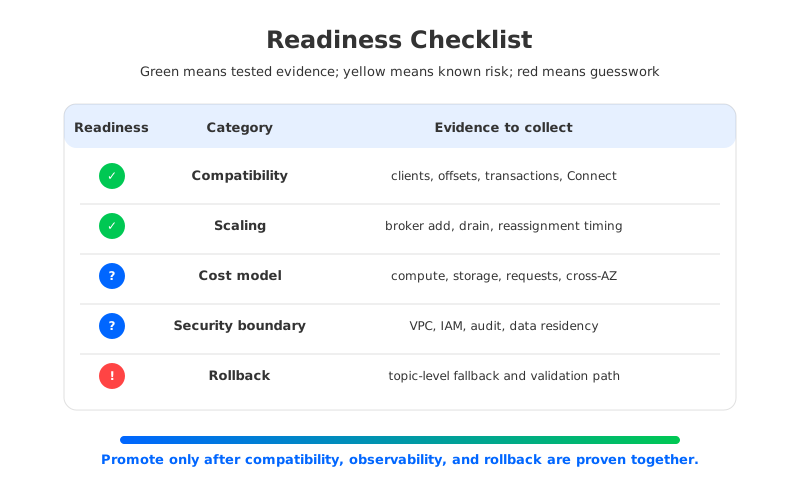
The most useful migration plan is a readiness scorecard, not a declaration that one architecture wins everywhere. Give each category a green, yellow, or red rating before moving a critical workload. Green means evidence, yellow means understood but not fully tested risk, and red means guessing.
| Category | Green signal | Red signal |
|---|---|---|
| Workload inventory | Topics, partitions, client versions, consumer groups, connectors, and retention policies are known. | The team discovers active clients only during cutover planning. |
| Compatibility | Critical clients, transactions, offsets, admin APIs, and Connect flows pass representative tests. | “Kafka-compatible” is accepted without testing the actual application paths. |
| Failure drills | Broker loss, controller failover, AZ impairment, and rollback are rehearsed. | The first recovery test is planned for the production migration window. |
| Cost model | Compute, storage, request, cross-AZ, and private network costs are modeled separately. | Monthly cost is estimated from broker count alone. |
| Observability | Metadata, storage, WAL, cache, client, and rebalance signals are visible in one operating view. | The team can see broker CPU but not the control-path or storage-path bottleneck. |
| Rollback | Topic-level or workload-level rollback is documented and tested. | The plan assumes a one-way cutover because rollback is too hard to describe. |
This scorecard also helps avoid overfitting. If the pain is unmanaged topic creation, fix governance first. If the pain is long retention on expensive disks, Tiered Storage may be enough. If every topology change drags durable data behind it, Shared Storage architecture deserves serious testing.
7FAQ
7.1Is metadata pressure the same as having too many partitions?
No. Partition count is a major contributor, but metadata pressure also includes topic policies, ACLs, quotas, client refresh behavior, group coordination, Connect workloads, broker lifecycle events, and storage placement. A partition cleanup can help, but it is not a full operating model.
7.2Does KRaft solve large-cluster metadata pressure?
KRaft improves Kafka metadata management by removing ZooKeeper from the metadata path and using a Kafka quorum. It does not remove the operational work caused by broker-local logs, replica movement, client metadata refreshes, or workload governance. Treat KRaft as an important foundation, not a complete answer to every large-cluster failure mode.
7.3Is Tiered Storage the same as Shared Storage architecture?
No. Tiered Storage moves older log segments to remote storage while keeping local storage in the hot path. Shared Storage architecture makes shared object storage the primary durable data layer and lets brokers operate as stateless compute nodes. Both can be useful, but they change different parts of the operating model.
7.4When should AutoMQ be evaluated?
Evaluate AutoMQ when Kafka compatibility is required but the current cluster is constrained by broker-local storage, slow reassignment, costly cross-AZ replication, difficult capacity planning, or frequent scaling and recovery operations. The first test should focus on representative client behavior, WAL choice, observability, and rollback, not only on peak throughput.
7.5What is the next practical step?
Pick one production-like workload and score it against compatibility, failure recovery, cost, governance, and migration risk. If the main blocker is stateful broker operations, test the workload on AutoMQ with the WAL option and deployment model that matches your environment. To explore the BYOC path, start with the AutoMQ team through this technical evaluation link.


