
Table of Contents
Table of Contents
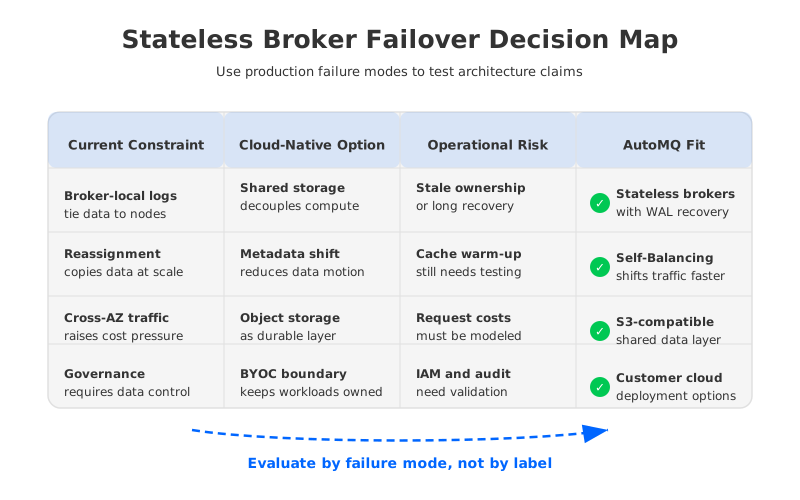
Searching for stateless broker failover kafka usually means a team has moved past generic availability advice. The question is no longer whether Kafka can survive a broker failure. It is whether the recovery path still fits the way the platform is operated: cloud instances are replaced, disks fill, partitions drift, retention grows, and the same cluster is expected to absorb traffic spikes without a long maintenance window.
That pressure changes the meaning of failover. In a small Kafka cluster, a failed broker is a node event. In a production platform with hundreds or thousands of partitions, the failed broker exposes a chain of decisions: where the durable log lives, how much data must be copied, whether replacement capacity has enough storage, which availability zone pays the network bill, and whether consumers can tolerate the recovery pattern. Stateless broker architecture is attractive because it can turn broker replacement into a compute scheduling problem. The hard part is proving that under the failure modes your workload creates.
1Why teams search for stateless broker failover kafka
Most teams do not start with a desire for statelessness. They start with incidents that feel larger than the broken machine. A broker disappears, leadership moves, replicas catch up, and the cluster remains available on paper, yet operators spend hours watching reassignment progress, disk watermarks, consumer lag, and network saturation. The incident closes, but the lesson is uncomfortable: the platform recovered because the team had spare capacity and patience, not because the architecture made recovery routine.
The search phrase also appears when cloud operating models collide with broker-local durability. Compute capacity can be replaced quickly. Attached storage and partition replicas are less flexible. If every broker owns part of the authoritative log, replacement may require storage provisioning, replica catch-up, and rebalance work before the system is healthy. That may be acceptable for stable clusters with predictable growth. It becomes harder with elastic infrastructure, long retention, frequent rolling changes, or workload spikes from analytics and AI pipelines.
There is a second motive behind the query: buyers want to separate a vendor claim from an operational property. "Stateless broker" can mean different things depending on where data is acknowledged, how metadata is fenced, what happens to unflushed writes, and whether clients continue using Kafka APIs. A broker without local disk can still have runtime state, cache warmth, ownership metadata, or WAL recovery concerns. The production question is not "is the broker stateless?" It is "which state can disappear without data loss or a long rebuild?"
2The production constraint behind the problem
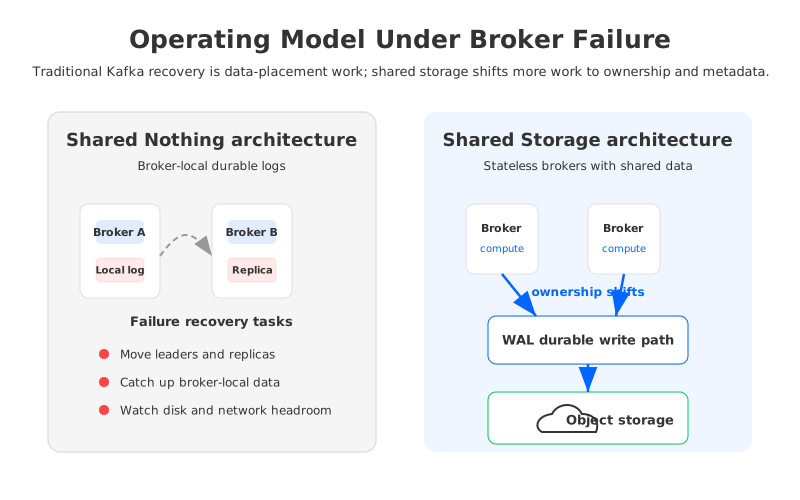
Traditional Kafka uses a Shared Nothing architecture. Each broker manages local or attached storage for the partition replicas assigned to it, and durability comes from replication across brokers through ISR (In-Sync Replicas). This design is proven and widely understood. It also makes broker identity operationally meaningful because storage, leadership, replica placement, and capacity are tied together.
That coupling turns common failures into multi-step recovery work. A failed broker is not merely a missing process. It is replicas stored somewhere, leaders that must move, followers that may need to catch up, and disks that shaped available headroom. When the cluster is already near storage or network limits, failover can push remaining brokers into the resource pressure recovery needs to avoid.
The same pattern appears during planned operations. Adding brokers can require partition reassignment before capacity is useful. Removing brokers can require moving data away first. Expanding retention can make storage the limit even if CPU is available. Rolling upgrades can be safe but slow because the team must protect local log layout while changing compute nodes. In cloud environments, cross-AZ replication and rebalancing traffic can also become a cost and saturation problem.
KRaft removes ZooKeeper from Kafka's metadata path, but it does not by itself remove broker-local log ownership. Apache Kafka's documentation describes KRaft as the metadata quorum architecture for Kafka, while broker storage behavior remains a separate design topic. Tiered Storage can reduce pressure from older log segments by moving eligible data to remote storage, yet the active write path and local replicas still matter in the production failover story. That distinction matters because many "stateless Kafka" evaluations mix three different questions: metadata management, historical retention, and active durable log ownership.
3Architecture options and trade-offs
Platform teams usually have four paths. They can keep traditional Kafka and invest in automation around capacity, balancing, runbooks, and conservative headroom. They can use managed Kafka to transfer some operational work to a provider while keeping broker-local storage. They can use Tiered Storage to change retention economics for historical data. Or they can evaluate a Kafka-compatible Shared Storage architecture where durable stream data is no longer owned by a specific broker disk.
The right path depends on which failure mode hurts. If the main problem is inconsistent runbooks, better automation may be fastest. If the problem is provider operations, a managed service can reduce toil. If the problem is long retention, Tiered Storage may help. If compute changes keep turning into data movement, storage architecture deserves a deeper review.
Use the same evaluation criteria across all options:
- Compatibility: Producers, consumers, offsets, transactions, Kafka Connect, Schema Registry, and monitoring tools should behave as expected. A storage-layer change should not force every application team to learn a different streaming API.
- Acknowledgment and durability path: Identify where a produce request becomes durable, how the write-ahead path works, and what data can be recovered after a broker loss.
- Failover boundary: Separate runtime state from durable log state. Connections, caches, leadership, and metrics can move; authoritative log data needs a protected home.
- Cost and capacity model: Model storage, compute, replication traffic, cross-AZ traffic, object storage requests, and operational headroom together. A narrow storage comparison can miss the network or recovery cost.
- Governance boundary: Decide where the data plane runs, which cloud account owns storage, how IAM and encryption are controlled, and what telemetry leaves the environment.
- Migration and rollback: Check whether the target architecture supports a staged migration, offset validation, dual-write or replication testing, and a rollback path that the team can execute under pressure.
This checklist is deliberately neutral. A stateless broker design is valuable only when it improves real failure modes. It does not remove monitoring, workload testing, or capacity planning. It changes which resources are on the critical path when a broker is replaced.
| Failure mode | Shared Nothing architecture concern | Shared Storage architecture question |
|---|---|---|
| Broker loss | Replica catch-up and local storage pressure can extend recovery. | Can another broker take ownership without reconstructing local durable logs? |
| Scale-out | New brokers need partition movement before capacity is useful. | Can ownership and traffic shift without bulk data copy? |
| Scale-in | Data must be drained from brokers before removal. | Can compute be removed while durable data remains in shared storage? |
| Long retention | Broker disks grow with retained log data. | Does object storage become the main durable capacity layer? |
| Cloud networking | Replication and reassignment may cross Availability Zones. | Is the data path designed to reduce broker-to-broker data movement? |
The table is not a verdict. It keeps the evaluation honest. If an architecture proposal claims stateless failover, ask which row changes, which row does not, and which metric will prove the difference during a PoC.
4Evaluation checklist for platform teams
A production evaluation should start with failure drills, not feature labels. Pick two workloads that represent the cluster: one high-throughput workload and one replay-heavy or retention-heavy workload. Then test broker replacement, scale-out, scale-in, leader movement, consumer recovery, and rolling upgrades while measuring on-call metrics.
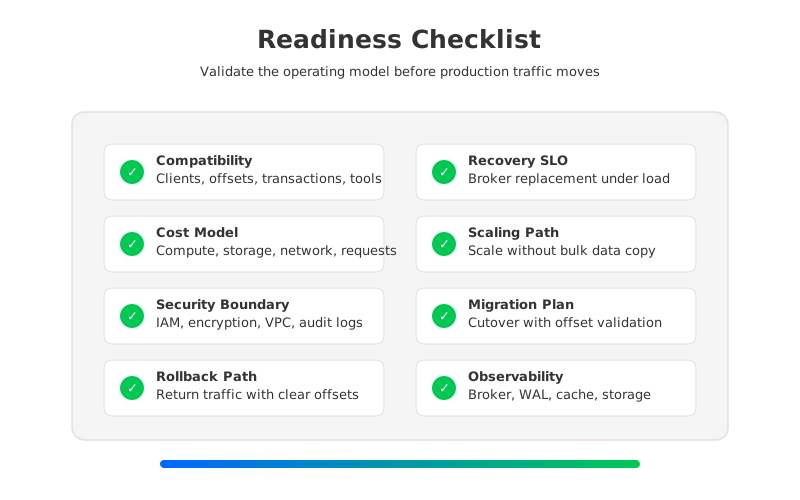
The most useful readiness scorecard is specific enough to block vague claims:
- Client behavior: Existing clients can produce, consume, commit offsets, and use required security settings without application code changes.
- Recovery time: Broker replacement returns the cluster to the expected health envelope within the team's SLO, under the target partition count and retention policy.
- Data movement: Recovery and scaling do not require bulk copying of the authoritative log between broker-local disks.
- Cost visibility: The team can explain compute, storage, object storage request, network, and observability costs before production rollout.
- Security model: IAM, encryption, network boundaries, audit logs, and data-plane ownership match the organization's governance requirements.
- Operational tooling: Metrics, logs, alerts, dashboards, and incident procedures cover broker, WAL, object storage, cache, metadata, and client-facing behavior.
- Rollback path: The team can return traffic to the previous platform or pause migration without losing offset visibility or creating duplicate processing risk.
Notice what is not on the list: a generic promise that brokers are stateless. That phrase is useful as a design direction, but it is not a release criterion. The release criterion is a measured recovery path that the operations team trusts.
5How AutoMQ changes the operating model
Once the evaluation reaches durable log ownership and data movement, AutoMQ becomes relevant as a Kafka-compatible cloud-native streaming platform built around Shared Storage architecture. AutoMQ keeps the Kafka-facing API and ecosystem expectations while moving durable stream storage away from broker-local disks through S3Stream, WAL (Write-Ahead Log), and S3-compatible object storage.
The operating model changes because AutoMQ Brokers are designed as stateless brokers. They still handle Kafka protocol requests, leadership, caching, routing, metrics, and runtime coordination. What changes is long-lived ownership of durable data. The WAL provides the durable write path, while object storage acts as the shared data layer. When a broker is replaced or capacity changes, recovery can focus on metadata, ownership, cache warm-up, and traffic routing rather than reconstructing the authoritative log from a failed machine.
This is also why AutoMQ is not the same category as Tiered Storage. Tiered Storage is useful when teams want to offload older segments from local broker disks. Shared Storage architecture is a broader shift: the broker should not be the durable center of the log. That distinction affects failover, reassignment, scale-in, and retention because the cluster is no longer designed around preserving each broker's local data as the primary source of truth.
For BYOC evaluations, the deployment boundary matters as much as the storage design. AutoMQ BYOC runs the control plane and data plane in the customer's cloud account, and AutoMQ Software targets customer-operated private environments. That can be important for teams that want Kafka compatibility without moving the data plane outside their governance boundary. The architecture still needs a workload-specific test, but the evaluation starts from a different premise: keep Kafka semantics at the edge, then make durable storage shared and broker compute replaceable.
The practical migration path should reflect that premise. Test compatibility first, then failure behavior, then cost. If client behavior breaks, the storage architecture does not matter. If failover cannot meet the SLO, the diagram is not enough. If cost modeling ignores cross-AZ traffic, object storage operations, or operational headroom, the decision will be incomplete. A good PoC makes those trade-offs visible before the platform team commits production traffic.
6Decision framework: when stateless failover matters
Stateless broker failover is most valuable when the cluster's pain comes from the relationship between broker compute and durable storage. Teams with stable workloads, short retention, and mature automation may get enough value from traditional Kafka with better operational discipline. Teams with elastic workloads, long replay windows, frequent infrastructure changes, or strict cloud cost scrutiny should evaluate whether local log ownership has become the bottleneck.
The decision can be summarized in one question: when a broker fails, what must be rebuilt before the platform is healthy again? If the answer is "a process, leadership, and cache warmth," the recovery model is closer to cloud-native compute replacement. If the answer is "local durable log placement across a large partition set," the platform still carries a stateful broker recovery problem, even if many parts of the environment are automated.
Return to the search that started the investigation: stateless broker failover kafka. The useful answer is not a slogan. It is a failure-mode map, a workload-specific drill, and a clear statement of which state can disappear safely. To evaluate that model with Kafka-compatible shared storage, review the AutoMQ architecture docs and run a PoC against the workloads that make broker-local recovery painful. You can also explore the project on GitHub or discuss a BYOC evaluation path at go.automq.com/home.
7FAQ
7.1Does stateless broker failover mean Kafka has no state?
No. A broker still has runtime state such as client connections, request queues, cache contents, leadership assignments, metrics, and metadata views. The important distinction is whether long-lived durable log data is bound to the broker's local disk. Stateless broker failover means a broker can be replaced without treating its local storage as the authoritative copy that must be rebuilt.
7.2Is KRaft the same thing as stateless broker architecture?
No. KRaft changes Kafka metadata management by replacing ZooKeeper with a Kafka-native metadata quorum. Stateless broker architecture is a storage and operating model question. A Kafka deployment can use KRaft while still relying on broker-local durable logs.
7.3Does Tiered Storage make brokers stateless?
Not by itself. Tiered Storage can move older log segments to remote storage, which helps with retention and historical reads. A stateless broker design goes further by making durable log ownership independent of broker-local storage.
7.4What should a PoC measure?
Measure client compatibility, produce and consume behavior, recovery time after broker replacement, data movement during scaling, consumer lag during failover, object storage behavior, observability coverage, and total infrastructure cost. The test should use representative partition counts, retention settings, and traffic patterns.
7.5Where does AutoMQ fit in this evaluation?
AutoMQ fits when the desired target is Kafka-compatible streaming with Shared Storage architecture, stateless brokers, object-storage-backed durability, and deployment models that can keep the data plane in the customer's environment. It should be evaluated with the same workload drills as any production platform decision.


