
Table of Contents
Table of Contents
When an architect searches for storage class durability kafka, they are rarely asking for a dictionary definition of a cloud storage class. They are answering a production question: if Kafka data is protected by replication, local disks, remote tiers, snapshots, or object storage durability, which failure modes still belong to the platform team? Storage durability and streaming durability are related, but they are not the same promise.
Kafka durability lives at the intersection of brokers, partitions, leaders, followers, offsets, retention, transactions, and the physical storage layer underneath them. A cloud storage class may describe how many copies an object service keeps inside a Region. Kafka still has to decide when a produce request is acknowledged, how a leader fails over, whether a follower is caught up, how consumers resume from offsets, and what happens when the cluster needs to scale while traffic keeps moving.
That is why the durable-storage question becomes a platform architecture question. The right answer is not "use the most durable storage class" or "replicate everything more." The right answer is to map production failure modes to the layer that is responsible for absorbing them, then choose a Kafka-compatible architecture whose operating model matches the team's failure budget.
1Why Teams Search for storage class durability kafka
The search usually starts after one of three events. A broker disk fills faster than expected. A recovery exercise reveals that moving partition data takes longer than the incident budget allows. Or a cloud bill shows that a highly available Kafka cluster is paying for the same bytes through broker storage, replica traffic, and cross-Availability Zone data movement. None of these events means Kafka is broken. They mean the cluster is exposing the cost of a Shared Nothing architecture under cloud operating conditions.
Apache Kafka's core model is elegant: a Topic is split into Partitions, each Partition has a leader, followers stay in sync through replication, and consumers track their progress through offsets. The model gives applications a stable log abstraction. It also means that a broker is not only compute. It is a storage owner. The moment a broker owns local durable data, scaling, failure recovery, and placement become storage operations.
That distinction matters when teams evaluate storage classes. A highly durable cloud block volume can protect bytes on a single broker, but it does not remove the need to replicate data for Kafka availability. A remote object tier can reduce pressure from long retention, but the hot path still has to handle active writes, leader changes, and reads from recent segments. A backup can help after data loss, but it does not make consumer offsets, transactional state, or in-flight records instantly usable in another cluster.
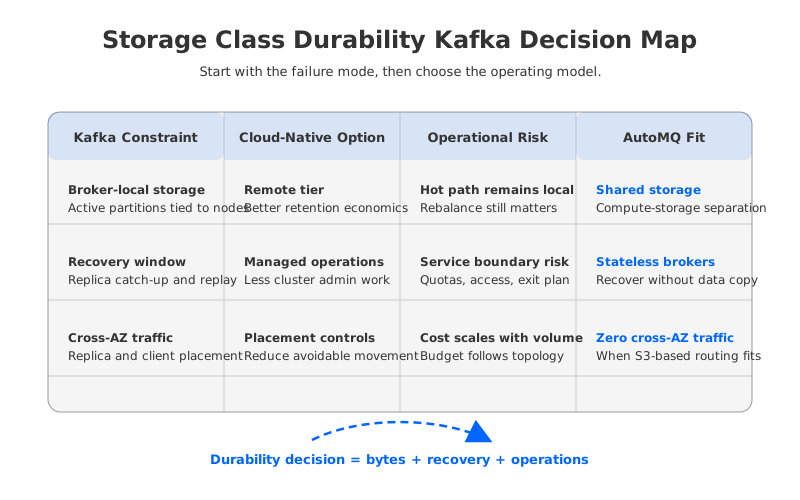
The production question is therefore narrower and harder: which failures must the streaming platform survive without turning recovery into a data-movement project? Once the team phrases it that way, storage class durability becomes one input in a larger design review instead of a checkbox.
2The Production Constraint Behind the Problem
Traditional Kafka runs as a Shared Nothing architecture. Each broker manages its own local log storage. Replication through ISR (In-Sync Replicas) protects Partition availability by keeping copies on multiple brokers, often spread across Availability Zones. This is a strong design for the environment Kafka came from: clusters where local disks were close to compute, machine-to-machine replication did not create a separate line item, and capacity planning was mostly a hardware problem.
Cloud infrastructure changes the economics and failure boundaries. Broker-local storage is still local from Kafka's point of view, but the underlying disks, zones, and network paths are cloud resources with their own placement and pricing rules. When a workload grows, you add brokers and rebalance Partitions. When a broker fails, replicas catch up or leaders move. When retention grows, disks expand or old data moves to a remote tier. Every one of those actions is valid Kafka operations work. The problem is that it asks SREs to manage storage placement inside a system whose users expect elastic service behavior.
The most common failure modes are not exotic. They are the ones platform teams rehearse during incident reviews:
- Broker-local disk exhaustion. Retention, compaction behavior, delayed consumers, and unexpected replay workloads can pressure local storage before the team has completed a planned resize or rebalance.
- Slow recovery after broker loss. Replacing a broker is not only starting a process. The cluster must restore leadership, catch up replicas, and rebalance data ownership.
- Cross-zone replication cost and traffic. Multi-AZ Kafka improves availability, but follower replication and client placement can generate inter-zone traffic that scales with workload volume.
- Hot partitions and uneven placement. A few high-throughput Partitions can overload specific brokers even when total cluster capacity looks sufficient.
- Migration and rollback uncertainty. Moving to a different platform is not only copying records. Offsets, consumer groups, transactional producers, ACLs, connectors, and rollback behavior must be validated.
This is the gap between "the bytes are durable" and "the streaming service is operable." A storage class can protect an object or volume according to the provider's durability model. It cannot, by itself, decide whether a Kafka consumer group resumes at the right offset after a migration, whether a transactional producer preserves its guarantees, or whether a scaling event completes before an on-call engineer runs out of options.
3Architecture Options and Trade-offs
Most teams have four architecture choices before they consider a deeper platform change. Each one is reasonable in a specific scope, and each one leaves a different operating responsibility behind.
First, they can keep conventional Kafka and invest in better capacity automation. This is the lowest semantic risk because the platform remains Kafka. It is also the option that keeps durable data attached to brokers. Capacity planning, Partition reassignment, disk monitoring, and replica catch-up stay central to operations. If the team's main pain is poor observability or under-invested automation, this may be enough.
Second, they can use Kafka Tiered Storage. Apache Kafka's Tiered Storage moves older log segments to remote storage while recent data remains on local broker storage. That is useful when long retention is the main pressure. It can reduce local disk requirements and make historical retention less expensive to hold. It is not the same as a diskless broker model. The active write path, hot reads, and broker ownership of recent data still matter.
Third, they can use a managed Kafka service. This can remove a large amount of undifferentiated operations work, especially around provisioning, upgrades, and routine infrastructure management. The trade-off moves from broker administration to service boundary evaluation. Teams still need to understand quotas, networking, IAM, Region coverage, observability access, connector support, cost model, and exit strategy.
Fourth, they can evaluate a Kafka-compatible Shared Storage architecture. In this model, the platform keeps Kafka protocol and ecosystem compatibility while moving durable stream storage away from broker-local disks. The design goal is not to make storage "more durable" in isolation. It is to make brokers less stateful so scaling, recovery, and placement are no longer dominated by copying local Partition data.
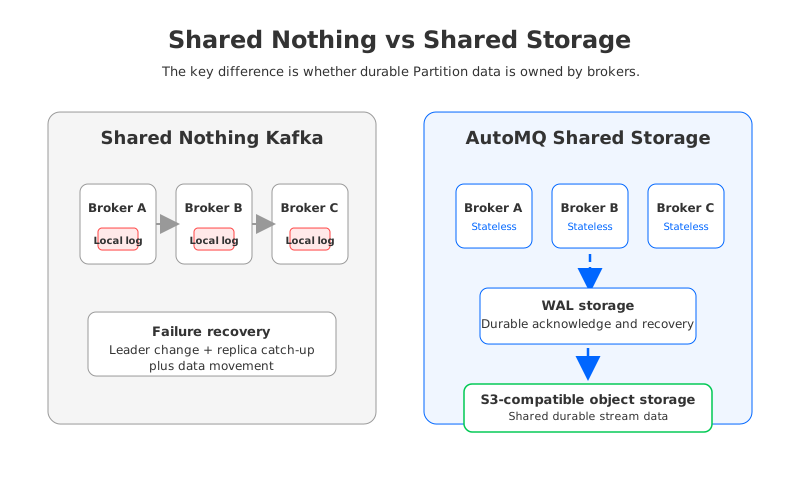
The choice depends on which constraint is actually hurting production. If the issue is long historical retention, Tiered Storage may be the right incremental step. If the issue is operational ownership, a managed service may fit. If the issue is that every failure, scale event, and cost review eventually becomes a broker-local storage conversation, the architecture itself is the object of evaluation.
4Evaluation Checklist for Platform Teams
A useful checklist does not start with vendor features. It starts with the invariants your Kafka estate cannot break. Existing producers and consumers may depend on Kafka protocol behavior, idempotent producers, transactions, compaction, consumer group rebalancing, Kafka Connect, Schema Registry, and monitoring conventions. A platform that looks attractive at the storage layer can still fail the evaluation if the application surface changes in ways the organization cannot absorb.
Use the following matrix to separate durability, operations, and migration concerns:
| Evaluation area | Question to ask | Failure mode it exposes |
|---|---|---|
| Kafka compatibility | Which client versions, APIs, transactions, offsets, and tools must work without application rewrites? | A storage migration becomes an application migration. |
| Write-path durability | What has to happen before a produce request is acknowledged? | Durable bytes exist, but acknowledged records are hard to recover consistently. |
| Scaling behavior | Does scale-out require moving Partition data, or only changing ownership and traffic placement? | Capacity arrives after the incident has already peaked. |
| Cost model | Which costs scale with writes, reads, retention, replicas, and cross-zone placement? | The design is available but economically hard to run. |
| Governance boundary | Where do data, credentials, telemetry, and control actions live? | Security approval blocks the platform after technical validation. |
| Migration and rollback | Can offsets, consumer groups, and producer cutover be validated before production switch? | Rollback becomes a second unplanned migration. |
| Observability | Can SREs see broker, storage, cache, object storage, and client behavior together? | The team cannot tell whether a symptom is compute, storage, network, or client driven. |
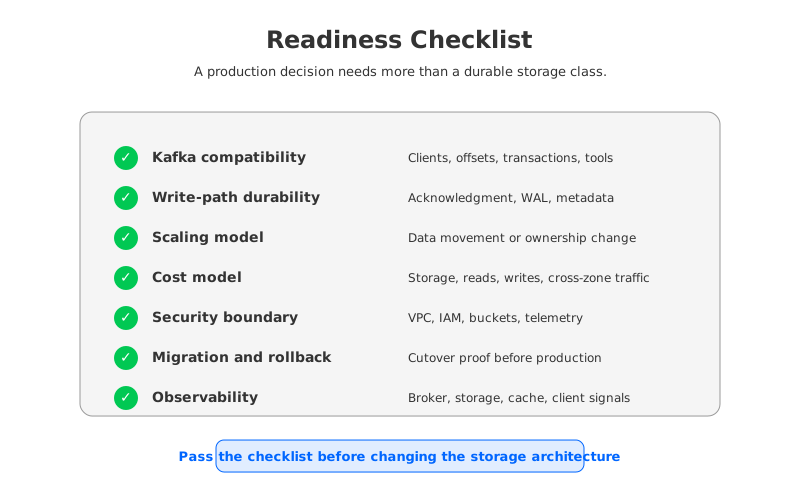
This checklist also prevents a common shortcut: assuming that object storage durability automatically solves Kafka durability. Object storage is a strong foundation for durable data, and AWS documents durability characteristics for S3 storage classes. But Kafka operators still need a write-ahead path, metadata consistency, leader coordination, read caching, consumer offset handling, and operational tooling. The production design lives in how those pieces fit together.
5How AutoMQ Changes the Operating Model
At this point, AutoMQ becomes relevant as an architecture category, not as an opening pitch. AutoMQ is a Kafka-compatible cloud-native streaming platform that keeps the Kafka protocol and ecosystem while replacing Kafka's broker-local log storage with S3Stream, WAL storage, and S3-compatible object storage. Its core bet is that a streaming platform built for cloud operations should separate compute from durable storage.
In AutoMQ's Shared Storage architecture, AutoMQ Brokers are designed as stateless brokers. They handle Kafka protocol requests, Partition leadership, scheduling, caching, and traffic, while durable data is stored through S3Stream. The write path uses WAL (Write-Ahead Log) storage for durable acknowledgment and recovery, then persists stream data into S3 storage. The object store is not a passive archive bolted onto the side of Kafka. It is the primary shared storage layer behind the streaming log.
That design changes several production behaviors. Scaling a broker fleet no longer has to mean copying large amounts of Partition data from one broker's local disk to another. A failed broker is less likely to become a storage reconstruction project. Self-Balancing and Seconds-level partition reassignment become possible because the control problem shifts toward ownership, leadership, and traffic placement. For teams that run in cloud environments, the same shift can reduce cross-Availability Zone data movement pressure because durable data is not maintained through broker-to-broker replica copies in the same way as Shared Nothing Kafka.
There is still engineering work to do. WAL type matters. AutoMQ Open Source uses S3 WAL, which is simpler to deploy but has different latency characteristics from Regional EBS WAL or NFS WAL available in AutoMQ commercial editions. Teams still need to test their own producers, consumers, transactions, Connect workloads, security model, and observability stack. The architectural advantage is not that evaluation disappears. It is that the evaluation can focus on workload behavior instead of spending most of its energy on broker-local data movement.
The deployment boundary also matters for governance. AutoMQ BYOC is designed for environments where the control plane and data plane run inside the customer's own cloud account and VPC. AutoMQ Software targets private data center or IDC deployments. For regulated teams, this is not a small detail. The durability conversation often reaches security review quickly: who controls the bucket, who can access credentials, where telemetry goes, how upgrades happen, and what happens during incident support. A storage architecture that reduces operational burden but fails the governance boundary is still not production-ready.
Migration should be treated as a controlled proof, not a leap of faith. Validate client compatibility first. Then test dual-running or linking behavior, consumer group progress, offset preservation, cutover sequencing, rollback triggers, and observability under replay. AutoMQ Kafka Linking can be evaluated for zero-downtime migration scenarios where byte-level message synchronization and offset consistency matter, while open-source migrations can use ecosystem tools such as MirrorMaker2 where their behavior fits the workload. The right migration plan is the one that makes rollback boring.
The original search query was about storage class durability. The production answer is broader: durable storage is necessary, but a Kafka platform earns trust by making failure recovery, scaling, governance, and migration predictable. If your current cluster makes every durability discussion end in broker disk sizing, replica traffic, and data movement windows, test a Shared Storage architecture against the failure modes your team actually carries. You can start with the AutoMQ deployment and architecture paths from the AutoMQ Console.
6FAQ
6.1Is storage class durability enough for Kafka data durability?
No. Storage class durability describes how a storage service protects bytes. Kafka data durability also depends on acknowledgment settings, leader and follower behavior, offsets, transactions, metadata, retention, and recovery procedures. Treat the storage class as one layer in the durability model.
6.2Does Kafka Tiered Storage make brokers stateless?
No. Kafka Tiered Storage offloads older completed log segments to remote storage, but the active hot tier remains broker-local. It is valuable for long retention pressure, but it is not the same as a Shared Storage architecture with stateless brokers.
6.3When should a team evaluate AutoMQ?
Evaluate AutoMQ when Kafka compatibility is required but broker-local storage is creating recurring problems around scaling, recovery time, cross-zone traffic, retention cost, or migration risk. The strongest proof is a workload-level test using your producers, consumers, offsets, security rules, and observability tools.
6.4What should be tested before migration?
Test client compatibility, produce acknowledgments, consumer group progress, offset behavior, transactional workloads, Kafka Connect jobs, ACLs, monitoring, failure recovery, rollback, and cost behavior under realistic traffic. A migration plan is incomplete until rollback has been tested.
7References
- Apache Kafka documentation: https://kafka.apache.org/documentation/
- Apache Kafka KRaft documentation: https://kafka.apache.org/43/operations/kraft/
- AutoMQ architecture overview: https://docs.automq.com/automq/architecture/overview?utm_source=blog&utm_medium=reference&utm_campaign=storage-class-durability-kafka
- AutoMQ WAL storage: https://docs.automq.com/automq/architecture/s3stream-shared-streaming-storage/wal-storage?utm_source=blog&utm_medium=reference&utm_campaign=storage-class-durability-kafka
- AutoMQ S3 storage: https://docs.automq.com/automq/architecture/s3stream-shared-streaming-storage/s3-storage?utm_source=blog&utm_medium=reference&utm_campaign=storage-class-durability-kafka
- AutoMQ migration overview: https://docs.automq.com/automq-cloud/migrate-to-automq/overview?utm_source=blog&utm_medium=reference&utm_campaign=storage-class-durability-kafka
- AWS S3 data durability: https://docs.aws.amazon.com/AmazonS3/latest/userguide/DataDurability.html
- AWS S3 storage classes: https://aws.amazon.com/s3/storage-classes/
- AWS EC2 on-demand pricing and data transfer notes: https://aws.amazon.com/ec2/pricing/on-demand/


