
Table of Contents
Table of Contents
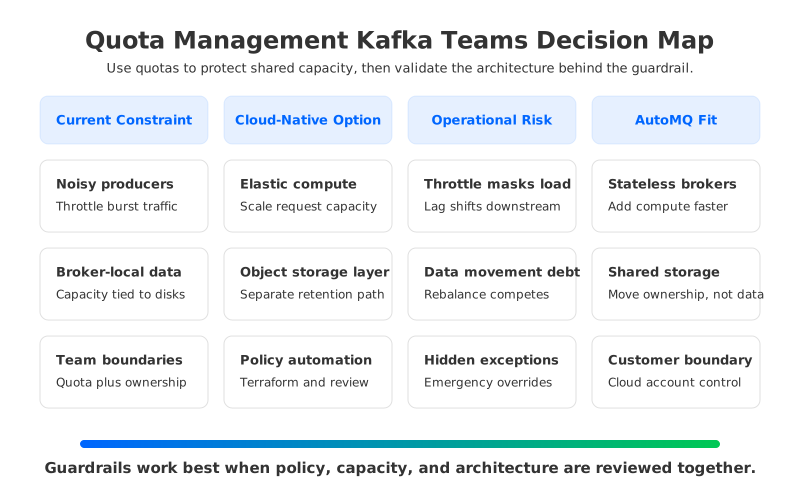
Teams usually search for quota management kafka teams after something has gone sideways. A producer deploy doubled traffic, a replay job crowded out customer-facing consumers, or one tenant turned a healthy Kafka cluster into a negotiation. Quotas look like the answer because they give platform teams a lever: slow the noisy workload before it becomes an incident. The sharper question is whether the quota also fits the architecture, ownership model, and recovery path behind the cluster.
Kafka quotas are useful production controls. Apache Kafka documents quota operations for clients and users, and many teams build workflows around produce throughput, fetch throughput, request percentage, and administrative ownership. But quota management is not a substitute for capacity design. If the cluster couples request handling, local disks, replica movement, and recovery onto the same brokers, a quota policy is only one guardrail layer.
1Why teams search for quota management kafka teams
The search intent is rarely academic. A platform team is usually trying to answer a practical governance question: how do we let many application teams share Kafka without turning every peak, replay, or backfill into a cluster-wide risk? Application teams want enough headroom to ship without waiting for a capacity review. SRE teams want throttling to be predictable, observable, and fair. Finance or platform leadership wants idle capacity and cloud spend to stop growing faster than actual product traffic.
Those goals sound compatible until the first disputed throttle. One team sees a quota as a production safety boundary; another sees it as a hidden product limit. The platform group then has to explain why a tenant was throttled, which resource was protected, and what evidence would justify raising the limit.
That is where quota management becomes an architecture problem. A strong policy has to connect four things:
- Workload identity. Every producer, consumer, connector, and administrative tool needs an owner, an environment, and a clear blast-radius expectation.
- Capacity dimension. The quota should map to the real constrained resource, such as write bandwidth, fetch bandwidth, request rate, connection count, retained storage, or replay concurrency.
- Observability. Teams need metrics that show throttle time, consumer lag, broker saturation, request latency, and tenant-level usage in the same incident narrative.
- Change control. A quota increase should have a review path, a rollback path, and a defined expiration when it is granted for a temporary migration or backfill.
The trap is treating those items as a spreadsheet exercise. They work only when the platform can enforce them without making normal growth painful. If every quota adjustment implies broker resizing, partition reassignment, cross-Availability Zone review, and a rebalance window, teams learn to avoid the process until the next incident.
2The production constraint behind the problem
Traditional Kafka deployments use Shared Nothing architecture: each broker owns local storage for assigned partitions, and replication keeps copies available across brokers. This model is mature and familiar, but it has a direct consequence for quota management. The broker is not only a request processor. It is also a storage owner, replication participant, recovery target, and cost unit.
When a producer exceeds its expected write rate, the immediate symptom may be broker request pressure. Deeper pressure can show up elsewhere. More writes become local log growth, replica traffic, retention pressure, page cache churn, and more work when partitions move. A quota can slow the producer, but the platform team still carries the capacity plan that made throttling necessary.
Consumer-side events create a different version of the same problem. A replay after a downstream outage may be legitimate and time-sensitive. Yet replay traffic competes with live consumers, broker fetch capacity, storage reads, and sometimes cross-zone network paths. If the sole guardrail is "raise the quota when the team asks loudly enough," the platform has not created a policy. It has created an escalation ritual.
The healthier model is to define quotas as contracts between teams and the shared platform. A contract says what a team can do by default, what happens when they exceed it, what metric proves the problem, and what architectural assumption the limit is protecting. This is where architecture decides whether the contract is pleasant or painful to operate.
3Architecture options and trade-offs
Quota management should be reviewed alongside the operating model, not after it. The same tenant limit means different things on a self-managed broker-local Kafka cluster, a managed service, a serverless endpoint, or a Kafka-compatible shared-storage platform. The useful comparison is not "which option has quotas?" Most serious platforms have some form of limit. The useful comparison is what happens when a team needs more capacity, when a tenant creates noisy traffic, or when the cluster has to recover while quotas are still being enforced.
| Option | What improves | What remains hard |
|---|---|---|
| Tune the existing Kafka cluster | Keeps the current client behavior, operational tools, and team knowledge. Quotas, topic ownership, partition design, and better alerts can fix many governance problems. | Broker-local storage and data movement still shape scaling, failover, and rebalance work. Headroom may stay tied to peak traffic rather than actual average demand. |
| Split tenants into more clusters | Reduces blast radius and makes ownership clearer. High-risk workloads can get dedicated capacity and separate incident runbooks. | More clusters mean more upgrades, monitoring surfaces, access policies, and idle capacity. Fragmentation can become its own platform tax. |
| Move to a managed Kafka service | Reduces some infrastructure operations and gives the team a service boundary for broker lifecycle work. | Published service limits, network placement, feature support, and cost units become architecture inputs. Quota changes may depend on provider-level constraints. |
| Evaluate Kafka-compatible shared storage | Preserves the Kafka-facing application model while changing the relationship between brokers and durable data. | Teams must validate compatibility, storage behavior, observability, migration tooling, and rollback before production cutover. |
This matrix keeps the discussion honest. Many teams should start by fixing ownership, dashboards, topic hygiene, and client behavior before changing infrastructure. Quotas are often poorly managed because no one owns the tenant contract. But when governance problems keep pointing back to slow scaling, broker-local data movement, high idle headroom, or fragile recovery windows, architecture deserves a closer look.
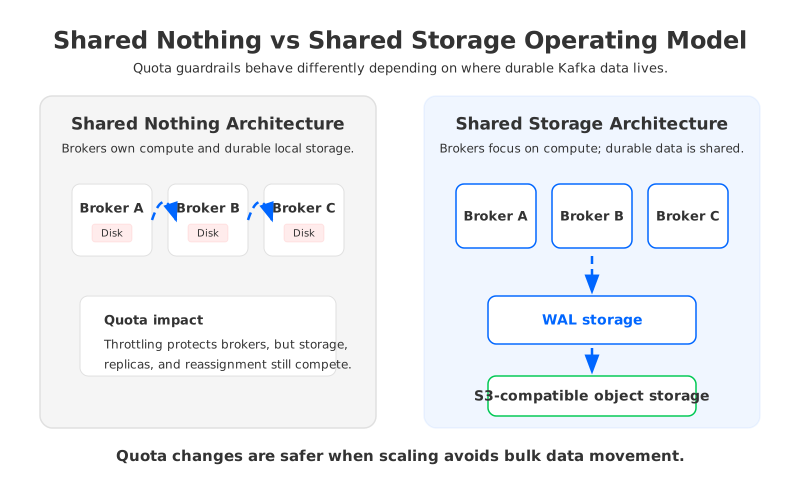
The distinction matters because quotas shape behavior during stress. A limit that is acceptable during steady state can be damaging during recovery if it delays critical replay. A generous limit for one team can become unfair if every other team funds idle capacity.
4Evaluation checklist for platform teams
Before changing quotas or choosing a different streaming platform, review the decision as a production system. A quota is not complete until it has a resource, owner, signal, and rollback path. That prevents the common failure mode: a limit that exists in configuration but not in the operating model.
Start with compatibility. Kafka workloads are not only producers and consumers. They may depend on Admin APIs, transactions, idempotent producers, offset behavior, Kafka Connect workers, Kafka Streams applications, Schema Registry integrations, ACLs, quotas, compaction, and monitoring conventions. The official Apache Kafka documentation is the baseline for understanding these semantics. A replacement or major operating-model change should be tested against the actual client libraries and administrative workflows in use, not against a demo topic.
Then map cost and capacity to workload shape. Team-level quotas should distinguish between steady write volume, burst write volume, read fanout, replay demand, retained data, connection count, and administrative activity. These dimensions behave differently. A service with low average ingest can still be expensive or risky if it keeps long retention and performs large replays. A platform with modest storage needs can still hit broker pressure if many consumers fetch the same hot partitions.
Security and governance need the same level of specificity. Quotas should align with identity, network, and audit boundaries. A platform team should be able to answer who can request a quota increase, which principal or service account is affected, which topics and consumer groups are in scope, and whether the change requires security review. The goal is not bureaucracy. The goal is to keep emergency exceptions from becoming invisible permanent policy.
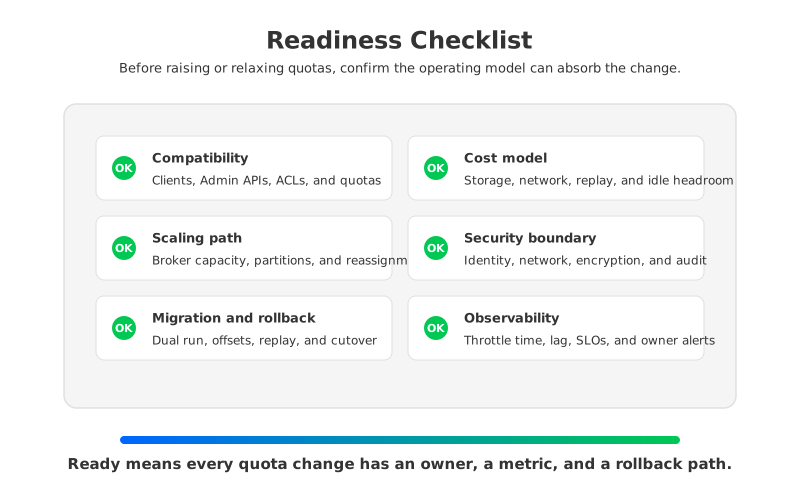
A practical readiness review can use these questions:
- Compatibility: Which clients, protocols, Admin APIs, ACLs, quota operations, and ecosystem tools must behave the same after the change?
- Scaling: If a tenant doubles traffic, does the platform add request capacity without moving large amounts of durable data?
- Cost: Which cost driver is the quota protecting: compute, local disk, object storage, network transfer, replay load, or support time?
- Failure recovery: During broker failure, AZ impairment, or downstream outage, which quotas stay fixed and which have an emergency override?
- Observability: Can an application team see whether it is throttled, whether lag is its own fault, and whether the platform is saturated?
- Migration and rollback: If the quota model changes during migration, can teams dual-run, compare offsets, and return to the previous path?
The answer does not have to be perfect on the first pass. It does need to be explicit. Vague quota policy creates two bad outcomes at once: application teams distrust the platform, and platform teams still carry the risk.
5How AutoMQ changes the operating model
Once a team has done the neutral evaluation, AutoMQ becomes relevant as a Kafka-compatible streaming platform built around Shared Storage architecture. AutoMQ keeps Kafka protocol and ecosystem compatibility as the application-facing contract, while replacing the broker-local storage model with S3Stream, WAL storage, and S3-compatible object storage. In practical terms, AutoMQ Brokers focus more on request handling, leadership, caching, and coordination, while durable stream data is stored outside broker-local disks.
That architectural shift changes quota management in three ways. First, scaling compute is less entangled with moving durable data. When brokers are stateless with respect to persisted log ownership, adding or replacing broker capacity can focus on traffic and metadata rather than copying partition data from one local disk estate to another. This matters when a quota review concludes that the right answer is more capacity, not a lower limit.
Second, team-level guardrails can be paired with a clearer storage model. WAL storage handles durable write acknowledgment and recovery buffering, while object storage acts as the primary data repository. The important point for quota management is that compute, write durability, retention, and catch-up reads can be reasoned about as separate concerns rather than one broker-local bundle.
Third, the operational surface can become more automation-friendly. AutoMQ documents Self-Balancing for continuously rebalancing traffic across brokers, and the broader product model includes AutoMQ Console, Terraform-oriented workflows, monitoring, Self-healing, and customer-controlled deployment boundaries through AutoMQ BYOC and AutoMQ Software. That does not remove the need for quotas. It changes what quotas are protecting. Instead of compensating for every slow data movement path, quotas can focus more directly on fairness, workload isolation, and SLO protection.
AutoMQ should not be evaluated as a bypass around governance. Platform teams still need topic ownership, service-account discipline, alert thresholds, runbooks, and change review. A Kafka-compatible architecture can reduce friction, but it cannot decide which team deserves a larger replay window or owns a business-critical freshness SLO.
6A migration scorecard for quota guardrails
For teams considering a move from broker-local Kafka operations to a cloud-native Kafka-compatible model, quota management is a useful migration test because it touches clients, operations, cost, and governance at once. Pick one important workload rather than a synthetic benchmark. Include a normal produce path, a burst, a consumer replay, an administrative change, and a failure drill. Then compare the old and target platforms against the same questions.
| Scorecard item | Pass condition |
|---|---|
| Client behavior | Producers, consumers, AdminClient tools, and automation scripts behave as expected under normal and throttled traffic. |
| Quota visibility | Application teams can see throttle symptoms, quota ownership, and the path to request a change. |
| Capacity response | Approved capacity increases do not require disruptive bulk partition movement. |
| Replay safety | Backfills and recovery reads have a policy that protects live traffic without blocking urgent recovery. |
| Cost accountability | The team can explain which cost drivers change when quotas are raised, relaxed, or split by workload class. |
| Rollback | The migration plan preserves offsets, ownership data, and a way to return if client behavior diverges. |
Quota management is a good forcing function because it exposes vague platform promises. If a platform says it is elastic, ask what happens when a tenant needs a temporary write increase. If it says it is compatible, test quota-related Admin APIs and client behavior. If it lowers operational work, run the failure drill where a broker disappears while one team replays and another serves live traffic.
Back at the moment that triggered the original search, the goal was never a prettier quota file. It was a production system where shared Kafka capacity can be governed without slowing every team down. If your current model already provides that, keep tuning it. If broker-local storage and data movement keep turning quota reviews into capacity incidents, evaluate a shared-storage Kafka-compatible path with your own workload: review AutoMQ deployment options and test the guardrails before the next disputed throttle.
7FAQ
7.1What is the most common mistake in Kafka quota management for teams?
The common mistake is treating quotas as isolated configuration values. Production teams need to connect each quota to an owner, a workload class, a constrained resource, an alert, and a review process.
7.2Should every team get its own Kafka cluster instead of shared quotas?
Not always. Separate clusters can reduce blast radius, but they also increase operational work and idle capacity. Shared clusters can work well when ownership, observability, and quota policy are mature.
7.3How do quotas relate to Kafka compatibility?
Quotas are part of the operational behavior many platform teams depend on. When evaluating a Kafka-compatible platform, test the client, Admin API, security, monitoring, and automation paths that your teams use to manage quotas.
7.4Does Shared Storage architecture remove the need for quotas?
No. Shared Storage architecture can reduce the operational cost of scaling and recovery, but teams still need quotas for fairness, workload isolation, and SLO protection.


