
Table of Contents
Table of Contents
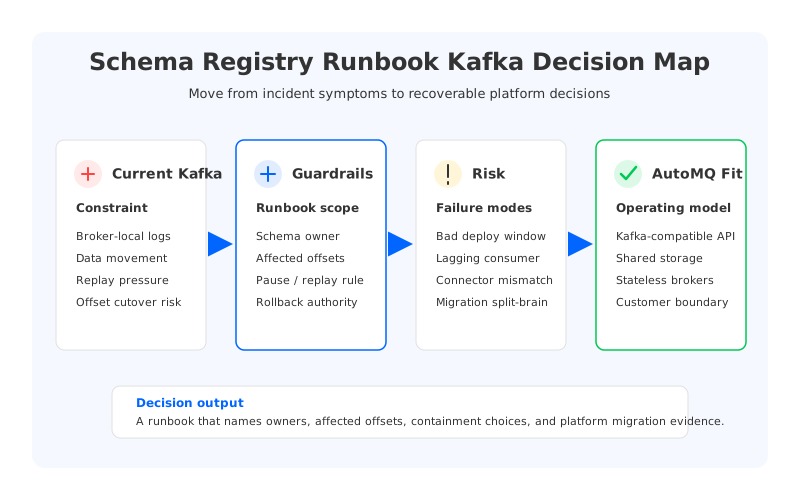
Teams search for schema registry runbook kafka when the schema registry has already become part of production risk. A producer release can pass CI and still break a consumer that reads older offsets. A connector can serialize valid records and still write the wrong subject name. A rollback can restore application code while leaving incompatible records in Kafka. The registry is the visible tool, but the incident usually spans clients, topics, offsets, serializers, Kafka Connect jobs, and the platform that must keep serving traffic while the team repairs the contract.
A useful runbook does more than list commands for checking schema IDs. It protects the path from a proposed schema change to a production record and then to every downstream reader that may replay that record later. That path crosses team boundaries: application teams own producer code, platform teams own Kafka, data teams own sink behavior, and SREs own the incident clock.
The guardrail view is stricter than a checklist of registry settings. It asks what must remain true during a bad deploy, a failed migration, a lagging consumer, or a broker replacement. If the runbook cannot say who owns the next decision and which system is authoritative, it will help people observe the failure but not contain it.
1Why teams search for schema registry runbook kafka
A schema registry runbook usually starts as an operational note: where to find the registry endpoint, how to inspect a subject, how to test compatibility, and how to roll back a producer. That is enough for a small team with a few topics. It breaks down when Kafka becomes shared infrastructure and schema changes are part of release flow, incident response, and migration planning.
The hard part is that schema errors are rarely isolated. A producer may publish records with a valid schema ID, but a downstream consumer may depend on a semantic meaning that the compatibility rule cannot infer. A Kafka Connect sink may fail only when a field reaches a warehouse type boundary. A stream processor may keep consuming from a Consumer group while writing partial output. By the time the registry appears in the incident channel, the record may already be durable, replicated, retained, and visible to several teams.
Start from four production questions:
- What changed? Identify the producer version, schema subject, schema version, topic, partition, offset range, serializer, and deployment window.
- Who is exposed? Name the Consumer groups, connectors, stream processors, table writers, and audit paths that may read the affected records.
- What can be stopped safely? Decide whether to block new writes, pause a connector, isolate a consumer, or route records to an error topic.
- What is the recovery point? Pick the offset, schema version, table commit, or deployment artifact that can become the basis for replay or rollback.
Those questions turn a registry runbook into a Kafka production runbook. The registry stores schemas and compatibility rules, but Kafka stores the recovery facts: topics, offsets, partitions, committed progress, and durable records.
2The production constraint behind the problem
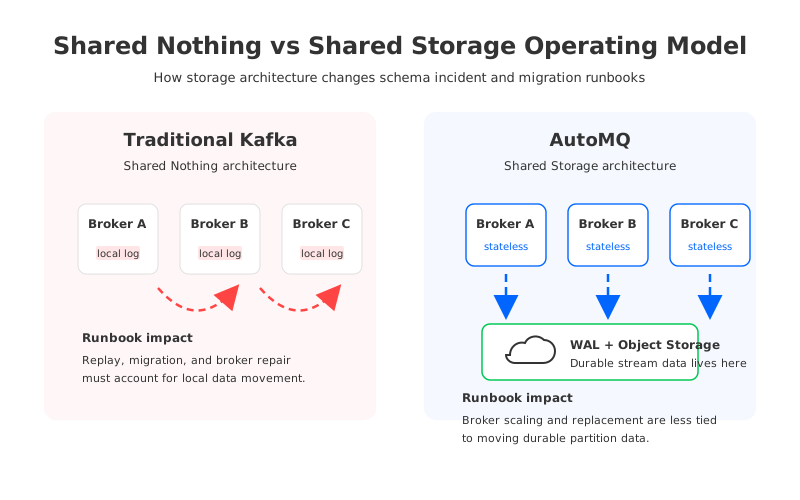
Traditional Kafka uses Shared Nothing architecture. Each broker manages local persistent storage, and partitions are placed on brokers with replication across broker nodes for availability. This model is proven and widely understood. It also means that many operational actions are tied to broker-local data: capacity planning, partition reassignment, broker replacement, catch-up reads, and recovery after failures.
Schema registry incidents put pressure on that model because recovery often requires old and new data to be handled at the same time. A team may need to replay a window after fixing a consumer, keep live producers writing, pause a sink, and inspect older records for the schema version that caused the break. If broker disks are already hot or a cluster is mid-rebalance, a schema incident becomes a storage incident as well.
The same coupling appears during migration. Moving a Kafka estate involves more than copying topic data. Teams must carry producer and consumer behavior, offset progress, subject naming rules, access control, connector configuration, dashboards, and rollback authority. When durable data is tied to broker placement, migration planning has to account for data movement and traffic shape in addition to application compatibility.
Tiered Storage helps with historical data economics by moving older segments to remote storage while brokers keep serving active data. It is a useful option for many Apache Kafka deployments. It does not make active brokers stateless, and it does not remove the need to validate registry behavior, offset continuity, Consumer group recovery, connector state, and rollback.
The useful platform question is: can the streaming layer keep recovery predictable when schema, offset, storage, and ownership decisions collide?
3Architecture options and trade-offs
Most platform teams face three practical options. They can harden the current Kafka deployment and keep the schema registry as a separate governance service. They can move more validation into CI, producer libraries, or connector workflows. Or they can evaluate a Kafka-compatible platform whose storage model changes how scaling and recovery behave. The right answer depends on the workload, but the review should use the same evidence for each option.
| Option | What it protects well | What to verify before production |
|---|---|---|
| Existing Kafka plus registry hardening | Familiar client behavior, existing dashboards, and a known release path | Broker storage headroom, replay cost, Consumer group recovery, and schema rollback procedure |
| Registry plus pipeline controls | Earlier feedback through CI checks, producer validation, connector tests, and error topics | Ownership of semantic changes, sink failure behavior, and how paused jobs resume |
| Kafka-compatible shared storage | Kafka API continuity with a different broker storage model | Client compatibility, operational tooling, security boundary, migration path, and rollback evidence |
The first option is often the right near-term move. A team can get a lot of risk reduction by naming owners for subjects, requiring compatibility checks in CI, testing deserializers against sample payloads, and documenting how to pause high-risk consumers. This is not glamorous work, but it removes the common failure where everyone can see the bad schema and nobody owns the next action.
The second option moves protection closer to release flow. Producer-side checks, contract tests, connector validation, dead-letter routing, and table writer tests catch many mistakes before they become retained records. The trade-off is fragmentation. If every language, framework, and connector expresses the contract differently, the runbook must explain which control wins when they disagree.
The third option matters when operational recovery is constrained by the Kafka storage model. If replay jobs, broker replacement, cross-Availability Zone traffic, or data movement dominate incidents and migrations, registry controls alone will not fix the bottleneck. The evaluation should then include the underlying platform architecture beyond the registry and client settings.
4Evaluation checklist for platform teams
A production runbook should be testable. If a team cannot rehearse a schema incident without improvising ownership, the document is not ready. Use this checklist as a readiness gate before onboarding more teams or migrating a critical workload.
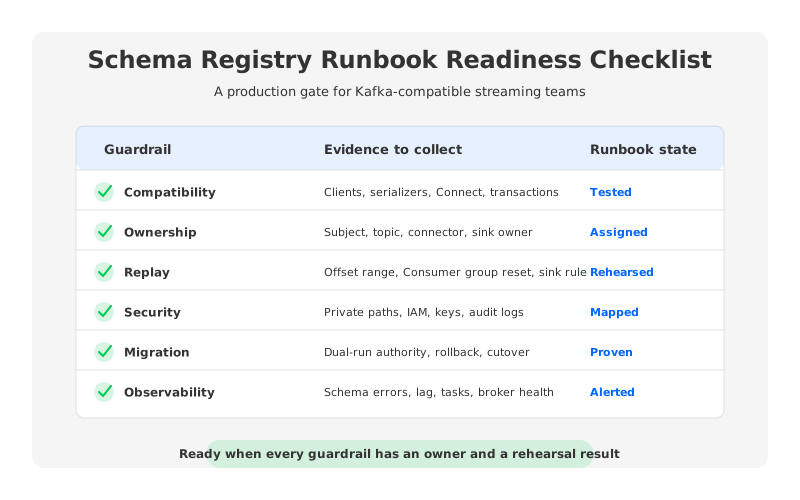
- Compatibility surface: Test the exact producer and consumer clients, serializers, schema registry client behavior, idempotent producers if used, transactions if required, Kafka Connect converters, and Admin API operations. "The producer can write one record" is not enough proof.
- Ownership map: Assign an owner for every subject, topic, connector, stream processor, and sink table. The runbook should say who can approve a breaking change and who can pause or restart each path.
- Offset and replay plan: Record how to identify the affected offset range, how to reset or replay a Consumer group, and how to prevent duplicate sink writes where that matters.
- Cost and capacity boundary: Separate steady-state cost from incident cost. Replay and catch-up reads can stress broker fetch capacity, object-storage reads, sink writes, network paths, and observability systems.
- Security and governance: Map registry endpoints, broker endpoints, object storage, secrets, IAM roles, audit logs, and private network paths. Schema metadata and Kafka data may have different controls.
- Migration and rollback: Define the authority during dual-run: old cluster, new cluster, replicated stream, or sink output. A rollback plan that ignores schema state and offsets is incomplete.
- Observability: Monitor rejected registrations, serialization errors, deserialization errors, producer failure rate, Consumer lag, connector task failures, dead-letter volume, broker health, and object-storage errors in one incident view.
The checklist is intentionally broad because schema incidents are cross-layer failures. A registry can reject an incompatible schema, but it cannot prove that a lagging consumer, a table writer, and a rollback script all agree on the same recovery point.
5How AutoMQ changes the operating model
After the neutral review points to a need for Kafka compatibility plus a different recovery profile, AutoMQ becomes relevant. AutoMQ is a Kafka-compatible, cloud-native streaming platform built around Shared Storage architecture. It keeps Kafka protocol behavior for clients and ecosystem tools while redesigning the storage layer so durable stream data is backed by shared object storage rather than broker-local disks.
This changes the runbook in a specific way. AutoMQ Brokers still handle Kafka-facing compute, request processing, partition leadership, cache, and coordination with the Controller. Durable data is handled through S3Stream, WAL (Write-Ahead Log) storage, and S3-compatible object storage. Because brokers are stateless brokers, replacing or scaling broker compute is less tied to moving partition data. For incident response, that means a schema recovery exercise is less likely to compete with large broker-local data movement.
The storage distinction also affects migration planning. In a traditional Kafka estate, a platform move often requires careful coordination around topic data, offsets, leader placement, replication, and cutover windows. AutoMQ's Kafka Linking is designed to support migration by syncing Kafka data and Consumer group progress while preserving Kafka-facing behavior for applications. A schema registry runbook still needs to validate subjects, serializers, connectors, and sink behavior, but the platform can reduce the amount of broker-local recovery work surrounding the migration.
AutoMQ BYOC matters for teams that want the control plane and data plane deployed inside their own cloud account and Virtual Private Cloud (VPC). Schema governance often has this requirement because schemas, records, object storage, IAM policy, encryption keys, and observability data may all be part of a regulated boundary. AutoMQ Software serves private data center deployments where the same Kafka-compatible operating model is needed outside public cloud.
The product should not replace the schema registry in your mental model. It changes the streaming platform underneath the registry. The registry remains the contract store. AutoMQ changes how Kafka-compatible streams scale and recover when the runbook faces a bad record window, cutover, or failed broker.
6A runbook pattern that survives incidents
Write the runbook around decisions, not screens. Start with detection: which alerts prove a schema problem rather than a broker problem or a sink problem? Then move to containment: whether to stop producers, pause selected consumers, block new schema registrations, or route records to an error topic. After containment, the runbook should name the recovery basis: schema version, application build, offset range, table commit, or connector configuration.
The middle section should be a matrix, not a paragraph. Each row should name a scenario, the owner, the allowed actions, and the rollback rule. For example, an incompatible producer release may be owned by the application team, but pausing a shared sink connector may require platform approval. A malformed record in a low-risk topic may go to an error topic, while the same issue in a regulated audit stream may require a formal replay record.
End the runbook with a rehearsal schedule. Pick one topic and run a controlled schema failure. Publish a rejected schema in staging. Publish a compatible but semantically dangerous change and verify that contract tests catch it. Pause a consumer, create lag, fix the reader, and replay a bounded offset range. During migration planning, repeat the exercise across both clusters and prove which side is authoritative.
This is where the architecture choice shows up in human terms. A platform team does not need a runbook because Kafka is fragile. It needs a runbook because Kafka is shared, durable infrastructure. Once records are written, the system remembers. The job of the runbook is to make that memory operationally useful rather than operationally dangerous.
7FAQ
7.1Is a schema registry runbook limited to registry configuration?
No. Registry configuration is one part of the runbook. Production recovery also depends on topics, offsets, Consumer groups, serializers, connectors, stream processors, sink systems, and the platform's ability to keep serving traffic during replay or rollback.
7.2What should be tested before a schema registry runbook is trusted?
Test producer registration, compatibility checks, serializer behavior, deserializer failure handling, Consumer group replay, connector pause and resume, dead-letter routing, topic access control, and rollback with real client versions. A staging test should include at least one bad schema and one semantically unsafe but structurally compatible change.
7.3Does Kafka compatibility remove schema migration work?
No. Kafka compatibility reduces application rewrite risk, but teams still need to validate schema subjects, registry endpoints, converters, connector behavior, offsets, ACLs, dashboards, and rollback authority.
7.4Where does AutoMQ fit in schema registry runbooks?
AutoMQ fits when the runbook is constrained by broker-local storage, data movement, replay cost, migration complexity, or cross-Availability Zone traffic. It keeps Kafka-compatible behavior while using Shared Storage architecture and stateless brokers to change the operational profile underneath Kafka.
7.5Should schema registry and Kafka live in the same ownership boundary?
They do not have to be run by the same team, but their incident paths must meet. The runbook should define who owns schema approval, topic ownership, client rollout, connector state, offset recovery, and platform capacity.
When you search for schema registry runbook kafka, the real goal is not a longer document. It is a smaller set of decisions that can be made under pressure. Start with the checklist, rehearse one bad schema window, and then evaluate whether your current Kafka architecture makes recovery predictable. If broker-local storage or migration work is part of the risk, review AutoMQ's cloud-native Kafka architecture with the same runbook in hand.
8References
- Apache Kafka documentation
- Apache Kafka consumer configuration documentation
- Apache Kafka transactions documentation
- Apache Kafka Connect documentation
- Apache Kafka KRaft documentation
- Apache Kafka Tiered Storage documentation
- AutoMQ architecture overview
- AutoMQ compatibility with Apache Kafka
- AutoMQ WAL storage documentation
- AutoMQ zero cross-AZ traffic documentation
- AutoMQ Continuous Self-Balancing documentation
- AutoMQ Kafka Linking documentation


