
Table of Contents
Table of Contents
Teams usually search for encryption key ownership kafka after a review has already become concrete. A security architect is asking whether event data is encrypted with a customer-controlled key. A governance team wants to know where retained records, offsets, schemas, backups, and diagnostic logs live. A Kafka platform owner is trying to answer without turning a security review into a quarter-long architecture archaeology project. The hard part is that "who owns the key?" sounds like a single checkbox, while a production Kafka environment turns it into a chain of storage, network, identity, audit, and recovery decisions.
The useful answer is not "enable encryption at rest." That is table stakes. A production-ready answer explains which party controls the cloud account, which storage systems hold durable data, which key policies apply to each system, what evidence auditors can inspect, and what happens when a broker fails, a key rotates, a region changes, or a migration rolls back. If the platform cannot explain those paths, the encryption setting may be technically real and still fail the governance test.
1Why teams search for encryption key ownership kafka
Kafka concentrates risk because it concentrates business history. A single cluster may carry payments, profile updates, operational telemetry, fraud signals, fulfillment events, and model features. Even when each producer owns only one topic, the platform team owns the shared durability layer underneath all of them. That is why encryption key ownership becomes a platform question rather than a narrow security setting.
The question also arrives with different meanings depending on the reviewer. Security teams may mean key material, rotation authority, and deletion controls. Compliance teams may mean evidence that encrypted data never leaves an approved jurisdiction. Data governance teams may mean the ability to connect topics, schemas, contracts, retention policies, and access reviews. SRE teams may mean whether a key-policy mistake can take down fetches, replays, compaction, or recovery.
Those meanings need to be separated before architecture evaluation starts:
- Control boundary. Which cloud account, virtual network, storage bucket, volume, and operational role can affect Kafka data?
- Cryptographic boundary. Which key service protects data at rest, who can administer the key, and how is rotation validated?
- Operational boundary. Which people or systems can read logs, modify topics, inspect metrics, trigger recovery, or change networking?
- Recovery boundary. If a key is disabled, deleted, rotated, or misconfigured, what exactly fails, and how does the team restore service?
The last boundary is where many designs become uncomfortable. A platform that looks compliant on a diagram may still have broker-local logs, replica copies, snapshots, tiered objects, connector buffers, schema metadata, and diagnostic bundles spread across multiple services. Encryption key ownership has to cover all of them or explicitly exclude them with a defensible reason.
2The production constraint behind the problem
Apache Kafka's original storage model is a Shared Nothing architecture. Each broker owns local log segments for the partitions assigned to it, and replication spreads partition copies across brokers for durability and availability. The official Apache Kafka documentation describes the same core abstractions that matter here: producers append records to topics, consumers read by offset, consumer groups coordinate partition ownership, and broker-side replication keeps partitions available when nodes fail.
That design is proven, but it changes the shape of the security review. Durable data is not one storage pool. It is broker-owned state distributed across disks, replicas, and operational workflows. When the cluster scales, reassigns partitions, rebuilds a replica, or restores after failure, data movement is part of the operating model. The encryption question therefore becomes: which keys protect every place this state can land?
The cost and operations side of the same design also matters. Broker-local storage creates capacity planning pressure because teams must reserve enough disk for retention, replicas, recovery headroom, and traffic bursts. A key-ownership policy that requires dedicated clusters, separate disks, or isolated accounts can multiply that capacity burden. A regulated workload may deserve that isolation, but the decision should be explicit rather than hidden inside a generic "secure Kafka" requirement.
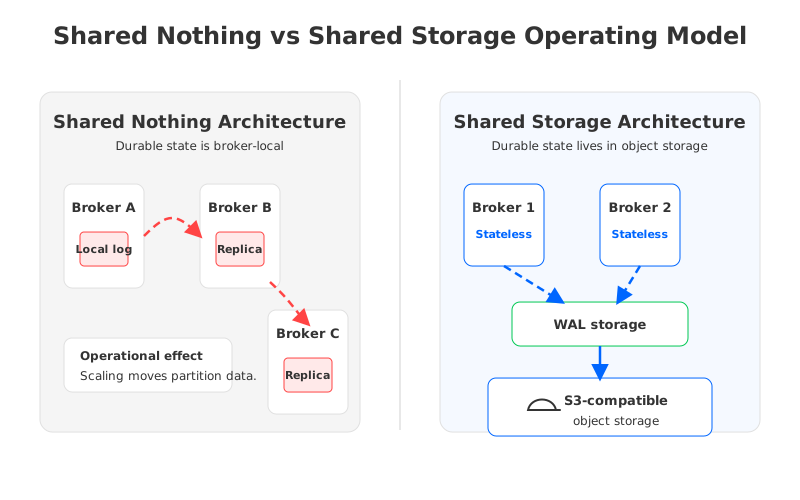
Tiered Storage changes part of this story but not all of it. Apache Kafka's Tiered Storage work moves older log data to remote storage while keeping the broker-centric log as the primary operating model. That can help retention economics, but it also adds another storage location that must be included in encryption, access control, and recovery evidence. For teams asking about key ownership, tiering is not automatically simpler; it can be simpler only if the remote tier, local tier, and control workflows are governed together.
3Architecture options and trade-offs
There are four common paths when encryption key ownership becomes a production gate. None is universally correct. The right option depends on the data classification, latency budget, operating model, and audit evidence required.
| Option | When it fits | Main trade-off |
|---|---|---|
| Self-managed Kafka in a customer account | The team wants full infrastructure control and can operate Kafka deeply. | Strong control, but broker-local storage, scaling, patching, and recovery remain platform responsibilities. |
| Managed Kafka in a provider account | The team prioritizes operational offload over infrastructure ownership. | Less operational work, but data-plane location, key model, telemetry, and support access need careful review. |
| BYOC managed platform | The team wants provider assistance while keeping deployment resources in its cloud boundary. | Better account and network alignment, but control-plane access, key support, and operational roles must be documented. |
| Kafka-compatible Shared Storage architecture | The team wants Kafka semantics with durable data separated from broker lifecycle. | Changes the storage model, so compatibility, latency, object-store behavior, and migration must be validated. |
The most practical way to compare those options is to treat key ownership as a decision map rather than a yes-or-no question. Start with the current Kafka constraint: where does durable state live, and how many copies or tiers exist? Then evaluate the cloud-native option: can durable data be centralized in a storage service whose encryption, IAM, audit, and residency controls already match the enterprise standard? Finally, test the operational risk: what fails when a key policy changes, and who can prove the failure mode?
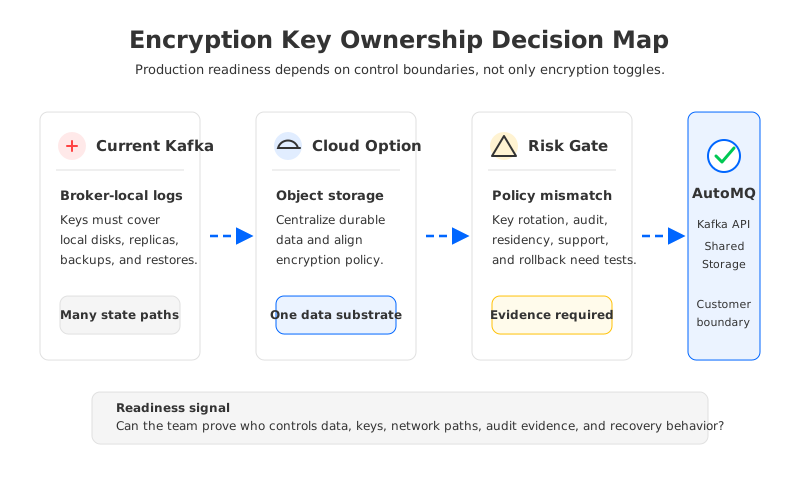
This framing prevents a common mistake: evaluating encryption separately from Kafka behavior. Kafka production readiness also depends on consumer groups, offsets, transactions, Kafka Connect, client compatibility, and admin workflows. A platform can pass an encryption review and still fail the migration if consumers cannot resume correctly, transactional producers behave differently, or connectors require credentials that violate the same governance policy the encryption project is trying to enforce.
4Evaluation checklist for platform teams
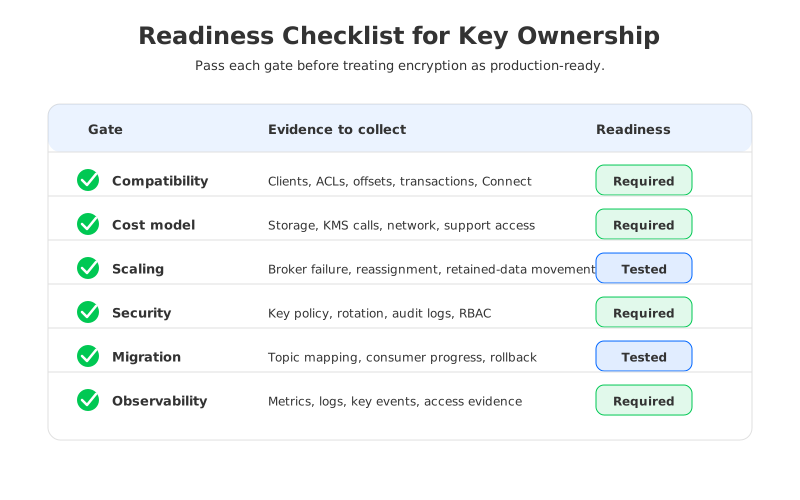
The checklist should be written as evidence requests, not product-feature questions. "Do you support encryption?" is too broad. "Show the storage services that contain durable records, offsets, metadata, connector buffers, logs, and backups; then map each one to an encryption and access-control policy" is closer to production reality.
Use this scorecard before approving a Kafka-compatible platform for regulated workloads:
| Gate | Production-ready evidence |
|---|---|
| Compatibility | Existing clients, serializers, admin tooling, consumer groups, offsets, transactions, and Kafka Connect patterns have been tested against the target platform. |
| Storage boundary | Durable records, metadata, WAL or local log storage, remote tiers, snapshots, and backups are mapped to cloud resources and encryption policies. |
| Key administration | The team knows whether keys are cloud-provider managed, customer managed, or bring-your-own-key, and whether custom key support is available for the specific deployment. |
| Audit evidence | Key usage, role changes, topic changes, ACL changes, support access, and operational actions can be reviewed with timestamps and ownership. |
| Cost model | The model includes storage, KMS or key-service requests where applicable, cross-zone traffic, private connectivity, retention, and migration overhead. |
| Failure recovery | Key rotation, disabled-key scenarios, broker failure, object-store access failure, and rollback paths are tested in staging. |
| Migration safety | Topic mapping, offsets, consumer progress, producer cutover, rollback, and validation windows are documented before production movement. |
The key-administration row deserves special attention. "Customer-owned deployment" and "customer-managed encryption key" are not the same thing. A service may run inside a customer's cloud account while using cloud-provider-managed keys for storage encryption. That can be acceptable for many compliance programs, but it is different from BYOK or customer-managed KMS control. The review should capture the exact model instead of relying on shorthand.
Cloud pricing and network design belong in the same checklist because encryption decisions often change architecture. Private connectivity, regional isolation, dedicated clusters, separate buckets, and extra replication can all affect cost. AWS, for example, documents separate considerations for Amazon S3 server-side encryption, AWS KMS keys, PrivateLink, and data transfer pricing. The article should not turn those pages into a cost estimate, but the platform team should verify the current pricing pages before committing to a design.
5How a Shared Storage architecture changes the operating model
This is where AutoMQ becomes relevant, but only after the control question is clear. AutoMQ is a Kafka-compatible streaming platform that changes the storage layer from broker-local durable logs to a Shared Storage architecture. Its brokers keep Kafka protocol and ecosystem semantics in view, while durable stream data is stored through S3Stream, WAL storage, and S3-compatible object storage.
That architecture changes the security conversation in a specific way. Instead of asking every broker to be a long-lived owner of durable data, the platform can treat brokers as stateless compute units and evaluate durable data primarily through the storage boundary. This does not remove encryption review. It makes the review more concrete: object storage, WAL storage, control-plane metadata, network paths, service roles, and observability data can be listed and tested as separate control surfaces.
AutoMQ BYOC and AutoMQ Software matter because the deployment boundary is part of the governance answer. In AutoMQ BYOC, the control plane and data plane run in the customer's cloud environment, and Kafka business data stays in customer-owned cloud resources. In AutoMQ Software, the deployment runs in the customer's private environment. Those boundaries can help teams align Kafka operations with existing cloud-account, VPC, data-residency, and security-review processes.
The important limitation is equally clear: AutoMQ documentation states that AutoMQ BYOC storage encryption uses cloud vendor storage encryption, and BYOK custom keys are not supported for that BYOC service storage feature. For some teams, cloud-provider-managed encryption is sufficient when combined with customer-owned accounts, network isolation, IAM, RBAC, and audit controls. For others, a hard BYOK requirement may mean the design needs exception handling, product validation, or a different deployment discussion. Production readiness means naming that boundary early.
Shared Storage architecture also changes scaling and recovery risk. In a broker-local model, partition reassignment often implies moving retained data. In AutoMQ's model, durable data is separated from broker lifecycle, so operations such as scaling, Self-Balancing, and partition reassignment can focus more on metadata, traffic, and leadership movement than bulk data copy. That is relevant to key ownership because fewer broker-local state paths make it easier to reason about where encrypted durable data resides.
Migration still needs discipline. AutoMQ Linking is designed for migration scenarios where teams need byte-level data synchronization and consumer progress continuity into AutoMQ. That helps with one of the most sensitive parts of governance migration: proving where consumers resume and how cutover or rollback is controlled. Even then, platform teams should test the exact client versions, authentication modes, ACLs, schema workflows, and connector behavior they run in production.
The cleanest production decision is rarely "choose the platform with the longest security checklist." It is "choose the platform whose data boundary, storage model, and recovery behavior your team can prove under failure." For encryption key ownership in Kafka, that proof is the real deliverable.
If your team is using a key-ownership review to rethink Kafka architecture, evaluate AutoMQ against your own topics, clients, retention profile, and cloud boundary. Start with the architecture and deployment model, then run a controlled compatibility and migration test through AutoMQ.
6FAQ
6.1Is encryption key ownership in Kafka only about KMS?
No. KMS or another key service is only one part of the control model. A production review should also cover storage location, IAM, network paths, backups, support access, audit logs, connector credentials, schema metadata, offsets, and recovery behavior.
6.2Does BYOC automatically mean customer-managed keys?
No. BYOC means the platform runs within a customer cloud boundary or account model, depending on the vendor design. It does not automatically mean BYOK or customer-managed key material. Always verify the exact encryption model for storage, metadata, logs, and backups.
6.3Why does Kafka architecture affect key ownership?
Kafka architecture decides where durable state lives and how it moves. Broker-local storage, replicas, remote tiers, snapshots, and restore paths all need encryption and audit coverage. A Shared Storage architecture can simplify the durable-data boundary, but it still requires explicit review.
6.4What should be tested before approving a Kafka-compatible platform?
Test client compatibility, consumer groups, offsets, transactions, ACLs, Kafka Connect, schema workflows, key rotation or key-policy changes, broker failure, object storage access failure, migration cutover, rollback, metrics, and audit evidence.
7References
- Apache Kafka documentation: https://kafka.apache.org/documentation/
- Apache Kafka KRaft documentation: https://kafka.apache.org/documentation/#kraft
- Apache Kafka Connect documentation: https://kafka.apache.org/documentation/#connect
- AutoMQ architecture overview: https://docs.automq.com/automq/architecture/overview?utm_source=blog&utm_medium=reference&utm_campaign=production-readiness-criteria-encryption-key-ownership
- AutoMQ Kafka compatibility: https://docs.automq.com/automq/architecture/technical-advantage/native-compatible-with-apache-kafka?utm_source=blog&utm_medium=reference&utm_campaign=production-readiness-criteria-encryption-key-ownership
- AutoMQ data encryption at rest: https://docs.automq.com/automq-cloud/manage-security/data-encryption-at-rest?utm_source=blog&utm_medium=reference&utm_campaign=production-readiness-criteria-encryption-key-ownership
- AWS Amazon S3 server-side encryption: https://docs.aws.amazon.com/AmazonS3/latest/userguide/UsingEncryption.html
- AWS KMS keys: https://docs.aws.amazon.com/kms/latest/developerguide/concepts.html#kms_keys
- AWS data transfer pricing: https://aws.amazon.com/ec2/pricing/on-demand/#Data_Transfer


