
Table of Contents
Table of Contents
Teams usually search for governed self service topics kafka after the first self-service portal has already worked. Application teams can request Topics, platform teams can provision them faster than before, and security no longer wants every request to arrive as a ticket. The harder question comes later: which self-service Topics are ready for production traffic, regulated data, replay, incident response, and migration?
Self-service is not the hard part. Kafka already has a clear resource model around Topics, Partitions, Producers, Consumers, Offsets, and Consumer groups. The hard part is proving that a Topic created through a lightweight workflow will behave like a production asset after other teams depend on it. A request form can collect ownership and schema metadata, but it cannot prove that retention is affordable, catch-up reads are isolated, or rollback is tested.
That is why governed self-service is a production readiness program, not a topic-creation feature. The useful question is not "Can a team create a Topic?" It is "Can the platform approve a Topic with enough evidence that the owner, governance function, and infrastructure team understand the blast radius?"
1Why teams search for governed self service topics kafka
The search phrase looks operational, but the pressure behind it is organizational. Platform teams want application teams to move without waiting for Kafka administrators. Data governance teams want schemas, data contracts, ownership, lineage, retention, and privacy controls visible before data enters a shared stream. Security wants least-privilege access and audit evidence. FinOps wants to know why one "small" Topic became a long-retention, high-fanout stream.
Those concerns collide because Kafka topics do not stay small in meaning. A Topic may start as a path between one Producer and one Consumer. Then another Consumer appears, a lakehouse pipeline subscribes, a connector writes to another system, and compliance asks whether records can be replayed for an audit window. The Topic has become a shared production contract, although the original approval may have captured only a name, partition count, and retention value.
Governed self-service should close that gap. The platform should let teams request and manage Topics without granting them broker-level or cloud-infrastructure permissions. At the same time, it should force production-facing questions into the workflow while the change is still reversible. The checklist has to cover both data semantics and runtime behavior:
- Ownership and accountability: Every Topic needs a producer owner, operational owner, and data owner.
- Contract and compatibility: Schema checks help, but governance also needs meaning, privacy classification, compatibility rules, and exception handling.
- Runtime limits: Quotas, Consumer group expectations, replay windows, and lag objectives belong in the approval.
- Infrastructure impact: Retention, fanout, partition count, and catch-up reads affect storage, capacity, and network paths.
- Exit and rollback: A governed Topic needs a way to migrate, pause, quarantine, or retire safely.
Forms collect intent. Production readiness proves whether the platform can enforce and operate that intent.
2The production constraint behind the problem
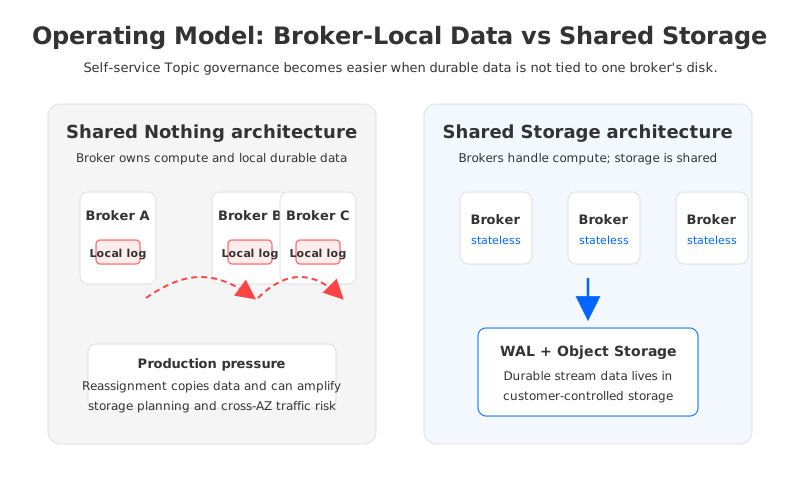
Traditional Kafka turns governance requirements into infrastructure requirements because its storage model binds durable data to brokers. In a Shared Nothing architecture, each broker owns local storage and Kafka uses replication across brokers for durability. That model is well understood, but some governance actions become operationally expensive. Longer retention consumes broker-local storage. More replay paths increase read pressure. More partitions and skewed consumers can require reassignment. Capacity changes can involve data movement, not only compute scheduling.
That does not make traditional Kafka wrong. It means governed self-service has to be honest about what a Topic request implies. Long retention asks for storage headroom. Many Consumers ask for read isolation and observability. A regulated Topic asks security to prove access, audit, and recovery behavior across Producers, Consumers, connectors, and operational workflows.
The cloud adds another layer. Multi-Availability Zone deployments improve resilience, but broker-to-broker replication, client routing, and data movement can create network paths that governance teams rarely see in the Topic request. A platform may approve a Topic for privacy and schema quality while missing the repair or scale-out path.
This is where "self-service" can become a trap. If the portal hides too much infrastructure, requests look low risk and reversible. If the portal exposes every Kafka detail, self-service becomes an admin workflow. Production readiness criteria create a better boundary: application teams specify intent and evidence; platform teams define the operating envelope.
3Architecture options and trade-offs
A governed self-service program can be built on several Kafka-compatible operating models. The right choice depends on control requirements, workload change rate, data sensitivity, and how much ownership the platform team will carry.
| Architecture option | What it solves | Production trade-off |
|---|---|---|
| Add workflow around an existing Kafka cluster | Faster Topic requests, clearer ownership, and basic policy review. | The underlying broker-local storage, reassignment, and capacity model remains the same. |
| Use a managed Kafka service | Reduces broker operations and standardizes many platform tasks. | Data-plane boundaries, network paths, and governance evidence depend on the service model and customer responsibilities. |
| Build a customer-controlled platform | Gives security and platform teams direct control over network, identity, observability, and data residency. | Requires disciplined automation and ongoing operations. |
| Evaluate Kafka-compatible Shared Storage architecture | Changes the relationship between durable data and broker compute. | Teams must validate compatibility, WAL choices, object-storage controls, and migration behavior. |
The useful pattern is to separate semantic governance from infrastructure governance. Semantic governance asks whether the Topic should exist: who owns it, what it means, what data is allowed, which Consumers may read it, and how changes are approved. Infrastructure governance asks whether the platform can operate it: whether storage grows predictably, reads and writes stay within SLOs, repairs are safe, and recovery evidence is available.
Kafka primitives support serious governance, but they do not decide the model for you. Consumer groups coordinate parallel consumption. Offsets define progress. Transactions and idempotent Producers can support stronger write behavior when applications use them correctly. Kafka Connect standardizes integrations, and KRaft handles metadata management in supported Kafka versions. These are building blocks, not a readiness framework.
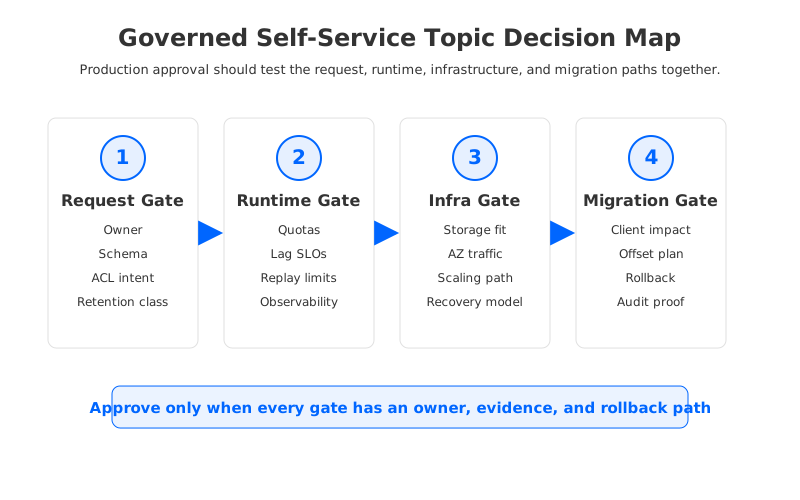
For that reason, the readiness decision should not be a single approval. It should be a sequence of gates that match the lifecycle of the Topic. Request-time governance prevents unsafe topics from being created. Runtime governance watches whether the Topic behaves within the approved envelope. Infrastructure governance verifies that scaling, retention, repair, and failover are sustainable. Migration governance protects the organization when the Topic needs to move, split, merge, or retire.
4Evaluation checklist for platform teams
The evaluation should be concrete enough to reject a Topic request. If every answer can be "yes, eventually," the checklist is too soft. A production gate needs named evidence and named owners.
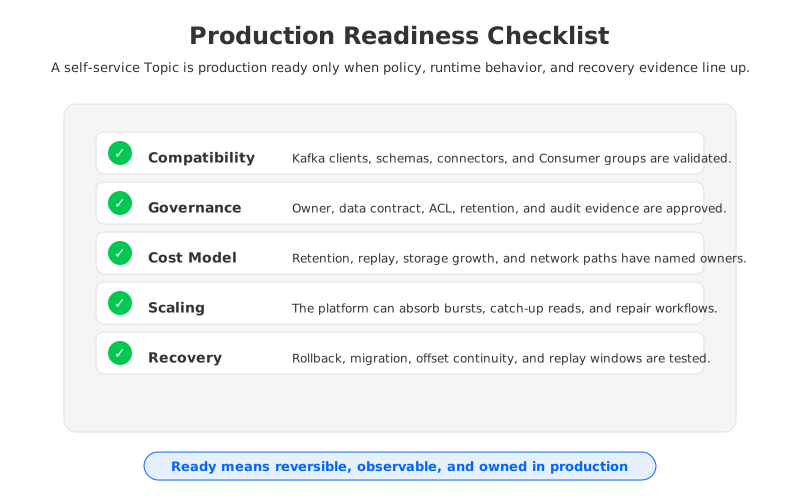
Start with compatibility because it is the fastest way to find hidden migration risk. Existing Producers and Consumers should be tested against the target platform, including authentication, client versions, serialization formats, batching, retries, transactions where used, and Consumer group recovery. Connectors and stream processing jobs need separate validation because they often depend on offsets, task state, schema behavior, and retry conventions.
Governance comes next. A Topic should not enter production without a data contract or equivalent agreement that covers structure, meaning, ownership, compatibility, sensitive fields, retention class, and allowed Consumers. A schema registry can enforce structural compatibility, but it cannot decide whether a field should be present, whether a replay is allowed, or whether a sink system is permitted to store the data.
Cost and capacity should be reviewed before the first long-retention stream lands. Avoid unsupported precision here. The platform team does not need to guess a perfect bill, but it should know the drivers: write throughput, retention, storage, replication, cross-AZ or private connectivity paths, catch-up reads, connector fanout, and headroom. The output should be a range and an owner.
Security and compliance require a runtime evidence model. The platform should be able to answer who changed the Topic, who produced data, which principals consumed it, which contract version applied, and which retention policy was active. Evidence should come from the platform and surrounding systems, not from a spreadsheet assembled after an audit request.
Migration readiness belongs in the checklist even when no migration is planned. A Topic may need to move to another cluster, region, account, or platform. The platform should know how offsets are preserved or translated, how Producers switch, how Consumers resume, and how rollback works if the target path fails.
5How AutoMQ changes the operating model
Once the evaluation reaches storage, scaling, migration, and customer-controlled boundaries, AutoMQ becomes relevant as a Kafka-compatible, cloud-native streaming platform built around Shared Storage architecture. AutoMQ keeps Kafka protocol compatibility while replacing broker-local durable log storage with S3Stream, WAL storage, and S3-compatible object storage. The point is not that architecture replaces governance. The point is that governance stops being forced through a broker-local storage model.
In a governed self-service setting, stateless brokers change the operational conversation. If durable stream data lives in shared object storage, broker replacement, scaling, and partition movement no longer have to be treated as large local-data-copy events. Compute can be adjusted more independently from storage, and long retention is less likely to require permanent broker-local disk overprovisioning.
The deployment boundary also matters. AutoMQ BYOC runs the control plane and data plane in the customer's cloud account and VPC, while AutoMQ Software is designed for customer-operated private environments. For regulated teams, the governance review can include customer-controlled network placement, identity, observability, storage buckets, and operational access.
AutoMQ's broader feature set should be evaluated as part of the same readiness model. Kafka Linking can be reviewed when migration continuity and Consumer group progress matter. Self-Balancing can be reviewed when self-service workloads create uneven traffic or catch-up reads. Table Topic can be reviewed when selected streams should be written into Apache Iceberg tables. These features are operating-model tools, not substitutes for policy.
The practical test is simple: can a platform team approve more self-service Topics without making production risk less visible? If the answer depends on hiding storage growth, replay cost, or migration complexity, the self-service program is moving too fast. If the platform can expose those concerns through clear gates, governed self-service becomes a way to scale responsibility instead of bypassing it.
6A readiness scorecard you can use
A scorecard should force a decision. Use three levels: "blocked," "pilot," and "production." Blocked means the Topic lacks ownership, contract, access control, or rollback. Pilot means it can run with limited blast radius while evidence is collected. Production means it has owners, runtime limits, observability, cost assumptions, and a tested recovery path.
| Readiness area | Blocked | Pilot | Production |
|---|---|---|---|
| Ownership | No accountable owner | Owner named, escalation path incomplete | Owner, operator, and data steward are defined |
| Contract | Schema only or informal agreement | Contract draft with compatibility rules | Contract, exception workflow, and audit evidence exist |
| Runtime | No quota, SLO, or lag expectation | Limits exist but are not tested | Limits are tested and observable |
| Infrastructure | Capacity impact unknown | Capacity range estimated | Storage, network, scaling, and recovery paths are approved |
| Migration | No rollback or offset plan | Manual rollback documented | Migration and rollback are tested for the Topic class |
The scorecard works because it respects how Kafka is used in real organizations. Some Topics are internal, short-lived, and low risk. Others become durable systems of record. Governed self-service should not slow every Topic to the same pace. It should make the risk class visible enough to move low-risk work quickly and hold high-risk work to a higher standard.
If your current Kafka platform makes every governance improvement feel like a storage, scaling, or migration problem, it is worth evaluating whether a Kafka-compatible Shared Storage architecture changes the constraint. For a customer-controlled cloud-native deployment path, start with AutoMQ Cloud and test one governed Topic class against your own compatibility, audit, and rollback criteria.
7FAQ
7.1Are governed self-service Topics the same as Kafka data contracts?
No. A data contract is one part of governed self-service. The self-service program also needs identity, ACLs, quotas, retention policy, observability, recovery, migration planning, and infrastructure ownership.
7.2Should application teams be allowed to create production Kafka Topics directly?
They can, if the platform turns "create" into an approval workflow with clear evidence. Application teams should own intent and data meaning. Platform teams should own the operating envelope, enforcement points, and recovery path.
7.3Does Shared Storage architecture remove the need for governance?
No. Shared Storage architecture changes the infrastructure constraint by separating durable stream storage from broker-local disks. Teams still need data contracts, least-privilege access, audit logs, schema workflows, and operational runbooks.
7.4What is the first readiness gate to implement?
Start with ownership and rollback. If nobody owns the Topic or knows how to reverse a bad change, schema quality and automation will not make it production ready.


