
Table of Contents
Table of Contents
Teams search for post quantum readiness streaming when cryptography stops looking like a security library upgrade and starts looking like a platform migration. A Kafka estate may have TLS, private networking, access control, encryption at rest, Schema Registry rules, and audit logging. That does not prove the estate is ready to change cryptographic assumptions while producers keep writing, Consumers keep replaying, and compliance teams keep asking for evidence. The production question is narrower and harder: can the streaming platform absorb a cryptographic transition without turning every retained event, client dependency, and failover path into a special project?
That question matters because post-quantum readiness is not a single switch. NIST released its first finalized post-quantum encryption standards in 2024, while joint government guidance has emphasized inventory, risk assessment, migration roadmaps, and vendor engagement. Streaming platforms sit in the uncomfortable middle of that work. They are transport systems for live business events, retention systems for historical replay, and integration systems for applications owned by different teams. A change to certificates, key exchange, client libraries, network policy, or storage encryption can touch all three at once.
The useful starting point is not "which algorithm does the broker support?" That answer will keep changing as standards, libraries, cloud services, and client ecosystems mature. Production readiness is the ability to discover cryptographic dependencies, isolate the blast radius, rehearse upgrades, prove rollback, and keep governance evidence attached to the data path. In other words, post-quantum readiness planning is a platform engineering problem before it is a cryptography rollout.
1Why Teams Search for post quantum readiness streaming
The search intent usually comes from a governance gap. Security leaders can produce a policy that says public-key cryptography must be inventoried and migrated over time, but Kafka platform owners have to translate that policy into listeners, certificates, clients, Connect workers, schema workflows, topic ownership, retention rules, and recovery playbooks. The harder the Kafka environment is to operate, the more the cryptography plan inherits unrelated operational debt.
There are four signals that the streaming platform is entering the post-quantum readiness discussion:
- Sensitive streams have a long confidentiality lifetime. If retained records remain valuable for years, "harvest now, decrypt later" becomes a data classification issue rather than a future research topic.
- Client ownership is fragmented. Producers, Consumers, stream processors, and connectors may be upgraded by different teams on different schedules, which makes a coordinated TLS or library change harder than a broker patch.
- Governance evidence is spread across tools. Schema rules, access control, network paths, key management, offset migration, and audit logs often live in separate systems.
- Migration windows are constrained by state. Reassigning partitions, replacing brokers, or changing storage tiers can require data movement that competes with the actual security change.
Kafka is a durable commit log, so readiness also has a time dimension. A database connection pool can be drained and restarted. A streaming platform may have slow Consumers, replay jobs, compacted topics, transactional producers, and Connect offsets that encode a history of operational assumptions. The production plan has to respect those assumptions instead of treating Kafka as a stateless message router.
2The Production Constraint Behind the Problem
Traditional Kafka uses a Shared Nothing architecture: each Broker owns local log segments, and durability comes from replication across Brokers. That model is proven and familiar, but it ties operational change to broker-local storage. When a platform team adds capacity, replaces nodes, shifts partitions, or recovers from failure, it often has to move data or wait for replicas to catch up. Post-quantum planning adds another kind of change pressure on top of that model.
The result is not that Kafka cannot be made secure. Kafka supports TLS, SASL, authorization, transactions, Consumer groups, offset management, Kafka Connect, and KRaft-based metadata management. The problem is that production readiness depends on how quickly the team can change the platform safely when security policy changes. If every readiness drill requires a large reassignment, a long maintenance window, or a separate migration plan for local storage, the cryptographic work slows down.
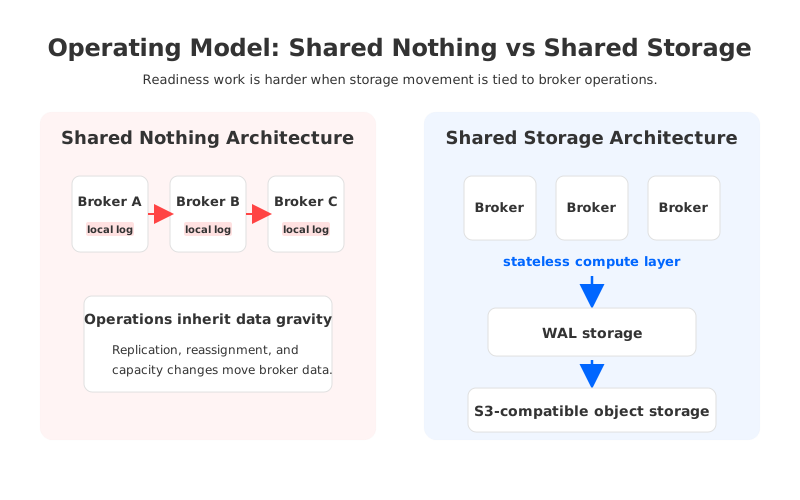
Storage architecture also affects governance boundaries. A broker-local estate forces teams to reason about durable data on many compute nodes, each with its own disk lifecycle, backup pattern, failure mode, and capacity plan. A cloud-managed Kafka service may reduce that workload, but it can also shift readiness decisions to provider-specific roadmaps and exposed controls. Self-managed Kafka keeps control closer to the platform team, but the team owns the full operational burden.
Those trade-offs are normal. The mistake is to score post-quantum readiness as if it were limited to a cryptographic primitive. A platform that can set a stronger algorithm but cannot rehearse client upgrades, isolate a sensitive stream, produce audit evidence, or roll back a bad rollout is not production-ready for the transition.
3Architecture Options and Trade-offs
For Kafka-compatible streaming, platform teams usually evaluate three operating models. The right answer depends on control requirements, team capacity, cost structure, and migration risk.
| Option | What It Preserves | Readiness Risk |
|---|---|---|
| Self-managed Kafka | Maximum configuration control and direct ownership of brokers, clients, and storage. | The team owns upgrades, local storage movement, multi-AZ replication, capacity planning, and evidence collection. |
| Managed Kafka service | Provider-operated lifecycle management, patching workflows, and integrated cloud controls. | Readiness depends on provider roadmap, exposed settings, region support, networking model, and audit scope. |
| Kafka-compatible Shared Storage architecture | Kafka APIs and ecosystem compatibility with durable data separated from broker compute. | Teams must validate compatibility, WAL choices, object storage policy, and operational boundaries for their workload. |
The table should not be read as a product comparison. It is a control comparison. Post-quantum readiness asks which team can make which change, how much data must move, which logs prove the change happened, and what rollback looks like if a client cannot connect. A highly regulated organization may prefer customer-controlled deployment even if it creates more operational responsibility. A smaller team may prefer a managed service if the provider's roadmap, regions, and controls match its policy.
Cloud costs belong in the same evaluation. Object storage pricing, inter-AZ traffic, private connectivity, NAT, load balancers, and Marketplace procurement can all shape the migration plan. The important discipline is to avoid averaging them away. A readiness drill that doubles cross-zone traffic for several days or creates a large temporary storage footprint may look harmless in a security plan and painful in the monthly bill. Use the cloud provider's pricing pages for the specific region and service path before approving the architecture.
4Evaluation Checklist for Platform Teams
A readiness review should be written as a set of production questions, not a list of security slogans. The team should be able to attach evidence to each answer: a configuration export, a metric, a runbook, a test result, a cloud policy, a schema rule, or an incident drill record.
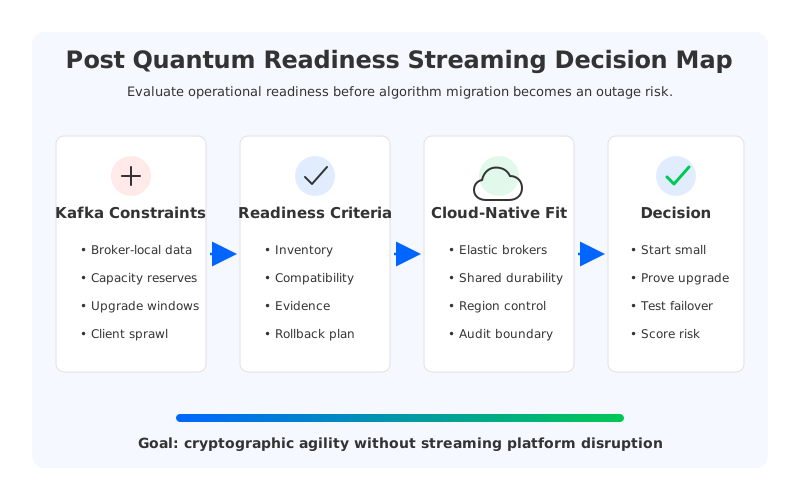
Start with compatibility. Which Kafka client versions are in use? Which producers use idempotence or transactions? Which Consumers rely on offset commits, static membership, or long polling behavior? Which connectors embed their own TLS stacks or dependencies? Apache Kafka compatibility is valuable only if the platform team knows which compatibility surface matters for its applications.
Then inspect the governance layer. Data contracts and schema rules should describe not only field compatibility but ownership, sensitivity, retention expectations, and replay constraints. A schema change and a cryptographic change are different events, but they meet in the same place: a team has to prove which producer wrote which records, which Consumer read them, and which policy protected the path. If governance cannot answer that for one sensitive topic, it will not answer it for 500.
The next checkpoint is operational agility. A readiness drill should include broker replacement, listener policy changes, certificate rotation, client upgrade staging, offset preservation, and rollback. The drill does not need to cover every topic at first. It needs to cover one representative stream deeply enough to expose real dependencies. If the drill passes only because the team picked a low-traffic test topic with no retention and no external Consumers, it did not test production readiness.
Cost and boundary checks follow the same pattern. Who owns the VPC (Virtual Private Cloud), keys, object storage bucket, network endpoints, and monitoring data? Which traffic paths cross Availability Zone boundaries? Which logs leave the customer environment? Which cloud accounts or subscriptions pay for temporary migration infrastructure? These questions may sound like procurement details, but they determine whether the post-quantum plan can pass a security review.
5How AutoMQ Changes the Operating Model
After the evaluation separates cryptographic readiness from ordinary Kafka administration, AutoMQ becomes relevant as a Kafka-compatible, cloud-native streaming platform built around Shared Storage architecture. AutoMQ keeps Kafka protocol and API compatibility while replacing broker-local durable log storage with S3Stream on S3-compatible object storage. WAL (Write-Ahead Log) storage provides the durable write path before data is uploaded to object storage, and stateless brokers reduce the amount of persistent data tied to compute nodes.
That architecture does not make post-quantum cryptography automatic. It changes the operating model around the transition. If durable stream data is stored in shared object storage and brokers are stateless, platform teams can evaluate broker image upgrades, listener hardening, scaling, failover, and replacement with less dependency on broker-local data movement. The readiness drill becomes more about proving compatibility and control boundaries, and less about waiting for storage to follow compute.
AutoMQ BYOC and AutoMQ Software are also relevant to governance because deployment boundaries are part of the security argument. In AutoMQ BYOC, the control plane and data plane run in the customer's cloud account and VPC. In AutoMQ Software, they run in the customer's private environment. For teams that need data residency, network isolation, customer-owned storage, and audit control, those boundaries can be evaluated directly rather than inferred from a shared service model.
AutoMQ features such as Self-Balancing, Kafka Linking, Managed Connector capabilities, Table Topic, and zero cross-AZ traffic patterns should still be evaluated through the same readiness lens. Do they preserve Kafka client behavior? Do they keep offsets and replay paths understandable? Do they improve the evidence trail? Do they reduce data movement during drills? Product capabilities help only when they make the production criteria easier to satisfy.
6Migration Scorecard for a Real Readiness Drill
The most useful post-quantum readiness exercise is small, but not synthetic. Pick one sensitive stream that has real producers, real Consumers, retention, access controls, monitoring, and rollback requirements. Build a scorecard before changing the platform.
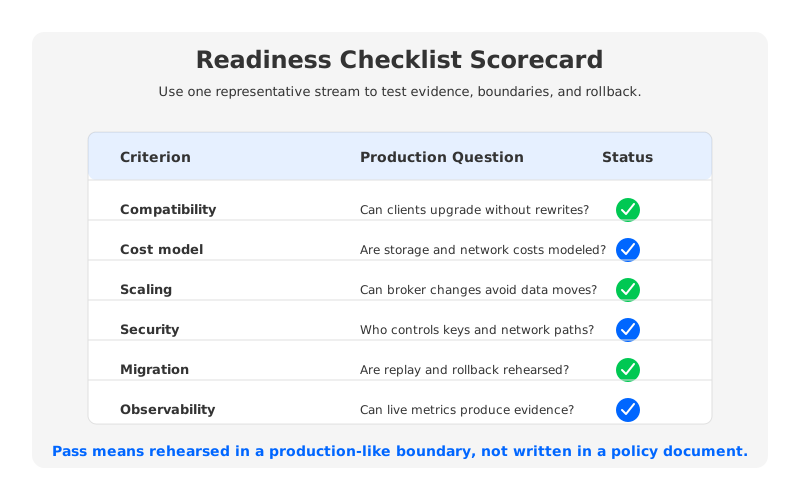
The scorecard should force a decision rather than produce a comforting dashboard. For each criterion, mark one of three states: proven in a production-like drill, partially proven with gaps, or not proven. Avoid "planned" as a pass state. Planning is useful, but auditors and incident responders need evidence.
Use these criteria as a starting point:
- Compatibility: Existing clients, transactions, Consumer groups, Connect jobs, and administrative tools behave as expected during the drill.
- Cryptographic inventory: TLS, certificates, key management, private connectivity, storage encryption, and service identities are mapped for the stream.
- Data governance: Schema rules, ownership, sensitivity labels, retention, and replay permissions are visible in one review.
- Operating agility: Broker replacement, scaling, failover, and rollback can be completed within the platform's service objective.
- Cost exposure: Temporary infrastructure, object storage, private connectivity, and inter-zone traffic are modeled with cloud-provider pricing.
- Evidence: Metrics, logs, configuration history, and change approvals show what changed and when.
This is where many teams find the real work. The missing piece is often not a cryptographic feature. It is an ownerless client, an undocumented connector, a topic with unclear retention, a network path nobody has priced, or an offset migration plan that has never been rehearsed. Those findings are useful because they turn a vague future risk into an actionable platform backlog.
Post-quantum readiness starts as a security concern, but it becomes credible only when the streaming platform can prove how it changes. If your Kafka environment cannot answer these questions for one sensitive stream, start there. If your evaluation points toward Kafka-compatible streaming with customer-controlled boundaries and Shared Storage architecture, use the same scorecard to assess AutoMQ in your own environment: start from the AutoMQ deployment path.
7FAQ
7.1What is post quantum readiness streaming?
Post quantum readiness streaming is the practice of preparing a streaming data platform to adopt post-quantum cryptography as standards, libraries, cloud services, and client ecosystems mature. For Kafka-compatible platforms, it includes cryptographic inventory, client compatibility, governance evidence, migration rehearsal, and rollback planning.
7.2Does Kafka need post-quantum cryptography?
Kafka deployments commonly rely on cryptography through TLS, authentication, certificates, private networking, storage encryption, and administrative access. The immediate production task is not to replace every algorithm at once. It is to inventory cryptographic dependencies and prepare upgrade paths for data and systems with long confidentiality lifetimes.
7.3Is Shared Storage architecture a cryptographic control?
No. Shared Storage architecture is not a cryptographic primitive. Its value for readiness planning is operational separability: durable data is less tied to broker-local disks, so teams can rehearse broker changes, scaling, failover, and rollback with less data movement.
7.4How should platform teams start a readiness plan?
Start with one sensitive stream. Map its clients, TLS configuration, identities, schema rules, retention, object storage, network paths, offsets, Connect jobs, metrics, and rollback plan. Then run a production-like drill and score which controls are proven, partially proven, or not proven.
7.5Where does AutoMQ fit in the evaluation?
AutoMQ fits when teams want Kafka-compatible APIs with a cloud-native Shared Storage architecture and customer-controlled deployment boundaries. It should still be tested against the same scorecard: compatibility, governance, cost exposure, operational agility, evidence, and rollback.
8References
- NIST: NIST Releases First 3 Finalized Post-Quantum Encryption Standards
- NIST: Post-Quantum Cryptography
- Apache Kafka: Official Documentation
- AutoMQ Docs: Architecture Overview
- AutoMQ Docs: Compatibility with Apache Kafka
- AutoMQ Docs: WAL Storage
- AWS: Amazon S3 Pricing
- AWS: AWS PrivateLink Pricing


