
Table of Contents
Table of Contents
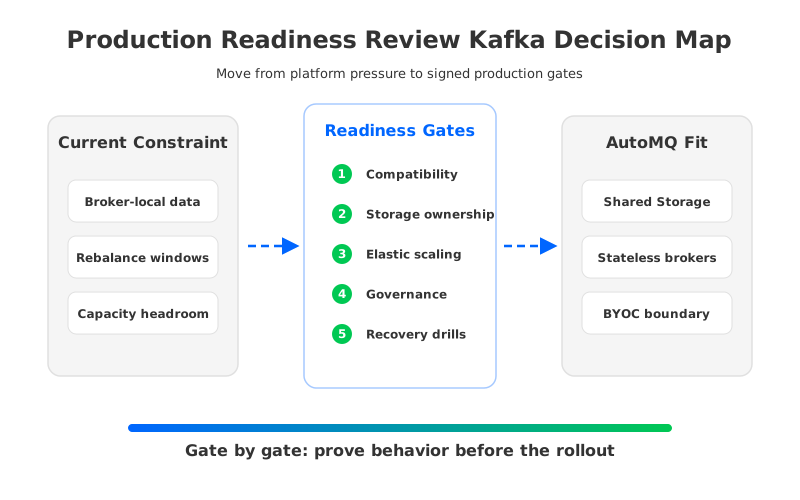
A team searching for production readiness review kafka usually has a launch date, not a curiosity problem. The cluster may already be serving staging traffic. Application owners may be waiting for a migration window. Security may be asking where data lives, finance may be asking why idle capacity is reserved, and SRE may be asking who owns the rollback when consumers fall behind. The useful question is not whether Kafka can run in production. It can. The harder question is whether your Kafka-compatible streaming platform has passed the gates that make production survivable.
That review has to be more specific than a generic checklist. Kafka production readiness depends on the contract between clients, brokers, storage, metadata, networking, and operations. A platform can pass a throughput test and still fail when a broker is replaced, a partition is reassigned, a consumer group resumes from copied offsets, or a governance team rejects the deployment boundary. The gate model in this article treats readiness as a series of decisions: what must remain compatible, what must become more elastic, what must stay under customer control, and what failure behavior the team is willing to own.
1Why teams search for production readiness review kafka
The search term sounds broad because the pressure is broad. A platform team may be evaluating a Kafka-compatible target, moving from self-managed clusters to a cloud-native Kafka architecture, consolidating multiple environments, or preparing a product launch that turns event streaming into a shared dependency. In each case, the review starts with Kafka but quickly expands into capacity planning, incident response, security boundaries, and team ownership.
The first gate is semantic continuity. Producers, consumers, admin tooling, Kafka Connect jobs, stream processing applications, and monitoring scripts depend on Kafka behavior that is easy to take for granted. Consumer groups rely on partition assignment and committed offsets. Idempotent and transactional producers rely on broker coordination semantics. Connectors rely on topic naming, credentials, offset storage, and retry behavior. A readiness review should prove those behaviors with the team's real client versions, not with a synthetic happy path.
The second gate is operational reversibility. A production cutover is not complete when the first record arrives on the target cluster. It is complete when the team can explain how to pause, resume, backfill, promote, downgrade, and roll back without losing the ability to reason about offsets and ownership. That is why a practical review treats migration and day-two operations as the same problem. Both ask whether the platform can preserve the application contract while the infrastructure underneath it changes.
2The production constraint behind the problem
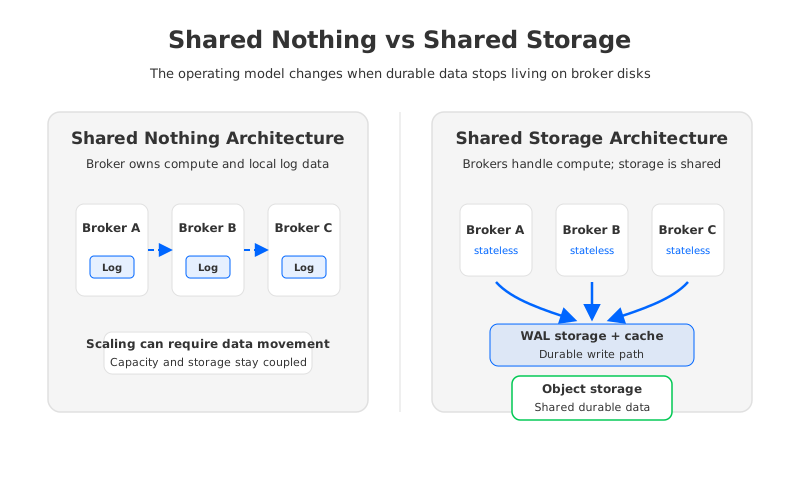
Traditional Kafka's Shared Nothing architecture made sense in the environment where Kafka grew up. Each broker owns local log data, partitions have leaders and followers, and durability comes from replication across brokers. The model is direct and understandable: if data is local to a broker, the broker can serve reads and writes from its disks, and other replicas protect against failure.
Cloud infrastructure changes the economics and the operating shape of that model. Broker-local persistent storage has to be provisioned ahead of demand. Multi-Availability Zone deployments turn replication into network traffic across fault domains. Scaling out or replacing a broker can involve moving retained partition data, not only moving compute. Long retention makes this tension sharper because the data that must be preserved grows faster than the live throughput that needs broker CPU.
The readiness question is not "is Shared Nothing bad?" It is "what production work does this architecture force your team to keep doing?" In a broker-local model, capacity planning, rebalance windows, disk pressure, replica placement, cross-zone traffic, and recovery drills become recurring platform work. Some teams are comfortable with that work because they need the control, have mature Kafka operations, or run in environments where local disks are the natural persistence layer. Others are really trying to operate cloud infrastructure with a storage model that binds durable data to replaceable compute.
That difference matters during incidents. If a broker fails, the team needs to know whether recovery mostly means electing leaders and warming caches, or whether it means rebuilding local replicas and waiting for data movement. If a workload spikes, the team needs to know whether adding brokers relieves pressure quickly, or whether the cluster has to redistribute partitions and data before the added capacity is useful. Production readiness is the gap between the architecture diagram and the pager path.
3Architecture options and trade-offs
The evaluation should compare operating models before comparing product names. Apache Kafka remains the baseline when the team wants full control over the broker, storage, version, and deployment topology. Managed Kafka services reduce some operational burden, but the underlying architecture may still expose teams to broker-local storage planning, traffic placement, and capacity reservations. Kafka-compatible platforms with Shared Storage architecture change the storage premise: the Kafka-facing contract remains familiar, while durable stream data moves into a shared storage layer.
Tiered Storage deserves a separate gate because it is often confused with a fully shared-storage design. Apache Kafka Tiered Storage moves older log segments to remote storage while brokers retain local storage for the active log. That can help with retention-heavy workloads, but it does not automatically make brokers stateless. A readiness review should ask where acknowledged writes become durable, which reads depend on local disks, how metadata is coordinated, and what happens to active partitions during broker replacement.
Use the decision map as a neutral frame:
| Gate | What to prove | Failure if skipped |
|---|---|---|
| Compatibility | Existing clients, Consumer groups, transactions, Connect jobs, and admin workflows behave as expected. | Migration looks complete until one application resumes from the wrong point or one client library hits an unsupported path. |
| Storage ownership | Durable data placement, retention, replay, and deletion are clear. | Storage cost and recovery behavior become surprises after production traffic arrives. |
| Elasticity | Scaling adds useful capacity without long data movement windows. | The cluster has more nodes but the bottleneck remains tied to partition placement. |
| Governance | Network, identity, audit, encryption, and data residency boundaries are explicit. | Security review blocks launch after the technical proof of concept succeeds. |
| Recovery | Broker failure, zone impairment, bad deployment, and rollback drills have documented outcomes. | Incident response depends on tribal knowledge instead of tested procedures. |
The table is intentionally unforgiving. Production readiness is not a single pass/fail event; it is a set of promises that different teams must be willing to sign. Application owners care about offsets and compatibility. SRE cares about recovery and observability. Security cares about identity and data boundaries. Finance cares about reserved capacity, network transfer, and storage growth. A good review gives each group one concrete gate instead of asking everyone to trust a generic platform label.
4Evaluation checklist for platform teams
Start with the workload, then test the platform against it. A representative review should include at least one high-throughput topic, one long-retention topic, one consumer group with strict offset expectations, one connector or stream processing job, one replay drill, and one rollback drill. Toy topics make the checklist look clean because they avoid the exact behaviors that create production risk.
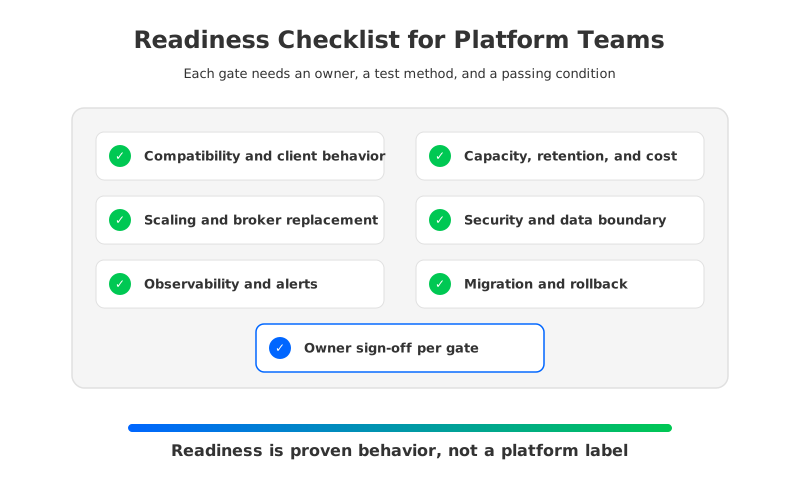
The readiness scorecard should answer these questions before the rollout plan is approved:
- Kafka compatibility: Which client versions, producer settings, transactional paths, Consumer group behaviors, admin APIs, and connector patterns are in scope? The answer should include application-owned clients and automation scripts, not only the libraries the platform team uses.
- Capacity and cost: What is the expected write rate, read fan-out, retention window, partition count, object storage footprint, network path, and compute floor? Avoid a single monthly number until the workload shape is clear.
- Scaling behavior: What happens when brokers are added, removed, isolated, or replaced? The review should distinguish metadata movement, traffic movement, cache warmup, and durable data movement.
- Security and governance: Where do records, logs, metrics, credentials, encryption keys, and control APIs live? A customer-controlled cloud boundary is a design requirement for many teams, not an implementation detail.
- Observability: Which metrics prove producer latency, broker saturation, Consumer lag, storage errors, cache behavior, connector health, and migration progress? A dashboard is not enough if the alert owner cannot explain the next action.
- Migration and rollback: How are topics, offsets, ACLs, schemas, connectors, producers, and consumers moved? What condition promotes the target, and what condition sends traffic back?
That list should become a signed artifact. Each gate needs an owner, a test method, a passing condition, and a known limitation. For example, "Consumer groups pass" is too vague. A better gate says that the payments service resumes on the target cluster from the expected committed offsets after a controlled pause, with duplicate handling confirmed by the application owner. That level of detail feels slower at the beginning, but it prevents the worst kind of migration failure: infrastructure declares success while applications are still negotiating the meaning of progress.
5How AutoMQ changes the operating model
After the neutral gates are written, AutoMQ becomes relevant when the blocker is not Kafka semantics but the operating model around storage, scaling, and customer-controlled deployment boundaries. AutoMQ is a Kafka-compatible streaming platform that keeps Kafka protocol expectations while replacing broker-local durable storage with a Shared Storage architecture. In that model, stateless brokers handle Kafka-facing compute, while S3Stream, WAL (Write-Ahead Log) storage, data caching, and S3-compatible object storage handle the durable storage path.
This shift changes several readiness gates. Broker replacement no longer has to mean rebuilding large broker-local logs. Partition reassignment can focus on leadership, metadata, traffic, and the small amount of data not yet persisted into shared storage. Long retention becomes less tied to provisioned broker disks. Scaling decisions can be framed around live throughput and cache behavior instead of treating every broker as both compute capacity and a long-lived data owner.
The change is architectural, not magical. Teams still need to test latency, WAL choices, cache behavior, object storage access, client compatibility, and failure recovery with their own workload. The value is that the review moves from "how do we keep every broker's local state balanced?" to "how do we prove the shared storage, stateless broker, and Kafka compatibility contract under production drills?" That is a more cloud-native question, and it gives platform teams cleaner ownership boundaries.
AutoMQ BYOC and AutoMQ Software also matter for governance gates. In BYOC (Bring Your Own Cloud), the control plane and data plane run in the customer's cloud environment, so teams can evaluate Kafka-compatible streaming within their own network, identity, audit, and storage controls. AutoMQ Console, Terraform workflows, monitoring integration, Managed Connector, Self-Balancing, Self-healing, and Kafka Linking then become operational mechanisms to test against the readiness scorecard rather than features to accept on faith.
The practical evaluation path is narrow on purpose. Pick one production-shaped workload. Prove Kafka compatibility, storage behavior, scaling, failure recovery, observability, and rollback. Only then expand the migration wave. If the original search was production readiness review kafka, the useful output is not a longer checklist; it is a platform decision that each owner can defend when the cluster is under pressure.
If your readiness review points toward Kafka-compatible streaming with shared storage and customer-controlled deployment boundaries, start with a focused proof of concept through the AutoMQ BYOC evaluation path and test one real workload before widening the rollout.
6FAQ
6.1What is a production readiness review for Kafka?
It is a structured review that proves a Kafka or Kafka-compatible streaming platform can support real production behavior: client compatibility, Consumer group offsets, transactions, storage durability, scaling, observability, security, migration, and rollback. It should use representative workloads and named owners for every gate.
6.2Is Kafka compatibility enough for production readiness?
No. Kafka compatibility lowers application migration risk, but production readiness also depends on storage architecture, operational tooling, failure behavior, deployment boundaries, and team ownership. A compatible API can still fail a recovery or governance gate.
6.3How is Shared Storage architecture different from Tiered Storage?
Tiered Storage typically offloads older log segments while brokers still retain local active logs. Shared Storage architecture makes shared storage central to durable stream storage and allows brokers to operate with far less broker-local persistent ownership. The readiness impact is strongest during scaling, broker replacement, and long-retention planning.
6.4When should AutoMQ be evaluated?
Evaluate AutoMQ when your Kafka production review shows pain around broker-local storage, scaling windows, cross-zone data movement, long retention, customer-controlled deployment boundaries, or migration operations. The right test is a production-shaped workload, not a generic benchmark.


