
Table of Contents
Table of Contents
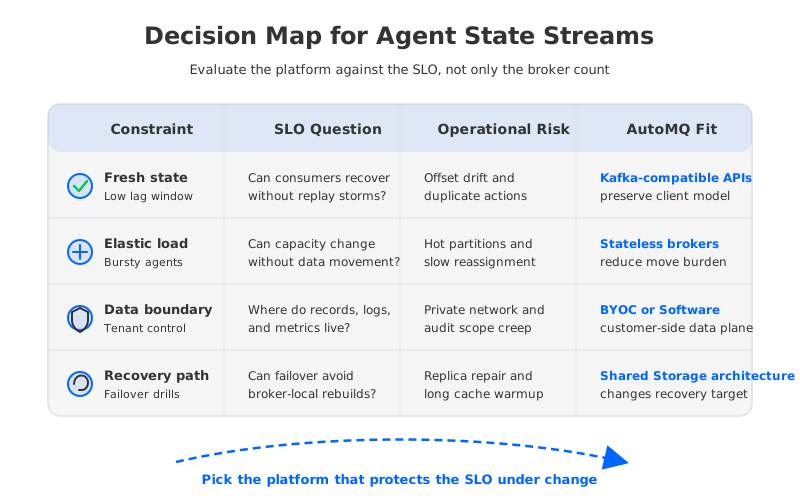
Teams search for agent state synchronization kafka when the prototype has already outgrown the whiteboard. A single agent can keep state in memory, a small group of agents can share a database table, and an early workflow can replay from a queue when something goes wrong. Production is less forgiving. Agents call tools, write intermediate state, revise plans, emit audit events, and hand work to other agents that may be running in another process, zone, or region. The question stops being "Can Kafka carry these events?" and becomes "Can the streaming platform protect the state SLO when the agent fleet changes under load?"
That difference matters because agent state is not ordinary telemetry. A stale tool result can trigger the wrong follow-up action. A duplicate state transition can make a workflow call the same external API twice. A missing offset commit can force a replay that looks harmless to infrastructure but expensive to the business process. For AI platform teams, Kafka-compatible streaming is attractive because it gives them ordered partitions, consumer groups, offsets, transactions, and a mature ecosystem. The hard part is deciding which operating model can keep those semantics usable when the workload becomes bursty and shared.
The practical thesis is simple: agent state synchronization should be evaluated as a production SLO problem first and as a Kafka cluster sizing problem second. Broker count, disk size, and retention settings matter, but they are only inputs. The platform has to preserve freshness, replay safety, cost boundaries, governance, and migration options while agents scale up and down.
1Why teams search for agent state synchronization kafka
The search usually starts with a concrete failure mode. A multi-agent workflow needs a durable event log for plans, tool calls, memory updates, handoffs, and final decisions. Engineers want Kafka because it already models event streams as topics and partitions, lets consumer groups divide work across instances, and gives each consumer a committed position through offsets. Those primitives map well to agent systems: one partition can serialize state transitions for an entity, and multiple consumers can process different entities in parallel.
The friction appears when agent state becomes both hot and durable. The platform must serve fresh events to active agents, hold enough history for replay and debugging, and keep audit trails available for governance. It also has to absorb spiky traffic. A customer support surge, fraud campaign, or batch of documents entering an AI review process can create a short, intense write pattern that is different from a steady analytics pipeline.
For production planning, the most useful questions are specific:
- What is the maximum acceptable freshness gap between an agent action and the next agent that depends on it?
- Which events are idempotent, and which events cause external side effects if replayed?
- How long must state transitions remain queryable for audit, recovery, or model evaluation?
- Which team owns schema changes, topic ownership, Consumer lag, and rollback?
- Can the platform scale for bursts without turning every broker change into a data movement project?
These questions explain why Kafka-compatible streaming sits in the middle of the architecture discussion. The API and semantics are familiar, but the operational burden depends heavily on the storage architecture behind those APIs.
2The production constraint behind the problem
Traditional Kafka runs as a Shared Nothing architecture. Each broker owns local storage for its partitions, and durability is commonly achieved by replicating partition data across brokers. That design has served many production systems well, especially when the workload is stable and the operations team can plan capacity ahead of time. Agent workloads put pressure on the parts of the model that are hardest to change quickly: broker-local storage, reassignment, recovery, and cross-zone data movement.
The issue is not that Shared Nothing architecture is flawed. It is that agent state synchronization tends to combine requirements that amplify each other. Low-latency tail reads push teams toward hot local data. Long audit windows push retention up. Bursty activity pushes compute capacity up and down. Governance pushes the data path into a controlled cloud account or VPC (Virtual Private Cloud). Once those requirements are combined, the streaming platform is no longer a neutral pipe. It becomes the state coordination layer for the agent runtime.
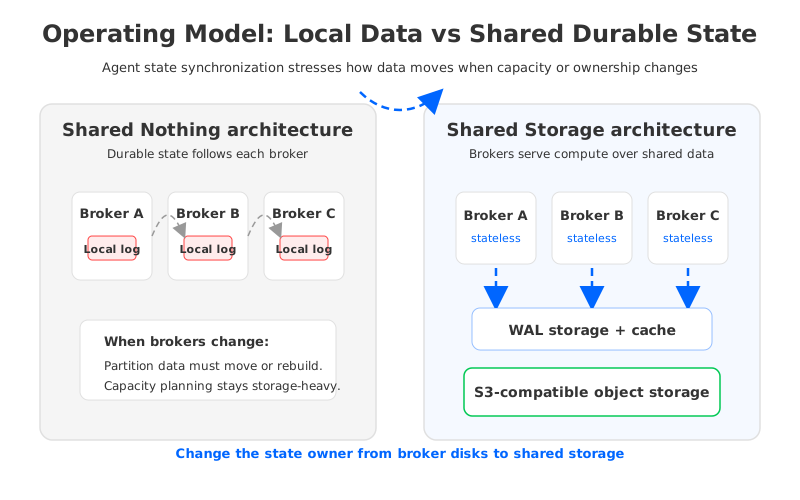
The operational symptoms are familiar to Kafka teams:
- Capacity is reserved for the worst hour. If brokers own both compute and durable data, scaling down after a burst can be harder than scaling up before it.
- Rebalancing competes with production traffic. Moving partitions can consume network, disk, and broker resources at the same time the agent system is trying to recover from load.
- Recovery depends on where the data lives. If a broker failure requires replica repair or local data rebuilds, the recovery SLO includes more than leader election.
- Cost modeling crosses layers. Storage, replication traffic, cross-Availability Zone traffic, and private connectivity can all appear in different parts of the cloud bill.
A serious architecture review should therefore separate Kafka semantics from the broker operating model. Kafka semantics define the contract that applications use. The broker operating model defines how much work the platform team must do to keep that contract healthy.
3Architecture options and trade-offs
There are several legitimate ways to build agent state synchronization on Kafka-compatible streams. The right choice depends on the state model, failure cost, retention window, and team boundary.
| Option | Where it fits | Main trade-off |
|---|---|---|
| Conventional Kafka with broker-local storage | Stable workloads with predictable throughput and mature Kafka operations | Strong ecosystem continuity, but scaling and recovery remain tied to local data ownership |
| Kafka with Tiered Storage | Longer retention where older log segments can move to remote storage | Helps with historical data pressure, but the active path still depends on broker-local responsibilities |
| Managed Kafka service | Teams that want less infrastructure ownership and can accept provider-defined boundaries | Reduces some operations work, but networking, cost, and data placement must be checked carefully |
| Kafka-compatible Shared Storage architecture | Workloads where elasticity, recovery, and storage-compute separation are central | Changes the storage model, so teams must validate latency, WAL behavior, cache behavior, and migration paths |
Tiered Storage deserves special attention because it is often confused with a full shared-storage design. Apache Kafka Tiered Storage moves older log segments to remote storage while brokers still participate in the active log path. That can be valuable for retention, but it does not make brokers fully stateless. For agent state synchronization, the distinction matters because the hottest data is usually the state that agents need next.
Shared Storage architecture makes a different bet. Durable stream data lives in shared object storage, while brokers focus on Kafka protocol handling, partition leadership, caching, scheduling, and serving traffic. A WAL (Write-Ahead Log) layer absorbs writes and provides a recovery path for data that has not yet been uploaded or organized in object storage. This does not remove the need for careful engineering. Object storage has different latency and request behavior from local disks. The point is that broker replacement and capacity changes are less dominated by moving retained partition data.
4Evaluation checklist for platform teams
Before choosing a platform, define the SLOs in operational language. An agent state topic is rarely one topic; it is a set of topics with different failure meanings. Plan updates, tool invocations, memory writes, model feedback, and audit events may require different retention, compaction, schema, and replay behavior.
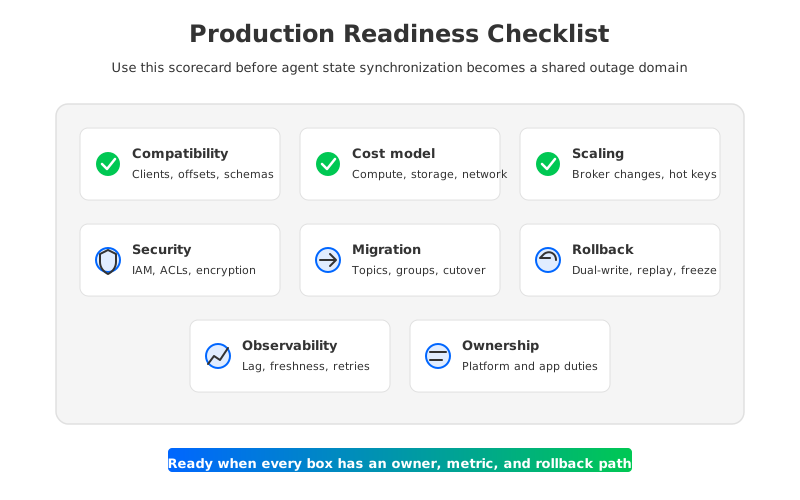
Use this checklist as a readiness scorecard:
This checklist also forces a boundary discussion. Application teams own state semantics and idempotency. Platform teams own the streaming substrate, security posture, capacity, and recovery drills. SRE owns the alert model and incident response. When those responsibilities are vague, Kafka becomes the place where every ambiguity accumulates.
5How AutoMQ changes the operating model
Once the evaluation framework is clear, AutoMQ becomes relevant as one implementation of Kafka-compatible Shared Storage architecture. AutoMQ keeps Kafka protocol compatibility while replacing broker-local log storage with S3Stream, a storage layer built around WAL storage, data caching, object metadata, and S3-compatible object storage. The application-facing goal is continuity: existing Kafka clients and ecosystem tools should keep speaking the Kafka protocol while the underlying storage model changes.
The operational change is more important than the product label. In AutoMQ, brokers are stateless brokers for durable data. They handle Kafka requests, partition leadership, scheduling, and cache behavior, but retained stream data is organized in shared object storage. WAL storage provides a durable write buffer and recovery path. That changes the failure and scaling question from "How much partition data must move with this broker?" to "How quickly can ownership, leadership, cache, and capacity converge?"
For agent state synchronization, that shift has several practical effects:
- Elasticity becomes easier to reason about. If retained data is not bound to broker-local disks, adding or replacing brokers does not have to imply large partition data movement.
- Recovery targets become narrower. A failure drill can focus on leadership transfer, metadata, WAL recovery, cache warmup, and client behavior rather than full local-data reconstruction.
- Data boundaries can stay customer-controlled. AutoMQ BYOC runs control plane and data plane components in the customer's cloud environment, while AutoMQ Software supports private deployments. That matters when agent state includes customer context, tool outputs, or audit records.
- Migration can be planned around Kafka semantics. AutoMQ Kafka Linking is documented for migration scenarios that need topic synchronization, Consumer group progress, and cutover planning.
There are still trade-offs to validate. WAL type affects latency and durability characteristics. Cache behavior matters for tailing reads and catch-up reads. Object storage request behavior matters for retention and replay. Security review should inspect the control channel, cloud permissions, private networking, and observability data path. The benefit is not that these checks disappear. The benefit is that platform teams can evaluate them as explicit design choices instead of inheriting every broker-local storage constraint.
6A production SLO model that survives change
A clean SLO for agent state synchronization has three layers. The first layer is stream health: produce latency, Consumer lag, broker availability, error rates, and retention. The second layer is state health: event age at the agent, duplicate transition rate, replay success, and state-store catch-up time. The third layer is business safety: external side effects, audit completeness, rollback time, and human escalation.
Those layers should be tested together. A broker metric can look healthy while an agent is acting on stale state. A consumer can catch up while replaying duplicate tool calls. A migration can preserve topic data while breaking a downstream consumer group that holds the real recovery point. The SLO should expose those gaps before an incident does.
The most useful production drill is intentionally uncomfortable: create a burst, shift consumers, fail a broker, run a replay, and exercise rollback while a subset of agents continues processing. If the platform only passes when the topology is static, it is not ready for agent state synchronization. If it passes when ownership changes, caches warm, consumers rebalance, and state stays fresh enough for the workflow, the architecture is doing the job.
For teams already using Kafka, the next step is not a rewrite. Keep the API contract, then evaluate whether the operating model behind that contract matches the agent SLO. If broker-local storage, data movement, and capacity reservation are the bottlenecks, test a Kafka-compatible shared-storage design. AutoMQ is worth including in that branch of the evaluation, especially when the requirements include stateless brokers, object-storage-backed durability, and deployment boundaries controlled by your cloud or private environment.
If you want to test this operating model against your own agent state workload, start with a workload-shaped proof of concept rather than a generic benchmark. Use your topics, your replay rules, and your failure drills, then compare the result with your SLO. You can explore AutoMQ on GitHub through this short link: try AutoMQ for Kafka-compatible streaming.
7FAQ
7.1Is Kafka a good fit for agent state synchronization?
Kafka can be a strong fit when agent state is represented as ordered, durable events and when the team needs replay, auditability, and parallel processing. It is less useful if the state model requires arbitrary mutable records with no event history. Many production designs use Kafka-compatible streams for state transitions and a separate serving store for query patterns.
7.2Do agent state topics need transactions?
Transactions are useful when a workflow writes to multiple partitions or combines consumed input with produced output and needs atomicity. They do not replace idempotency. External tool calls, database updates, and human-facing actions still need their own duplicate protection.
7.3Does Tiered Storage make Kafka brokers stateless?
No. Tiered Storage can offload older log segments to remote storage, but the active broker responsibilities remain different from a Shared Storage architecture where durable stream data is primarily stored outside broker-local disks.
7.4What should be measured first in a proof of concept?
Start with workflow-level freshness, Consumer lag, replay behavior, duplicate side effects, recovery time, and rollback. Broker-level throughput is useful, but it does not tell you whether agents are making decisions from acceptable state.
7.5Where does AutoMQ fit in this decision?
AutoMQ fits when teams want Kafka-compatible APIs while reducing the operational coupling between brokers and durable data. It should be evaluated with the same compatibility, latency, security, migration, and rollback tests as any production streaming platform.
8References
- Apache Kafka Documentation
- Apache Kafka Operations: KRaft
- Apache Kafka Operations: Tiered Storage
- Apache Kafka Design: Message Delivery Semantics
- Apache Kafka Connect Documentation
- AutoMQ Shared Storage architecture
- AutoMQ WAL Storage
- AutoMQ Continuous Self-Balancing
- AutoMQ Kafka Linking migration overview
- AutoMQ BYOC environment overview
- AWS EC2 On-Demand Pricing, data transfer notes
- AWS PrivateLink Pricing


