
Table of Contents
Table of Contents
Teams usually search for data lake freshness sla kafka after a dashboard has already gone stale once. Kafka was healthy, Flink was healthy, and the object store was healthy, yet the business-facing table still missed its freshness promise. That gap is the real problem: freshness is not a single component metric. It is a production SLO that crosses producers, Kafka-compatible streams, stream processors, table writers, catalogs, and readers.
Kafka exposes many useful signals, but none of them alone says, "the lake is fresh." Consumer lag measures distance from the head of a partition. Offsets tell you where a consumer is in an ordered log. Transactions protect atomic writes across partitions. Kafka Connect moves records into external systems. These are necessary building blocks, but a freshness SLA needs a wider control loop: event time, processing time, commit time, table visibility, replay behavior, and recovery time after failure.
The practical thesis is this: a data lake freshness SLA should be owned as an end-to-end SLO, but the streaming platform determines how expensive and fragile that SLO becomes under production pressure. If broker storage, retention, and scaling remain tied to local disks, the lake team eventually pays for freshness with capacity buffers, rebalances, longer incident windows, and tighter coordination across teams.
1Why teams search for data lake freshness sla kafka
Freshness work starts with a plain question: how old can the lake data be before downstream users call it wrong? For an observability pipeline, 5 minutes of delay may be acceptable. For fraud features, even a shorter delay can change the decision loop. These are product promises, not Kafka configuration values.
Once the promise is written down, the engineering question changes. The team is no longer asking whether Kafka can retain data or whether Flink can checkpoint state. It is asking whether the whole path can absorb backfill, schema changes, broker failures, consumer restarts, table commit contention, and object storage throttling without breaking the window.
A useful freshness SLO has four timestamps, not one:
- Event time: when the source system says the event happened. This matters for business correctness.
- Kafka append time: when the record became available in the stream. This shows ingestion delay and producer-side trouble.
- Processing or sink commit time: when the pipeline transformed or wrote the event. This reveals stream processor and connector pressure.
- Table visibility time: when the data became queryable through the lake table and catalog. This is the timestamp users experience.
The SLO is the maximum acceptable distance between event time and table visibility time, with separate error budgets for ingestion, streaming, sink write, and catalog publication. Without that split, the team reacts after the miss. With it, the team can decide whether to add connector capacity, tune checkpoint intervals, reduce compaction contention, or change the streaming platform.
2The production constraint behind the problem
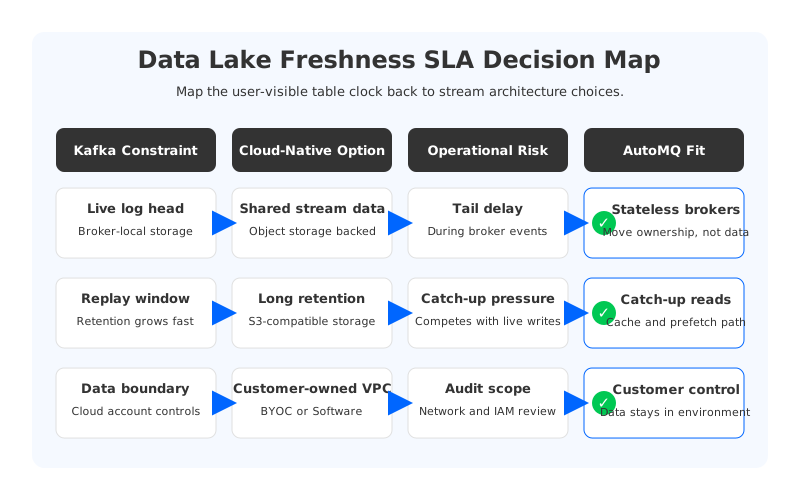
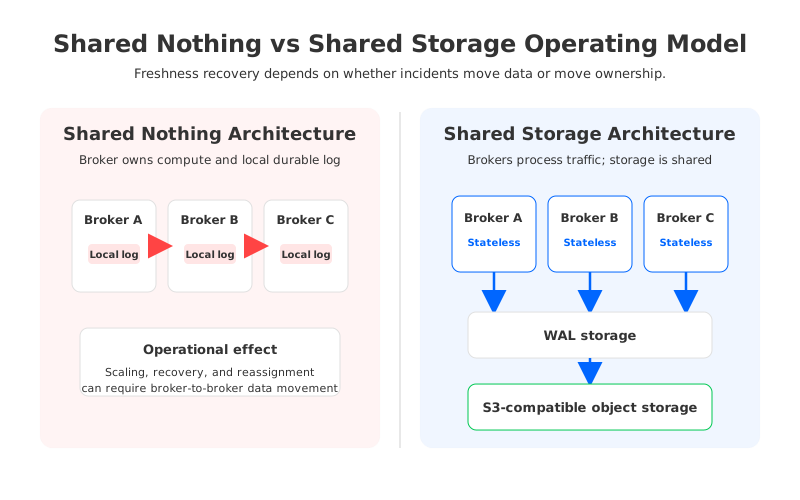
Traditional Kafka was designed around a Shared Nothing architecture. Each broker owns local log storage, partitions are assigned to brokers, and replication keeps follower copies close enough to take over after failure. This design is proven, but it turns storage layout into an operational constraint. When a cluster grows, shrinks, or rebalances hot partitions, data movement becomes part of the change. When retention grows for longer replay windows, local storage grows with it.
Freshness SLAs expose those constraints because lake ingestion is bursty in ways that differ from user-facing microservices. Backfills read old offsets at high speed. A table writer may pause while a catalog commit retries. A schema rollout may force a connector restart. In every case, the pipeline needs catch-up throughput and predictable tail latency. Local broker disks serve hot writes, follower replication, long retention, and catch-up reads from the same operational surface.
Tiered Storage helps by moving older segments to remote storage, and Apache Kafka documents it as a way to extend retention beyond local broker storage. It does not remove the primary storage dependency from the broker. The live head of the log still lives on broker-attached storage, partition ownership still matters, and operational changes still need care around local data.
The production constraint is not that Kafka cannot feed a lake. It can. The constraint is that the cost of reliability rises as the platform team adds buffers around broker-local storage: more disk headroom, more replica traffic, more careful reassignment windows, and more rollback planning.
3Architecture options and trade-offs
Platform teams usually choose among three patterns when they formalize a data lake freshness SLA. The first keeps Kafka as the stream of record and uses stream processors or Kafka Connect sink tasks to write table files. The second extends Kafka retention with Tiered Storage. The third moves the Kafka-compatible storage layer to shared object storage, so brokers handle protocol and compute work while durable stream data lives outside broker-local disks.
The right answer depends on workload shape, team boundaries, and failure expectations. A short-retention operational stream with modest replay needs may not need an architectural change. A lakehouse ingestion path with long replay windows, frequent backfills, and strict table visibility targets should be evaluated differently. The platform is no longer only carrying messages. It is carrying the recovery boundary for the lake.
| Option | What improves | What remains hard | Freshness SLO risk |
|---|---|---|---|
| Kafka with local broker storage | Familiar operations, mature tooling, predictable Kafka semantics | Capacity buffers, partition reassignment, local disk pressure, cross-AZ replication planning | Backfill or broker maintenance can compete with live ingestion |
| Kafka with Tiered Storage | Longer retention on object storage and lower local storage growth for older segments | Live log head still depends on broker-local storage and partition ownership | Replay improves, but live-edge incidents still need careful handling |
| Kafka-compatible Shared Storage architecture | Durable stream data moves to shared object storage, and brokers become easier to replace or scale | Requires evaluation of WAL type, object storage behavior, and deployment boundaries | Freshness recovery can focus on ownership and throughput instead of large data relocation |
Shared storage is not a magic switch, and Tiered Storage is not a failed idea. They solve different problems. Tiered Storage extends the storage hierarchy around a broker-owned log. Shared Storage architecture changes the ownership model by making object storage the durable stream repository. During an incident, that distinction becomes concrete: are you moving data between brokers, or moving compute ownership over data already in shared storage?
4Evaluation checklist for platform teams
The strongest freshness designs begin with a checklist that crosses team boundaries. Data platform teams care about table visibility. Kafka teams care about broker health, offsets, partitions, and client compatibility. SREs care about error budgets and recovery drills. FinOps teams care about whether retention and backfills create network or storage surprises.
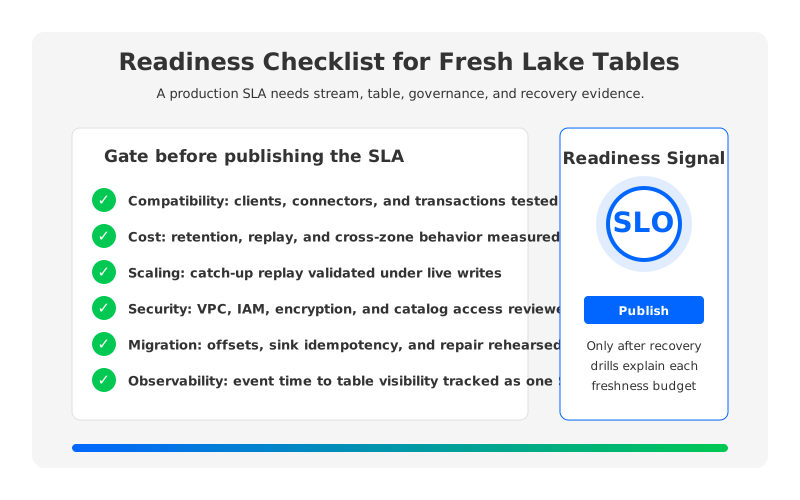
Use the following checklist before choosing or changing the streaming platform behind a lake ingestion path:
- Define the freshness contract. State the target as event time to table visibility time, then break it into ingestion, stream processing, sink commit, and catalog visibility budgets.
- Measure lag in more than one clock. Track Kafka consumer lag, event-time delay, processing-time delay, sink commit latency, and table snapshot age. A single lag metric will hide at least one failure mode.
- Test catch-up under live traffic. Run a replay or backfill while producers continue writing. The question is whether catch-up throughput steals capacity from the live edge.
- Audit retention and replay cost. Confirm how long data must stay replayable, where it is stored, and what read, write, storage, and cross-zone charges are created by normal recovery behavior.
- Validate compatibility before migration. Check client versions, producer idempotence, transactions, consumer group behavior, Kafka Connect tasks, schema tooling, and observability integrations.
- Write a rollback plan. A migration is not ready until offsets, dual writes or linking, sink idempotency, and table repair procedures have been tested.
- Assign ownership for the lake-visible SLO. Kafka health and table freshness may sit with different teams. The SLO needs one escalation path.
The checklist should be tested during a controlled failure, not only during design review. Stop one sink task. Restart a broker. Pause a catalog service. Trigger a backfill. If the team cannot explain which budget is being spent during each drill, the SLO is still an aspiration.
5How AutoMQ changes the operating model
After that evaluation, AutoMQ becomes relevant as a Kafka-compatible shared storage platform rather than as a replacement for the lake stack. It keeps Kafka protocol and ecosystem compatibility while replacing broker-local log storage with S3Stream, backed by WAL (Write-Ahead Log) storage and S3-compatible object storage. AutoMQ Brokers are stateless brokers: they process Kafka requests, manage leadership and caching, and coordinate with KRaft metadata, but durable stream data is not pinned to local broker disks.
For freshness SLAs, this changes the recovery conversation. A broker failure or scaling event does not need to be treated as a large local data movement problem. Partition reassignment and traffic balancing can focus on ownership, metadata, and compute capacity. The lake team still measures table commit latency and catalog visibility, but the platform team is no longer protecting the SLA by over-provisioning broker-local disks for every replay scenario.
AutoMQ also gives platform teams a clearer deployment boundary. AutoMQ BYOC runs the control plane and data plane in the customer's cloud account and VPC, while AutoMQ Software serves private data center deployments. For regulated lake workloads, message data, object storage, networking, and access policies remain under the customer's environment. The same evaluation still applies: validate Kafka client compatibility, choose the WAL type for latency and durability requirements, test observability, and rehearse rollback.
The most direct lakehouse connection is Table Topic. AutoMQ Table Topic writes streaming data into Apache Iceberg tables without requiring a separate ETL pipeline for that path. It does not remove the need for data contracts, schema governance, or table maintenance. For teams that already run Flink or Kafka Connect, it becomes another option in the architecture review, not an automatic replacement.
The operating model shift is subtle but important. A lake freshness SLA is not met because a vendor says the stream is real time. It is met because the team can explain what happens when a broker is replaced, a sink restarts, a table commit retries, or a backfill competes with live ingestion. Shared storage makes some of those answers shorter and more testable.
6FAQ
6.1Is consumer lag enough to measure a data lake freshness SLA?
No. Consumer lag is useful, but it measures stream consumption distance, not table visibility. A pipeline can have low consumer lag while table commits, catalog updates, compaction, or query engine metadata refreshes are delayed. Measure event time to table visibility time, then use consumer lag as one contributing signal.
6.2Does Tiered Storage solve lake freshness problems?
Tiered Storage can help with long retention and replay economics, especially for older log segments. It does not fully remove broker-local storage from the live write path. For freshness SLAs that are sensitive to live-edge incidents, broker ownership, local storage pressure, and reassignment behavior still need explicit testing.
6.3Where should AutoMQ appear in an evaluation?
AutoMQ should be evaluated after the team defines the freshness SLO, failure modes, replay windows, compatibility requirements, and governance boundaries. It is a Kafka-compatible Shared Storage architecture, so the strongest fit is where broker-local storage and data movement are becoming the bottleneck for lake ingestion reliability or cost control.
6.4Does Table Topic replace Flink or Kafka Connect?
Not universally. Table Topic is useful when the goal is to write streaming data directly into Apache Iceberg tables with less pipeline surface area. Flink and Kafka Connect remain useful for transformations, enrichment, custom sink behavior, and broader integration workflows. The right choice depends on how much logic sits between the stream and the table.
6.5What should be tested before committing to a production SLA?
Test live ingestion, catch-up replay, broker replacement, sink restart, table commit retry, catalog interruption, schema change, and rollback. The test should show which budget is consumed by each failure and whether the platform can return to the target freshness window without manual data movement surprises.
7Closing the freshness gap
The first stale table usually looks like a pipeline problem. After the postmortem, it looks more like an ownership problem: the stream, processor, sink, catalog, and query layer each kept their local contract, but no one owned the lake-visible clock. Start by making that clock explicit. Then choose a Kafka-compatible streaming architecture that keeps the recovery path short enough for the SLA you are willing to publish.
If broker-local storage and replay operations are becoming the limiting factor, evaluate AutoMQ's shared-storage approach with your own workload and failure drills. The next step is to try the open-source project or talk through a BYOC architecture using the AutoMQ technical team: start from GitHub.


