
Table of Contents
Table of Contents
Teams search for event time aggregation kafka when an aggregation has started to disagree with the business clock. The dashboard may still look healthy. The fraud counter still increments, the usage meter still emits rows, and the Flink job still checkpoints. The problem is subtler: a delayed mobile event lands in yesterday's window, a device reconnects with buffered telemetry, or a correction event changes a revenue total that downstream systems already used.
That is when event-time aggregation stops being a stream processing configuration detail and becomes a production SLO. The aggregation is no longer judged only by throughput or Consumer lag. It is judged by whether the platform can keep windows open long enough, replay history fast enough, absorb bursts without starving the hot tail, and prove that late data, offsets, checkpoints, and derived tables all line up.
1Why teams search for event time aggregation kafka
The search phrase usually comes from a team that already understands Kafka basics. They know topics, partitions, offsets, Consumer groups, and producers. They may also know that stream processors such as Apache Flink distinguish event time from processing time and use watermarks to reason about out-of-order data. What they need is a production frame: how should the Kafka-compatible streaming platform behave when the aggregation is tied to business time rather than broker arrival time?
Event-time aggregation is common in systems where the question depends on when the fact happened, not when the record arrived. Payment risk teams count attempts inside a time window around the authorization. IoT teams aggregate sensor readings by device event time because gateways can buffer data. SaaS usage systems roll up activity into billing periods, and late corrections are normal. Product analytics teams count sessions, funnels, and cohorts where mobile networks, retries, and batching distort arrival order.
The SLO should reflect that reality. A pipeline may have acceptable broker latency and still violate the product if it closes windows too early, cannot replay a repaired schema, or forces a painful backfill every time a hot key shifts traffic. For production teams, the right question is not "Can Kafka support event time?" It is "Can the whole operating model support the event-time aggregation contract?"
2The production constraint behind the problem
Kafka gives the platform a durable ordered log per Partition, offsets for replay, Consumer groups for parallel consumption, and transactions for workloads that need atomic writes across partitions or topics. Those primitives are useful because they make recovery measurable. A stream processor can checkpoint offsets and state. A table writer can know which records were consumed. An SRE can inspect lag and retained data instead of guessing where the pipeline stopped.
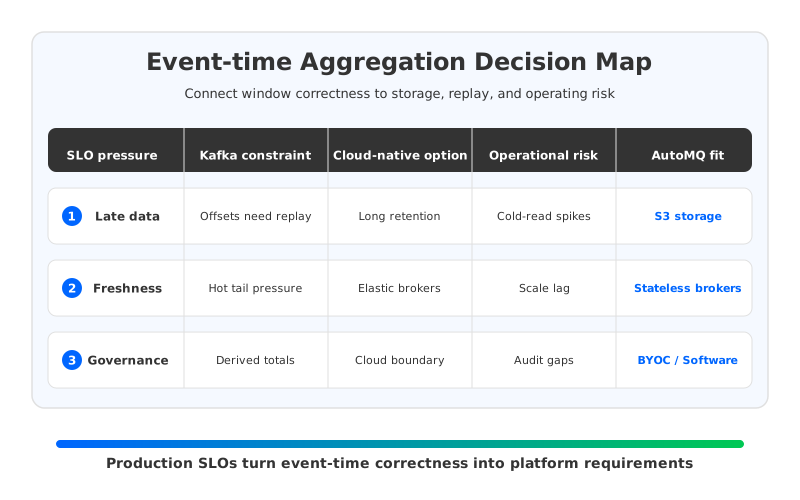
Event-time aggregation adds three constraints that often stay hidden until the first production correction. First, correctness depends on the timestamp policy: event timestamp, broker append time, source system time, or a normalized field extracted by the processor. Second, lateness is not a rare exception. It is part of the input model, which means watermarks, grace periods, and correction handling must be intentional. Third, replay is not optional. A bad timestamp extractor, schema bug, or window definition change can require rebuilding aggregates from retained Kafka data.
Those constraints turn a storage decision into an SLO decision. If retained data is expensive or hard to fetch, the team shortens the replay horizon. If adding brokers requires large partition movement, the team over-provisions capacity before a planned backfill. If cross-Availability Zone paths are not understood, a replay or failover can become both an operational event and a cost surprise. None of these issues change the definition of event time, but all of them change whether the aggregation is safe in production.
3Architecture options and trade-offs
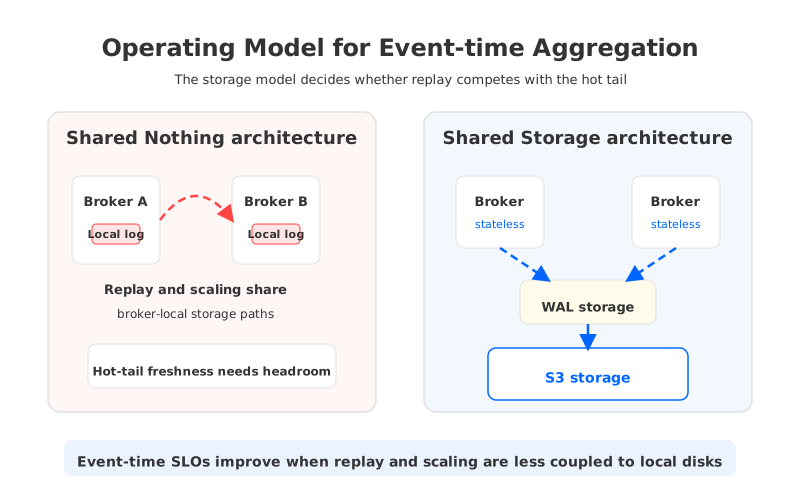
Traditional Kafka uses a Shared Nothing architecture. Each Broker owns local log storage for the partitions it hosts, and reliability comes from replication between Brokers. This design is proven and widely understood, but it couples data placement to operational changes. Broker replacement, scaling, partition reassignment, and retention planning all have to account for data that lives on Broker-local or attached storage.
That coupling matters for event-time aggregation because the pipeline often needs two different read profiles at the same time. The hot tail must stay fresh while the processor consumes recent events and advances watermarks. At the same time, a backfill may need to scan older retained records to rebuild a window, correct a late-data policy, or regenerate a downstream table. If the platform treats both activities as pressure on the same Broker storage and network paths, the SLO becomes harder to defend.
Tiered Storage can help with long retention by moving older log segments to object storage. It is a good fit when the main pain is retaining more history without keeping every segment on the primary storage tier. The trade-off is that Tiered Storage does not make brokers stateless. Hot data, leaders, local storage pressure, and operational movement still need attention. For an event-time aggregation pipeline, the team still has to validate how cold reads, hot-tail freshness, and reassignment behavior interact during the same incident window.
Managed Kafka services reduce some infrastructure work, but they do not remove the need to inspect the operating model. Private connectivity, cross-zone traffic, connector placement, client compatibility, and region boundaries still shape the SLO. The platform may be managed, while the aggregation contract remains owned by the application and data platform teams.
| Platform option | Where it fits | Event-time aggregation risk to test |
|---|---|---|
| Self-managed Kafka with Broker-local storage | Stable workloads, experienced Kafka operators, and clear capacity plans. | Partition movement, disk headroom, backfill isolation, and multi-AZ traffic during replay. |
| Kafka with Tiered Storage | Longer retention and historical replay without keeping all segments on the primary tier. | Cold-read behavior, hot-tail pressure, local tier sizing, and restore expectations. |
| Managed Kafka service | Teams that want provider operations and can accept the service's topology and feature boundary. | Network path cost, private access, connector location, version support, and migration controls. |
| Kafka-compatible shared storage platform | Teams that want Kafka APIs while changing how stream data is persisted and moved in the cloud. | Client compatibility, WAL durability, object storage behavior, observability, and rollback path. |
The table is not a shortcut to a vendor decision. It is a way to keep the evaluation honest. If the team has stable traffic and short replay needs, hardening an existing Kafka cluster may be the right answer. If the team has long retention, bursty backfills, strict cloud-account boundaries, and frequent scaling events, the storage architecture becomes part of the event-time SLO.
4Evaluation checklist for platform teams
A useful event-time aggregation SLO separates product correctness from infrastructure behavior. Product owners should define which aggregate is allowed to be stale or corrected, and for how long. Platform teams should define the Kafka-compatible envelope that can make that promise measurable during normal traffic, late data, backfills, and failures.
Start with five layers:
This layering prevents a common incident pattern. The stream processor team sees late records and blames producers. The Kafka team sees Consumer lag and blames the processor. The analytics team sees wrong totals and blames the sink. The real failure is often that nobody defined the contract across all layers.
For platform evaluation, the checklist should be concrete enough to run as a pre-production drill:
- Compatibility: Verify Kafka clients, authentication, schema tooling, Kafka Connect, and stream processing integrations against the platform version and support boundary.
- Cost model: Trace compute, storage, cross-AZ transfer, private connectivity, object storage requests, and backfill reads as separate drivers. Use official cloud pricing pages when publishing cost estimates.
- Scaling behavior: Test producer spikes, hot keys, Consumer lag, and historical replay together rather than in isolated benchmarks.
- Recovery path: Rebuild a representative aggregate from retained data, then compare offsets, checkpoints, result timestamps, and sink state.
- Observability: Put event timestamp, broker append time, Consumer lag, watermark progress, checkpoint age, object storage latency, and aggregate freshness into one incident timeline.
The checklist also clarifies team boundaries. A Kafka-compatible platform cannot decide whether a late payment should amend a closed invoice. It can, however, make the replay and correction path affordable, observable, and repeatable enough that the business rule can be enforced.
5How AutoMQ changes the operating model
If the hard part is the operating model around retained data, replay, and scaling, then the architectural alternative is to keep Kafka compatibility while changing how persistent stream data is stored. AutoMQ is a Kafka-compatible cloud-native streaming platform that uses a Shared Storage architecture. Brokers continue to speak Kafka-compatible APIs, while S3Stream stores persistent stream data in S3-compatible object storage with WAL storage in the write path.
The important shift is that Brokers are stateless for persistent data. In traditional Kafka, a Broker is both a compute node and a storage owner. In AutoMQ, the Broker handles Kafka protocol work, leadership, caching, and scheduling, while durable data is backed by shared storage. The write path uses WAL storage for durability before data is organized into S3 storage. Reads use cache for hot data and object storage for catch-up reads.
For event-time aggregation, this changes several SLO discussions. Scaling no longer has to be treated primarily as a large data-copying exercise. Retention can be evaluated around object storage growth rather than Broker-local disk planning alone. Replay drills can focus on fetch behavior, cache pressure, and processor state instead of whether the cluster has enough local disk headroom for the next retention decision. Self-Balancing and seconds-level partition reassignment become relevant because the platform can move traffic ownership without the same persistent-data movement pattern.
Deployment boundaries also matter. AutoMQ BYOC runs the control plane and data plane inside the customer's cloud account and VPC. AutoMQ Software targets private data center environments. For event-time aggregation pipelines that produce billing totals, fraud features, compliance evidence, or customer analytics, this boundary is part of the governance SLO. The streaming platform should not force business data outside the environment that owns the risk.
There is still real evaluation work. WAL type affects latency and durability behavior. Object storage choice affects region, compliance, request profile, and operational policy. Migration must preserve topics, offsets, and downstream correctness. AutoMQ Kafka Linking is relevant when teams need to move Kafka-compatible workloads while preserving data and Consumer group progress. Table Topic is relevant when event streams should be written directly into Apache Iceberg tables for lakehouse-style aggregation outputs. These capabilities are useful only when mapped to the pipeline's event-time SLO rather than treated as generic feature names.
6Readiness scorecard for production aggregation
Use this scorecard before a production event-time aggregation pipeline becomes a product dependency. A pass should mean the team has an owner, metric, threshold, dashboard, and rollback action. Anything weaker is a discussion note, not an SLO.
| Area | Production question | Pass signal |
|---|---|---|
| Timestamp | Can the pipeline prove which timestamp drives each window? | Event-time field, extractor, validation rule, and rejection policy are documented. |
| Lateness | Can late data be handled without guessing? | Watermark, grace period, correction path, and downstream update rule are tested. |
| Replay | Can the aggregate be rebuilt after a bug? | Retention, offsets, checkpoints, state snapshots, and sink reconciliation are verified. |
| Scaling | Can hot-tail freshness survive a backfill? | Scale and replay test runs while production-like ingestion continues. |
| Cost | Can the team explain what a replay costs? | Storage, network, endpoint, object request, and compute drivers are separated. |
| Governance | Can the team prove where source and derived data live? | Region, VPC, IAM, audit, encryption, and retention boundaries are documented. |
| Observability | Can an incident timeline cross every layer? | Producer, Broker, processor, storage, and aggregate freshness metrics are correlated. |
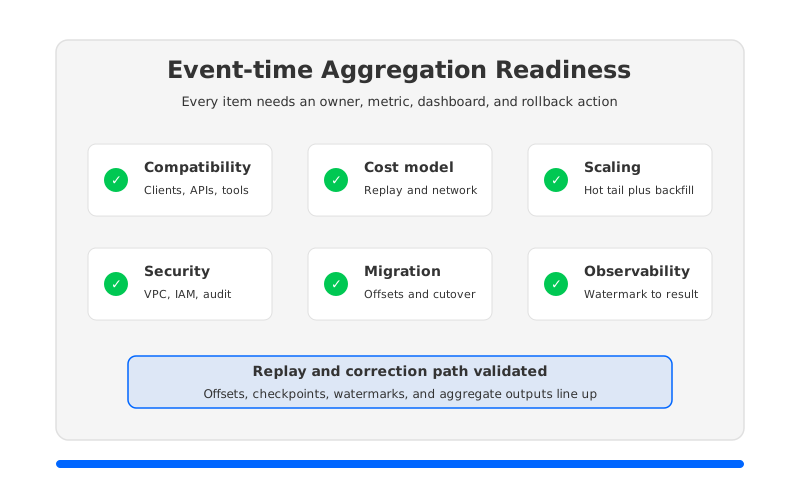
The scorecard should be run before migration, not after a late-data incident. It forces the team to answer the practical questions behind the search for event time aggregation kafka: which clock is authoritative, what happens when events arrive late, how far back the platform can replay, and whether the storage model helps or hurts when the pipeline is under pressure.
If your team is evaluating a Kafka-compatible platform for event-time aggregation, use the checklist as a design review and run one replay drill with production-like data before committing the SLO. To see how a Shared Storage architecture changes the operating model, start with the AutoMQ GitHub repository.
7FAQ
7.1Is event-time aggregation a Kafka feature or a stream processing feature?
The aggregation logic usually belongs in a stream processor such as Apache Flink or Kafka Streams. Kafka provides the durable log, offsets, Consumer groups, retention, and replay boundary that the processor depends on. The production SLO spans both layers.
7.2How is event time different from processing time?
Event time is when the business fact happened. Processing time is when the processing system sees the record. Event-time aggregation is needed when delayed, batched, retried, or corrected records should still count in the business window where they occurred.
7.3Does Tiered Storage solve replay for event-time aggregation?
Tiered Storage can improve long-retention economics by moving older segments to object storage, and it is useful for replay-heavy workloads. It does not remove every hot-tier, leader placement, scaling, or cold-read trade-off. Teams should test replay and hot-tail freshness together.
7.4Where does AutoMQ fit?
AutoMQ fits when teams want Kafka-compatible APIs and ecosystem behavior while changing the storage model underneath. Its Shared Storage architecture, stateless brokers, S3Stream, WAL storage, and S3 storage can reduce the amount of persistent data movement tied to scaling and recovery. The fit should be validated against the pipeline's timestamp, lateness, replay, and governance SLOs.
8References
- Apache Kafka documentation
- Apache Kafka client compatibility documentation
- Apache Kafka transactions documentation
- Apache Kafka KRaft documentation
- Apache Kafka Tiered Storage documentation
- Apache Kafka Connect documentation
- Apache Flink time and event time documentation
- Apache Flink event time and watermarks documentation
- AutoMQ Shared Storage architecture
- AutoMQ compatibility with Apache Kafka
- AutoMQ Kafka Linking overview
- AutoMQ Table Topic overview
- AWS EC2 data transfer pricing
- AWS PrivateLink pricing


