
Table of Contents
Table of Contents
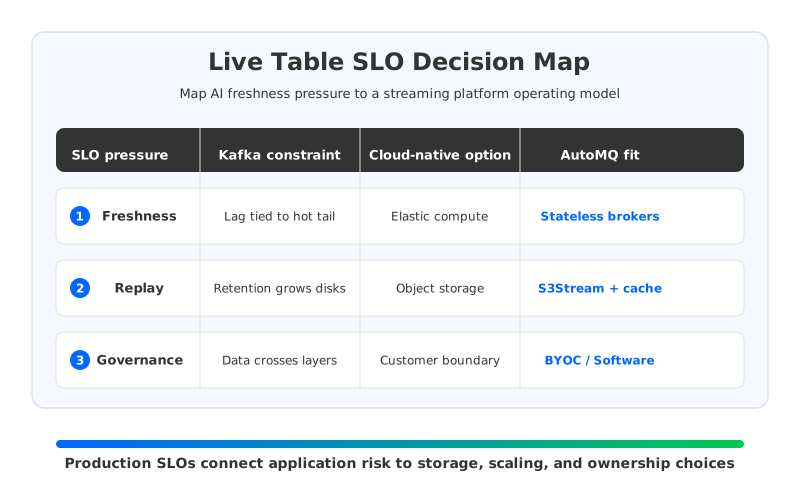
Teams usually search for live tables ai applications kafka after a prototype has already worked. A product catalog, risk score, support profile, or agent memory table is being refreshed from events, and the AI application depends on that table being fresh enough to trust. The hard part is no longer whether Kafka can move events. The hard part is whether the streaming platform can keep the table fresh, recoverable, governed, and affordable while producers, consumers, schemas, regions, and model traffic keep changing.
A live table for AI is an operational contract between event capture, stream processing, serving systems, and the application that turns context into an answer or action. If the table is stale, the model uses old context. If replay is slow, backfills delay product changes. If ownership is vague, nobody knows whether a freshness breach belongs to the Kafka team, the feature platform, the vector index, or the application. Production SLOs turn that ambiguity into a platform decision.
1Why teams search for live tables ai applications kafka
The phrase sounds narrow, but the search intent is practical. Readers are usually asking whether Kafka-compatible streams can support live tables that feed AI applications without becoming another brittle pipeline. They already know Kafka topics, partitions, offsets, Consumer groups, and connectors. What they need is a way to decide where the SLO should live and which architecture makes the SLO operable.
For AI workloads, the table is often a derived view rather than a source of truth. It may join customer events with account metadata, convert behavioral events into embeddings, expose the latest risk indicators, or maintain a session-level memory that an agent reads before choosing a tool. Each use case has a different tolerance for lag and replay, but the platform questions repeat:
- Freshness: How old can the row, feature, embedding, or context record be before the AI decision becomes unsafe or unhelpful?
- Replay: How quickly can the team rebuild the table after schema repair, model feature changes, or downstream corruption?
- Isolation: Can bursty backfills and agent traffic run without starving the ingestion path that keeps the table fresh?
- Governance: Can data ownership, retention, access control, and audit trails stay inside the right cloud and team boundaries?
- Migration: Can the team move the workload without changing producers, breaking offsets, or forcing a risky cutover?
That list is deliberately broader than latency. A table can have low write latency and still fail the product if recovery takes too long, costs scale unpredictably, or the team cannot prove which version of the context was used for a decision.
2The production constraint behind the problem
Traditional Kafka is extremely good at the log abstraction: records are appended to partitions, consumers advance by offsets, and Consumer groups divide work across members. Those primitives are why Kafka remains a natural backbone for event-driven AI architecture. They also create a clear SLO vocabulary. Freshness maps to producer latency and Consumer lag. Replay maps to retained records and fetch throughput. Migration maps to offset continuity and client compatibility.
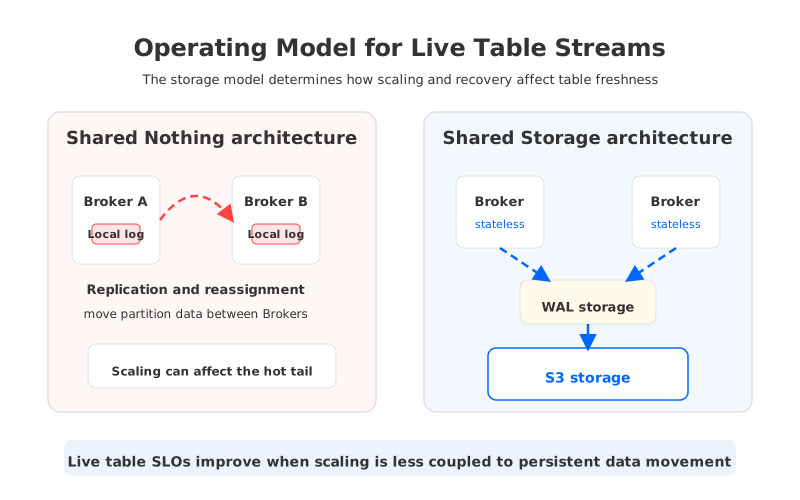
The pressure appears when a live table turns those primitives into continuous product state. A table builder may consume many partitions, checkpoint its progress, write a materialized view, and feed both online inference and offline validation. A temporary lag spike becomes a stale recommendation. A slow partition reassignment becomes a delayed scale-out. A retention decision becomes a product recovery limit. The platform team is asked to provide a table SLO, but the bottleneck may sit in broker-local storage, network traffic, processor state, sink throughput, or ownership between teams.
3Architecture options and trade-offs
The right platform choice depends on which SLO dominates. A fraud decision table may prioritize tail freshness and failover. A customer 360 table may prioritize governance and replay. An embeddings refresh table may prioritize backfill throughput and storage cost. Treating all of them as "real-time AI data pipeline" problems hides the real design work.
| Option | Where it fits | What to validate before production |
|---|---|---|
| Self-managed Kafka with local disks | Teams with deep Kafka operations expertise and stable capacity patterns. | Partition reassignment time, disk headroom, multi-AZ traffic, operational ownership, and backfill isolation. |
| Kafka with Tiered Storage | Workloads that need longer retention and historical replay without keeping every segment on the primary tier. | Hot-tier sizing, restore behavior, cold-read performance, and whether table freshness still depends on local storage pressure. |
| Managed Kafka service | Teams that want to reduce infrastructure work and accept the provider's operating model. | Network topology, connector boundaries, private connectivity cost, version compatibility, and data residency commitments. |
| Kafka-compatible shared storage platform | Teams that want Kafka APIs while changing how stream data is persisted and moved in the cloud. | Client compatibility, write path durability, object storage behavior, rollback plan, and observability across Broker, WAL, cache, and storage. |
This table is not a ranking. It is a way to make the hidden trade-off visible. If the team has a stable workload and strong Kafka operations muscle, the simplest answer may be to harden the existing deployment. If the workload has volatile AI traffic, long replay windows, and strict cloud-account boundaries, the architecture decision shifts from "which Kafka service is easier to run" to "which storage model makes the SLO measurable under change."
4Evaluation checklist for platform teams
A useful SLO starts with numbers, but not every number belongs in the same document. Application teams should define product tolerance, while platform teams define the infrastructure envelope that can meet it. Mixing the two creates vague promises such as "near real time," which nobody can debug during an incident.
Start with four SLO layers:
- Application freshness SLO: the maximum acceptable age of context used by the AI application. This should be expressed per table or feature group, not as one global streaming target.
- Stream processing SLO: the allowed Consumer lag, checkpoint delay, and backfill completion time for the job that builds the live table.
- Platform SLO: the broker, storage, network, and scaling behavior required to keep ingestion and replay inside the processing envelope.
- Governance SLO: the audit, retention, access, and region boundaries required for the table's data and derived outputs.
The second layer is where Kafka semantics become useful. Consumer lag gives a measurable signal for freshness. Offsets give a recovery boundary. Transactions and idempotent producers can help control duplicate or partial writes when the table builder spans multiple partitions or sinks. Kafka Connect may be enough for a straightforward source or sink path, while a stream processor is usually needed when the live table applies joins, windows, deduplication, enrichment, or stateful transformations.
Once the SLO is layered, the platform review becomes more concrete. Do not ask whether a platform is "AI-ready." Ask whether it can answer these questions during a bad day:
- Compatibility: Which Kafka client versions, APIs, authentication modes, schema tooling, and ecosystem components are part of the support boundary?
- Scaling: What happens when producers spike, consumers fall behind, or a backfill reads older retained data at the same time as online traffic?
- Storage: Which data sits on Broker-local disks, which data sits in object storage, and what must move during scale-out, failover, or partition reassignment?
- Network: Which paths cross Availability Zones, VPC boundaries, PrivateLink endpoints, or regions, and how are those paths billed?
- Recovery: How are offsets, table checkpoints, retained events, and downstream table snapshots coordinated during rollback?
- Observability: Can the team correlate producer latency, Consumer lag, processing checkpoints, Broker health, object storage latency, and table freshness in one incident timeline?
This checklist tends to expose whether the team is buying a streaming service, building a data product platform, or accepting a storage architecture as a long-term operating model.
5How AutoMQ changes the operating model
If the core problem is that table SLOs inherit the operational cost of broker-local storage, then the architectural alternative is to keep Kafka compatibility while changing the storage model. AutoMQ is a Kafka-compatible cloud-native streaming platform that uses a Shared Storage architecture: Brokers remain compatible with Kafka clients and ecosystem tools, while persistent stream data is moved to S3-compatible object storage through S3Stream and WAL storage.
The important shift is not the phrase "object storage." The important shift is that Brokers become stateless for persistent data. In AutoMQ, data is written durably through WAL storage and uploaded to S3 storage, while Brokers focus on Kafka protocol handling, caching, leadership, and scheduling. Because partition data is not bound to a Broker's local disk, operations such as scaling, replacing nodes, and rebalancing traffic are less coupled to large data movement.
For live tables, that changes the questions platform teams ask. Instead of sizing every Broker as a long-lived storage container, the team can separate compute headroom from durable storage growth. Instead of treating replay as a local-disk capacity event, it can reason about catch-up reads from shared storage and cache behavior. Instead of making every scale event a partition-copying exercise, it can evaluate stateless brokers, seconds-level partition reassignment, Self-Balancing, and object-storage-backed durability as part of the SLO envelope.
AutoMQ also matters for deployment boundaries. AutoMQ BYOC runs the control plane and data plane inside the customer's cloud account and VPC, while AutoMQ Software targets private data center environments. For teams building regulated AI systems, that boundary is often as important as performance. The live table may contain customer context, prompts, decisions, or derived features, and the platform has to keep those assets inside the approved network, identity, and audit model.
There is still evaluation work to do. WAL type affects latency and durability behavior, object storage choices affect region and compliance planning, and migration design must preserve application semantics. AutoMQ Kafka Linking is relevant when a team needs to move from an existing Kafka-compatible source while preserving topic data and Consumer group progress. Table Topic is relevant when a team wants stream data to flow directly into Apache Iceberg tables for analytics-oriented live views. Those features should be mapped to the live table SLO rather than treated as generic platform capabilities.
6A readiness scorecard for live table SLOs
Use the scorecard below before committing the first production AI table to a Kafka-compatible streaming platform. A "yes" should mean the owner, metric, threshold, dashboard, and rollback action are defined. A "no" should become either a design task or an explicit risk acceptance.
| Area | Production question | Pass signal |
|---|---|---|
| Freshness | Can the application state its maximum acceptable table age? | Per-table freshness SLO with Consumer lag and table update metrics. |
| Compatibility | Can producers, consumers, schemas, and tools run without application rewrites? | Verified Kafka client, API, authentication, and connector matrix. |
| Cost | Can the team explain storage, compute, cross-AZ, endpoint, and replay cost drivers? | Cost model tied to throughput, retention, topology, and backfill behavior. |
| Scaling | Can capacity grow and shrink without delaying the hot tail? | Tested scale event with ingestion, replay, and table writes running together. |
| Recovery | Can the table be rebuilt or rolled back after bad data? | Documented offset, checkpoint, snapshot, and replay procedure. |
| Governance | Can the platform prove where data lives and who accessed it? | Region, VPC, IAM, audit, retention, and encryption controls are documented. |
| Observability | Can an incident timeline cross application, stream, Broker, and storage layers? | Shared dashboard and alert ownership across platform and application teams. |
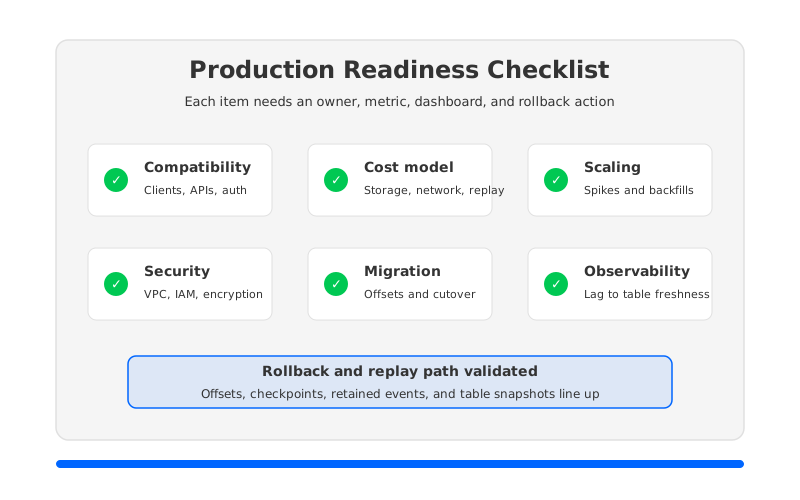
The scorecard is intentionally operational. A live table that feeds an AI application is not complete when the first rows appear. It is complete when the team can change schema, replay history, absorb traffic bursts, prove data boundaries, and recover from bad context without guessing which layer owns the failure.
If your AI platform team is turning Kafka-compatible streams into production live tables, use this scorecard as a design review and test the operating model before the table becomes a product dependency. To evaluate AutoMQ for this pattern, start from the AutoMQ GitHub repository.
7FAQ
7.1Is Kafka still a good fit for live tables in AI applications?
Kafka is a strong fit when the live table is derived from event streams and the team needs ordered records, offsets, Consumer groups, replay, and broad ecosystem support. The question is not whether Kafka can feed the table. The question is whether the chosen Kafka-compatible platform can meet the freshness, replay, governance, and cost SLOs for that table in production.
7.2Do live tables require stream processing?
Usually, yes. Kafka can carry the events, but the live table often needs joins, deduplication, windowing, enrichment, aggregation, or stateful correction. Kafka Connect may handle simple movement into a sink, but table semantics usually belong in a stream processor or a platform feature designed for table materialization.
7.3How should teams set freshness targets?
Start from product risk, not infrastructure preference. A support assistant profile may tolerate different freshness than a fraud decision or an agent authorization table. Define the maximum acceptable age per table, then map it to producer latency, Consumer lag, processing checkpoint delay, and sink update time.
7.4Where does AutoMQ fit in this architecture?
AutoMQ fits when a team wants Kafka-compatible APIs but wants to change the Broker storage model for cloud-native operations. Its Shared Storage architecture, stateless brokers, WAL storage, and S3 storage can reduce the amount of data movement tied to scaling and recovery. Teams should still validate WAL choice, deployment model, and migration behavior against their own SLOs.
8References
- Apache Kafka 4.3 documentation
- Apache Kafka compatibility documentation
- Apache Kafka KRaft operations documentation
- Apache Kafka Tiered Storage operations documentation
- AutoMQ Shared Storage architecture
- AutoMQ compatibility with Apache Kafka
- AutoMQ Table Topic overview
- AutoMQ Kafka Linking overview
- AWS EC2 data transfer pricing
- AWS PrivateLink pricing


