
Table of Contents
Table of Contents
Teams search for warehouse offload pipeline kafka when the nightly export has stopped being a nightly export. The warehouse is still the analytical system of record, but product events, CDC updates, audit logs, and feature signals need to arrive continuously. A batch job that used to copy yesterday's data into a cloud warehouse becomes a production stream with consumers, offsets, retention, schema changes, and recovery expectations. The question is no longer "Can Kafka deliver the records?" It is "Can this pipeline meet warehouse SLOs without turning the Kafka platform into the next bottleneck?"
That is a different problem from building a connector demo. A warehouse offload pipeline has to protect source systems, absorb uneven producer traffic, keep downstream tables fresh, tolerate replay, and maintain a clear rollback path when the warehouse sink, table format, or transformation job misbehaves. The platform team also has to explain where costs land: broker storage, network movement, sink compute, object storage, private networking, and operational labor. Good SLOs make those trade-offs explicit before the pipeline becomes a shared dependency for finance, product analytics, fraud, and AI features.
1Why teams search for warehouse offload pipeline kafka
The search phrase sounds narrow, but it usually hides a broader architecture decision. A team may be moving operational database changes into Snowflake, BigQuery, Redshift, or an open lakehouse. Another team may be replacing direct application-to-warehouse writes with Kafka so that multiple consumers can reuse the same event stream. A third team may be trying to keep Kafka as the real-time system while offloading historical or tabular workloads to a warehouse or object-storage-backed table format.
Kafka gives these projects useful primitives. Producers can write ordered records into Topic partitions. Consumers and Consumer groups can track progress through offsets. Kafka Connect provides a standard framework for source and sink integration. Transactions and idempotent producers can support stronger write behavior for workloads that need them. KRaft removes the ZooKeeper dependency for cluster metadata. These primitives make Kafka a good coordination layer, but they do not decide whether the production SLO is realistic.
A practical SLO set for warehouse offload has to cover more than freshness:
The hard part is that these SLOs are enforced by infrastructure behavior as much as by application code. A platform can promise a 15-minute freshness objective, but that promise depends on retention headroom, catch-up read behavior, broker placement, consumer throughput, warehouse ingest limits, and the team's ability to scale without days of data movement.
2The production constraint behind the problem
Traditional Kafka uses a Shared Nothing architecture. Each Broker owns local log segments for the partitions assigned to it, and durability comes from replicas across Brokers. That model is familiar and proven, but it makes storage locality part of every operational decision. When a warehouse offload pipeline asks for longer retention, the platform needs Broker disk capacity. When a sink falls behind and requires replay, old data is read from the Kafka storage path. When the team adds Brokers to handle a recomputation wave, partition reassignment can move large volumes of data because ownership and local durable data are coupled.
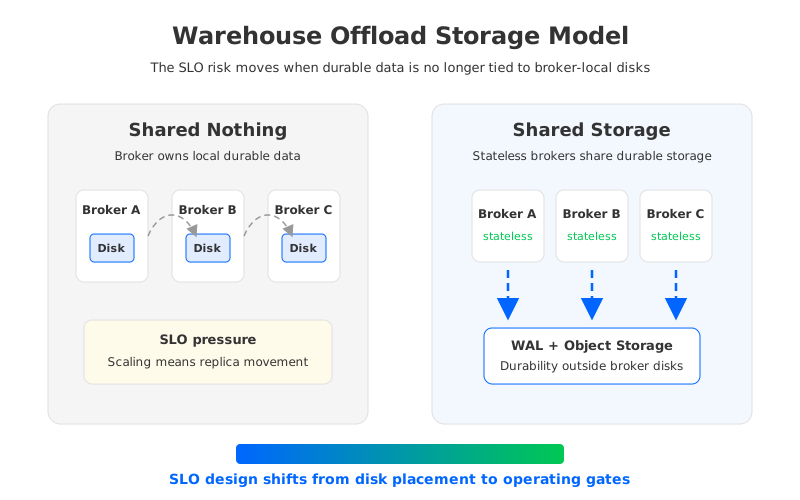
Tiered Storage is often evaluated at this point. It can reduce pressure from historical retention by moving older log segments to remote storage while recent data remains local. For a warehouse offload pipeline, that can be valuable because replay windows and audit retention are real requirements. But Tiered Storage does not make Brokers stateless, and it does not eliminate every live-data placement, scaling, or recovery concern. The team still has to size hot storage, test read behavior during catch-up, and understand how much operational coupling remains between partitions and Brokers.
This distinction matters for SLO design. A retention SLO asks whether the data is still available. A replay SLO asks whether the data can be read fast enough without harming current traffic. A recovery SLO asks whether the pipeline can restore service after a Broker, connector, warehouse, or network failure. A cost SLO asks whether all of that remains inside an approved budget envelope. If the storage model makes each objective depend on pre-provisioned local capacity, the SLO is fragile even when the application code is correct.
3Architecture options and trade-offs
The right evaluation starts with workload behavior, not vendor category. A warehouse offload pipeline has four distinct paths: writes into Kafka, reads by transformation or connector workers, writes into the warehouse or table format, and replay from retained history. Each path has a different bottleneck. Producer spikes stress ingress and partition leadership. Sink throttling creates Consumer lag. Long retention stresses storage economics. Backfill stresses both historical reads and downstream write quotas.
The architecture decision should compare options against those paths:
| Option | Strong fit | SLO risk to test |
|---|---|---|
| Self-managed Kafka on local or cloud disks | Teams that need full Kafka control and already have mature operations | Storage headroom, reassignment time, Broker recovery, and inter-zone traffic during replication and reads |
| Managed Kafka service | Teams that want less base-cluster operations | Service limits, network placement, connector boundaries, cost transparency, and migration exit path |
| Kafka with Tiered Storage | Workloads dominated by longer retention and occasional historical replay | Hot-data sizing, catch-up read behavior, local disk dependency, and balancing during traffic changes |
| Kafka-compatible shared storage | Teams that want Kafka APIs with a storage model designed around cloud object storage | Protocol compatibility, WAL behavior, object storage dependency, observability, and migration rehearsal |
No row is a universal answer. A predictable pipeline with short retention may run well on a traditional cluster. A heavily regulated team may care more about deployment boundary and auditability than raw elasticity. A lakehouse-heavy team may prioritize table-format integration and long replay windows. The SLO process is useful because it turns those preferences into testable claims.
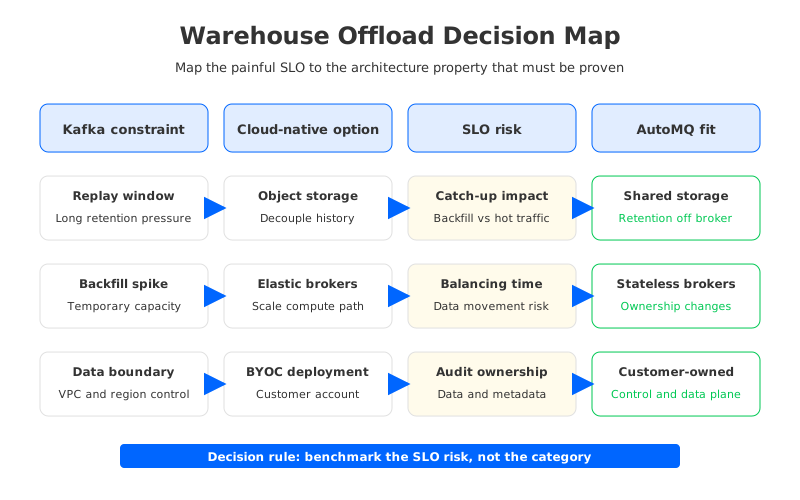
The decision map should force one uncomfortable question: which failure mode is most expensive? If freshness misses are caused by the warehouse sink, improving Kafka storage will not fix the sink. If freshness misses are caused by replay competing with hot traffic, storage and caching behavior matter. If the platform overprovisions Brokers because a monthly backfill might arrive, elasticity and reassignment behavior matter. If every architecture review stalls on data residency, the deployment boundary and network model matter.
4Evaluation checklist for platform teams
Use the checklist as a production readiness gate, not as procurement theater. Run it against a representative pipeline: one high-throughput Topic, one long-retention Topic, one connector or stream processing job, one warehouse or table sink, one replay drill, and one rollback drill. The goal is not to prove that a platform can pass a happy-path demo. The goal is to find the first place where the SLO depends on an assumption no one has tested.
Start with compatibility. Validate the real Producer and Consumer clients, AdminClient operations, Kafka Connect workers, security settings, transactions if used, compaction if used, schema handling, metrics, and deployment automation. Kafka-compatible is meaningful only when the workload, tooling, and failure behavior match what production will require.
Then test elasticity and recovery together. A warehouse offload pipeline rarely fails in a clean, isolated way. A warehouse outage can create Consumer lag. A connector restart can trigger reprocessing. A schema issue can require pausing a sink while the source keeps producing. A Broker failure during that window tests whether the platform can recover without turning a downstream incident into a Kafka incident.
The readiness checklist should be explicit:
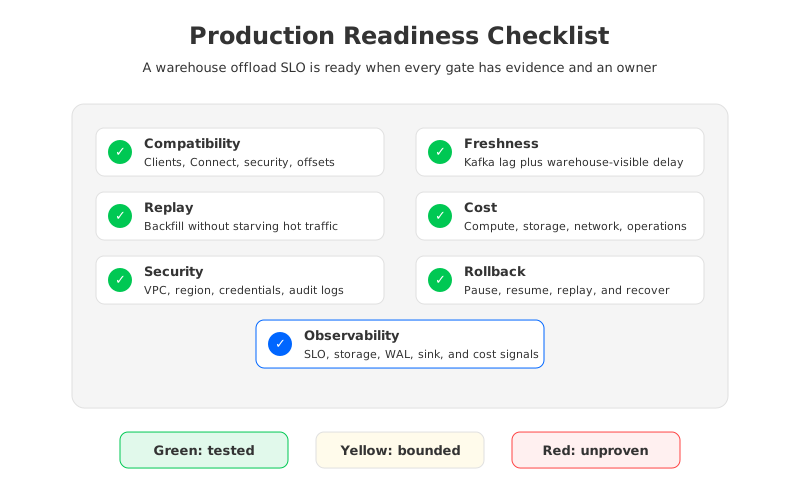
A useful scorecard uses plain language. Green means the behavior has been tested and has an owner. Yellow means the behavior is understood but needs a limit, runbook, or staging drill. Red means the SLO depends on a platform behavior the team cannot prove. Red items are not a failure of the evaluation; they are the reason to evaluate before the warehouse offload path becomes production-critical.
5How AutoMQ changes the operating model
After the neutral evaluation, the recurring pattern is clear: many warehouse offload risks come from coupling Kafka compute to broker-local durable storage. AutoMQ is relevant here as a Kafka-compatible streaming platform built around Shared Storage architecture. It keeps Kafka protocol and ecosystem compatibility while moving durable stream storage to S3-compatible object storage through S3Stream. AutoMQ Brokers handle Kafka requests, leadership, caching, and scheduling, while persistent data is no longer tied to local Broker disks.
That changes the SLO conversation. Scaling a Kafka-compatible cluster no longer has to be treated primarily as a local-data migration project. Broker replacement is less coupled to restoring partition data from a failed node. Long retention can be planned around object storage rather than Broker disk headroom. Self-Balancing and seconds-level partition reassignment become more practical because the system can change ownership and traffic placement without the same kind of large local-data copy that traditional Kafka operators plan around.
The WAL (Write-Ahead Log) is the detail that keeps this architecture honest. AutoMQ uses WAL storage as a durable write buffer for low-latency acknowledgement and recovery, while S3 storage is the main storage layer. AutoMQ Open Source uses S3 WAL. AutoMQ commercial editions can use additional WAL storage types such as Regional EBS WAL and NFS WAL, depending on deployment requirements. For warehouse offload SLOs, record the WAL type in the architecture decision because it affects latency profile, failure domain, cloud resources, and operational review.
AutoMQ BYOC also matters for teams that offload sensitive operational data into analytical systems. In AutoMQ BYOC, the control plane and data plane run inside the customer's cloud environment, and customer business data stays in that environment. That model lets platform and security teams evaluate Kafka-compatible operations while preserving account, VPC, region, and governance boundaries. For private data centers, AutoMQ Software provides a customer-operated deployment model with the same need to validate storage, network, and operational assumptions.
Warehouse offload may also evolve toward direct table integration. AutoMQ Table Topic is designed to write streaming data into Apache Iceberg tables, which can simplify some pipelines that otherwise require separate sink jobs. That does not replace every warehouse connector, and it should be evaluated against the same SLO gates. The useful point is architectural: when Kafka-compatible streams, object-storage-backed durability, and table-oriented output are designed together, the platform team has more room to reduce duplicate movement and isolate failure domains.
Migration still needs proof. AutoMQ Kafka Linking is designed for migration from Apache Kafka or other Kafka-compatible distributions, including data replication and Consumer group progress synchronization according to AutoMQ documentation. Treat that as a mechanism to test, not as permission to skip the migration plan. Topic mapping, offset behavior, producer switchover, consumer resume, capacity during sync, and rollback timing should all be part of the readiness scorecard.
6Decision scorecard: turn SLOs into operating gates
The final decision should combine architectural fit with measured operating evidence. A platform is not ready because it can run a connector. It is ready when the warehouse offload pipeline can miss, recover, replay, and scale inside the boundaries the business approved.
Use a five-point score for each category:
| Category | 1 point | 3 points | 5 points |
|---|---|---|---|
| Freshness | Only Kafka lag is measured | Kafka lag and sink delay are measured | End-to-end warehouse freshness is measured with owners |
| Replay | Retention exists | Backfill tested in staging | Backfill tested with production-like load and cost signals |
| Elasticity | Manual scaling with long balancing windows | Scaling works during planned windows | Scaling and balancing fit normal operating windows |
| Recovery | Runbook exists | Failure drill completed in staging | Broker, connector, sink, and rollback drills completed with owners |
| Governance | Access and schemas reviewed separately | Data and infrastructure gates documented | Cost, security, SLO, and rollback gates enforced before production |
The score is less important than the evidence behind it. A low freshness score means the warehouse-visible metric is missing. A low replay score means the retention promise may be unusable during an incident. A low governance score means the team is approving pipelines without knowing who owns the blast radius. That is the practical purpose of SLOs for warehouse offload pipelines on Kafka-compatible streams: they turn a vague architecture search into a set of operating gates a platform team can defend.
7FAQ
7.1What is a warehouse offload pipeline in Kafka?
It is a streaming pipeline that uses Kafka or a Kafka-compatible platform to move operational events, CDC records, logs, or derived data into a warehouse, lakehouse, or table format. The production concern is not only delivery; it includes freshness, replay, failure isolation, cost, security, and rollback.
7.2Is Kafka Connect enough for warehouse offload?
Kafka Connect is a strong integration framework, but it is only one layer of the pipeline. The platform still has to validate Kafka storage behavior, Consumer lag, connector capacity, downstream ingest limits, network boundaries, and recovery procedures.
7.3Does Tiered Storage solve long-retention warehouse pipelines?
Tiered Storage can help with historical retention by moving older Kafka log segments to remote storage. It does not make Brokers stateless, and it does not remove every hot-data sizing, reassignment, recovery, or live replay concern.
7.4When should AutoMQ be evaluated for warehouse offload?
Evaluate AutoMQ when the bottleneck is Kafka's broker-local storage model: slow scaling, long retention pressure, replay-heavy analytics, cross-AZ traffic review, or operational risk during migration. The right proof is a production-shaped workload test against your SLO checklist.
If the search for warehouse offload pipeline kafka started because one pipeline became too important to treat as a connector task, make the SLOs the benchmark. Start an AutoMQ BYOC evaluation with a production-shaped offload workload through AutoMQ Cloud.


